


When a business expands beyond its home country, taxation can quickly become more complicated. A company may be incorporated in one country, managed from another, serve customers across several markets and make payments to suppliers or related entities overseas. Each of these activities can create different tax and reporting considerations.
This is where international tax planning becomes important. For business owners, it is not simply about finding a country with a lower tax rate. It is about understanding how different tax systems interact and structuring international business activities in a way that is commercially practical, legally compliant and suitable for long-term growth.
Ready to expand globally? Connect with Vorx Consultancy.
What Is International Tax Planning?
International tax planning is the process by which a business owner can find ways to structure international business activities so that they are commercially reasonable, legally compliant and favorable from a tax perspective. A business owner should evaluate how a business’s structure and operations, including income and apportionment of profits, may be viewed under the tax laws in different countries, including possible tax and reporting implications.
International tax planning considerations apply to business owners, whether they operate a small or medium-sized enterprise or a large multinational corporation.
Why Does International Tax Planning Matter?
A business owner can be subject to taxation in more than one country, since businesses often operate in multiple countries. In the absence of appropriate tax planning, the initial business structure that may seem optimal at the time of incorporation can lead to adverse tax or reporting consequences.
International tax planning can help a business owner understand potential tax exposures, facilitate the structuring of cross-border transactions, analyze double taxations risks and help comply with relevant tax and reporting requirements. International tax planning should always be conducted with a view to reflect economic realities, and legal requirements rather than seeking to conceal income or evade taxes.
Ready to expand globally? Connect with Vorx Consultancy.
Key Factors That Shape International Tax Planning
International tax planning can be related to several key areas, including:
- Tax residency: A company or individual’s tax residency can be relevant as it determines which countries’ tax laws apply;
- Permanent establishment: Activities carried out in another country can create a permanent establishment, which is a taxable entity;
- Corporate tax: Corporate tax rules, including the computation and payment of corporate tax, can differ significantly from one jurisdiction to another;
- Withholding tax: Some countries levy a withholding tax on cross-border payments;
- DTAA: DTAA (Double Tax Avoidance Agreement) provisions between two countries can affect the taxation of income;
- Transfer pricing: Related party transactions typically need to reflect arm’s length pricing and be appropriately documented.
Recommended Reading:
Choosing the right international structure from the beginning can help businesses avoid tax and compliance complications as they expand overseas.”
International Tax Planning Strategies for Businesses
1. Choose the Right Business Structure
The choice between a subsidiary, branch, holding structure or another entity can affect taxation, compliance and future flexibility. Business owners should consider the structure alongside ownership, funding, liability and long-term plans.
2. Evaluate the Right Jurisdiction
A low corporate tax rate alone does not make a jurisdiction suitable. Tax treaties, foreign ownership rules, substance requirements, compliance costs, banking and the actual business environment should also be considered.
3. Use Tax Treaties Effectively
Where a tax treaty applies, its provisions can influence the taxation of cross-border income and payments. Reviewing the relevant treaty before structuring transactions can help identify potential double taxation issues.
4. Plan Cross-Border Transactions
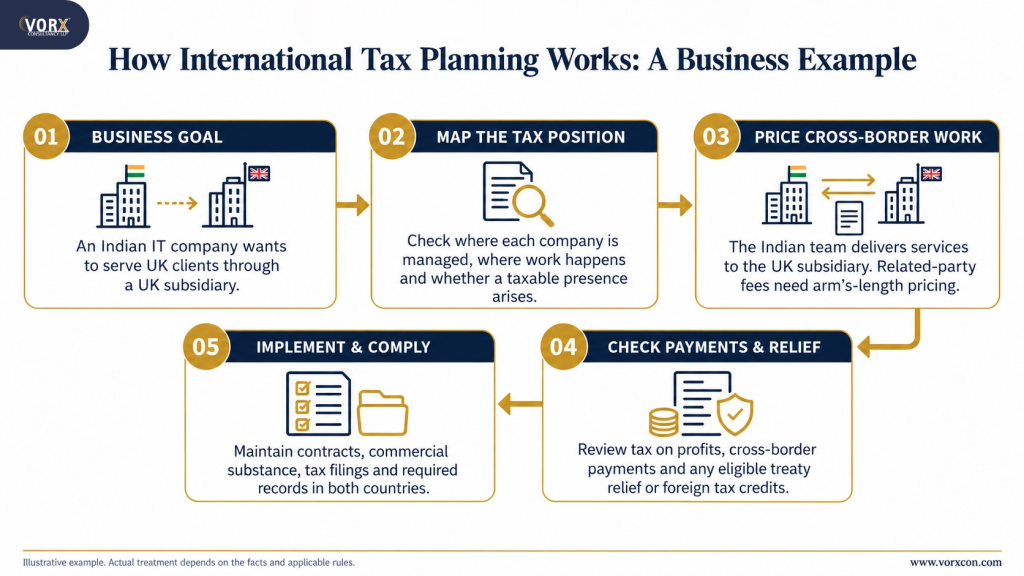
Payments between parent companies, subsidiaries, suppliers and service providers can have different tax consequences. Reviewing these transactions in advance helps businesses understand withholding tax, transfer pricing and reporting requirements.
5. Review Transfer Pricing
As businesses operate through multiple entities, transactions between related companies become more common. Appropriate pricing and documentation can become important for demonstrating that these transactions comply with applicable transfer pricing rules.
6. Plan the Movement of Profits and Funds
Dividends, interest, royalties and management fees may each receive different tax treatment. Businesses should consider the tax consequences before moving funds between countries rather than addressing them only after the transaction takes place.
7. Consider Substance and Actual Business Operations
An international structure should reflect the business’s genuine operations. Management, employees, offices and decision-making activities may all be relevant when assessing the tax position of an international structure.
Common International Tax Planning Mistakes
Many companies make the mistake of engaging in international tax planning only after establishing an overseas entity, thereby greatly limiting their options and creating headaches for themselves. Another mistake is looking only at the headline corporate tax rate, neglecting the big picture as well as the compliance burdens associated with a particular jurisdiction. Some other mistakes include:
- Ignoring tax residency: Not assessing where the company or its management may be considered tax resident.
- Overlooking cross-border taxes: Failing to consider withholding tax, PE or DTAA implications before making international payments.
- Poor transaction planning: Structuring related-party transactions without reviewing transfer pricing requirements.
- Treating compliance as an afterthought: Focusing on incorporation while overlooking ongoing tax filings, documentation and reporting obligations.
When Should a Business Start International Tax Planning?
International tax planning should ideally begin before establishing an overseas business structure. Early planning allows business owners to compare different jurisdictions and structures while there is still flexibility to make changes. It becomes particularly important when a business is:
- Setting up a company abroad or entering a new international market.
- Expanding operations through subsidiaries, branches or related entities.
- Moving management, employees or business functions across countries.
- Planning significant cross-border transactions, investments or fund transfers.
Starting early helps ensure that the company’s structure and operations are aligned with its tax and compliance responsibilities from the beginning.
Recommended Reading:
For entrepreneurs combining international investment with business expansion, understanding the relationship between investment, residency and taxation is equally important.”
International Tax Planning Checklist for Business Owners
Area | Key Questions |
Structure & Tax | Where is the company incorporated and where are profits taxed? |
Cross-Border | Could PE, withholding tax or DTAA rules apply? |
Compliance | Are transfer pricing, filings and reporting requirements covered? |
A business structure should be reviewed as a whole rather than based on a single tax rate or benefit.
Ready to expand globally? Connect with Vorx Consultancy.
Build a Tax-Aware International Business Structure With Vorx Consultancy
At Vorx Consultancy we specialize in international company formation, business setup, banking, tax and compliance planning and can advise you on all aspects of setting up and running an international business. a sound multinational business structure and corporate tax planning can enable business owners to navigate the complexities of international business with confidence and minimize exposure to unnecessary risks and compliance burdens
For professional guidance on international tax planning and cross-border business structures, connect with Vorx Consultancy
Book a Strategy Call: (Calendly Link)
Visit: www.vorxcon.com
Email: support@vorxcon.com
Final Thought
International tax planning is not simply about reducing tax costs; it is about understanding how different tax systems can affect your business as it expands across borders. From choosing the right structure and jurisdiction to managing tax residency, cross-border transactions, tax treaties and ongoing compliance, each decision can influence the overall tax position of a business. Starting this planning early allows entrepreneurs to build a more efficient, transparent and compliant international structure that can support sustainable growth in the long run.