

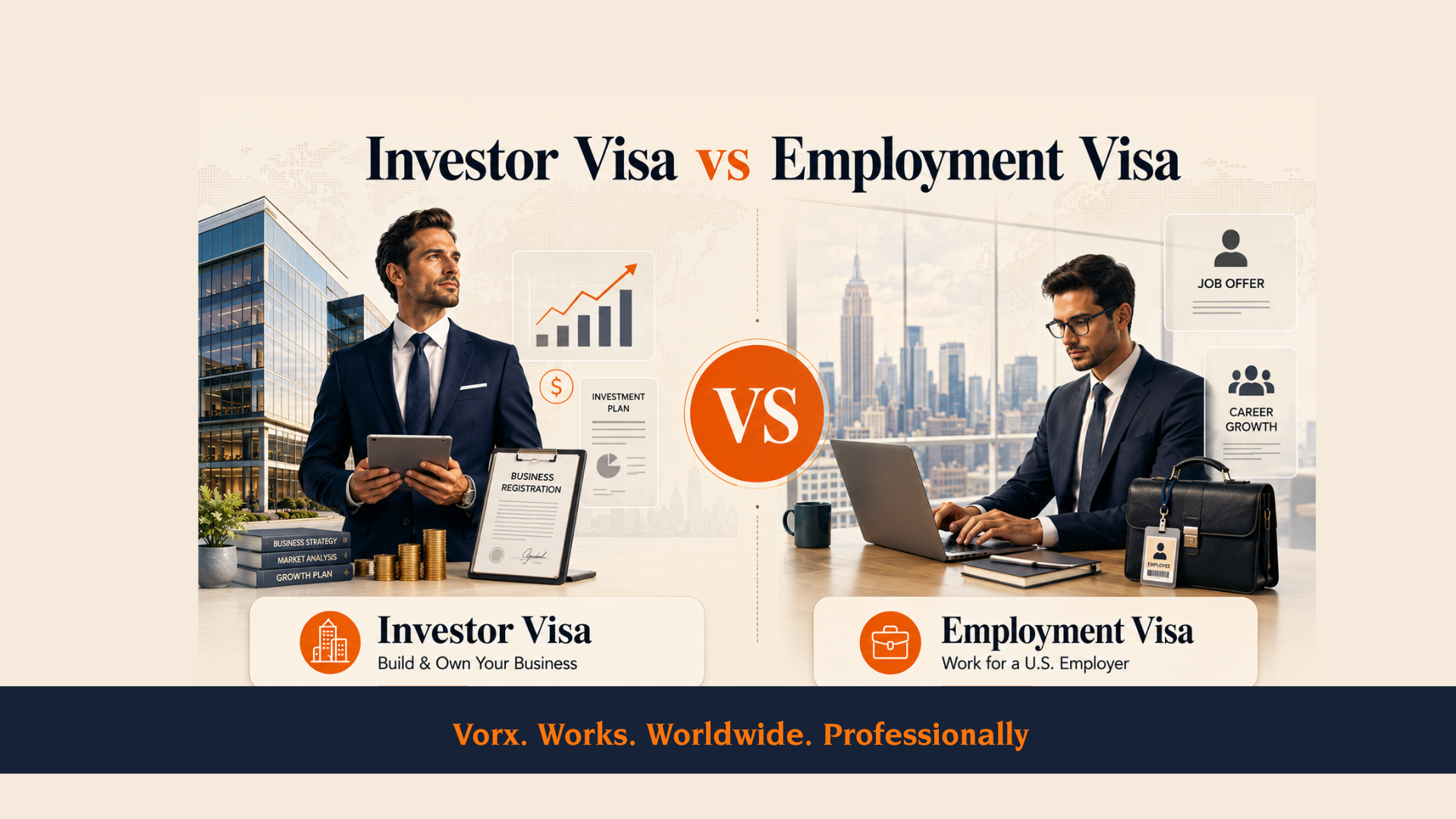
Moving to the United States means something different to everyone. For some, it means finally starting the business they had always wanted to build.
For others, it is about getting a job in an international company and advancing their career to a bigger level. And this is often where the confusion begins: should you get an investor visa or an employment visa?
They can look similar from a distance both end with you living and working in the U.S. But underneath, they’re built for completely different people. The investor visa is for entrepreneurs willing to invest in the U.S. economy. The employment visa is for skilled professionals who have already secured a job with a U.S. company.
If you are Googling “Investor Visa vs. Employment Visa” to figure out which one suits your situation, here are the key differences based on eligibility and pros and cons. It also explains how to decide which path best aligns with your goals.
What Is an Investor Visa?
An investor visa lets you enter the U.S. by making a qualifying investment or running a business there. You don’t need an employer willing to sponsor you — your investment and your business activity are the application.
The two most common options people ask about are:
- EB-5 Immigrant Investor Program : for individuals who meet the required investment threshold and seek permanent residency through that investment.
- E-2 Treaty Investor Visa : for citizens of countries that have a treaty with the U.S. and who start and actively manage a business in the U.S. (citizenship is a key factor here, so not everyone is eligible).
The appeal is pretty obvious: independence. You’re not answerable to a single employer, and depending on which category you fall under, you get real say over how your business runs and where it goes.
But it’s not just a numbers game. Immigration authorities want to know where your money actually came from, whether the investment is legitimate, and whether it checks the boxes the program requires. Skipping this homework is where a lot of applicants end up wasting time — and money — later.
Simply put: if you want to build something of your own instead of working for someone else’s company, this path is worth exploring.
What Is an Employment Visa?
An employment visa is for professionals who already have a job offer. Typically, the employer sponsors you and demonstrates that your skills meet a genuine need.
Common categories include:
- H-1B Visa : For specialized roles in sectors such as IT, engineering, finance, and healthcare.
- L-1 Visa : For employees transferring from a foreign office to the US branch of the same company.
- EB-2 and EB-3 : Employment-based Green Card categories for qualified professionals and skilled workers.
Unlike the investor route, there’s no big capital requirement. What matters here is your experience, your qualifications, and whether an employer is willing to back you.
For a lot of skilled professionals, this ends up being the more practical entry point where you get international experience and a steady paycheck, and in some cases, it can eventually lead to a green card through employment-based immigration.
The catch that people don’t think about enough: your status is tied to your employer. Lose the job unexpectedly, and your visa can be affected too, unless you find another sponsor fast or shift into a different category.
That’s really the heart of the investor visa vs work visa debate — one gives you independence, the other ties you to an employer in exchange for a more straightforward path in.
Investor Visa vs Employment Visa: The Real Differences
So, which one is actually better? To be honest, it depends on what you are trying to create.
If the goal is your own business, the investor visa gives you more room to move. If you’re a skilled professional trying to grow your career at an international company, the employment visa is usually the more practical, less expensive way in.
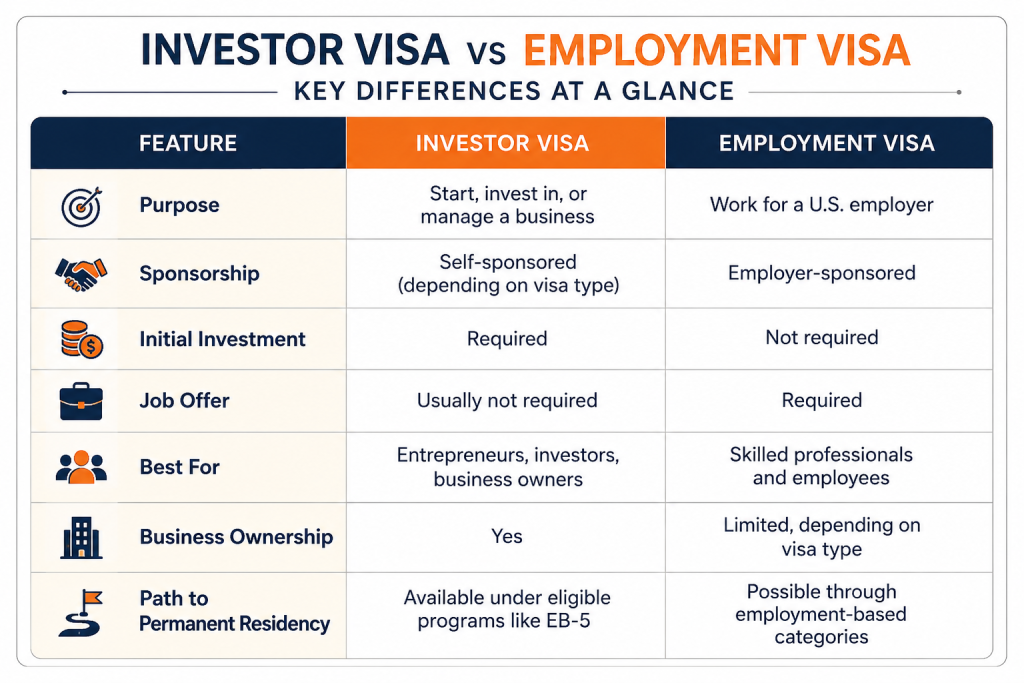
Investor visas like EB-5 are about buying residency with capital. Employment visas are about a company vouching for you. Neither one is objectively “better” ; they just serve different people with different plans.
Take EB-5 vs H-1B as an example. EB-5 is built around investment and can lead more directly to permanent residency if you meet the requirements. H-1B lets you work in a specialized role, but it lives and dies by employer sponsorship and its own set of rules.
So maybe the better question isn’t “which visa is better” — it’s “which one fits the life I’m actually trying to build?”
Which Visa Is Right for You?
There’s no universal answer here. It comes down to your finances, your background, and where you want to be in five or ten years.
An investor visa might be the right call if:
- You already run a business, or you’re planning to start one
- You have the investment capital required
- You want more control over your own career
- You’d rather be self-sponsored than employer-sponsored
- You’re thinking about expanding internationally long-term
An employment visa might make more sense if:
- You’ve already got a job offer
- You work in a high-demand field like IT, engineering, healthcare, or finance
- You’d rather not put a large sum of money down upfront
- You want international work experience before thinking about starting a business
A simple way to frame it: building a business points you toward an investor visa. Building a career points you toward an employment visa.
Mistakes People Keep Making
Talking to enough aspiring immigrants and entrepreneurs, the same mistakes come up again and again:
- Picking a visa based on cost alone, without weighing what it actually offers
- Assuming any investor visa automatically means a green card
- Applying before actually understanding the eligibility requirements
- Underestimating how long processing can take, or how much documentation is involved
- Choosing a visa that doesn’t line up with where you actually want to be in a few years
None of these are complicated to avoid — they just take a bit of planning up front. Skip that step, and you could be looking at months, sometimes years, of avoidable delays.
How Vorx Consultancy Can Help
Choosing between an investor visa and an employment visa isn’t really a paperwork decision, it’s a decision that shapes your career, your finances, and your family’s future.
At Vorx Consultancy, we work with entrepreneurs, investors, and professionals to help them understand their options before they even start the application. That means guidance on visa pathways, documentation, business setup where it’s relevant, and overall immigration planning — so you’re moving forward with a clear head, not just crossing your fingers.
Our advice? Don’t pick a visa because it’s the one everyone talks about. Pick the one that actually supports where you’re trying to go whether that’s building a business, growing a career, or setting your family up for something new.
Conclusion:
When you’re weighing an investor visa against an employment visa, the right answer was never about which one sounds more impressive. It’s about which one fits your goals.
If you’re an entrepreneur with plans to grow something internationally, the investor visa likely gives you the flexibility you need. If you’re a skilled professional chasing career growth in the U.S., the employment visa may be the smarter first move.
Either way, take the time to actually understand the requirements, the costs, and what each path means long-term. A little research now can save you a lot of headache later.
Need help figuring out which path fits you? The team at Vorx Consultancy can walk you through your options and help you land on the visa pathway that actually matches your goals.