
If you’ve spent any time researching where to set up your EU company, you’ve probably landed on Ireland more than once.
Low corporate tax, an English-speaking workforce, a legal system that’s straightforward for foreign founders to navigate, and instant credibility with EU clients and investors. It’s a genuinely good option, not just a trendy one.
But here’s what usually happens next: you start reading about “requirements” and hit a wall of legal terms constitution, NACE code, Section 137 bond, RBO with no one explaining what they actually mean for someone sitting in Bangalore, Dubai, or Singapore trying to figure out if this is even doable without flying to Dublin.
It is doable. Thousands of non-resident founders register Irish companies every year without ever setting foot in the country.
This guide walks through the full Ireland company formation requirements, the legal steps, the paperwork, and the parts that trip up non-resident founders specifically. No fluff, no vague “consult a professional” hand-waving where a straight answer would do.
What Are the Ireland Company Registration Requirements?
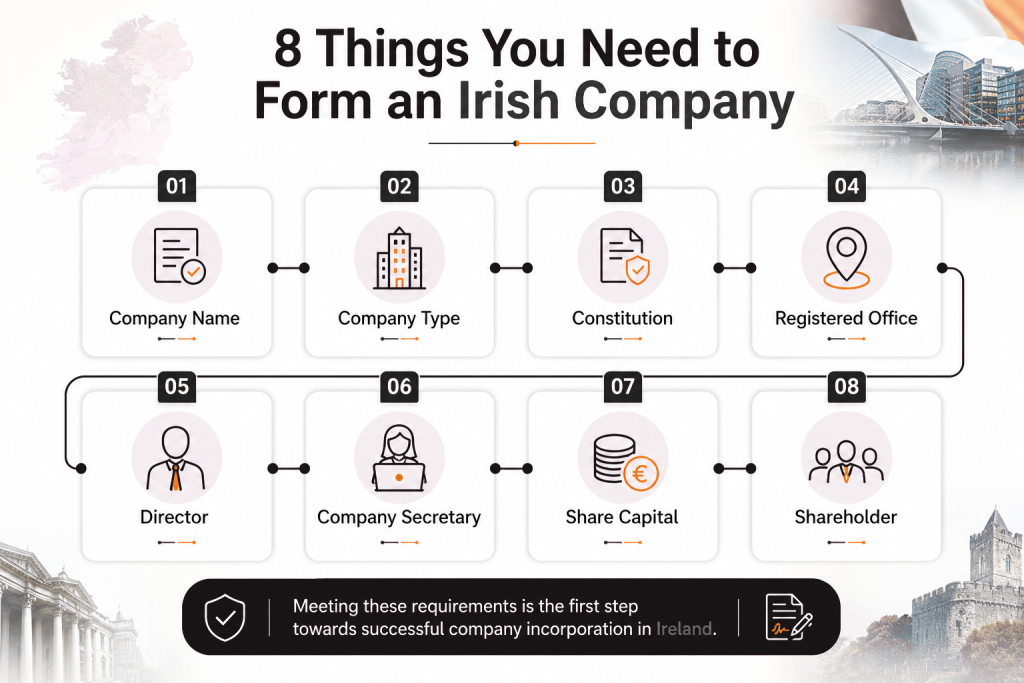
Strip away the jargon and every Irish company registration comes down to eight things.
These are the core Ireland company registration requirements you can’t skip, regardless of company type. You need to decide or provide:
- A company name that’s unique and CRO-approved
- A company type almost always a Private Limited Company (LTD) for new founders
- A constitution outlining your company’s rules and principal business activity
- A registered office a physical address in the Republic of Ireland
- At least one director with an EEA-residency requirement to address if you’re not one
- A company secretary a separate legal requirement from directors
- Share capital how ownership is structured
- At least one shareholder who can be you, personally or through another company
That’s the whole skeleton.
Everything else in this guide is filling in the details on each one, plus the parts most guides skip: what it actually costs, what happens after you’re registered, and where non-resident applications tend to go wrong.
1. Choose a Company Name
Ireland Company Name Requirements
Your company name has to be genuinely distinguishable from every other name already on the CRO register, not just “different enough” in your own head.
The Companies Registration Office (CRO) runs a similarity check, and it’s stricter than people expect. “Kelly Consulting Ltd” and “Kelly Consulting Group Ltd” can get flagged as too close, even with a word added.
A few other rules to know before you fall in love with a name:
Restricted words like “Bank,” “Institute,” “Ireland,” “Group,” or “Trust” need special consent from the relevant regulator before CRO will approve them. If your name doesn’t need one of these words, skip it; it just adds a delay.
Offensive or misleading names get rejected outright, including names implying a government connection you don’t have.
Run a free name check on the CRO’s CORE portal before you draft anything else. This takes five minutes and saves you from writing a constitution around a name that gets bounced.
Real example: A founder we’ll call Arjun wanted to register “Emerald Tech Solutions Ltd.” Simple enough except a nearly identical name existed on the register from an unrelated dormant company.
He lost a week reworking his constitution and business documents around the new name “Emerald Tech Ventures Ltd.” Checking the name first would have avoided that entirely.
2. Choose the Right Company Type
Most founders reading this will end up with an LTD — Private Company Limited by Shares, commonly just called an Irish limited company.
It’s the default structure in Ireland for a reason: simple to set up, only needs one director and one shareholder, no cap on authorised share capital, and it’s what banks, investors, and clients expect to see.
Here’s how it stacks up against the alternatives:
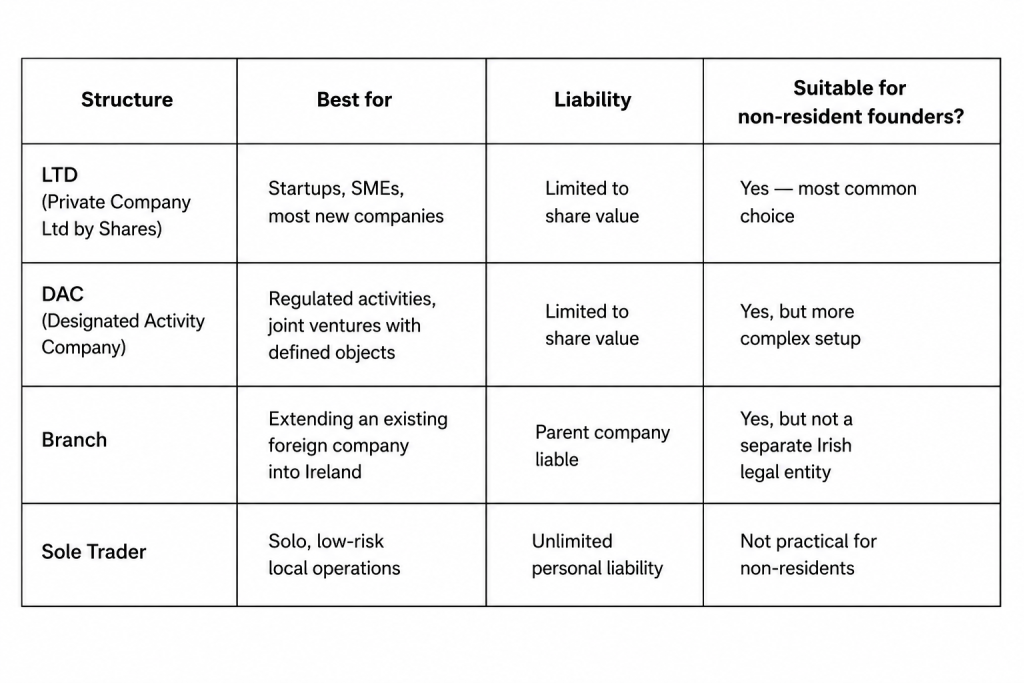
Unless you have a specific regulatory reason to need a DAC, or you’re extending an already-established foreign company rather than starting fresh, go with the LTD.
It’s the path of least resistance and the one this guide focuses on from here. (If you’re still weighing jurisdictions, see our Ireland vs UK company formation comparison for how the two stack up side by side.)
3. Prepare the Company Constitution
Every Irish company needs a constitution that replaced the old “Memorandum and Articles of Association” system back in 2014, and for an LTD, it’s genuinely simple: one document instead of two.
Your constitution covers:
Your company’s internal rules — how decisions get made, how shares are issued, how meetings run
Principal business activity — a plain description of what your company actually does
NACE code — a standardised EU classification code for your industry. CRO requires this on your registration form, and it’s also what determines some statistical filings later.
If you’re not sure which code fits, the CRO’s own NACE code list lets you search by keyword “software development,” “consulting,” “e-commerce” all map to specific codes.
Company powers — under an LTD structure, your company has full legal capacity to do essentially anything a natural person could do in business, so this section is usually boilerplate rather than something you need to customize heavily.
Most company formation agents provide a standard LTD constitution template that just needs your specific details dropped in. You don’t need to draft this from scratch.
4. Have an Irish Registered Office
This is one of the most misunderstood requirements for foreign founders, so let’s be precise about it.
Your registered office has to be a physical address in the Republic of Ireland. Not a UK address. Not a PO box.
Not your home address in Mumbai. This is the official address where legal notices, CRO correspondence, and statutory documents get sent; it’s a legal requirement, not a formality.
It’s different from your trading address where your business actually operates day to day. These can be, and often are, different addresses.
Plenty of Irish companies have a registered office at their accountant’s or company formation agent’s premises while doing all their actual business elsewhere, including entirely outside Ireland.
If you’re not based in Ireland, the practical solution is straightforward: use a registered office service through a company formation agent or accountant.
5. Appoint Company Directors
Information Required for Each Director
For every director, CRO wants:
- Full legal name (as it appears on your passport)
- Nationality
- Residential address
- Date of birth
- Occupation
- Details of any other current directorships, anywhere in the world.
That last one catches people off guard if you’re already a director of a company in India or elsewhere, you need to disclose it.
CRO cross-checks this against international director databases, so leaving it off isn’t a shortcut, it’s a red flag.
EEA-Resident Director Requirement
Here’s the part that actually determines whether you need extra paperwork:
Irish law requires at least one director to be resident in the European Economic Area, unless your company qualifies for an exemption.
If you’re a founder in India, the US, or anywhere else outside the EEA, and you don’t have an EEA-resident co-founder or willing director, you have three real options:
Option A — Appoint an EEA-resident director. This could be a co-founder, a trusted contact, or a nominee director arranged through a formation agent.
It’s the simplest route if you have someone willing to take on the role, but they do carry legal responsibility as a director, so this isn’t a decision to make lightly with someone you don’t fully trust.
Option B — Take out a Section 137 Bond. This is a specific type of insurance bond that satisfies the EEA-resident requirement without needing an actual EEA-resident director.
It covers the company against certain fines under the Companies Act and Taxes Consolidation Act for a two-year period.
It typically takes one to two weeks to put in place, so factor that into your timeline if you’re going this route.
Option C — Claim the Economic Activity Exemption (Section 140). If your company can demonstrate a “real and continuous” economic link to Ireland genuine trading activity, an Irish business connection, actual operations rather than a shell presence you can apply for an exemption instead of getting a bond.
In practice, this is harder to qualify for at the point of incorporation, since you usually need evidence of trading activity, which a brand-new company doesn’t have yet.
Most first-time non-resident founders end up going with the bond simply because it’s faster and doesn’t require pre-existing trading history.
Real example: A founder based in Dubai wanted to register an Irish LTD for a SaaS product targeting EU customers.
She didn’t have an EEA-resident co-founder, so she compared the bond against finding a nominee director.
The bond cost more upfront but meant she retained full control without adding another person with statutory authority over her company for a solo founder, that trade-off is usually worth it.
Director Age and Legal Responsibilities
Directors must be at least 18. Beyond the age requirement, directors carry real legal duties under the Companies Act 2014 acting in good faith, avoiding conflicts of interest, ensuring the company meets its filing obligations.
This isn’t a title you hand out casually; it comes with personal legal accountability.
6. Appoint a Company Secretary
Every Irish company needs a company secretary; this is a separate statutory role from a director, and it’s easy to overlook if you’re used to jurisdictions where this isn’t required.
The catch for solo founders: if you’re a single-director company, you cannot also be your own secretary.
You need a second person, or you can appoint a corporate secretary service (a company that provides this function professionally, common among formation agents).
The secretary’s responsibilities include maintaining statutory registers, filing annual returns on time, and keeping meeting minutes.
7. Understand Share Capital Requirements
Authorised Share Capital
Here’s a myth worth clearing up immediately: Irish LTD companies have no cap on authorised share capital. This changed with the 2014 Companies Act reform.
Older guides sometimes still reference authorised capital limits from pre-2014 rules but ignore those, they no longer apply to LTDs.
Issued / Paid-Up Share Capital
Bigger myth to clear up: there is no legal minimum paid-up share capital required to register an Irish company.
You can technically incorporate with €1 or €100 in issued share capital. Founders often assume Ireland requires a substantial capital injection like some other EU jurisdictions it doesn’t.
Shares represent ownership percentage, plain and simple. If you’re the sole founder, Ireland fully permits a single-member company: one shareholder, one director (plus your separately-appointed secretary) is a completely valid structure.
8. Provide Shareholder Details
Shareholders can be individuals or corporate entities, resident anywhere in the world there’s no residency requirement on shareholders, unlike directors. For each shareholder, you’ll need to provide:
- Full name and address
- Nationality
- Number and class of shares held
If you’re setting up with a co-founder, this is also the point to actually decide your cap table who owns what percentage, and whether shares vest over time. It’s far easier to get this right at incorporation than to restructure it six months in.
Also Read This: How to Register a Company in Ireland from India
Documents and Information Checklist for Irish Company Formation
Before you start the actual registration, gather:
- Proposed company name (plus 1–2 backups, in case your first choice is rejected)
- Company type confirmed (LTD, in most cases)
- NACE code and description of principal business activity
- Registered office address in Ireland
- Full details for every director, including ID and proof of address
- Company secretary details (individual or corporate service)
- Share capital structure how many shares, at what value
- Shareholder details and ownership split
- A plan for your beneficial ownership filing (covered next don’t skip this)
Have your documents ready? Let Vorx Consultancy help you move from requirements to Irish company incorporation with the right documentation and structure.
Register of Beneficial Ownership (RBO): A Requirement Most Guides Skip
This is the part that catches almost every non-resident founder off guard, and most articles on this topic barely mention it.
Every Irish company must file its beneficial ownership information with the RBO within five months of incorporation. This isn’t optional, and it isn’t the same as your CRO registration; it’s a separate legal filing.
A “beneficial owner” is generally anyone who owns or controls 25% or more of the company, directly or indirectly.
Here’s where it gets specific for non-residents: to file with the RBO, you normally need a PPSN (Personal Public Service Number) ,the Irish equivalent of a national ID number.
Most foreign founders don’t have one. Instead, you use Form BEN2, which requires identity verification through a different process (typically involving a certified copy of your passport and a declaration).
Skipping this or missing the five-month window isn’t a minor slap on the wrist; penalties can include fines, and it can hold up other filings and banking processes down the line.
If you’re using a company formation agent, confirm explicitly that Register of Beneficial Ownership filing is included in their service, because some packages only cover the CRO registration and leave this step for you to handle separately.
What Happens After Registration? Post-Incorporation Requirements
Getting your CRO certificate isn’t the finish line, it’s the starting gun. A few things need to happen fairly quickly after:
Corporation Tax registration (Form TR2) : you’ll need to register with Revenue using Form TR2, which sets you up for corporation tax (Ireland’s well-known 12.5% rate for trading income).
VAT registration thresholds registration isn’t automatic. You need to register for VAT if your turnover is expected to exceed the relevant threshold, or you can register voluntarily earlier if it benefits your business (for instance, if you’re invoicing other VAT-registered EU businesses and want to reclaim input VAT from day one).
PAYE/PRSI registration : required the moment you plan to hire employees, even one.
Opening a business bank account for non-residents — and this is where non-resident founders hit real friction.
Traditional Irish banks (AIB, Bank of Ireland) can be genuinely difficult for non-resident directors without an in-person visit, and processing times can stretch to weeks.
Many non-resident founders instead start with an EMI (electronic money institution) business account Wise Business, Revolut Business, or similar which can be set up remotely and gets you operational far faster.
Some founders open both eventually: an EMI account to get moving quickly, and a traditional bank account later once they have trading history.
RBO filing — don’t forget the five-month deadline mentioned above. It’s easy to lose track of once you’re focused on actually running the business.
Common Reasons Ireland Company Registration Applications Get Delayed or Rejected
Worth knowing before you submit, not after:
Name too similar to an existing company : the single most common rejection reason. Always run a name check first.
Incomplete or incorrect Form A1 : missing signatures, inconsistent details between the form and constitution, or director details that don’t match ID documents.
Constitution drafting errors : using outdated pre-2014 templates, or a NACE code that doesn’t match your stated business activity.
Missing director consents : every director needs to formally consent to act, in writing, as part of the application.
Registered office issues : submitting a non-Irish address, or an address that doesn’t match what’s on your supporting documents.
Most of these are avoidable with a careful first pass rather than a rushed submission CRO doesn’t offer a quick “fix and resubmit” process, so a rejected application usually means starting the clock over.
Ireland Company Formation Requirements for Non-Residents
Since this is likely why you’re reading this, let’s answer the direct questions plainly.
Can a non-resident fully own and incorporate a company in Ireland?
Yes. There’s no restriction on foreign ownership of Irish companies.
You can be 100% shareholder and director as a non-resident, as long as you address the EEA-resident director requirement through one of the three options covered earlier.
Do you need to visit Ireland to register?
No. The entire process from name registration to opening an EMI business account can be done remotely. Plenty of Indian founders complete this without ever booking a flight.
What about document authentication? Some documents, particularly ID verification for the RBO filing or bond application, may need certified copies or notarization depending on which formation agent or bank you’re working with.
This varies by provider, so confirm requirements upfront rather than assuming a plain photocopy will do.
What’s the realistic friction point for Indian founders specifically? Usually it’s less about the legal requirements and more about the sequencing getting your Section 137 bond arranged before your registered office lease starts, getting your RBO filing in before the five-month clock runs out, getting a business bank account open before your first invoice is due. None of these are hard individually. They just need to happen in the right order.
Ready to Set Up Your Irish Company?
From company structure and registered office requirements to EEA-director solutions and RBO compliance, Vorx Consultancy can guide you through the setup.
Get in touch with Vorx Consultancy to discuss your Ireland company formation.
Conclusion:
Meeting the Ireland company formation requirements isn’t complicated once you know the actual sequence name, structure, director requirement, registration, then the post-incorporation filings that most guides leave out entirely.
The founders who hit delays are almost always the ones who skipped the RBO filing or didn’t sort their EEA-director requirement before submitting.Get those two right, and the rest is genuinely straightforward paperwork.
Ready to register your Irish company? Get a fixed-price formation package that includes your registered office, EEA-director bond arrangement, and RBO filing so nothing falls through the cracks in your first five months.