

Italy remains one of the more attractive markets for international expansion, a large domestic economy, strong manufacturing and design sectors, and access to the wider EU single market.
For Indian entrepreneurs and other foreign business owners, incorporating a company in Italy is often the easier part. Staying compliant afterward is where most people underestimate what’s involved.
Unlike jurisdictions such as the UAE or Singapore, where a company might deal with one or two regulators, an Italian company answers to several at once: the Companies Register for filings, the tax agency for corporate tax and VAT, INPS and INAIL if you hire locally, and the data protection authority if you handle personal information.
None of these obligations are unusual by EU standards, but taken together, they require a structured approach rather than a reactive one.
This guide walks through what Italy company compliance requirements actually look like in 2026, including a few regulatory changes this year that most existing guides haven’t caught up with, a partial suspension of the beneficial ownership register, a stricter director liability framework, and an updated e-invoicing specification, among others.
It’s written for founders managing a Società a Responsabilità Limitata (SRL), the most common structure for foreign-owned Italian companies, with notes on branch offices where the obligations differ.
As always with cross-border compliance, individual circumstances vary. This guide explains the general framework; specific filings and deadlines should be confirmed with a licensed Italian accountant (commercialista) or legal advisor.
Why Does Italy Compliance Look Different for Foreign Business Owners?
If you’ve set up a company in the UK or the UAE before, Italy’s system will feel more document-heavy and more dependent on local professional support.
Part of this comes down to structure. A branch office, a representative office, and an SRL are treated quite differently under Italian law.
A representative office generally can’t carry out commercial activity at all; it’s a liaison presence. A branch office extends the foreign parent’s legal identity into Italy, so its compliance is tied to the parent company’s accounts.
An SRL, by contrast, is its own legal entity with its own full set of filing, tax, and governance obligations.
Most foreign founders choose the SRL route because it limits personal liability and gives the business independent standing with Italian banks, suppliers, and clients but it also means the compliance calendar is entirely your own.
The second reason Italy feels heavier is regulatory fragmentation. There isn’t a single “business compliance department.” You’re dealing with:
- Registro delle Imprese (Companies Register, via the local Chamber of Commerce) for incorporation, annual filings, and UBO declarations
- Agenzia delle Entrate (Revenue Agency) for corporate tax, VAT, and e-invoicing
- INPS and INAIL for social security and workplace injury insurance once you employ anyone locally
- Garante per la Protezione dei Dati Personali for data protection
At Vorx Consultancy, this is usually the first thing we clarify with founders evaluating Italy not whether incorporation is possible, but whether they’ve mapped which of these four systems will actually apply to their specific business model.
What Are the Main Company Compliance Requirements in Italy?
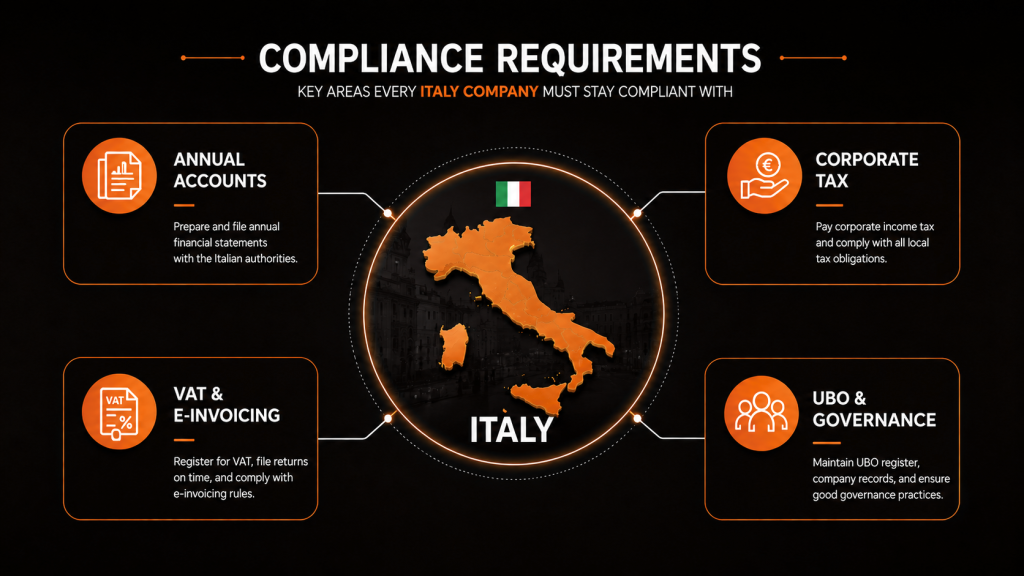
Broadly, obligations fall into three rhythms: annual, ongoing, and event-triggered.
Annual obligations include filing financial statements, confirming your UBO declaration, and submitting corporate tax returns.
Ongoing obligations run monthly or quarterly VAT returns, e-invoicing, and payroll filings if you have staff.
Event-triggered obligations happen when something changes in the business: a new hire, a change in shareholding, or an update to how you process personal data.
The sections below cover each category. If you’re only looking for one, this structure should make it easy to jump to the relevant part.
Planning to Set Up a Company in Italy?
Get expert guidance from Vorx Consultancy for your Italy company setup and compliance.
Annual Financial Statements and Business Register Filing
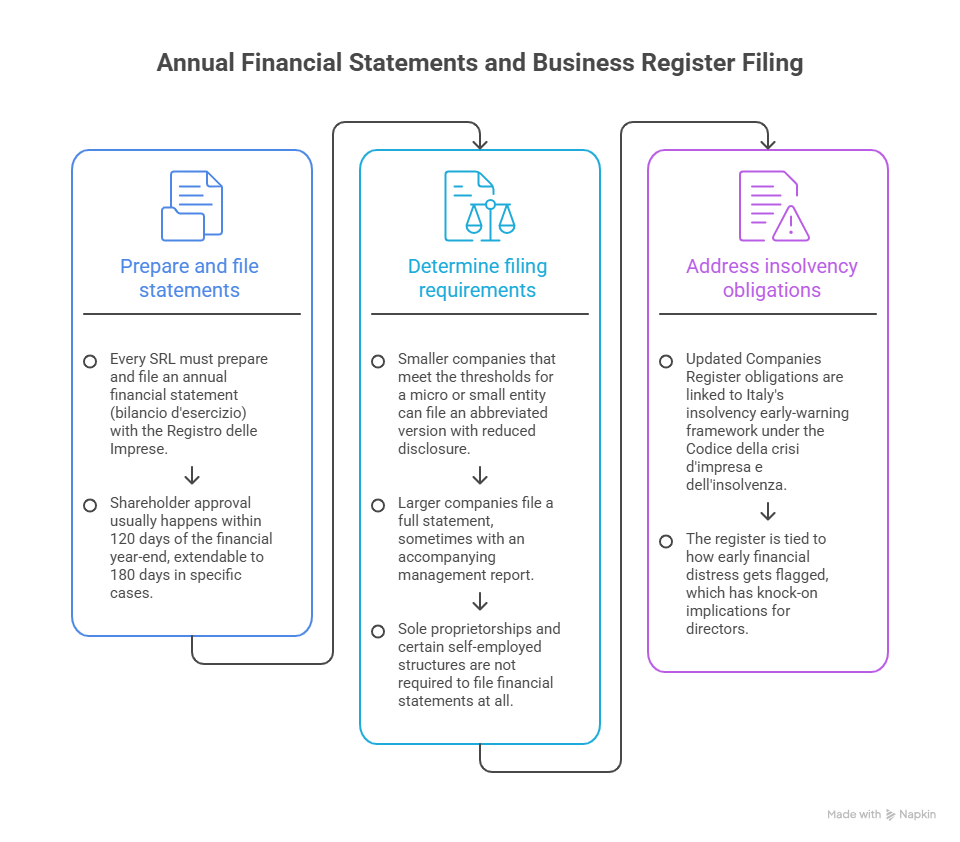
Every SRL files an annual bilancio with the Registro delle Imprese, usually within 120 days of shareholder approval (extendable to 180).
Micro/small entities get a simplified filing. In 2026, the Register also linked to Italy’s insolvency early-warning framework (CCII).
Corporate Tax and IRAP Compliance
Companies pay IRES and IRAP annually, with advance payments during the year.
In 2026: the cooperative compliance regime’s access threshold dropped, tax credit offsets are restricted once overdue debts cross a limit, and Indian parent companies should factor in the India-Italy DTAA for dividend repatriation.
VAT and E-Invoicing Requirements
Italy’s SDI e-invoicing system validates every invoice before delivery. FatturaPA v1.9.1 became mandatory from 15 May 2026 non-compliant software means rejected invoices and cash-flow risk.
Invoices must be archived for 10 years (conservazione sostitutiva). Payment providers also face new POS/transaction reporting rules.
Accounting and Record-Keeping Requirements
Statutory books (libro giornale, libro degli inventari) must be kept for 10 years.
A licensed commercialista is essential for nearly every foreign-owned company budget for it as a fixed cost, not an extra.
Employment, INPS and INAIL Compliance
Hiring even one employee triggers immediate obligations: INPS and INAIL registration before day one, monthly UNIEMENS payroll reporting, and correct contract classification (fixed-term vs. open-ended) to avoid disputes.
Corporate Governance and Beneficial Ownership (UBO)
UBO is determined by a 25%+ ownership test (or control via voting/contracts).
Key 2026 update: access to the UBO register is now restricted to “legitimate interest” parties (Legislative Decree 210/2025), and the register itself is currently suspended pending a Council of State ruling.
However, the filing obligation itself is not suspended; companies must still file and confirm UBO data on schedule.
GDPR and Data Protection Compliance
The Garante now expects RoPA (Records of Processing Activities) to reflect current operations; outdated RoPAs are treated as a real compliance failure, not paperwork.
GDPR and the EU AI Act are increasingly reviewed together, especially for AI-driven HR or credit-decision tools. A DPO isn’t automatically required to assess based on scale, don’t assume you’re too small.
Antitrust and the Legality Rating System
AGCM’s Legality Rating is optional but helps with public tenders and financing.
From 16 March 2026, renewing it requires a genuinely active antitrust compliance program, not just a written policy.
Director and Shareholder Liability Under the Insolvency Code
Shareholders aren’t personally liable for company debts (Art. 2462 Civil Code) but director liability under the Insolvency Code (CCII) has tightened.
Directors of foreign-owned subsidiaries aren’t exempt from monitoring duties just because oversight sits abroad, and early-warning obligations can apply even after a past restructuring.
Penalties for Non-Compliance
Compliance area | What triggers a penalty | Consequence |
UBO filing | Missed or inaccurate declaration | Administrative fines, potential criminal liability for false declarations |
E-invoicing | Non-conforming invoice format post-May 2026 | Automatic SDI rejection, delayed payment, cash flow disruption |
Financial statement filing | Late or incomplete filing | Administrative penalties, reputational impact with banks and partners |
GDPR | Data protection breach or non-compliance | Fines of up to 4 percent of global turnover |
Legality Rating / Antitrust | Incomplete or incorrect compliance program disclosure | Loss of rating, reduced access to public tenders and financing benefits |
The financial penalty is often the smaller issue. A rejected invoice delays payment.
A lapsed good-standing status can affect financing conversations or supplier trust. Treating compliance as a credibility issue, not just a legal one, tends to be the more useful mindset.
How Can Foreign Business Owners Stay Compliant?
Most foreign-owned Italian companies rely on three separate professional relationships: a commercialista for accounting and tax, a legal advisor for governance and contracts, and, in many cases, a registered office or local representative for correspondence and administrative matters.
Trying to consolidate all three into one provider sometimes works for very small operations, but as the business grows, specialization tends to serve you better.
A few practical steps worth prioritizing early:
Set up SPID or PEC (certified digital identity and certified email) early; these are mandatory digital tools for interacting with Italian authorities, and most non-resident founders haven’t encountered anything equivalent before incorporating.
Build a compliance calendar rather than responding to deadlines as they appear. Given how many agencies are involved, a reactive approach is where most missed filings happen.
Revisit assumptions periodically rather than treating Italian compliance as static. The UBO register situation and the AI Act’s phased rollout are both examples of frameworks still evolving through 2026; a compliance approach that assumes today’s rules are permanent is likely to need revisiting within the year.
At Vorx Consultancy, we typically start by mapping which of these obligations actually apply to a founder’s specific business model, since not every company needs every filing on this list at the same intensity.
Also Read us: How to Register a Company in Italy from India: Complete 2026 Guide
Need Help With Italy Company Compliance?
Vorx Consultancy helps foreign entrepreneurs manage their Italy compliance requirements.
Italy Company Compliance Checklist 2026
Frequency | Obligation |
Monthly / Quarterly | VAT returns and e-invoicing (SDI submission) |
Monthly (if employing staff) | Payroll filing via UNIEMENS, INPS/INAIL contributions |
Annual | Financial statement filing (Registro delle Imprese) |
Annual | IRES and IRAP tax returns |
Annual | UBO declaration confirmation |
Event-triggered | New hire → INPS/INAIL registration |
Event-triggered | Change in ownership or control → UBO update |
Event-triggered | New data processing activity → RoPA update |
Ongoing | 10-year record retention (invoices and accounting books) |
How Vorx Consultancy Can Help
Figuring out which of these obligations actually apply to your business, and in what order, is where most founders get stuck.
At Vorx Consultancy, we help Indian entrepreneurs and foreign business owners map that out early — from choosing between an SRL and a branch office, to coordinating with a local commercialista and legal advisor, to flagging changes like the UBO suspension before they turn into a missed filing.
We don’t guarantee outcomes on tax, approvals, or timelines. Every case depends on current regulations and your specific structure but we can give you a clearer, honest starting point before you commit to a structure that doesn’t fit.
Need Help With Italy Company Compliance?
Vorx Consultancy helps Indian and foreign entrepreneurs manage Italy company compliance with the right professional support.
Conclusion
Italy company compliance requirements aren’t unusually difficult on their own — most of what’s covered in this guide is standard practice across EU jurisdictions.
What makes Italy feel heavier is the number of moving parts involved at once, and the pace at which some of them are changing in 2026 specifically.
The UBO register situation alone is a good example of why “compliant” isn’t always a fixed status; it can shift under a company that hasn’t changed anything about how it operates.
For Indian entrepreneurs and other foreign business owners, the practical takeaway is straightforward: build your compliance approach around a calendar, not a memory.
Know which obligations are annual, which are ongoing, and which are triggered by specific events like hiring or a change in ownership.
Get the right local professionals in place early rather than after a filing is missed. And treat this guide as a starting framework. The specifics of your entity, sector, and structure will always need a closer look before you rely on them for a real filing deadline.
If you’re at the stage of deciding whether Italy is the right market for your next step, or you’ve already incorporated and want a clearer picture of what’s still outstanding, that’s the kind of conversation worth having before the next deadline, not after it.