


For an Indian entrepreneur weighing international expansion, Italy and the UAE represent two very different bets.
One puts you inside the European Union, with access to over 450 million consumers and a Schengen residency card in your pocket.
The other puts you a short flight from Mumbai or Delhi, in a market with no personal income tax and one of the largest Indian business communities anywhere in the world.
Both are genuinely good options. But “good” depends entirely on what you’re trying to build, and most comparison articles skip the part that actually matters most for an Indian founder:
what happens on the India side before you even open a foreign bank account, and what happens to your profits once they come back home.
At Vorx Consultancy, we work with Indian founders evaluating exactly this decision every month, and the pattern we see most often is people comparing UAE and Italy the way they’d compare two SaaS pricing plans, feature by feature, without accounting for RBI rules, Indian tax residency risk, or their own long-term visa goals. This guide is built around that gap.
Italy vs UAE at a Glance
Before going deeper, here’s a quick snapshot to orient you.
Factor | Italy | UAE |
Corporate Tax | Higher tax burden | Lower, tiered tax |
Personal Tax | Progressive tax applies | No personal income tax |
Setup Capital | Low for some structures | Depends on free zone |
Setup Time | Usually longer | Generally faster |
Market Access | EU & Schengen | GCC & MENA |
Residency Options | Startup & Self-Employment visas | Investor & Golden Visa |
Business Environment | EU-regulated | Business-friendly |
Keep in mind this table is a starting point, not the final word. Requirements, thresholds, and tax treatments change from year to year and can vary based on your specific business activity, so treat this as a map rather than a rulebook.
Why Indian Entrepreneurs Are Looking at Italy and UAE Right Now
There’s a reason these two jurisdictions keep coming up together in the same conversation.
Both offer something India-based founders increasingly want: a second business base that isn’t the US or UK, where competition for company formation content (and clients) is already saturated.
The UAE’s appeal is practical. It’s close, time-zone friendly, has zero personal income tax, and has hosted Indian traders and business owners for generations.
Walk into most business setup offices in Dubai or Sharjah and you’ll find Indian consultants, Indian-run accounting firms, and bankers who’ve processed hundreds of applications from Indian nationals.
That familiarity counts for something when you’re building a business from scratch in a new country.
Italy’s pitch is different. You’re not just getting one country, you’re getting a foothold in the EU single market and, if your residency situation qualifies, the ability to move around the Schengen area.
For a founder targeting European clients, or one who genuinely wants a long-term life and business base in Europe rather than just a company on paper, that’s a meaningfully different proposition than a Gulf trade license.
The India-Side Rules You Need to Understand First
This is the part almost nobody covers properly, and it’s usually the first place plans go sideways.
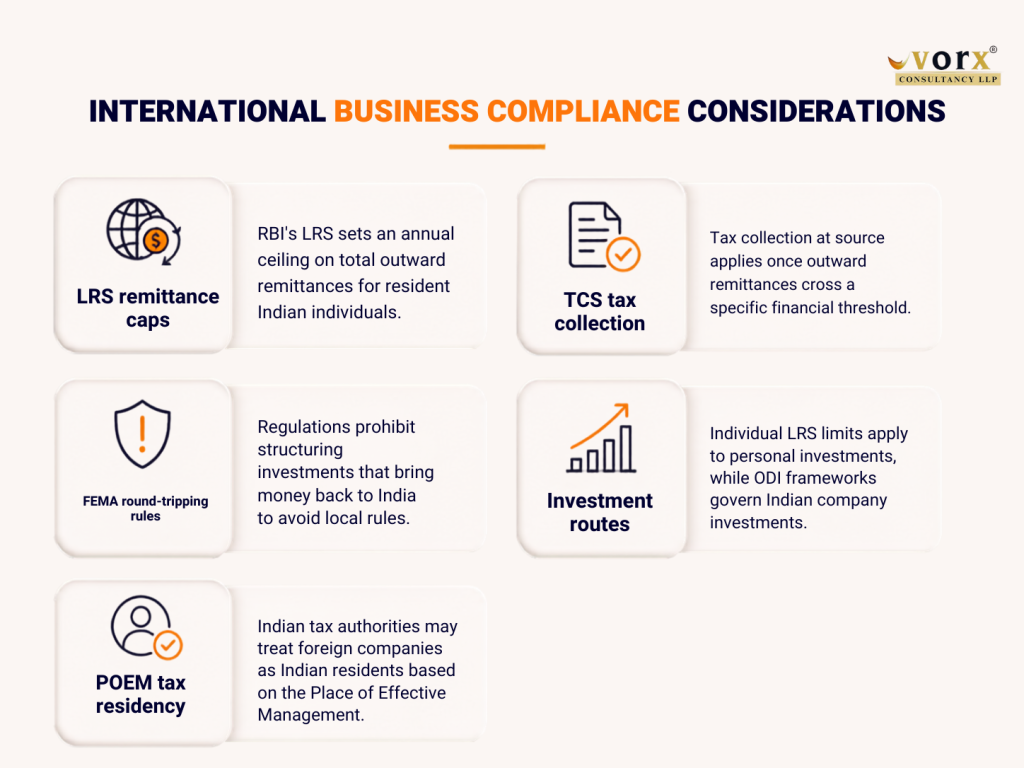
The Liberalised Remittance Scheme (LRS) caps how much you can send out. As a resident Indian individual, RBI’s LRS sets an annual ceiling on your total outward remittances, and this limit covers everything combined, education, travel, investments, gifts, business capital, all of it.
If you’re funding a company setup personally, this ceiling applies to your entire year’s outward remittance, not just the incorporation fee, so it’s worth mapping out before you commit funds.
There’s a tax collection step most people forget about. Once your outward remittances in a financial year cross a certain threshold, TCS starts applying.
It’s not a penalty, and it’s adjustable against your income tax later, but it does affect your cash flow at the moment of transfer, and we’ve seen founders get caught off guard simply because nobody mentioned it during planning.
FEMA has specific rules about round-tripping. You can’t structure things so that your new UAE or Italy company invests back into an Indian entity in a way that effectively brings the money full circle to avoid Indian regulations.
RBI and FEMA regulations are explicit about this, and it’s worth having a compliance-focused conversation before you finalize any structure that involves both an Indian and a foreign entity.
Two different routes exist, depending on who’s investing. If you personally invest, you’re working within your individual LRS limit.
If an existing Indian company is investing in the foreign entity, that typically falls under the Overseas Direct Investment (ODI) framework instead, which has its own compliance requirements.
These aren’t interchangeable, and choosing the wrong one can create paperwork headaches later.
Where you actually run the company matters more than where you incorporate it. This is the one that surprises people most.
If you incorporate a company in the UAE or Italy but continue making all the real decisions from your desk in India, Indian tax authorities may still treat that company as having its Place of Effective Management (POEM) in India, which can mean it’s taxed as an Indian resident company regardless of where the certificate of incorporation says it’s based.
If your plan depends heavily on the foreign entity being taxed only abroad, this is a conversation to have with a tax advisor early, not after the company is already running.
Vorx Consultancy Insight: We’ve had founders come to us after setting up a UAE free zone company, expecting to run it entirely from India while treating it as fully outside Indian tax jurisdiction.
That’s rarely how it plays out in practice. A foreign company can absolutely be a smart move, but the substance of where decisions are made needs to match the paperwork.
Planning to Set Up in Italy or the UAE?
Ensure your setup works for India and your chosen jurisdiction.Vorx Consultancy helps with company formation, tax, RBI/FEMA, and residency.
Get a personalised Italy vs UAE business setup assessment with Vorx Consultancy.
Company Formation: Italy vs UAE Structures
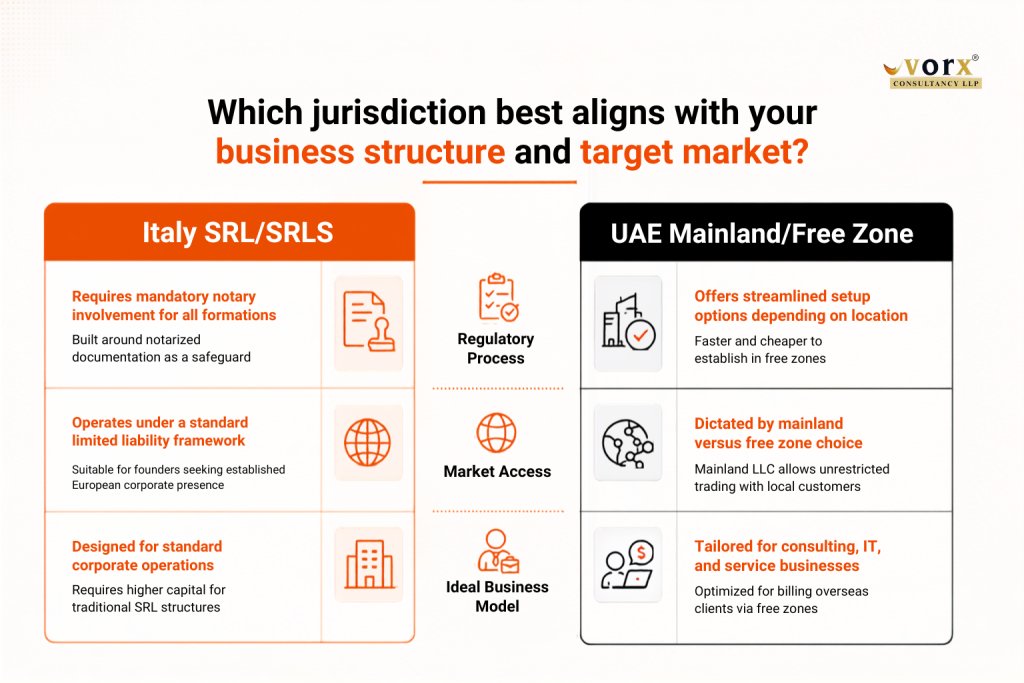
In Italy, the two structures most foreign founders consider are the SRL (a standard limited liability company) and the SRLS, a simplified version with a lower starting capital requirement.
Both require a notary as part of the process, and the paperwork tends to be more document-heavy than what founders coming from a UAE or UK background might expect.
It’s not necessarily slower for the wrong reasons, Italy’s system is simply built around notarized documentation as a safeguard.
In the UAE, the first real decision isn’t the entity type, it’s mainland versus free zone. A mainland LLC lets you trade directly with UAE customers without restriction, which matters if you’re running an e-commerce business or need to sell to local mainland clients.
A free zone company is usually faster and cheaper to set up, and works well for consulting, IT, and service businesses that mostly bill overseas clients, but it comes with more limitations on direct mainland trading.
Neither is universally “better”, it depends entirely on who you’re planning to invoice.
Registering a Company from India: What's Actually Involved
For Italy, an Indian applicant will typically need attested and translated documents, a registered office address, a notary appointment (which can sometimes be coordinated remotely through a local representative), and registration with the Registro delle Imprese along with a VAT number application.
Because of the translation and attestation steps, timelines for non-resident applicants tend to run longer than for someone already based in the EU.
For the UAE, the process is generally more streamlined for non-residents. Depending on the free zone or mainland authority you choose, you’ll need a passport copy, address proof, and in some cases a simple business plan.
Several UAE free zones allow the bulk of the process to happen remotely, with an in-person visit sometimes needed later for visa stamping or Emirates ID processing.
Both processes are manageable without relocating first, but “manageable” doesn’t mean identical in effort.
If your timeline is tight, get a realistic estimate for your specific business activity rather than relying on generic “X days” claims you’ll see quoted online.
Tax: Where the Real Difference Shows Up
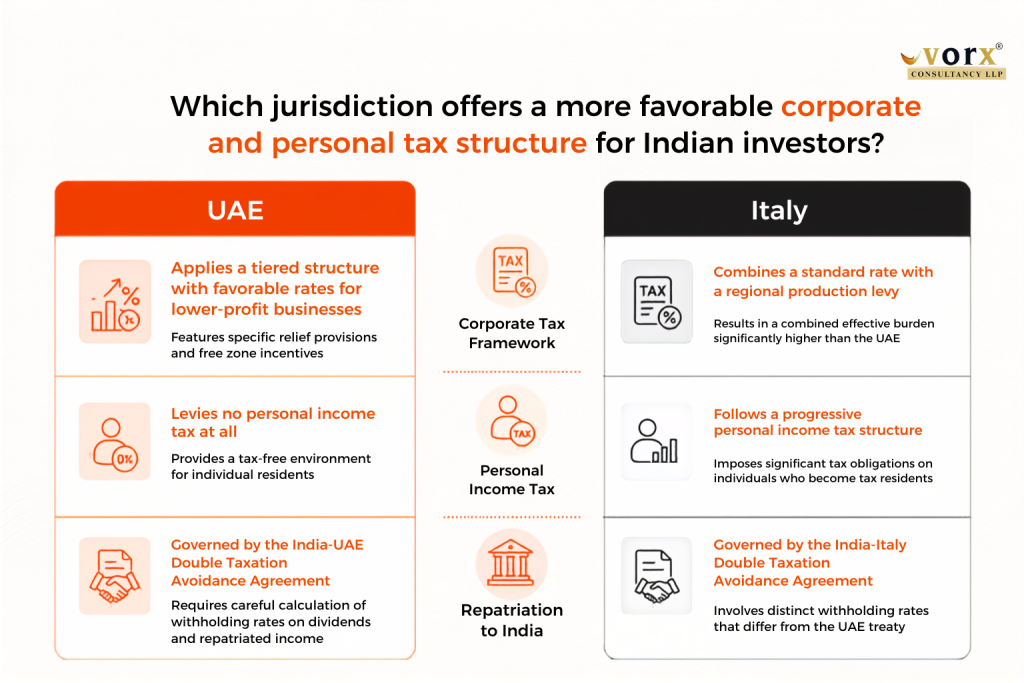
The UAE’s tax pitch gets oversimplified constantly, so it’s worth being precise. The UAE applies a tiered corporate tax structure, with lower-profit businesses generally taxed at a favorable rate and higher profits taxed at the standard rate.
Free zone companies can qualify for a preferential rate on qualifying income if they meet specific conditions as a Qualifying Free Zone Person, but this isn’t automatic, and income earned from UAE mainland clients generally doesn’t count as qualifying income.
There’s also a Small Business Relief provision for lower-revenue companies, though it’s a transitional measure with a scheduled end date rather than a permanent feature, so it shouldn’t be the foundation of a long-term tax plan.
Italy’s corporate tax framework combines a standard rate with a regional production levy (IRAP), putting the combined effective burden well above the UAE’s structure.
Personal income tax is also a real consideration in Italy if you become a tax resident there, since it follows a progressive structure, unlike the UAE’s approach of not levying personal income tax at all.
But here’s the part that gets left out constantly: what happens when profits come back to India.
The India-UAE and India-Italy Double Taxation Avoidance Agreements (DTAAs) set specific withholding rates on dividends and other repatriated income, and these rates aren’t identical between the two countries.
Whatever tax advantage you gain abroad needs to be looked at alongside what you’ll owe (or credit against) when that money reaches your Indian bank account.
This is exactly the kind of calculation worth doing with a cross-border tax advisor before you commit to a structure, not after your first profitable year.
Also Read this blog: Italy Company Tax Guide 2026
Market Access and Business Opportunity
If your customers are mostly in Europe, or you’re building a product that benefits from EU regulatory recognition, Italy’s access to the single market is hard to replicate through a UAE base.
E-commerce businesses in particular can benefit from the EU’s VAT OSS scheme, which simplifies cross-border VAT compliance when selling into multiple EU countries from one registration.
If your business model leans toward trade, re-export, logistics, or serving Gulf and South Asian clients, the UAE’s geographic position and infrastructure, particularly around Dubai’s ports and free zones, offer a genuine operational advantage that Italy doesn’t match for that specific use case.
Residency and Visas: Company Formation Isn't the Same as Residency
This is worth stating plainly: setting up a company in either country does not automatically grant you residency, and residency does not automatically lead to permanent status or citizenship. They’re related but separate processes, each with its own eligibility criteria.
The UAE offers investor visas tied to company setup, a Golden Visa for those meeting specific investment or qualification criteria, and remote work visa options.
Italy offers routes like the Startup Visa and Self-Employment Visa, both of which involve their own approval process separate from simply registering a company.
A well-prepared application can help demonstrate the strength and viability of your business case, but neither country guarantees approval based on incorporation alone.
Which Should You Choose?
No single right answer exists, although there is a relatively obvious way to go about it:
Choose the UAE if fast results, zero personal income tax, closeness to India, and targeting the Gulf, MENA, or South Asian market are what matters most to you.
Choose Italy if getting into the EU market, possibly even getting access to the Schengen Area, and having a business model that works well within the European framework of regulations and consumers appeals to you.
For many founders we work with at Vorx Consultancy, the decision ultimately comes down to where their customers actually are, not just where the tax rate looks best on paper.
Still Deciding Between Italy and the UAE?
The right choice depends on your business, market, and long-term goals. Let Vorx Consultancy help you choose the right jurisdiction for your business.
Conclusion
Italy and UAE aren’t really competing for the same job. One gives you a fast, tax-efficient base close to home with a large existing Indian business network.
The other gives you a foothold inside the EU, with market access and mobility that a Gulf-based company simply can’t offer. Neither is the “better” jurisdiction in absolute terms, the right one is whichever matches where your customers are, how you plan to run the business day to day, and what your long-term residency goals actually look like.
What matters more than the choice itself is getting the sequencing right: understanding your RBI/FEMA obligations before you remit a single rupee, structuring the company so its management genuinely matches where it’s incorporated, and knowing what you’ll owe once profits make their way back to India.
Get that foundation right, and either jurisdiction can work well. Skip it, and even the “correct” choice can turn into a compliance problem a few years in.
If you’re still weighing the two, it’s worth mapping your specific business model, revenue sources, and residency goals against both jurisdictions before filing any paperwork.
At Vorx Consultancy, this kind of side-by-side evaluation, grounded in your actual numbers rather than generic assumptions, is usually where clarity starts.
Ready to Choose Your International Business Base?
Choose Italy or the UAE based on your business goals, market, and residency plans. Vorx Consultancy helps with company formation, tax planning, banking, and residency solutions.
Start your international business journey with Vorx Consultancy.
