

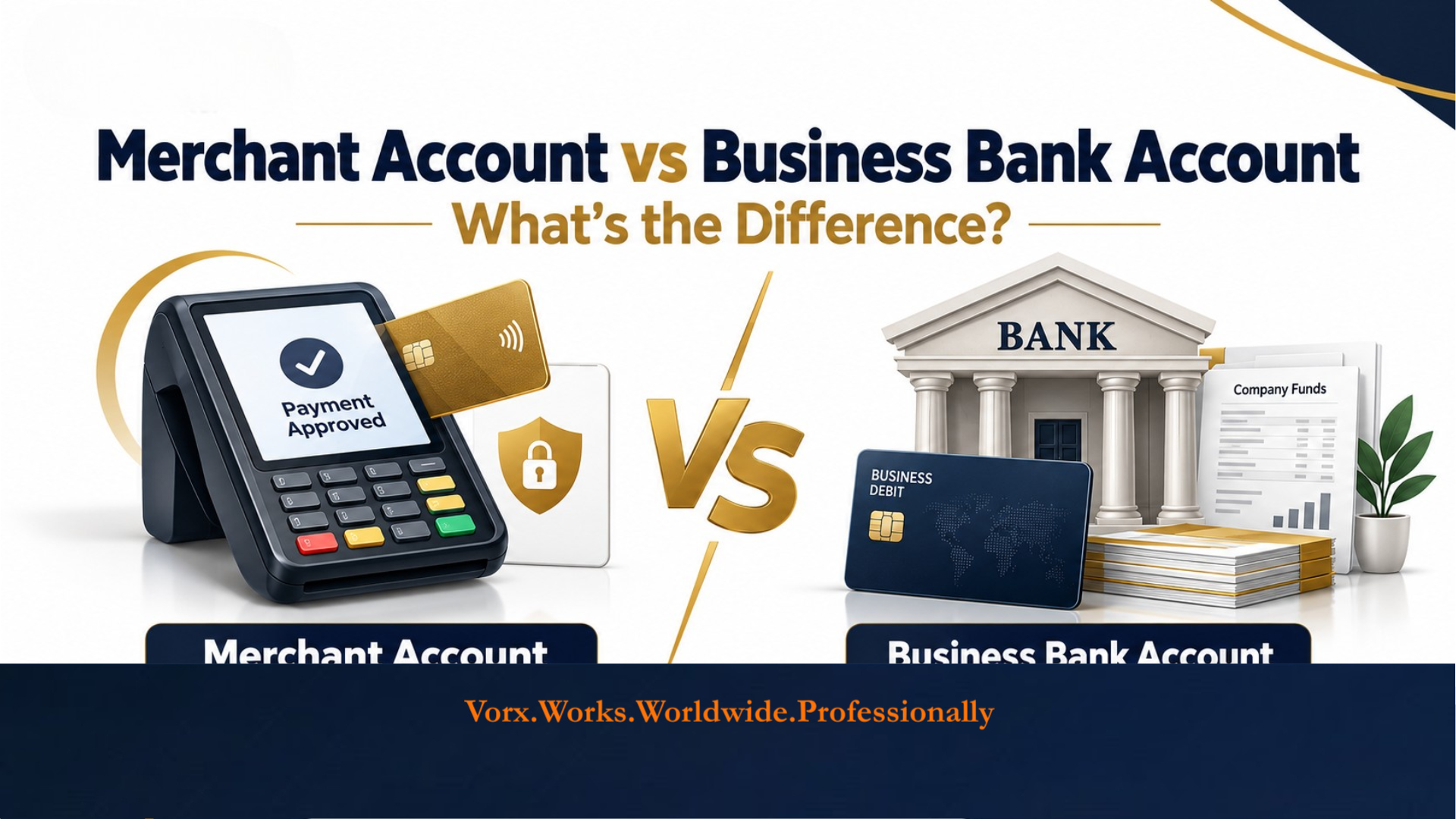
Running a business means handling the constant inflow, outflow, and redistribution of money between your business’s financial ecosystems. Which is why the difference between a merchant account and business bank account often gets blurred.
While the two services may seem similar at first glance, they have different purposes: a business bank account helps you track your business expenses and profits. And a merchant account lets you process card payments.
Understanding what a merchant account is and how it differs from a business bank account will help you establish the most suitable payment infrastructure for your business and avoid potential banking or payment processing issues.
What Is a Merchant Account?
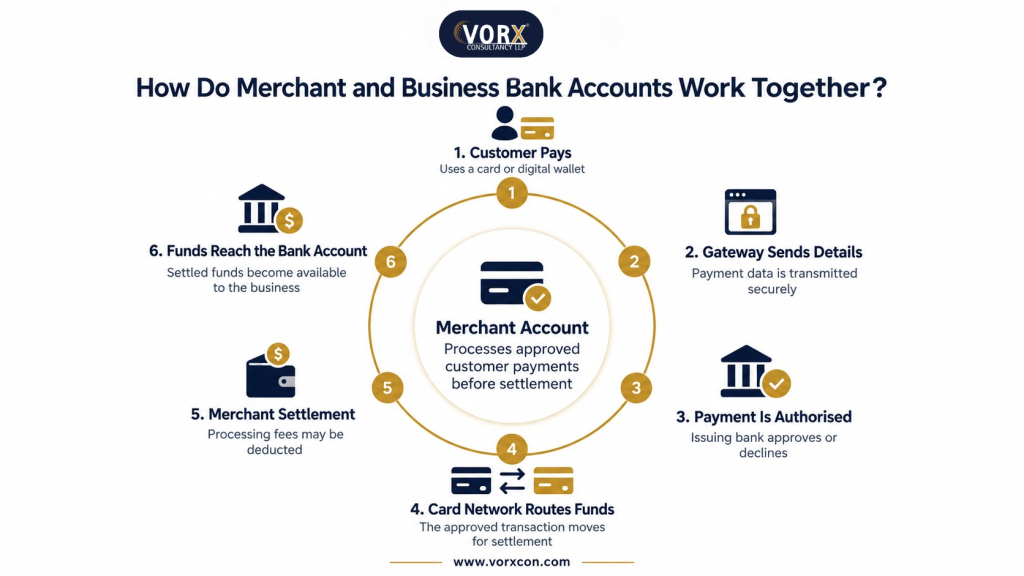
A merchant account is part of the infrastructure that allows a business to accept electronic payments, including debit and credit card transactions. When a customer makes a card payment, the money does not usually move directly into the company’s regular bank account. The transaction first passes through a payment-processing system. Once the payment is authorised and settled, the funds are transferred to the business bank account after applicable fees or deductions.
Depending on the provider, a business may have a dedicated merchant account or use a payment service provider that combines merchant-account functionality with payment processing. Merchant accounts are commonly used by:
- E-commerce stores
- Retail businesses
- Subscription-based companies
- Restaurants and hospitality businesses
What Is a Business Bank Account?
A business bank account is an account opened under the company’s/firm’s name and uses to receive income and make payments to suppliers, operate expenses, salaries, and other matters. A business account differs from a personal account in the sense that it tracks all financial transactions and serves as a tool for bookkeeping and tax accounting. Businesses commonly use this account to:
- Receive bank transfers and settled customer payments
- Pay suppliers, employees and operating expenses
- Make local and international transfers
- Manage taxes and business-related charges
- Maintain clear financial records
However, having a business bank account does not automatically allow a company to accept debit or credit card payments. For that, the business needs a payment-processing solution.
Recommended Reading:
International founders can read our guide on opening a business bank account abroad without traveling to understand remote onboarding, documentation and compliance checks.
What Is the Difference Between a Merchant Account and a Business Bank Account?
The clearest difference is their purpose. A merchant account processes customer card payments, while a business bank account receives, stores and manages business funds.
Feature | Merchant Account | Business Bank Account |
Primary purpose | Processes card payments | Manages business finances |
Direct access to funds | Generally limited | Yes |
Typical transactions | Card and digital payments | Deposits, transfers and withdrawals |
Holds funds long-term | Generally no | Yes |
Common charges | Processing and chargeback fees | Maintenance and transfer fees |
Needed by | Businesses accepting card payments | Almost every registered business |
Does Your Business Need Both Accounts?
It depends on how your customers pay you. Most businesses need a business bank account to receive income, pay expenses and manage company funds. A merchant account—or a payment provider offering the same functionality—is needed when the business accepts debit or credit card payments.
Here is how it works in practice:
- Consultant receiving bank transfers: A business bank account may be enough because clients pay directly into the account.
- E-commerce store accepting cards: Both functions are required. The merchant-payment system processes the card transaction, while the business bank account receives the settled funds.
- Retail shop using a card machine: The card terminal processes payments through a merchant service, and the final amount is transferred to the shop’s business bank account.
- Subscription-based business: Both are generally needed because recurring card payments require payment-processing infrastructure before funds can reach the business bank account.
- Business using Stripe, PayPal or a similar provider: A separate dedicated merchant account may not be required because the provider can offer merchant-account functionality. However, a linked business bank account is still normally needed to receive withdrawals or settlements.
Recommended Reading:
Businesses handling cross-border transactions can also explore these digital banks and neobanks for international business payments to compare multi-currency and global payment options.
Which Account Is Right for Your Business?
The right account depends on how the company receives, processes and manages the payments. For example, the e-commerce store that regularly accepts orders from customers by card needs reliable processing of payments, rapid settlement of funds and protection against chargebacks, and a business account to manage its money flows.
Before choosing the provider, it is important to compare the transaction fees, settlement time, available currencies, payment limits and international availability. It is also necessary to clarify the possibility of connecting the solution to the website and accounting system. The most optimal variant should be found, which will cover the company’s needs in processing payments, as well as not limit the development and growth of the business.
What Are the Common Misconceptions About These Accounts?
One common misconception is that a merchant account works like a normal bank account. In reality, it is designed primarily to support payment processing rather than everyday business banking. Another misconception is that a business bank account can accept card payments on its own. It can receive settled funds, but card acceptance normally requires additional payment-processing infrastructure.
Businesses may also assume they always need a dedicated merchant account. Payment service providers can offer aggregated merchant services, which may be easier for smaller companies to access. However, fees, account controls and settlement terms can differ, so convenience should not be the only deciding factor.
How Can Vorx Help You Choose the Right Banking Setup?
Choosing a payment and banking setup becomes more complicated when a company operates internationally, serves customers in multiple countries or receives payments in different currencies.
Vorx can help businesses evaluate suitable company structures, business bank account options and merchant-payment solutions based on their activities and target markets. We can also assist with documentation, banking applications and the compliance information providers commonly request.
The aim is not simply to open an account, but to create a practical setup that supports how the business actually receives and manages money.
Need the right banking and payment setup? Let Vorx help you choose with confidence.
Book a Strategy Call: (Calendly Link)
Visit: www.vorxcon.com
Email: support@vorxcon.com
Final Thoughts
The difference between a merchant account and a business bank account is straightforward: one helps process customer card payments, while the other stores and manages company funds. A business that accepts only bank transfers may not need separate merchant-account functionality. However, businesses accepting online, in-store or recurring card payments will usually need both functions.
Before selecting any provider, look beyond basic fees. Consider payment methods, settlement periods, supported currencies, chargeback policies and access to funds. The right setup should support your current operations while remaining suitable as the business grows.
