

Most guides frame the Oman free zone vs mainland question as “tax holiday versus market access.”But that’s just half the story. The critical element is much easier: Where are your customers? Where do your products or services go?
Whether you’re looking at Oman free zone company formation or a mainland LLC, get that one question right and the rest usually falls into place, including ownership, tax, hiring and budget. Get it wrong and you’ll likely be paying to restructure within two years.
This guide explains how the decision works for foreign investors today. It covers two recent changes many older articles miss: Oman’s new free zone law of 2025, and the India–Oman CEPA, which came into force in June 2026.
Read this guide: Oman Company Formation for Foreigners guide in 2026.
Oman Free Zone vs Mainland: The Quick Answer
If your business… | Lean towards |
Sells mainly to customers inside Oman (retail, services, contracting, distribution) | Mainland |
Manufactures or processes goods mainly for export | Free zone |
Re-exports to the GCC, East Africa or South Asia through Oman’s ports | Port-linked free zone |
Wants government contracts | Mainland |
Sells locally and exports, both at real volume | Both (hybrid) |
Not Sure Which Oman Company Structure Fits Your Business?
Choosing between mainland and free zone depends on your business activity, target market and investment goals.
Oman Mainland Company Formation: What It Means Today
The mainland entity is registered with the Ministry of Commerce, Industry, and Investment Promotion (MOCIIP).It is allowed to operate in any place in Oman’s “customs territory”, that is, the entire country except for the free zones. The most popular choice among foreign investors is the LLC form of business organization.
Mainland companies can take on any activity their licence allows. They can bid for government work and sell directly to Omani businesses and consumers.
100% Foreign Ownership in Oman and the Negative List
Most of the information available online is outdated on this issue. Prior to 2020, foreigners were not allowed to hold more than 70% of a mainland business, and thus the Omani partner was common.
This was brought about by the enactment of Foreign Capital Investment Law (Royal Decree 50/2019), where since 2020 up to date, 100 percent foreign ownership is allowed for most of the activities, and the minimum fixed capital for foreign investors has been scrapped.
The exception is a “negative list” of activities reserved for Omani nationals. The Act has been updated since 2024 to cover a total of 123 activities.
Most of these fall into the category of small-scale local businesses that are not usually considered by foreign investors.
But don’t forget that you need to confirm your specific activity code. Moreover, other regulated sectors such as banking, insurance, and telecommunications also require special licenses.
Check: if a guide suggests that you always require an Omani partner, then it is based on the old law.
Oman Free Zone Company Formation: How Free Zones Work
Oman’s free zones and special economic zones are overseen by OPAZ, the Public Authority for Special Economic Zones and Free Zones.
They sit around ports, airports and industrial land. They’re designed for manufacturing, logistics, processing and re-export, not for selling to a customer down the road in Muscat.
The free zone company is 100 percent foreign-owned. It works within the boundaries of the free zone and enjoys tax exemptions on the importation of raw materials and machinery to the extent that the items remain in the free zone or are re-exported.
The 2025 Free Zone Law: What Changed for New Investors
Royal Decree 38/2025 changed the old Free Zones Law of 2002 to one that applies to all zones. There are two things to bear in mind about this:
- Existing firms retain their incentives: Existing firms retain their incentives until the period of these incentives expires.
- New comers will have to abide by the new system: This includes the new tax exemption system. Regulations will follow the laws, so make sure that you know the terms first before signing any documents.
Oman Free Zone vs Mainland: Side-by-Side Comparison
Factor | Mainland | Free zone |
Regulator | MOCIIP | OPAZ / zone authority |
Foreign ownership | Up to 100%, except negative-list activities | 100% |
Selling inside Oman | Direct, no restriction | Treated as an import into Oman |
Corporate income tax | 15% standard rate | Conditional exemption for qualifying companies |
Customs on imported inputs | GCC common tariff applies | Exempt while goods stay in the zone or are re-exported |
Omanisation | Sector quotas, often stricter | Usually relaxed, set per zone |
Government tenders | Eligible | Rarely the right vehicle |
Where you operate | Anywhere in Oman | Inside the zone boundary |
Oman Free Zone vs Mainland for Trading: Who Are Your Customers?
This is where most decisions are won or lost, especially for trading companies.
Under Oman’s free zone rules, goods leaving a zone for the rest of the country count as foreign goods, even if they were made in Oman from local materials.
Customs duty and VAT apply when those goods reach Omani buyers. You’ll usually also need a local distributor or a mainland entity to make the sale.
So if a free zone company ends up selling most of its output locally, it has to pay for an export structure to run a domestic business.
Example 1 (hypothetical): A Pune-based auto-parts maker plans to supply workshops across Oman.
The Sohar Free Zone tax exemption looks tempting. But almost every sale would be domestic, so each shipment would cross into Oman as an import. A mainland LLC serves this business better, possibly located in an industrial estate.
Example 2 (hypothetical): A textile exporter from Surat seeks a base for buyers in Saudi Arabia, East Africa and the US.
Fabric comes in, gets finished and leaves by sea. A port-linked free zone fits naturally, because the product never needs to enter Oman’s domestic market.
Oman Free Zone Tax Benefits vs Mainland Corporate Tax
Mainland companies pay corporate income tax at the standard 15% rate, with annual filings with the Oman Tax Authority.
On the free zone side, the tax benefits extend beyond income tax. They include customs exemptions on imports into the zone and VAT relief on qualifying zone activity.
Is There Corporate Tax in Oman Free Zones?
Under the 2025 law, qualifying free zone companies can receive a 10-year income tax exemption. It can be renewed for two further periods for certain specialised activities.
If an article quotes flat 25- or 30-year holidays, it’s describing terms granted to earlier companies under the old zone-by-zone rules.
The exemption is conditional. It depends on your approved activity, operating inside the zone and meeting the zone’s requirements.
Under the old law, for example, companies had to export a set share of their output. If you breach the conditions, you can lose the benefit.
The 15% Minimum Tax for Large Groups
Since January 2025, Oman has applied a 15% domestic minimum top-up tax to entities of multinational groups with consolidated revenue of €750 million or more.
For those groups, a zero-tax zone can be topped up to 15%, so the Oman free zone corporate tax advantage largely disappears.
One more point: being tax-free in Oman doesn’t mean being tax-free at home. For an Indian resident, how profits are taxed depends on Indian law and the India–Oman tax treaty. Plan both sides together, ideally with [international tax planning] support before you incorporate.
Read this guide: Oman Corporate Tax 2026: What Foreign-Owned Companies Actually Pay.
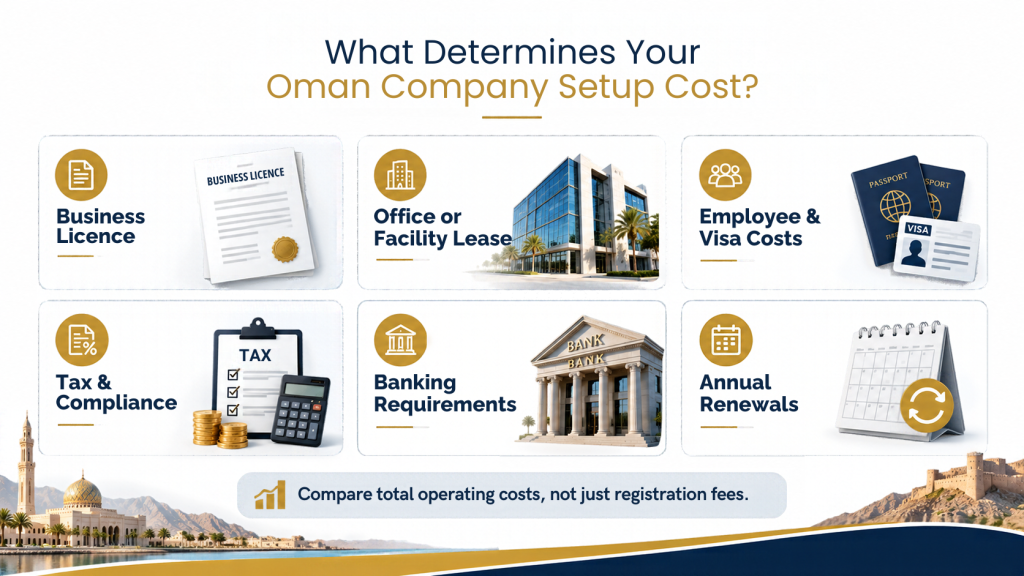
Oman Free Zone vs Mainland Setup Cost: What Drives Your Budget
Fees depend on the zone, the activity and the premises, and they change often. Any figure you find online is a snapshot. It’s more useful to know which factors move your total in each structure.
Mainland Company Setup Cost Factors
- Premises: You need commercial premises that meet your activity’s licensing rules, and a virtual address won’t satisfy every licence.
- Omanisation: Hiring and keeping Omani staff to meet sector quotas affects payroll from year one.
- Profit tax: Profits are taxed at 15%, with annual filings and, above certain thresholds, an audit.
- Sector approvals: Some activities need separate approvals from their regulator.
Free Zone Company Setup Cost Factors
- Lease: Land, warehouse or office space inside the zone is often your biggest commitment, especially for industrial plots.
- Zone obligations: You have annual licence renewals and reporting to the zone authority.
- Duty on local sales: Customs duty and VAT apply to anything you sell into Oman. This quietly erodes the tax advantage as local sales grow.
- Logistics: Duqm and Al Mazunah are far from the main consumer markets, so moving goods to customers adds expense.
Hidden Costs Both Structures Share
- Visas and labour: Both structures carry visa and labour-related expenses.
- Accounting and VAT compliance: Both need bookkeeping and VAT handling.
- Banking delays: Opening a [business bank account in Oman] can take time when shareholders are foreign.
- Restructuring later: If the first choice doesn’t fit, you’ll need new licences, new contracts and sometimes new premises. This is the most expensive item of all.
Compare structures over three years, not on setup day. A structure that looks lighter at registration can turn heavier once you add duty on local sales or a long industrial lease.
Planning Your Oman Company Setup Budget?
Vorx Consultancy helps foreign investors evaluate registration requirements, licensing costs and ongoing compliance before making a decision.
Oman Free Zone Company Requirements: Omanisation, Visas and Hiring
Both structures can sponsor work visas for foreign staff. The real difference is Omanisation, the share of jobs that must go to Omani nationals.
- Mainland: quotas vary by sector and can be demanding for some activities.
- Free zones: rates have historically been lower, roughly 10–25% depending on the zone. Under the new law, confirm the rate for your activity when you apply.
Other common free zone requirements include:
- A lease or investment agreement with the zone
- Operating within the zone boundary
- Annual reporting to the zone authority
If your model depends on a large expatriate team, Omanisation alone can decide the question.
Best Free Zone in Oman for Foreign Investors
There’s no single best free zone. The right one depends on your industry, your shipping routes and your scale.
Sohar Free Zone Company Setup
Sohar Free Zone sits next to Sohar Port in northern Oman, within driving distance of the UAE. It’s strong for metals, petrochemicals, food processing and logistics. It suits investors who want port access with close links to UAE markets.
Salalah Free Zone Company Formation
Salalah Free Zone is close to Salalah’s deep-water port and airport in the south. It suits chemicals, materials processing, assembly and re-export towards East Africa, South Asia and the wider region.
Duqm Special Economic Zone Company Setup
Duqm is a large special economic zone built for heavy industry, refining, petrochemicals and green hydrogen. It’s best for capital-intensive projects that need large plots and port infrastructure, rather than small trading businesses.
Al Mazunah and the Airport Free Zones
Al Mazunah, near the Yemen border, is a niche option for cross-border trade. The airport free zones in Muscat, Sohar and Salalah were established in 2022 for air-cargo-linked activity, such as high-value or time-sensitive goods.
Can You Run Both a Free Zone and a Mainland Company?
Yes, and many growing businesses end up here. A common pattern is a free zone entity for manufacturing or re-export, plus a mainland LLC for domestic sales and government work.
The trade-off is two sets of licences, accounts and compliance filings. Unless your volumes justify both from day one, start with the structure that matches your main revenue source and add the second one later.
Oman Company Registration for Foreigners: What Indian Founders Should Know
The India–Oman CEPA came into force on 1 June 2026. Oman now offers duty-free access on almost all its tariff lines, covering nearly all of India’s exports by value.
Many Indian goods with valid proof of origin can therefore enter mainland Oman at zero or reduced duty. That weakens the old argument for using a free zone simply to avoid import duty on Indian products. Rules of origin still apply, so check your HS codes.
The CEPA also raised the ceiling for intra-corporate transferees. That makes it easier to move Indian managers into an Omani subsidiary.
On the Indian side, setting up an overseas company counts as overseas direct investment under FEMA and the RBI’s Overseas Investment rules. You’ll have to report it through your bank, whichever Oman structure you choose.
Expanding Your Indian Business to Oman?
Get professional guidance on company formation, ownership requirements and cross-border compliance with Vorx Consultancy.
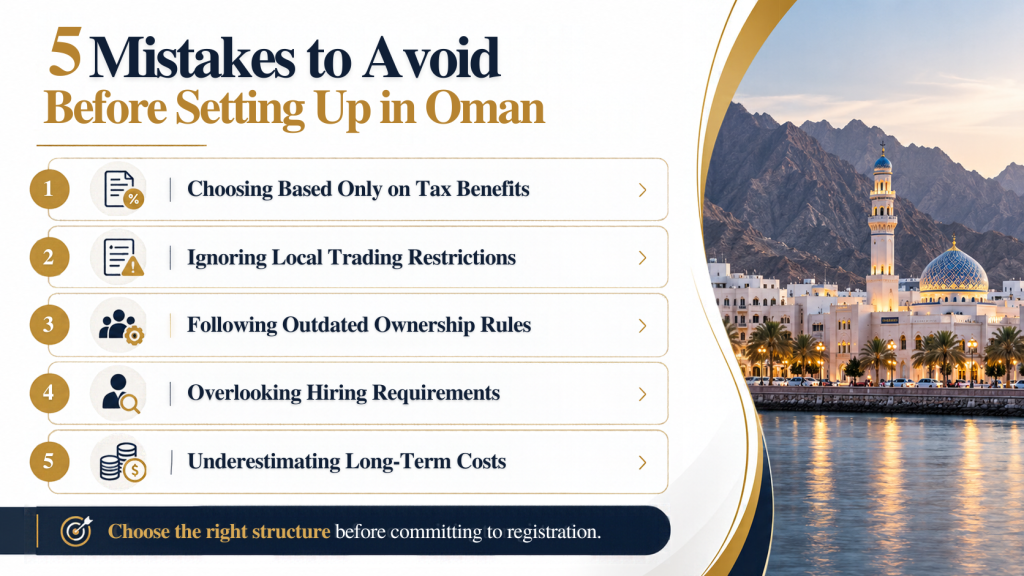
Common Mistakes When Choosing a Structure
- Picking a free zone for the tax holiday when most revenue will come from Omani customers.
- Following pre-2020 advice about mandatory local partners.
- Assuming the old 25–30 year tax holidays apply to new companies.
- Ignoring Omanisation until it’s time to hire.
- Comparing setup-day spending instead of three-year running spend.
Read this guide: Oman Company Compliance Requirements in 2026 Guide.
Free Zone or Mainland in Oman: Making the Final Call
The Oman free zone vs mainland choice comes down to where your revenue comes from:
- Domestic customers point to the mainland.
- Exports and re-exports point to a free zone.
- Both at scale point to a hybrid.
When you sign the lease agreement, make sure that you have taken three important steps: mapping your customers, comparing your activities to the list of negatives, and three-year expenditure projection.
For those who need an expert’s advice, Vorx Consultancy provides services that allow business owners to compare Oman’s structures, complete company registration in Oman, open bank accounts, and develop a tax strategy for both Oman and India. Book a consultation to discuss your business model.
Ready to Set Up Your Company in Oman?
Whether you’re considering mainland or free zone, Vorx Consultancy can assist with company registration, banking support and ongoing compliance.
