


Poland has quietly become one of the more practical entry points into the European market. It sits at the geographic center of the EU, has a large and skilled workforce, and offers a tax environment that rewards smaller and growing businesses rather than punishing them.
For Indian entrepreneurs and other foreign founders looking at European expansion, that combination matters more than the headlines about GDP growth; it means the paperwork is manageable and the market on the other side of it is real.
This guide walks through what it actually takes to register a company in Poland in 2026: the legal structures available, the documents you’ll need, realistic timelines, and the mistakes that tend to slow foreign founders down.
We’ll also be direct about what company registration does not give you, particularly around residency, since that’s one of the most common points of confusion we see at Vorx Consultancy when advising clients on international business registration.
Can Foreigners Register a Company in Poland?
Yes. There are no restrictions preventing foreign individuals or foreign companies from registering a business in Poland.
Whether you’re a solo founder in Mumbai or a corporate group looking to open a European subsidiary, the door is open.
That said, not every structure is available to everyone in the same way. EU and EEA nationals can generally register a sole proprietorship (JDG) under the same terms as Polish citizens.
If you’re a non-EU national, your ability to use that particular structure depends on your immigration status in Poland but the limited liability company, which is what most foreign founders choose anyway, doesn’t carry that restriction.
One clarification worth making early: registering a company in Poland is a corporate matter, and it does not, by itself, grant you a visa, a work permit, or residency. Those are separate legal processes.
We’ll come back to this later in the guide, but it’s worth keeping in mind from the start so expectations are set correctly.
What Types of Companies Can You Register in Poland?
Choosing the right legal structure shapes everything that follows your liability, your tax treatment, how easily you can raise investment, and how banks will view your application later on.
Here’s how the main options compare.
Structure | Capital | Liability | Best For |
Sp. z o.o. (LLC) | PLN 5,000 | Limited | Foreign founders, SMEs |
PSA | PLN 1 | Limited | Startups, investors |
JDG | None | Unlimited | Freelancers, small businesses |
Branch Office | None | Parent company | Existing companies |
Representative Office | None | N/A | Market research |
In practice, the overwhelming majority of foreign investors choose the Sp. z o.o. roughly 94% of foreign-owned businesses in Poland use this structure, and for good reason.
It’s well understood by Polish banks and tax authorities, offers limited liability, and doesn’t require the more complex governance that comes with a joint-stock company.
The PSA is worth a closer look if you’re a startup planning to bring in outside investors down the line.
It was designed with flexible share structures in mind, and the minimum capital requirement is symbolic rather than a real barrier.
One restriction to flag: under Polish commercial law, a limited liability company cannot be established as the sole shareholder of another single-shareholder LLC.
It sounds like a technicality until it isn’t. We’ve seen registration applications rejected purely because of this structure, forcing founders to restart the process. If your ownership structure involves holding companies, it’s worth checking this before you file, not after.
Vorx Consultancy Insight: For founders deciding between Sp. z o.o. and PSA, the real question usually isn’t which is “better” — it’s whether you expect to raise external capital in the next two to three years. If yes, the PSA’s share flexibility tends to save restructuring costs later.
What Documents Do You Need to Register a Company in Poland?
The paperwork differs depending on whether you’re registering as an individual or through a foreign corporate entity, so it helps to separate the two.
If you’re registering as an individual:
- A valid passport or national ID
- A notarized power of attorney, if you won’t be present in Poland during registration, along with an apostille or legalization where required
- A registered office address in Poland — this can be a physical office or a virtual office arrangement
- Selected PKD codes describing your business activities (usually one main code and a few secondary ones)
- A qualified electronic signature or a Trusted Profile (ePUAP) — required for filing through the online S24 system
If you’re registering through a foreign company:
- An excerpt from your home country’s commercial register confirming the company exists
- A notarized power of attorney authorizing the incorporation, again with apostille or legalization as needed
- Certified translations of any foreign-language documents
- The same registered office and PKD code requirements as above
Banks and registration providers may ask for additional documents for anti-money-laundering and know-your-customer checks, particularly if your ownership structure spans multiple jurisdictions.
This is separate from what the registry itself requires, and it’s worth preparing for both rather than assuming registration paperwork alone will satisfy your future bank.
How to Register a Company in Poland: Step by Step
This is the part most guides gloss over, so let’s walk through it properly.
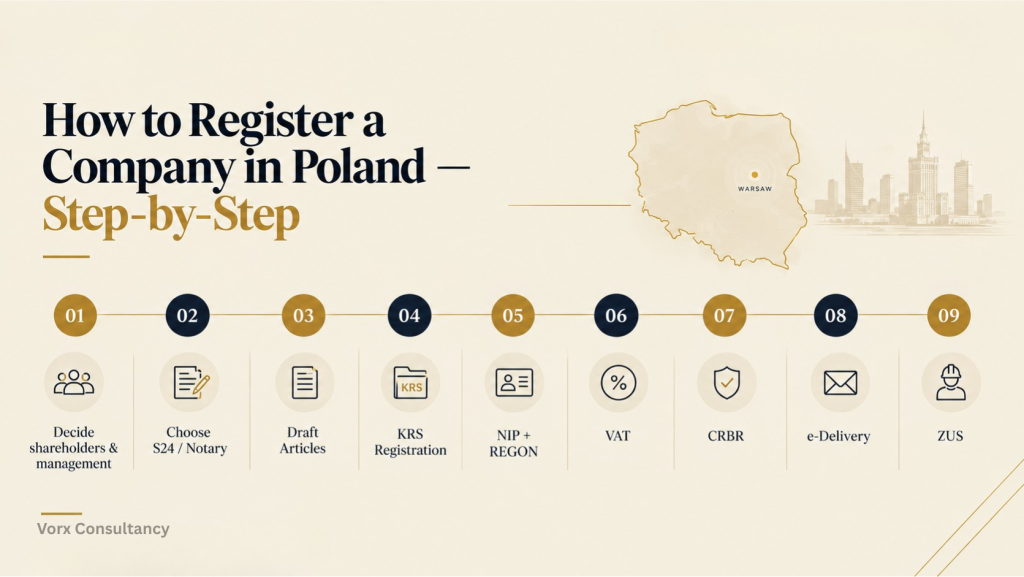
- Settle the core details. Before filing anything, decide on your shareholders, the management board, and your share capital.
These decisions shape your Articles of Association and can’t easily be changed later without additional cost.
- Choose your registration route. You have two real options. The S24 online system, run by the Polish Ministry of Justice, uses a standard template for your Articles of Association and requires a qualified electronic signature or ePUAP. It’s faster and cheaper.
The alternative is incorporation via notarial deed, which is slower and more expensive but necessary if you need customized governance provisions that don’t fit the standard template.
- Draft the Articles of Association. This document defines your company’s name, purpose, share capital, and internal governance.
- File with the National Court Register (KRS). This is the official act of incorporation.
- Obtain your NIP and REGON numbers. NIP is your tax identification number; REGON is your statistical identification number. Both are typically issued as part of KRS registration.
- Register for VAT, if applicable. This uses the VAT-R form and generally takes one to two weeks to process.
- Register your beneficial owners with CRBR. This must happen within seven days of company registration. It’s a short deadline and one that’s easy to miss if you’re not tracking it.
- Set up e-Delivery. As of 2026, this government electronic mail system is mandatory for entities registered in the KRS, and it’s how you’ll receive legally binding communication from public authorities going forward.
- Register as a ZUS Remitter if you plan to hire. This is Poland’s social insurance registration, required before you can bring on employees.
A simple way to decide between routes: use S24 if standard governance terms work for you and you have an e-signature ready.
Use a notary if your shareholder agreement needs custom provisions, or if a local representative will be handling parts of the process on your behalf.
Planning to Register a Company in Poland?
From choosing the right structure to completing KRS registration, Vorx Consultancy helps foreign founders manage the process with clarity.
How Long Does It Actually Take?
Here’s where expectations and reality tend to diverge. Registration itself can be fast — as little as one to three business days through S24 if you’re present or already have your e-signature sorted. Remote registration involving notarized and couriered documents can take up to 30 days.
But “registered” and “operational” are not the same thing. NIP and VAT filings typically add another one to two weeks. CRBR registration is quick on its own, but the seven-day legal deadline means it needs to happen almost immediately after incorporation.
The real bottleneck, more often than not, is the bank account opening one for a newly registered company can take anywhere from two weeks to three months, depending on how complex your ownership structure is and how thorough the bank’s KYC review needs to be.
A founder we worked with recently, a fintech-adjacent startup based in Delhi had their Polish company legally registered within four days through S24. Their bank account, however, took closer to seven weeks because their ownership structure included a UK holding company, which triggered additional beneficial-ownership checks. The lesson isn’t that something went wrong; it’s that the timeline for “ready to actually operate” should be planned separately from the timeline for “legally registered.”
Opening a Business Bank Account in Poland
The application process itself is straightforward on paper: submit an application, complete KYC documentation, and wait for the bank’s decision.
In practice, banks look closely at the residency of board members, how the company is represented, and who the ultimate beneficial owners are.
A board composed entirely of non-resident directors with no prior EU banking history can face a longer or more difficult approval process not because it’s disallowed, but because it requires more verification.
A physical visit to Poland isn’t required to open an account, but it often speeds things along. If your structure is straightforward one or two individual shareholders, no holding companies involving a remote application is usually manageable. If it’s more layered, budgeting extra time is the safer assumption.
Common Mistakes Foreign Founders Make When Registering in Poland
A few patterns show up repeatedly, and most are avoidable with a bit of foresight:
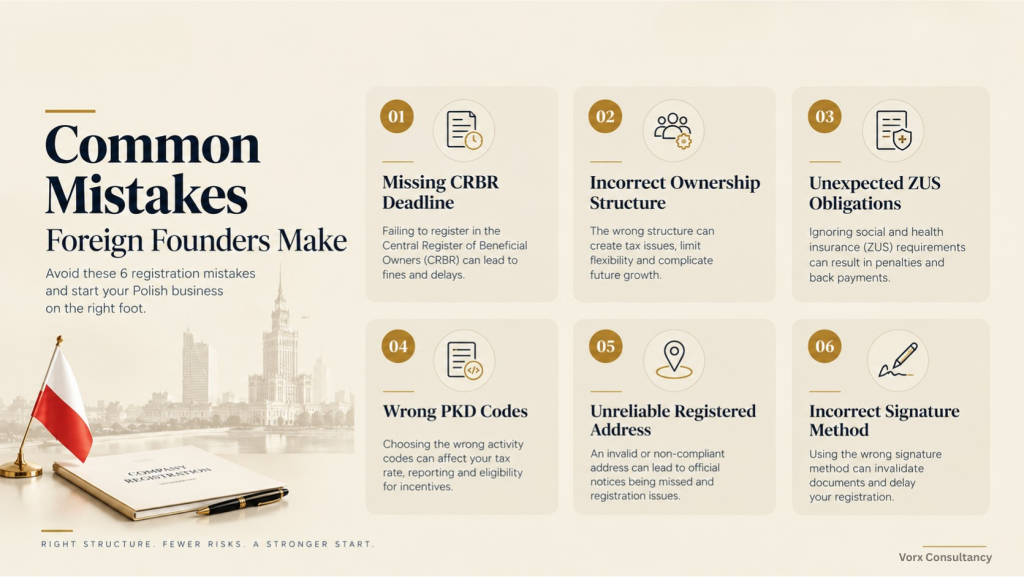
Missing the seven-day CRBR deadline. It’s easy to treat this as a formality and file it late, but penalties for missing it can be significant.
Structuring ownership without checking the single-shareholder LLC restriction. As mentioned above, this can force a full restart of the registration process.
Assuming a sole LLC shareholder avoids social insurance obligations. In practice, sole shareholders of an LLC can be treated as entrepreneurs by ZUS, triggering mandatory social and health insurance contributions.
This catches founders off guard because it isn’t obvious from the registration process itself, and the obligation is worth confirming before you finalize your ownership structure.
Choosing PKD codes without reviewing the actual business model. Codes that don’t match your real activities can create complications later, particularly around licensing or tax classification.
Using a registered address that can’t reliably receive official correspondence. Given how much communication now happens through mandatory e-Delivery, this is a bigger risk than it used to be.
Assuming wet-ink signatures are acceptable. They’re not, for most of the digital registration process a qualified electronic signature or Trusted Profile is required from the outset.
None of these are complicated to avoid once you know they exist. The issue is that most founders only learn about them after running into one.
Company Ownership vs. Residency: What This Means for Indian and Other Foreign Founders
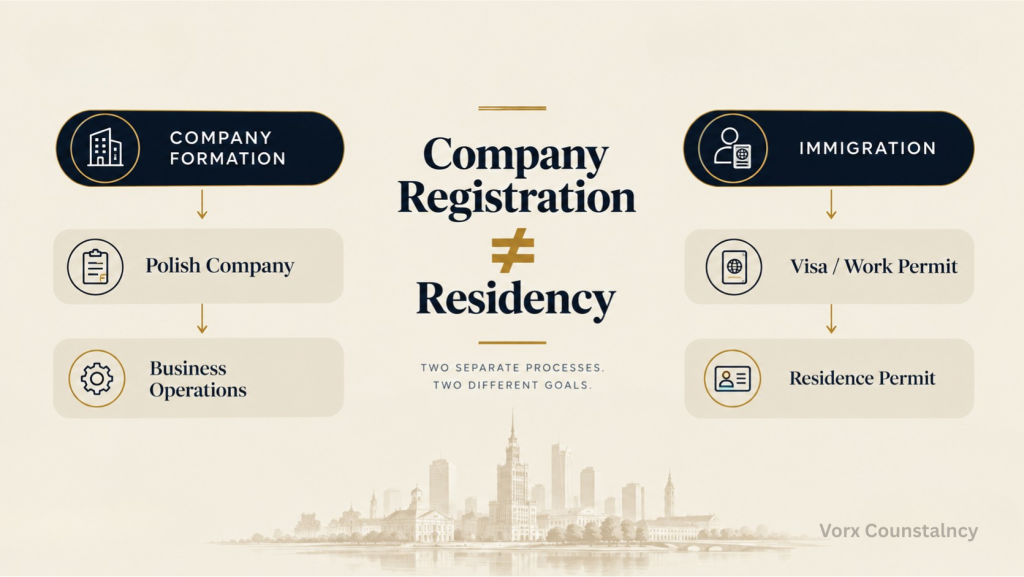
This is worth repeating clearly: registering and owning a company in Poland does not automatically grant you a visa, a work permit, or a residence permit.
These are handled through separate immigration processes, and it’s important to plan for both corporate registration and personal immigration rather than assuming one leads automatically to the other.
For Indian entrepreneurs specifically, tax residency is another factor to think through early, particularly if you intend to remain tax resident in India while running a Polish company.
Double taxation treaties between India and Poland exist to prevent the same income from being taxed twice, but applying them correctly depends on where your company is managed from, where dividends flow, and where you personally hold tax residency. This isn’t something to figure out after the fact.
At Vorx Consultancy, we typically encourage founders to treat company formation and immigration planning as two parallel tracks from day one, rather than sequencing them.
It tends to save both time and cost compared to addressing residency questions only after the company is already operational.
Expanding to Poland? Plan Beyond Registration.
Get coordinated guidance on company formation, tax considerations and immigration planning for your European expansion.
Conclusion:
Registering a company in Poland is genuinely one of the more accessible ways for foreign founders to gain a foothold in the EU market.
The process itself isn’t the hard part most of the friction we see comes later, in the gaps between what’s legally required and what’s practically needed to actually operate: a bank account that works, a compliance calendar that doesn’t get missed, and an ownership structure that holds up when a bank or the registry looks closely at it.
None of that means you need to overthink the decision. It means the details are worth getting right the first time, since fixing a rejected filing or a delayed bank account almost always costs more time than planning for them upfront would have.
Ready to Establish Your Business in Poland?
Vorx Consultancy helps international founders navigate company formation and cross-border business setup with a structured approach.
