
If you’ve spent any time researching company registration in the Netherlands, you’ve probably noticed the same problem: most guides either give very general advice like “choose a business structure, register with the KVK, and open a bank account,” or they include outdated information that no longer reflects the latest rules.
This guide is different. It explains the entire process using the latest 2026 requirements in a clear and practical way.
It’s especially useful for Indian entrepreneurs and other non-EU founders who often have questions about visas, document requirements, remote registration, and opening a business bank account.
By the end of this guide, you’ll understand how to register a Dutch company step by step, what documents you’ll need, whether you can complete the process remotely, the costs involved,you should know before getting started.
Why Register a Company in the Netherlands?
Before you commit time to actually register a company in the Netherlands, it’s worth knowing why the country shows up constantly in ‘best places to incorporate in Europe’ lists
and it’s not just SEO content repeating itself. There are practical reasons founders keep landing here.
It’s the logistics gateway to Europe. Rotterdam is Europe’s largest port, and Schiphol is one of the continent’s busiest cargo airports.
If you’re running an import-export business or a wholesale operation shipping into the EU, this isn’t a nice-to-have; it directly affects your delivery times and costs.
The regulatory environment doesn’t fight you. English is functionally a second business language here.
Contracts, government correspondence, and even court proceedings in commercial disputes are frequently available in English.
That alone removes a huge chunk of friction most non-native founders hit elsewhere in Europe.
One incorporation, the whole EU market. A Dutch BV isn’t just a Dutch company, it’s an EU company.
You can trade, invoice, and operate across all 27 member states without setting up separate entities in each one.
The tax structure is genuinely competitive. Corporate income tax in 2026 sits at 19% on the first €200,000 of profit, and 25.8% above that.
For a company still scaling, that lower bracket on the first slice of profit matters more than people initially realize.
The startup ecosystem is real, not decorative. Amsterdam has one of the densest concentrations of VC-backed startups in Europe.
If you’re an AI or SaaS founder eventually looking for institutional investors, being incorporated somewhere investors already understand and trust removes a due-diligence hurdle before it even comes up.
None of this means the Netherlands is automatically right for every business but for the audience reading this, it’s rarely wrong.
Who Can Register a Company in the Netherlands?
Short answer: almost anyone, from almost anywhere.
There’s no nationality restriction on who can own or direct a Dutch company. You don’t need to be an EU citizen, and you don’t need to live in the Netherlands.
A founder in Bangalore can own 100% of a Dutch BV without ever setting foot in the country.
That said, EU/EEA citizens and non-EU citizens aren’t treated identically on paperwork. EU citizens generally sail through with minimal extra checks. Non-EU citizens including Indian founders go through slightly more thorough identity verification during the notary and KVK process, mostly around proving who you are and where you’re based.
Can Indian citizens own 100% of a Dutch company?
Yes. Fully. There’s no requirement for a local Dutch partner, no mandatory percentage of Dutch ownership, nothing like that.
Where founders get confused is mixing up ownership with residency. Owning and directing a Dutch BV does not automatically give you the right to live or work in the Netherlands; that’s a completely separate visa/immigration process.
You can run a Dutch company entirely from India if your business doesn’t require you to be physically present.
This distinction trips up more people than you’d expect. I’ve seen founders assume that incorporating gives them some kind of residency pathway, then get surprised when it doesn’t. Keep the two processes mentally separate from day one.
Read this blog: How to Start a Business in Netherlands: The 2026 Guide
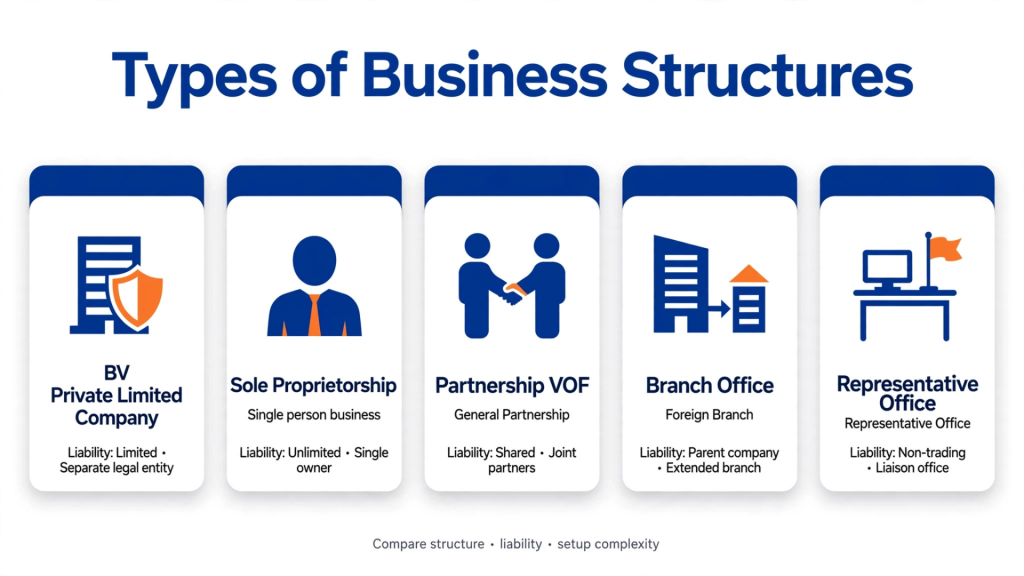
Types of Business Structures in the Netherlands
Picking the wrong structure here isn’t fatal, but it does mean redoing paperwork later so it’s worth five minutes of real thought before you register.
Dutch BV (Besloten Vennootschap) This is the private limited company, and it’s what the overwhelming majority of foreign founders choose.
It gives you limited liability if your personal assets stay separate from business debts and it’s the structure most banks, clients, and investors expect to see.
Here’s something that surprises a lot of first-time founders: there’s no minimum share capital requirement. You can technically incorporate with €0.01 of share capital.
That reform happened back in 2012, and yet plenty of guides still quote outdated capital minimums.
Sole Proprietorship (Eenmanszaak) Simple and cheap to set up, but you and the business are legally the same entity meaning you’re personally liable for everything.
It suits solo consultants and freelancers more than anyone building something they plan to scale or bring investors into.
Partnership (VOF – Vennootschap onder Firma) For two or more people running a business jointly, with shared (and again, personal) liability.
Think of it as the partnership equivalent of a sole proprietorship — straightforward, but exposed.
Public Limited Company (NV) This is built for larger operations, particularly ones planning to raise capital publicly or eventually list.
Most founders reading this guide won’t need an NV at incorporation; it’s a later-stage structure.
Branch Office If you already run a company in India (or anywhere else) and want to formally operate in the Netherlands without creating a brand-new legal entity, a branch office is your track.
The catch: your parent company remains fully liable for the branch’s obligations. There’s no legal separation like there is with a BV.
Representative Office Strictly for non-commercial activity market research, scouting the landscape before you commit.
You can’t invoice clients or actually trade under this structure. Think of it as a toe in the water, not a business.
So which one should you actually pick?
If you’re a SaaS founder, an e-commerce seller, a consultant building something with growth potential, or an investor the BV is almost always the right call.
If you already run an established company in India and just want a European presence for that same business, look at a branch office instead of forming a new BV from scratch.
And if you’re a solo freelancer just testing whether the Dutch market makes sense for you, the Eenmanszaak might be enough, provided you understand you’re personally on the hook for everything.
Requirements Before Registering a Company
Before you touch the actual registration process, get these pieces in place:
A valid passport for every director and shareholder involved
A Dutch business address : this can be your own premises, a co-working space, or a registered/virtual office provider. A PO box alone won’t be accepted.
A unique company name that doesn’t clash with existing entries in the KVK register or infringe on existing trademarks
Director and shareholder identity details.
Articles of Association (statuten) : this document has to be drafted and formally executed through a Dutch civil-law notary; you can’t skip this step for a BV
Share capital : again, no legal minimum since 2012, so this isn’t the hurdle it used to be
Tax identification details, which get generated as part of the registration process itself
Here’s the one requirement Indian founders consistently underestimate: apostille and translation requirements.
Any document you’re supplying that was issued in India, think identity documents, existing company records if you’re setting up a branch may need to be apostilled and, in some cases, officially translated into Dutch or English before the notary or KVK will accept it.
This single step is responsible for more registration delays than almost anything else in this guide. Sort it out early, not after you’ve already scheduled your notary appointment.
Step-by-Step Process to Register a Company in the Netherlands
Here’s the full process to register a company in the Netherlands, broken into ten steps from checking eligibility to opening your first bank account.
Step 1: Check your eligibility and visa situation
Confirm you understand that incorporating and getting a residence/work visa are two separate tracks.
If you eventually plan to relocate, look into the Netherlands’ self-employed or startup visa options but don’t let visa planning hold up incorporation if you don’t need to be physically present to run the business.
Step 2: Choose your business structure
Go back to the section above if you haven’t decided yet. This choice shapes everything downstream, so don’t rush it.
Step 3: Check your company name
The KVK checks your proposed name against existing registered businesses and flags conflicts. Have two or three backup names ready — a surprising number of “obvious” names are already taken.
Step 4: Arrange your Dutch business address
Decide between using your own premises, a co-working membership, or a registered office service. If you’re not planning to physically operate from the Netherlands, a registered office provider is usually the practical choice.
Step 5: Prepare your documents
Gather everything from the requirements list above. If you’re in India, start the apostille process now — it has its own timeline and you don’t want it to be the bottleneck.
Step 6: Draft and notarize the Articles of Association
This has to go through a civil-law notary — it’s not optional for a BV. Here’s the part most guides gloss over: you almost always don’t need to fly to the Netherlands for this.
Most notaries can execute the deed through a power of attorney, meaning you sign remotely and the notary handles the formal execution on your behalf.
This single fact changes the entire calculus for founders assuming they need to travel.
Step 7: Register with the KVK
You’ll also select an SBI code during this step a classification number describing what your business actually does.
Pick it carefully; banks and insurers sometimes reference it later, and a mismatched code can cause friction down the line.
For a BV, your notary can often coordinate much of this registration for you rather than you needing to show up in person.
Step 8: Get your tax and VAT (BTW) registration Good news here — this part is automatic.
Once you’re registered with the KVK, the Dutch Tax Administration is notified and issues your RSIN and VAT number without a separate application. You don’t file anything extra for this step.
Step 9: Open a corporate bank account
I’m going to be blunt about this one because most guides aren’t: traditional Dutch banks apply strict KYC checks to non-residents, and rejections are common.
This isn’t a scare tactic, it’s the reality founders run into constantly. Fintech and EMI (electronic money institution) alternatives have become the practical workaround for a lot of non-resident founders, but onboarding policies shift, so verify what’s currently accepted before you build your whole plan around one provider.
Step 10: Start operating
Set up your bookkeeping system, get your invoicing compliant with Dutch requirements, and mark your first VAT filing deadline on the calendar so it doesn’t sneak up on you.
Documents Required for Company Registration
Here’s the full checklist in one place:
- Passport copies for all directors and shareholders
- Proof of personal address
- Proof of your Dutch business address
- Articles of Association
- Shareholder register details
- Director information, plus a UBO (Ultimate Beneficial Owner) declaration
- If you’re setting up a branch office rather than a new BV: your existing Indian (or other foreign) company’s incorporation documents
- Apostille certification and, where required, certified translation for any document issued outside the Netherlands
Don’t treat the apostille step as an afterthought. It has its own processing time through the relevant authority in India, and it’s genuinely one of the most common reasons registration timelines stretch longer than founders expect.
Also Read this Blog: What is the Process to Register a Company in Europe (Greece, Poland, Netherlands & Germany)?
How Long Does Company Registration Take?
For a straightforward BV with all documents ready and apostilled in advance, you’re typically looking at days to a couple of weeks from notary execution to a live KVK number not months.
Where that timeline stretches:
Incomplete or missing apostilles/translations: the single biggest delay factor for Indian founders specifically
Name conflicts requiring you to pick a new company name mid-process
Notary scheduling backlogs, especially during busier periods
Bank account approval, which is honestly the real bottleneck more often than the KVK registration itself your company can be legally registered and still be waiting weeks for a working bank account
If someone tells you registration “takes X days” without qualifying it, treat that as the best-case scenario, not the guaranteed one.
Taxes After Registering a Dutch Company
Corporate Income Tax (CIT)
19% on the first €200,000 of annual profit, 25.8% above that threshold. These brackets are unchanged from 2025 into 2026, so if you’ve seen older figures like 15% up to €395,000 floating around, that’s stale data from 2022 — not current.
VAT (BTW)
The Netherlands runs standard, reduced, and zero VAT rates depending on what you’re selling.
If you’re an e-commerce seller shipping into multiple EU countries — say, an Amazon or Shopify store based in the Netherlands but selling across France, Germany, and beyond — look specifically into the EU’s One-Stop-Shop (OSS) VAT scheme.
It lets you report EU-wide VAT through a single return instead of registering separately in every country you sell into.
Payroll Tax
Once you hire staff, wage tax and social security contributions kick in. This doesn’t apply to a solo-founder BV with no employees, but plan for it the moment you’re bringing on your first
Annual Compliance Requirements
Registering the company is the beginning, not the finish line. Every year, you’re on the hook for:
Annual accounts filed with the KVK.
Corporate income tax return.
VAT filings, on a frequency tied to your turnover and registration type.
Payroll obligations, if you have employees.
UBO register updates whenever ownership structure changes.
Record-keeping, with a statutory minimum retention period for financial records.
None of this is unusual by European standards, but it does mean budgeting for ongoing accounting support, not just the one-time registration cost.
Benefits of Registering a Dutch BV
Pulling this together, here’s what you actually gain:
Limited liability — your personal assets are protected from business debts
Credibility — EU clients, suppliers, and marketplaces (this matters a lot if you’re selling on Amazon.de or Amazon.fr) tend to trust a Dutch-registered entity more readily than an offshore one
Direct EU market access from a single incorporation
Smoother B2B banking and payments within the EU once your account is set up
An investor-friendly structure — if you’re a startup planning to raise from VCs, a Dutch BV is a format investors already understand
Legitimate tax planning room, including treaty access if you’re structured correctly from the start
Common Mistakes to Avoid
A quick list of the errors I see repeatedly:
Forming a new BV when a branch office would fit better — if you already run an established Indian company and just want a European presence for that same business, a branch is usually simpler.
Confusing incorporation with residency — registering a company doesn’t grant you a visa or the right to live in the Netherlands.
Using an address that won’t hold up — a PO box or an unverifiable address will get flagged during registration.
Delaying VAT/OSS registration if you’re an e-commerce seller this catches up with you fast once you’re shipping across multiple EU countries.
Structuring ownership after incorporation instead of before, which can cost you the reduced DTAA dividend rate entirely.
Skipping apostille and translation prep this is the single most common cause of registration delays for Indian applicants.
Assuming a Dutch bank account will be quick — budget real time for this, and have a fintech alternative in your back pocket in case a traditional bank declines you.
Why Choose Vorx Consultancy?
If everything above sounds manageable but you’d rather not personally coordinate a notary, the KVK, the Dutch tax office, and a bank across two time zones, that’s exactly the gap we fill.
Vorx Consultancy handles end-to-end company registration, including full remote incorporation support for Indian and other non-resident founders who never need to set foot in the Netherlands.
We help navigate the banking friction described above, including fintech alternatives when traditional banks aren’t the right fit.
And because we work with founders from SaaS, e-commerce, and investment backgrounds specifically, we can advise on DTAA structuring and compliance from day one not retrofit it after you’ve already incorporated the wrong way.
If you’re ready to register a company in the Netherlands the right way the first time, get in touch we’ll walk you through exactly what your specific situation needs.
