


If you’ve been researching Malta company formation, you’ve probably noticed something frustrating.
Most articles either read like a Malta government FAQ, copy-pasted with “Indian entrepreneurs” sprinkled in for keywords, or they’re written by Malta-based agents who have no idea what FEMA, ODI, or RBI even stand for.
That’s the gap this guide fills.
We’re not just going to tell you how to register a company in Malta. We’re going to walk through what actually happens on the India side too because that’s usually where Indian founders get stuck, not in Malta.
A friend of mine runs a small SaaS product out of Bangalore. Two years ago, he wanted to set up a Malta entity to sell into the EU market without the headache of VAT registration in every individual country.
He got his Malta company registered in about three weeks with no issues at all. Then he spent the next four months untangling FEMA reporting because nobody had told him an Indian company investing abroad needs to file Form ODI within a specific window. That’s the kind of thing this guide is meant to prevent.
Let’s get into it.
Why Should Indian Entrepreneurs Consider Malta for Company Formation?
Malta isn’t the obvious first choice when Indian founders think “Europe.” Ireland and the Netherlands usually get more attention. But Malta has a few things going for it that make it worth a serious look.
English is an official language of Malta. That alone removes a huge amount of friction from your incorporation documents, your bank paperwork, your contracts with local service providers, none of it needs translation.
If you’ve ever dealt with a German or French notary who insists on local-language documentation, you’ll appreciate how much time this saves.
Malta’s legal system also draws heavily from English common law principles, layered with civil law influences from its history. For Indian entrepreneurs used to a common-law-adjacent legal framework at home, Malta feels less foreign than, say, incorporating in Luxembourg.
As an EU member state, a Malta company gives you access to the EU single market. If you’re building a SaaS product, running an e-commerce operation, or offering consulting services, this matters more than it sounds. A single EU entity can, in many cases, serve customers across member states without setting up shop in each country individually.
Malta has also built out real infrastructure for specific sectors iGaming, fintech, blockchain, and financial services in particular with regulatory bodies that are used to dealing with international founders. This isn’t a jurisdiction that’s figuring things out as it goes.
We’ll get into how Malta’s tax system actually works a little further down, because it deserves proper explanation rather than a one-line teaser here.
Can Indians Legally Own and Register a Company in Malta?
Yes, and this is worth stating plainly because a lot of people assume there’s some restriction that doesn’t exist.
Malta allows 100% foreign ownership of a company. You don’t need a Maltese co-founder, a local shareholder, or a Maltese majority on your board.
Indian nationals can be directors and shareholders of a Malta company with no nationality-based restriction.
What you will encounter is standard EU-level KYC and anti-money-laundering screening this applies to everyone, not just Indians, but expect your documentation to be scrutinized more closely than it might be for an EU citizen, simply because you’re coming from outside the bloc.
Here’s the part that actually matters more than the “can I” question: how you invest determines which Indian regulatory framework applies to you.
If an Indian company, LLP, or registered partnership is the one investing in the Malta entity, you’re in ODI (Overseas Direct Investment) territory. This is governed by RBI’s Foreign Exchange Management (Overseas Investment) Rules.
If an individual : you personally, as a resident Indian, is investing directly and holding shares in the Malta company in your own name, you’re operating under LRS (Liberalised Remittance Scheme), a completely different framework with its own limits and reporting requirements.
Which Malta Company Structure Is Right for an Indian Entrepreneur?
For the vast majority of Indian founders, the answer is a Private Limited Company (Ltd) — Malta’s equivalent of a private limited company back home.
It offers limited liability, a familiar governance structure, and it’s the entity type Malta’s own corporate service providers are most equipped to set up quickly.
There are a couple of alternative structures worth knowing about, even if they’re not the right fit for most people:
Branch of an Indian company : Instead of creating a new legal entity, you register your existing Indian company as operating through a Malta branch.
This sounds simpler on paper, but it isn’t. A branch doesn’t get the same liability separation a subsidiary does, and it ties your Malta operations’ legal standing directly to your Indian company’s standing. Most founders steer away from this unless there’s a very specific reason for it.
Subsidiary structure : A new Malta Ltd company owned by your Indian parent company. This is what most people mean when they say “set up a Malta company,” and it’s what the rest of this guide focuses on. It keeps liabilities ring-fenced and gives you a clean, standalone EU entity.
Holding company structures : If you’re running multiple businesses or plan to expand across several EU countries eventually, some Indian groups set up a Malta holding company that then owns operating subsidiaries elsewhere in the EU. This is more advanced and usually only makes sense once you’re past the “just getting started” stage.
One honest note before we move on: if your business has no genuine operations tied to the EU, no EU customers, no EU team, nothing beyond a company on paper a Malta entity may not be the right move at all. We’ll explain exactly why when we get to economic substance later in this guide, because it’s a real risk, not a technicality.
What Are Malta's Company Formation Requirements?
Malta keeps its formation requirements fairly lean compared to some EU jurisdictions, but there are a few non-negotiables:
At least one director and one shareholder : these can be the same person, and both can be non-residents, including Indian nationals.
A registered office address in Malta : this is a legal requirement, not optional. Your company needs a physical Maltese address for official correspondence.
A company secretary : Malta requires this role to be filled, and many founders use their corporate service provider’s staff for this rather than hiring someone dedicated.
Minimum share capital : a nominal amount must be allotted, with a portion typically required to be paid up at incorporation.
Here’s something worth flagging early rather than burying it: your registered office cannot just be a mailbox that forwards letters once a month.
If Malta or Indian tax authorities ever look closely at whether your company has genuine economic substance, an empty-shell registered address works against you.
We’ll come back to this properly in the substance section, but keep it in mind as you’re setting things up it affects decisions you make now, not just later.
What Documents Do Indian Entrepreneurs Need for Malta Company Registration?
Here’s what you’ll typically need to have ready. Some of this needs notarization or apostille certification from India before it’s accepted in Malta, so build in time for this it’s rarely instant.
Passport copies of all directors and shareholders
Proof of address (utility bill, bank statement) for each director and shareholder, usually not older than three months
Memorandum and Articles of Association (M&A) : the foundational document setting out the company’s purpose, share structure, and governance rules
UBO (Ultimate Beneficial Owner) declaration: Malta maintains a UBO register and enforces it strictly. If your ownership structure has multiple layers (say, an Indian holding company that’s itself owned by individuals), you’ll need to disclose the full chain up to the actual human beings who ultimately control it.
Proof of source of funds : this is one document Indian applicants should not underestimate. Malta banks and corporate service providers will want evidence of where your share capital and investment funds are coming from. Keep this documentation clean and ready, because it resurfaces later in both the banking process and your FEMA/ODI filing.
Business plan or activity description : not always mandatory for registration itself, but often requested by whichever corporate service provider you’re working with, and almost always requested by your bank later.
A quick, practical tip: get your source-of-funds documentation organized before you start the registration process, not after. It’s the single most common thing that causes delays for Indian applicants down the line, particularly during banking.
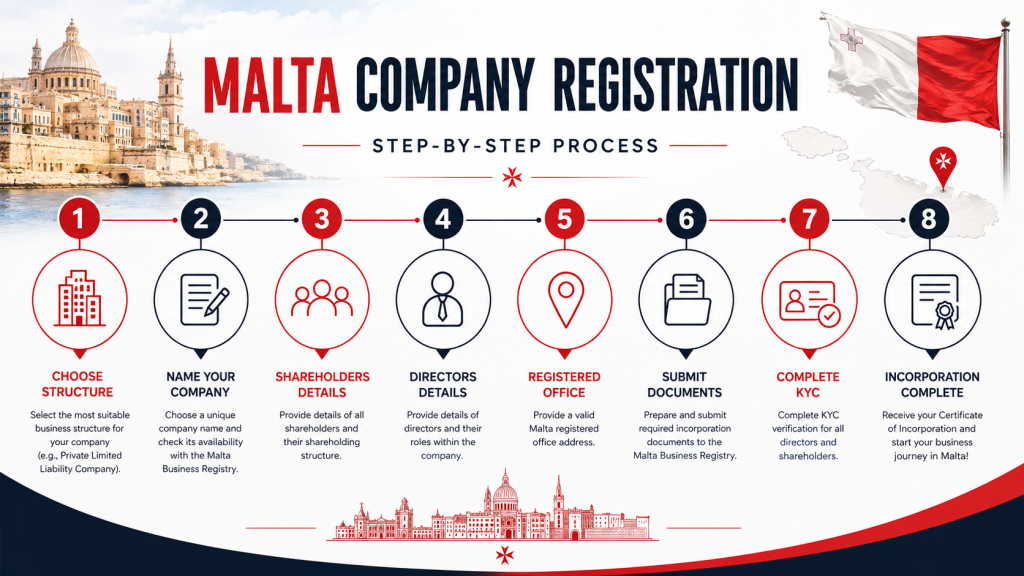
How to Register a Company in Malta from India? (Step-by-Step Process)
Here’s the actual sequence, start to finish.
Step 1: Choose your structure. Decide between a subsidiary, branch, or holding structure based on what we covered above. For most founders, this means confirming a straightforward Ltd subsidiary.
Step 2: Reserve your company name. Submit your preferred name to the Malta Business Registry for approval. Have two or three backups ready in case your first choice is taken or rejected for being too similar to an existing entity.
Step 3: Decide your shareholding structure. Map out who owns what percentage, and confirm whether the shareholder is your Indian company (ODI route) or you personally (LRS route).
Step 4: Appoint directors and a company secretary. Confirm who will serve in these roles and gather their documentation.
Step 5: Arrange your registered office. Most Indian founders use a local corporate service provider’s address to start, then transition to a genuine operational address as the business grows; this ties back to the substance point above.
Step 6: Prepare the Memorandum and Articles of Association. Your corporate service provider typically drafts this based on your inputs regarding share structure, business purpose, and governance.
Step 7: Complete KYC and UBO documentation. Submit all identity, address and beneficial ownership documents.
Step 8: Arrange your share capital. Ensure the required portion of share capital is available and can be transferred in accordance with Malta’s requirements and in line with whichever Indian regulatory route (ODI or LRS) governs your investment.
Step 9: Submit your incorporation application to the Malta Business Registry.
Step 10: Receive your Certificate of Incorporation. Once approved, your company legally exists.
Step 11: Complete tax and VAT registrations. Register with the Malta Commissioner for Revenue for corporate tax purposes and for VAT if your business activity requires it.
Step 12: Open your corporate bank account. We’ve dedicated a full section to this below because it deserves more than a bullet point; it’s often the slowest part of the entire process for Indian founders.
Step 13: Set up ongoing compliance systems. Annual returns, audited accounts, and critically for Indian founders your India-side FEMA reporting obligations, which start the moment your investment is made, not after the company is fully operational.
Ready to Set Up Your Malta Company?
Get expert support for company formation, banking, tax, and India-side compliance.
What Taxes Apply to a Malta Company?
Malta’s tax system works differently from what most Indian founders expect, and understanding the mechanism not just the headline reputation matters.
Malta applies what’s known as a full imputation system. In simple terms, the company pays corporate tax on its profits first. When those profits are distributed as dividends to shareholders, the shareholders can claim a refund of a portion of the tax the company already paid, because the system is designed to avoid taxing the same profit twice once at the company level and again at the shareholder level.
This is genuinely useful for internationally structured businesses, but it’s also the single most misunderstood part of Malta company formation, particularly by people writing generic guides.
It’s not a “low tax country” in the simplistic sense; some content implies it’s a specific refund mechanism tied to how and when profits are distributed.
Now, here’s what almost no Malta-focused article for Indian founders actually addresses:
The India-Malta Double Taxation Avoidance Agreement (DTAA). India and Malta have a tax treaty specifically designed to prevent the same income from being taxed twice, once in Malta and again when it reaches you in India.
If you’re planning to eventually bring profits back to India as a shareholder or founder, the DTAA is what determines how that repatriated income gets treated on the Indian side.
Ignore this, and you risk either overpaying tax through missed treaty relief, or under-reporting income and creating a compliance problem for yourself.
POEM — Place of Effective Management. This is the risk that genuinely deserves more attention than it gets in most content on this topic.
Indian tax law allows authorities to determine that a foreign company is actually “resident” in India for tax purposes if the company’s effective management and control happen from India regardless of where it’s incorporated.
Here’s what that means practically: if a Malta company is incorporated abroad but all key business decisions are made by its director from India, Indian tax authorities may consider its Place of Effective Management (POEM) to be in India. This can create Indian tax residency and additional tax obligations.
What FEMA and ODI Rules Apply to Indian Entrepreneurs?
This is where a lot of Malta company formation guides simply stop being useful, because they’re written by people who’ve never had to deal with Indian regulatory reporting. Let’s actually walk through it.
First, go back to the distinction we made earlier: are you investing as an Indian company/LLP/partnership, or as an individual?
If it’s a corporate entity investing (ODI route):
Most overseas direct investment is permitted under the Automatic Route, meaning you don’t need prior RBI approval provided you meet the conditions.
These generally include staying within sector eligibility (your business activity isn’t in a restricted category), maintaining a clean compliance history (no wilful defaulter status, no ongoing investigations), and keeping your total financial commitment within permitted limits.
That last point matters a lot: your total financial commitment, equity, loans, and guarantees combined cannot exceed 400% of your Indian entity’s net worth, based on your last audited balance sheet.
This caps how large an investment your Indian company can make into the Malta entity, and it’s a number founders frequently don’t check before they start the process.
Once your investment is made, you’ll need to file Form ODI, which comes in two parts. Part I covers reporting the initial investment. Part II covers subsequent reporting requirements as your investment continues — this isn’t a one-time filing, it’s an ongoing obligation. Both are filed through an Authorised Dealer (AD) Category I bank, which is why your relationship with your bank matters well beyond just moving money.
If it’s an individual investing (LRS route):
If you personally hold shares in the Malta company rather than investing through an Indian company, you’re working within the Liberalised Remittance Scheme framework instead, which has its own separate reporting requirements and remittance conditions distinct from ODI. Don’t assume ODI rules apply to you if you’re investing as an individual — the compliance paperwork, limits, and reporting cadence are genuinely different.
Whichever route applies to you, the underlying theme is the same: this isn’t a “file it once and forget it” process. FEMA compliance for outbound investment is an ongoing relationship with your AD bank, not a box you tick during incorporation.
How Can an Indian Entrepreneur Open a Malta Corporate Bank Account?
Let’s be honest about this part, because most guides gloss over it and it’s genuinely the slowest step for Indian founders.
EU banks apply enhanced due diligence to applicants from outside the bloc, and Indian-owned entities are no exception.
This isn’t discrimination specific to India, it’s standard practice for any non-EU beneficial owner but it does mean you should not expect the same turnaround time an EU-resident founder might get.
Banks will typically want to see the documentation we discussed earlier UBO declarations, proof of source of funds, a clear business plan, and often evidence of your company’s genuine operational purpose (tying back, again, to substance). If your paperwork is scattered or incomplete, expect delays measured in weeks, not days.
Given this friction, many Indian founders don’t rely solely on traditional banks. Electronic Money Institutions (EMIs) regulated fintech alternatives to traditional banks that can hold and process business funds have become a common parallel path.
They’re often faster to onboard with and more accustomed to dealing with international founders, though they come with their own considerations around what services they offer compared to a full banking relationship.
A practical approach: start your bank application in parallel with your incorporation process rather than waiting until after your Certificate of Incorporation arrives.
It rarely speeds things up dramatically, but it prevents your company from sitting idle, fully incorporated but unable to actually transact, for weeks longer than necessary.
How Vorx Consultancy Can Help
Setting up a Malta company from India involves more than incorporation. You also need to manage FEMA/ODI or LRS compliance, banking, tax, and ongoing reporting across both jurisdictions.
Vorx Consultancy brings these processes together from company formation, entity structuring, and registered office setup in Malta to ODI/LRS guidance, banking support, and ongoing compliance in India.
This connected approach helps keep your documentation, tax position, and compliance requirements aligned from day one.
Ready to Set Up Your Malta Company?
Get expert support for Malta company formation, banking, tax, and India-side ODI/LRS compliance.
Conclusion
Malta’s own registration process is genuinely the easy part: a name reservation, some documentation, a few weeks, and you have a Certificate of Incorporation.
The real complexity lies in everything running quietly in parallel back in India: knowing whether ODI or LRS applies to you, staying within the 400% net worth cap, filing Form ODI on time, and remembering the Annual Performance Report every single year, active company or not.
None of this is a reason to avoid Malta if it genuinely fits your business for SaaS, e-commerce, consulting, and fintech founders selling into the EU, it remains one of the more practical bases available.
It’s simply a reason to go in with both sides of the process mapped out from day one, rather than discovering the India-side obligations four months after your Malta company is already up and running.
Get the ODI/LRS classification right, build real substance into your Malta entity from the start, and treat your compliance calendar as one connected system rather than two separate checklists and a Malta company from India stops being a compliance risk and becomes exactly what it should be: a clean, working EU base for your business.