


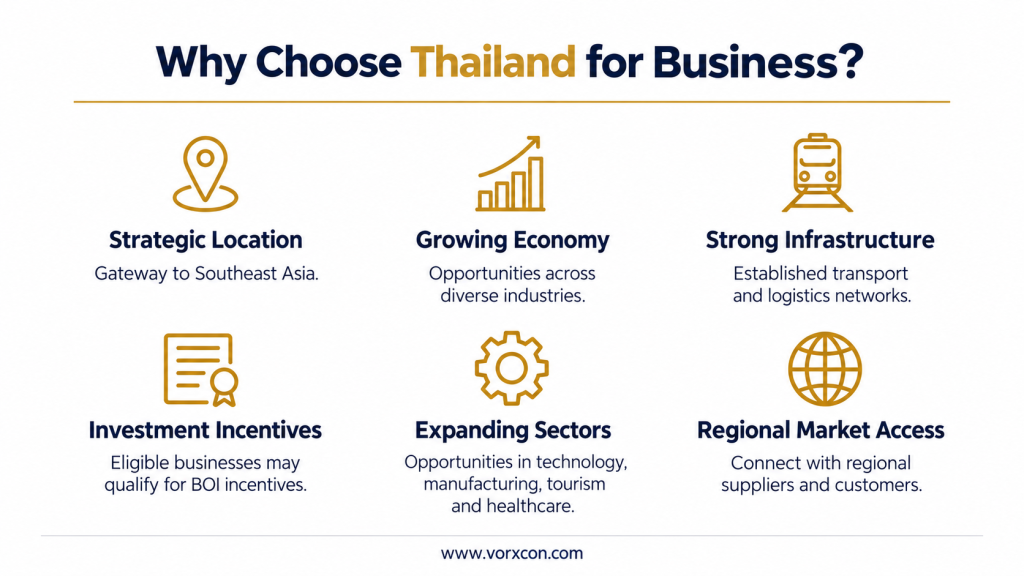
Thailand has become a new destination for businesses, offering strategic location, well-established manufacturing capabilities, thriving tourism and proximity to other markets that makes it a good place to consider for entrepreneurs who want to establish their presence in South East Asia. That said, venturing into business in Thailand includes more to it than simply incorporating a company in the country. Foreign investors should consider Thailand’s ownership restriction laws, licensing requirements, work permits and tax obligations before making the move.
Familiarising yourself with these aspects will enable you to determine the most appropriate structure for your business and help you avoid complications down the line.
Explore Vorx Consultancy’s services to discuss your Thailand business setup requirements.
What Are Thailand’s Foreign Ownership Rules?
The Foreign Business Act B.E. 2542 (1999) regulates the foreign ownership in Thailand. Depending on the type of business activity, foreign-owned enterprises may be required to obtain a Foreign Business Licence, Foreign Business Certificate or other necessary permits before engaging in any business activities.
A company is not necessarily restricted to a 49% foreign ownership in Thailand, as the restrictions depend on the business activity category and whether alternative investment incentives apply. Before establishing your company, you should determine the following:
- Whether the activity you wish to pursue is subject to restrictions.
- Whether you are eligible for a Foreign Business Licence, Certificate or other investment promotion.
- Whether the ownership structure you are considering is lawful.
- Whether there are additional approvals or authorisations needed for the activity in question.
Having local shareholders in order to conceal foreign ownership is likely to cause more harm than good, as it creates the risk of violating ownership restrictions. The company’s organisational structure needs to reflect the legal relationship between the company and its shareholders. The Department of Business Development (DBD) offers guidance on Thailand’s foreign business permissions and requirements.
Do Foreign Entrepreneurs Need Work Permits in Thailand?
Purchasing shares in a company and working for the company are effectively two different things. As a foreigner, you can own a company in Thailand without a work permit, but you may not be able to perform work for the company if you do not have the appropriate visa and work permit.
Foreign nationals are generally required to apply for the correct visa and work permit before engaging in gainful work in Thailand, depending on their circumstances and there are a number of exemptions and special considerations that could apply. Work permits can be issued under various types of visa depending on one’s position, company eligibility, investment level and more. Please take the time to familiarise yourself with Thailand’s rules and regulations regarding work permits. The Thailand Board of Investment’s work permit guidelines offer additional information.
Explore Vorx Consultancy’s services to discuss your Thailand business setup requirements.
Which Business Structure Should You Choose?
The best business structure in Thailand depends on your ownership plans, activities and operational needs.
Structure | When it may be suitable |
Private limited company | Businesses seeking a separate legal entity for local operations and growth |
Branch office | An overseas company conducting permitted business activities directly in Thailand |
Representative office | An overseas company undertaking permitted non-revenue-generating support activities |
Partnership | Businesses whose owners prefer a partnership arrangement, subject to the applicable liability and ownership rules |
A private limited company is a common choice for establishing a separate Thai legal entity. However, foreign ownership restrictions and licensing requirements must be checked before deciding on the structure.
Recommended Reading:
Choosing the right business structure is an important step in international expansion. Read our guide on sole proprietorship vs private limited company abroad to understand the differences in ownership, liability, taxation and compliance.
How to Register a Company in Thailand?
The Thailand company registration process generally involves the following steps:
- Select and reserve a company name: Check availability through the DBD’s name-reservation system.
- Determine ownership and capital: Identify shareholders, directors, registered capital and the proposed business activities.
- Prepare incorporation documents: Complete the required constitutional and registration documents.
- Submit the registration application: File the application with the relevant DBD office or through the applicable electronic registration system.
- Complete post-registration formalities: Address tax registration, VAT where applicable, employer registration, licences and banking requirements.
Foreign-owned businesses may need additional documents or approvals. Registration alone does not authorise a company to undertake every business activity.
What Documents Are Required?
The documents required to register a company in Thailand depend on its structure, ownership and activities. Common requirements include:
- Proposed company name and business objectives.
- Details and identification documents of shareholders and directors.
- Memorandum of Association and relevant incorporation documents.
- Registered office address and supporting address documents.
- Details of share capital and share allocation.
- Foreign shareholder or parent-company documents, where applicable.
- Additional licences, declarations or approvals for regulated activities.
Documents issued overseas may require translation, certification or other formalities. Confirm the requirements with the relevant authority before submission.
What Is the Cost of Setting Up a Company in Thailand?
The cost of setting up a company in Thailand depends on its business structure, registered capital, ownership arrangements and licensing requirements. Foreign entrepreneurs should consider both the initial incorporation expenses and the costs of maintaining the business after registration. Key expenses may include:
- Government registration fees: Charges for company incorporation and required filings.
- Legal and professional fees: Costs for preparing documents, structuring ownership and obtaining professional assistance.
- Office and administrative expenses: Registered office arrangements, rent and other initial operating costs.
- Licences and permits: Additional expenses for regulated activities or foreign business permissions.
Explore Vorx Consultancy’s services to discuss your Thailand business setup requirements.
How Long Does Company Registration Take in Thailand?
The timeline for setting up a business in Thailand depends on document readiness, ownership structure and whether additional approvals are required.
Registration Stage | Estimated Timeline |
Company Name Reservation | 1–3 working days |
Preparation of Company Documents | 2–5 working days |
Company Registration with DBD | 1–3 working days, once documents are complete |
Tax Registration | 1–3 working days, depending on the application |
VAT Registration, if applicable | 3–7 working days |
Corporate Bank Account Opening | 1–3 weeks, depending on bank checks |
Foreign Business Licence (if required) | Up to 60 days after submission, with additional time possible for preliminary checks |
BOI Investment Promotion (if applicable) | 40–90 working days, depending on investment size |
What Are Thailand’s Tax and Compliance Rules?
Tax obligations and general compliance requirements are essential considerations when setting up operations overseas. Here are a few matters to consider:
Company tax: A company’s profits are subject to taxation at 20% (after allowable deductions). Various exemptions and incentives can apply depending on your situation.
Value-added tax (VAT) – Businesses with annual turnover above the threshold of THB 1.8 million typically need to be VAT registered, unless exemption applies. There are other taxes that apply to your business activity of choice such as customs duties.
Bookkeeping and financial reporting: Accounting records must be kept and financial reporting must be done in accordance with applicable reporting standards and regulations. Audit requirements may apply depending on the scope and size of the business.
Filing and reporting: Filing company tax returns along with other reports to the Revenue Department within the stipulated deadlines.
Payroll tax and social security tax: These apply if you are planning to employ people.business must consider labour laws, social security laws.
Recommended Reading:
To prepare for international expansion, review this compliance checklist before registering a company abroad and understand the legal, tax and documentation requirements that should be considered before incorporation.
How Can Vorx Help with Company Formation?
Taking on a business overseas is a comprehensive process involving aspects of incorporation, ownership structure, documentation and ongoing compliance. Vorx Consultancy can help foreign entrepreneurs identify key considerations and requirements pertinent to the specific jurisdiction of their choice and help them set up their company and prepare other necessary documents.
They can help walk you through the considerations and requirements from the outset – spanning across everything from identifying the appropriate business structure for your plans to understanding documentation and banking requirements to preparing for tax and other compliance obligations.
Planning to expand your business into Thailand? Connect with Vorx Consultancy For Expert Advice.
Book a Strategy Call: (Calendly Link)
Visit: www.vorxcon.com
Email: support@vorxcon.com
Final Thoughts
While Thailand is a great place to consider as a base for your South East Asia enterprise, there are important considerations to bear in mind before making the move. You should determine the most appropriate structure for your enterprise based on the foreign ownership laws and ensure that you understand the work authorisation rules pertaining to you as well as the costs and ongoing compliance requirements applicable to your company. With the right considerations in mind and the help of the right experts, you will be able to make more informed decisions about your venture in Thailand.