
Establishing a company in Singapore may be exciting, but foreign founders are often surprised that maintaining it in good standing requires more than simply incorporating their business. Although the country’s regulatory environment is designed to promote a pro-business approach, all companies incorporated in Singapore must follow specific statutory requirements. At the same time, the main purpose of mandatory Singapore Company Annual Compliance is to facilitate the government in ensuring that firms are operating legitimately and transparently while being able to monitor the national economy effectively. Another critical aspect of annual compliance is that it serves as an indicator of whether a company is credible enough to raise capital in the local market, perform international trade, and engage with financial organizations.
Therefore, Indian entrepreneurs, overseas investors, and start-up founders should understand the essential details about the process to ensure nothing goes wrong and prevent their companies from delisting.
The following guide will discuss the key elements of the Singapore Company Annual Compliance in detail and provide an overview of the required procedures and deadlines
Why Annual Compliance Matters in Singapore?
Singapore is one of the easiest countries to do business in, as its regulatory environment is highly efficient, transparent, and reliable. but it is essential to remember that any regulatory simplicity and transparency are linked to the corresponding responsibilities that companies must fulfill in a timely manner.
Thus, compliance shows that a company is operational, has ongoing accounting, and is therefore legally compliant with Singapore law. In addition, compliance helps to maintain the company’s reputation in front of banks, investors, partners, and official authorities. The neglect of compliance obligations may lead to adverse consequences for the company, ranging from increased scrutiny and loss of reputation to heavy fines.
For businesses planning international expansion or raising capital, a clean compliance history often becomes an important due diligence factor.
Recommended Reading:
Planning to relocate while setting up your business? Read our Singapore EntrePass Guide to understand the eligibility criteria, application process, and how the EntrePass fits into your overall business expansion strategy.
What Does Singapore Company Annual Compliance Include?
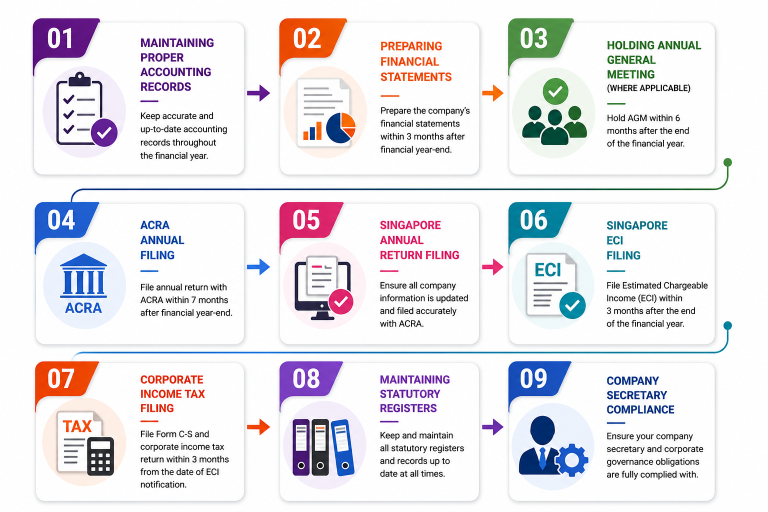
The annual compliance framework consists of several interconnected legal, accounting, and tax responsibilities. Rather than treating each filing independently, businesses should view them as parts of one structured compliance cycle. The primary areas include:
- Maintaining proper accounting records
- Preparing financial statements
- Holding Annual General Meeting (where applicable)
- ACRA annual filing
- Singapore annual return filing
- Singapore ECI filing
- Corporate income tax filing
- Maintaining statutory registers
- Company secretary compliance
Each requirement has its own timeline and legal significance, making advance planning essential.
Maintaining Accurate Accounting Records:
Every company in Singapore is obliged by law to maintain proper accounting records that must be available for inspection at all times during the financial year. This is a crucial step that should be taken seriously since these records are the basis for any subsequent tax or compliance procedures. Bookkeeping normally consists of maintaining income, expenditure, invoice, payroll, banking, contract, and all other relevant financial records.
Deferment of bookkeeping to the time of filing leads to increased complexity and cost of one’s tax and compliance matters.
Besides, financial records that are prepared on the basis of incomplete data may contain inaccuracies, which may cause filing delays and complications during an audit or similar procedures.
Vorx Pro Tip:
Many founders focus only on incorporation. Long-term success depends on building a compliance calendar immediately after registration.
Understanding ACRA Annual Filing Requirements:
One of the vital aspects of Singapore Company Annual Compliance is the ACRA’s Annual Filing. In particular, the Accounting and Corporate Regulatory Authority (ACRA) requires that companies file an Annual Return, which includes the basic information about the company’s status.
This data enables ACRA to ensure that the companies in Singapore operate according to the corporate law. Depending on the companies’ structures, financial reporting requirements, and whether an entity is exempt from providing financial statements, additional information may also need to be provided.
Businesses must be aware that any late filings may incur penalties from ACRA, which grow exponentially the longer the delinquency period is. Thus, it is crucial to avoid such unwanted expenses.
Holding Annual General Meeting (where applicable):
For most Singapore companies, an Annual General Meeting (AGM) is an integral part of their annual compliance cycle. This is because an AGM offers directors of the company the opportunity to report the company’s financial progress to the shareholders and also provides them a forum to discuss other matters of importance regarding the company. However, it is important for business owners to note that certain private companies are permitted to have the exemption of holding an AGM on a yearly basis
Although, it must be noted that the applicability of such an exemption must be considered in detail before taking any decision.
Singapore Annual Return Filing Explained:
Many new founders confuse financial reporting with Singapore annual return filing, but they serve different regulatory purposes. The Annual Return updates ACRA regarding the company’s current corporate information, while financial statements provide details of its financial performance. Although both processes are closely connected, they are not interchangeable, and completing one does not automatically satisfy the other.
Preparing financial statements early allows businesses to complete annual return submissions without unnecessary delays.
Singapore ECI Filing Requirements:
Another significant type of compliance is associated with Singapore ECI filing, which stands for Estimated Chargeable Income. This term refers to a company’s provision of an approximate estimation of its chargeable income to the Inland Revenue Authority of Singapore (IRAS).
Not every company is required to file ECI under all circumstances, as certain qualifying businesses may receive exemptions. However, eligibility should always be assessed carefully rather than assumed.
Incorrectly assuming an exemption can create avoidable tax compliance issues that become more complicated to resolve later.
Corporate Tax Filing Requirements:
Along with ECI, businesses must also deal with their corporate income tax liabilities. In general, Singapore’s corporate tax compliance includes the preparation of financial information, computation of taxable income, identification of available deductions, and submission of tax returns to IRAS. Thorough bookkeeping throughout the year can help simplify the process and reduce errors.
Firms dealing with multinational activities, foreign shareholders, transfer pricing, or diverse revenue streams require special care and expertise when finalizing their tax filings and computations.
Vorx Pro Tip:
Tax filings should never begin at year-end. Good compliance starts with accurate monthly bookkeeping and document management.
Company Secretary and Statutory Registers:
Every Singapore private limited company is obliged to appoint a qualified company secretary and ensure that statutory registers are updated on a timely basis. Statutory registers contain information on directors, shareholders, beneficial ownership, and other matters. Whenever changes take place, they should be updated as soon as possible instead of leaving them to annual filing.
The reason is that statutory updates should not be left till the last minute as it creates compliance risks and inconsistencies with other filings.
Financial Statements and Audit Considerations:
The financial statements are very important for every company because they support tax reporting, regulatory filings, and business decision-making.
The companies may be exempt from an audit depending on the particular set of circumstances, whereas others are subject to a mandatory audit. In addition, business owners should be cautious not to assume that all privately held companies are entitled to audit exemptions from either the IRS or the SEC.
there are specific criteria for each of these designations, but it is often hard to say without a professional evaluation, so both these options should be considered for any uncertain cases.
Common Compliance Mistakes Founders Make:
International entrepreneurs frequently encounter compliance challenges because they assume Singapore’s regulatory system operates similarly to their home jurisdiction. International entrepreneurs frequently encounter compliance challenges because they think the rules and regulations are similar to what they are used to in their home jurisdiction. Some of the most common mistakes include:
- Missing statutory filing deadlines
- Postponing bookkeeping until year-end
- Confusing tax filings with annual returns
- Assuming ECI filing is always exempt
- Forgetting to update statutory registers
- Ignoring company secretary responsibilities
These issues are generally preventable through structured planning and regular compliance reviews.
Building an Effective Annual Compliance Calendar:
Rather than reacting to approaching deadlines, successful businesses create an internal compliance calendar covering the entire financial year. A well-planned calendar usually incorporates accounting reviews, financial statement preparations, tax planning meetings, statutory filing due dates and internal documentation audits
This approach enables organizations to avoid the stress associated with last-minute filings while enhancing reporting accuracy and overall efficiency
Companies that embrace compliance management as a continuous process rather than a year-end ritual record fewer regulatory challenges than others.
Recommended Reading:
Before planning your compliance budget, explore our Cost of Company Registration in Singapore (Full Breakdown 2026) guide to understand the key setup expenses and ongoing business obligations.
How Vorx Consultancy Can Help?
Navigating Singapore Company Annual Compliance can prove challenging for overseas founders, particularly for those juggling their business while on the other side of the world. At Vorx Consultancy, we assist businesses with bookkeeping, ACRA annual filing, Singapore annual return, Singapore ECI filing, corporate secretarial requirements, and other compliance-related matters to ensure that the business remains compliant.
By having the right compliance partner on board, you can dedicate your time and effort towards growing the business rather than keep track of the compliance requirements.
Final Thoughts:
While Singapore remains one of the easiest places in the world to do business, this reputation is earned through years of strict compliance with regulations. All companies, regardless of their size, need to keep in mind that the annual reports are just a small part of ongoing obligations. Preparing accurate accounts, timely filing of ACRA annual return, correct submission of Singapore annual return, proper ECI filing in Singapore, and tax compliance are some of the activities that would help any organization maintain its status and competitive advantage.
Therefore, serious entrepreneurs that want to keep their business running smoothly and avoid double-checking everything by official auditors should include compliance management in their annual planning. By doing so, they would not only meet the requirements set by government agencies and other official organizations but also improve the overall performance of their business, ensure its stability, and remain successful in local and international markets.
