
Spain has quietly become one of the more approachable EU markets for Indian entrepreneurs looking to expand westward.
It offers direct access to the EU single market, a large domestic consumer base, and a startup ecosystem that has grown fast in cities like Madrid, Barcelona, and Valencia. For an Indian founder, though,approachable doesn’t mean simple.
Company formation in Spain runs on its own legal logic, and layered on top of that is a second, less-discussed set of rules back home in India that determine whether you can even move money to fund the company in the first place.
This guide walks through both sides of that equation. We’ll cover the Spain company formation requirements for 2026, the structures available, the paperwork, and the parts of the process that catch Indian founders off guard including the RBI compliance most articles on this topic never mention.
Planning to Set Up a Company in Spain?
Get expert guidance on Spain company formation, documentation, RBI compliance and funding routes from India.
Talk to Vorx Consultancy
What Does Company Formation in Spain Actually Involve?
At its core, forming a company in Spain means choosing a legal structure, registering it with the Spanish Mercantile Registry, obtaining tax identification for the business and its owners, and setting up the banking and compliance infrastructure to operate legally.
That’s the Spain-side process, and it’s fairly well documented.
What’s less well documented is the India-side process running in parallel getting your documents apostilled, working out whether your remittance falls under RBI’s Liberalised Remittance Scheme or the Overseas Direct Investment route, and understanding what the India-Spain tax treaty means for how profits eventually flow back to you.
Skipping this half of the picture is where a lot of otherwise well-planned incorporations run into trouble later.
Vorx Consultancy Insight: We’ve noticed that founders often treat Spain incorporation and Indian outward remittance as two separate problems to solve one after another.
In practice, they need to be planned together from day one, because the funding route you choose in India can affect how quickly and cleanly you’re able to capitalize the Spanish entity.
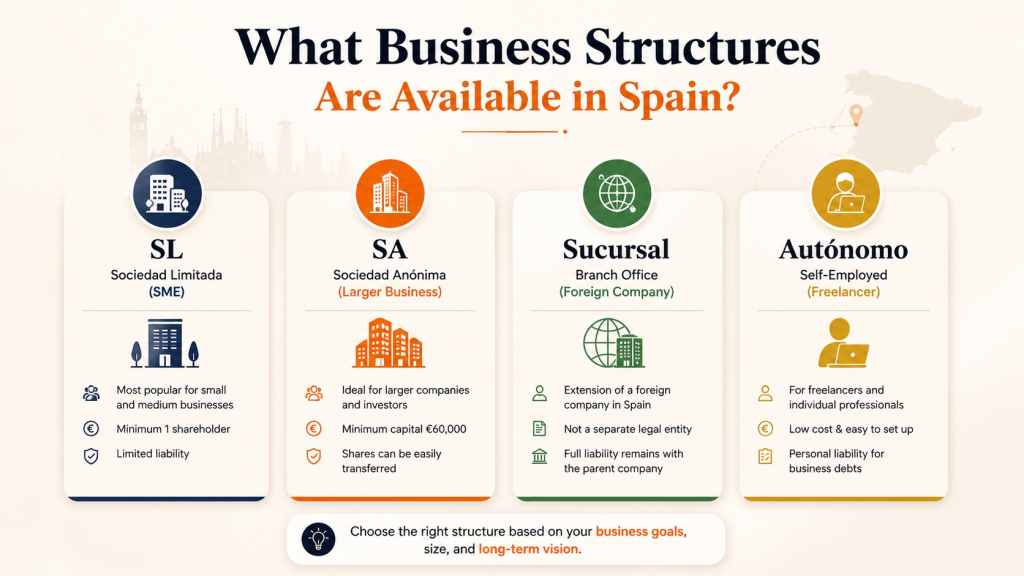
What Business Structures Are Available in Spain?
Most foreign founders choose between a handful of structures, and the right one depends on scale, funding plans, and whether you’re starting fresh or expanding an existing Indian business.
Sociedad Limitada (SL) : the default choice for small and medium businesses. It offers limited liability, relatively straightforward governance, and is the structure most Indian founders end up using.
Sociedad Anónima (SA) : suited to larger ventures, particularly those planning to raise capital more broadly or eventually list. It comes with a higher capital requirement and more formal governance obligations.
Sucursal (branch office) : relevant if an existing Indian company wants a physical presence in Spain without incorporating a fully separate legal entity. A branch isn’t a distinct legal person the way a subsidiary is, which has implications for liability.
Autónomo (sole trader) : an option for individual consultants or freelancers, though it doesn’t offer the liability protection a company structure does.
Structure | Liability | Best For | Structure |
SL | Limited | Small & medium businesses | SL |
SA | Limited | Large businesses & investors | SA |
Sucursal | Parent company liability | Existing Indian companies expanding to Spain | Sucursal |
Autónomo | Unlimited personal liability | Freelancers & consultants | Autónomo |
For most Indian entrepreneurs entering Spain for the first time, the SL is the practical starting point. It’s flexible enough for early-stage operations and doesn’t demand the capital commitment an SA requires.
What Are the Core Spain Company Formation Requirements in 2026?
A few requirements sit at the center of any Spanish incorporation, regardless of which structure you choose:
A minimum share capital, which is deposited into a Spanish bank account before the company is formally incorporated. Spain has reformed its capital rules in recent years, and the figures applicable to your structure should be confirmed at the time of filing, since this is one of the areas where regulations have shifted.
A NIE (Número de Identidad de Extranjero) for every foreign director and shareholder. This is a foreigner’s tax identification number, and without it, you legally cannot be listed as an owner or director of a Spanish company.
A registered business address in Spain.
A notarial deed of incorporation, signed before a Spanish notary, followed by inscription at the provincial Mercantile Registry.
Drafted company statutes covering share structure, decision-making authority, and the roles of directors.
None of these requirements are unusual by EU standards, but the sequencing matters.
Your NIE, for instance, needs to exist before the notarial deed can be signed, which means it’s often the first thing an Indian founder should apply for, not the last.
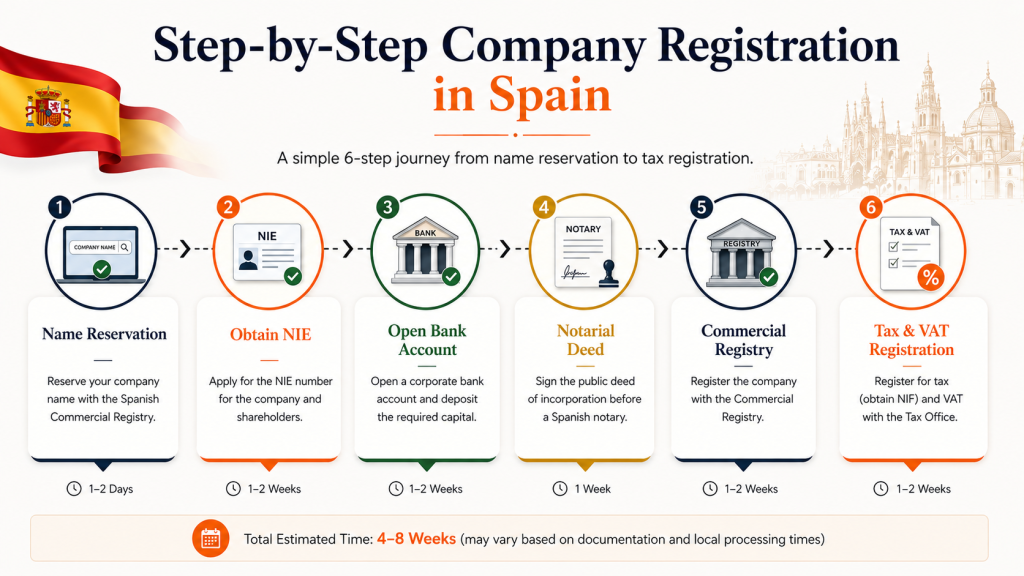
What Is the Step-by-Step Company Registration Procedure?
Reserve the company name through Spain’s Central Mercantile Registry, which confirms your chosen name isn’t already in use.
Obtain NIE numbers for all foreign shareholders and directors this can typically be initiated from India through a Spanish consulate, or in some cases via a power of attorney without traveling.
Open a Spanish bank account in the company’s name and deposit the required share capital, receiving a bank certificate as proof.
Draft the company statutes and sign the notarial deed of incorporation before a Spanish notary.
Register the company with the provincial Mercantile Registry, which formally grants it legal personality.
Register for tax and social security purposes, including obtaining the company’s tax identification number (CIF) and registering for VAT (IVA) if applicable.
The full timeline depends heavily on how quickly the NIE step moves, which in turn depends on consulate appointment availability from India.
This is usually the single biggest variable in how long the entire process takes, not the Spanish registration steps themselves, which tend to be more predictable once the paperwork is in order.
What Documents Are Required for Spain Company Incorporation?
- Passport copies for all directors and shareholders
- NIE certificates
- Proof of address
- The name reservation certificate
- Bank certificate confirming the capital deposit
- Power of attorney, if incorporation is being handled remotely from India
One detail that trips up Indian applicants specifically: documents issued in India such as board resolutions, certificates of incorporation for a parent company, or notarized declarations usually need to be apostilled before Spanish authorities will accept them.
India is part of the Hague Apostille Convention, so this is a solvable administrative step, but it’s one that’s easy to overlook until a registrar sends the paperwork back asking for it.
How Is This Different for Indian Entrepreneurs Specifically?
This is the part of the process that most general guides skip entirely, and it’s arguably more important than the Spanish paperwork itself, because getting it wrong doesn’t just delay your company, it can create compliance issues back in India.
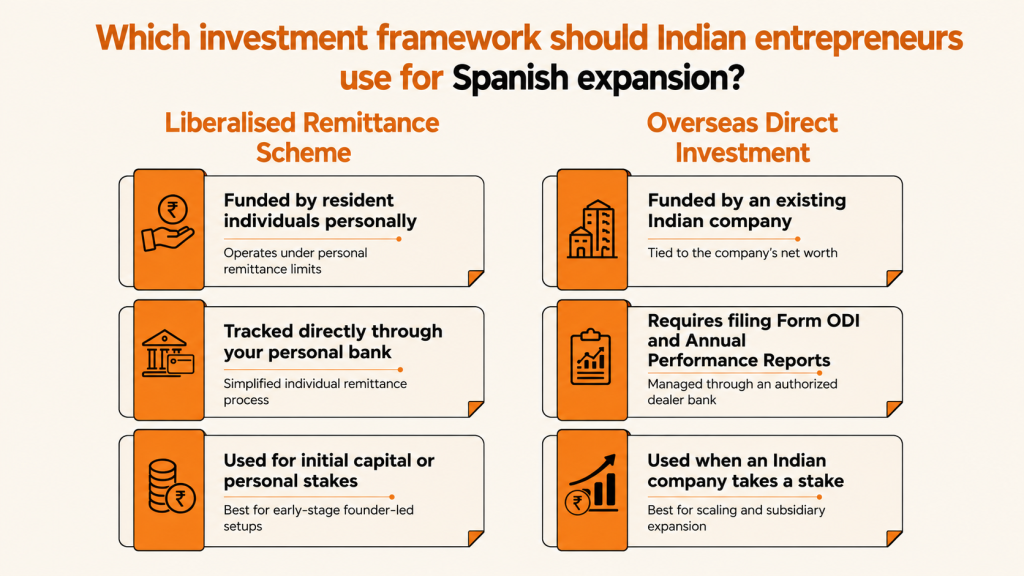
Choosing between LRS and ODI. If you’re an individual funding the company personally, you’re likely operating under the Reserve Bank of India’s Liberalised Remittance Scheme, which allows resident individuals to remit funds abroad up to a set annual limit.
If an existing Indian company is the one investing, say, to open a Spanish subsidiary that typically falls under the Overseas Direct Investment framework instead, which works on a different basis tied to the investing company’s net worth.
These aren’t interchangeable, and the reporting obligations differ: LRS remittances are tracked through your bank, while ODI investments require filing Form ODI and, later, Annual Performance Reports with the RBI through an authorized dealer bank.
A short example. Consider a Bangalore-based SaaS founder who wanted to open a Spanish SL to serve EU clients directly. As an individual, he used the LRS route to remit the initial capital, which was well within his annual limit.
A year later, once the Spanish company started generating meaningful revenue and he wanted his Indian company (not himself personally) to take a stake, the compliance picture changed that investment needed to be routed and reported under the ODI framework instead, through his company’s authorized dealer bank.
The lesson here isn’t that either route is difficult on its own; it’s that founders sometimes only realize the rules changed once their structure changes, and it’s worth checking this before, not after, moving funds.
Understanding the tax treaty. India and Spain have a Double Taxation Avoidance Agreement in place, which matters once your Spanish company starts sending dividends, interest, or royalty payments back to India.
The treaty sets reduced withholding tax rates on these payments compared to what might otherwise apply, and it’s designed specifically to prevent the same income being taxed fully in both countries.
The exact benefit depends on your structure and how income flows, so this is worth reviewing with a cross-border tax advisor rather than assuming a blanket rate applies.
Ready to Expand Your Business to Spain?
From Indian remittance compliance to Spanish incorporation, get your expansion plan mapped out with Vorx Consultancy.
Start Your Spain Business Setup
What Are the Residency and Visa Options for Indian Founders?
Company formation and residency are two separate legal tracks, even though they’re often connected in a founder’s mind. Owning a Spanish company does not, by itself, grant you the right to live in Spain.
For founders who want to relocate, the Entrepreneur Visa, established under Spain’s law supporting entrepreneurs and expanded by the more recent Startup Law, is the most relevant route.
It requires a detailed business plan that receives a favourable evaluation from ENISA, Spain’s national innovation agency, along with proof of sufficient financial means to support yourself during the visa period.
It doesn’t fix a minimum investment amount the way some other countries’ investor visas do; the emphasis is on the viability of the business itself.
Founders running remote-first businesses that don’t require a Spanish company at all may find the Digital Nomad Visa more relevant, since it’s built for people working for or running businesses based outside Spain.
Separately, new tax residents who qualify may be able to elect into the Beckham Law tax regime, which offers a flat rate on certain income for a limited number of years rather than Spain’s standard progressive tax scale.
Eligibility depends on not having been a Spanish tax resident in the recent past, among other conditions, so it’s not automatically available to everyone who relocates.
It’s worth being clear-eyed here: a visa grant is not the same as permanent residency, and neither is guaranteed by having a strong business plan or a well-capitalized company.
Each of these company formation, visa approval, and long-term residency is assessed independently, under its own criteria, and outcomes vary based on individual circumstances and how current regulations are applied at the time of application.
Planning to Move to Spain as an Entrepreneur?
Explore the right company formation and visa pathway for your business goals.
Speak With a Spain Business & Visa Expert
What Ongoing Compliance Should You Expect After Registration?
Incorporation is the starting point, not the finish line. Once your Spanish company is active, expect:
- Annual accounts filed with the Mercantile Registry
- Periodic tax filings, including corporate tax returns and VAT filings where applicable
- Social security registration for directors and any employees
- Corporate tax at Spain’s standard rate, with a reduced rate often available to new companies during their first profitable years the specific thresholds and rates should be confirmed against current Spanish tax law, as these are periodically adjusted
Falling behind on these filings has consequences beyond penalties: a company that misses its annual filing obligations can eventually find itself unable to transact through the Mercantile Registry at all, which effectively freezes its ability to operate normally.
What Mistakes Do Indian Entrepreneurs Commonly Make?
A few patterns show up repeatedly:
Sending funds to Spain before confirming whether the transfer falls under LRS or ODI, and only discovering the mismatch during a later compliance review.
Forgetting to apostille Indian-issued documents, which delays registration once Spanish authorities request corrected paperwork.
Assuming that forming the company automatically supports a visa application, when in reality the two processes have separate documentation and approval requirements.
Underestimating how long the NIE step takes from India, which then pushes back every step that depends on it.
None of these are complicated problems once you know to look for them. They’re just easy to miss if you’re navigating the process for the first time, particularly when most available guides focus only on the Spanish side of the paperwork.
Conclusion:
Spain’s company formation process itself isn’t the hard part, it’s a well-trodden path with clear, predictable steps.
What actually determines how smoothly an Indian entrepreneur gets through it is whether the Indian side of the equation, the LRS or ODI route, apostilled documentation, and DTAA-aware tax planning is handled correctly from the outset.
At Vorx Consultancy, we help Indian founders plan both sides of this process together: the Spanish incorporation steps and the Indian regulatory compliance that runs alongside it.
That means looking at your funding route before you remit a single euro, making sure your paperwork is apostilled before a registrar asks for it, and factoring in visa or residency plans if relocation is part of the picture.
If Spain is part of your international expansion plan, it’s worth having that full picture mapped out before you begin.
Ready to Start Your Spain Business Journey?
Set up your Spanish company with the right structure, documentation, funding route, and compliance strategy from India.