


When Indian businesses expand into international markets, tax can quickly become an important part of the planning process. India has DTAA agreements with several countries, helping businesses understand how cross-border income may be taxed and where tax obligations may arise.
But the rules and applicable rates are not the same for every country. The treatment of dividends, interest, royalties and other payments can differ depending on the treaty.
So, if you are planning to invest, expand or do business overseas, here are 10 important countries with DTAA agreements with India in 2026.
What Is a DTAA Agreement?
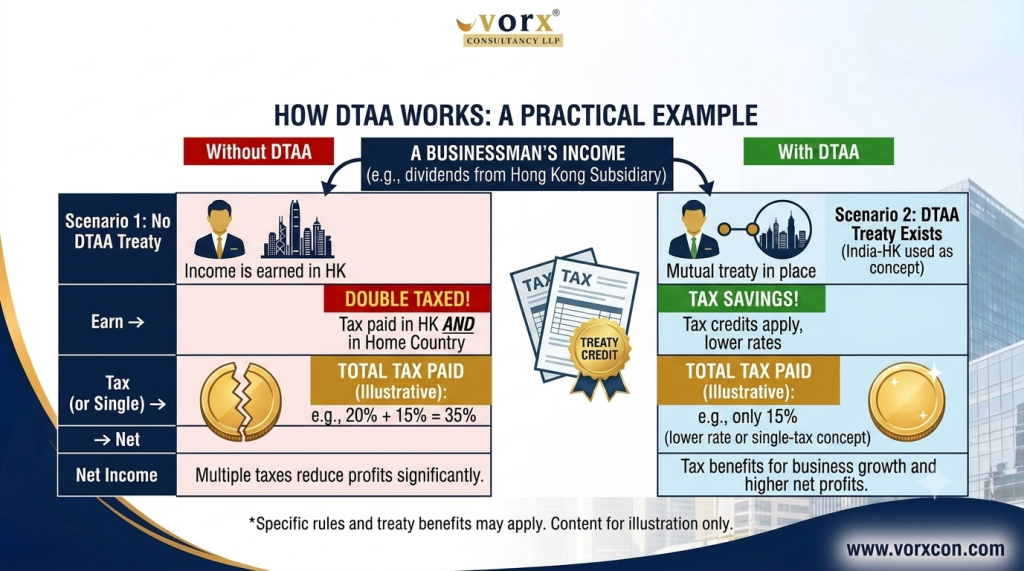
Double Taxation Avoidance Agreement (DTAA) is a treaty between two countries to determine the tax incidence of certain cross-border incomes and provide means to relieve double-taxation.
For example, an Indian company earns interest income of ₹10 lakh from Singapore. Singapore may levy tax on this income and so may India (as the company is an Indian taxpayer). However, as India and Singapore have a DTAA, the tax incidence in Singapore may be restricted to the rate prescribed under the DTAA (say 10% or so) and the Company may be able to claim foreign tax credit/relief in India for the tax so paid in Singapore (subject to the provisions of the DTAA).
1. United Arab Emirates
The India-UAE DTAA is particularly relevant for Indian entrepreneurs because of the extensive India-UAE business and investment corridor. Under the treaty, dividends are generally subject to a 10% withholding rate. Interest is generally 5% where the loan is granted by a bank or similar financial institution, while 12.5% may apply in other cases. Royalties are generally subject to 10%, while there is no separate FTS provision under the treaty. For Indian businesses operating through UAE entities, these provisions can be important when structuring investments, financing arrangements and cross-border payments.
2. Singapore
Singapore is one of Asia’s leading financial and investment hubs and has strong commercial links with India. Under the India-Singapore DTAA, dividends are generally subject to 10% where the recipient company holds at least 25% of the shares, and 15% in other cases. Interest is 10% where qualifying loans are provided by banks or similar financial institutions, and 15% otherwise. Royalties and fees for technical services are generally subject to 10%. These provisions make the treaty relevant for Indian companies with Singapore subsidiaries, investors and cross-border service arrangements.
3. United States
India-US DTAA is specifically relevant for Indian companies – tech-businesses, investors or professionals with US-related income, since it regulates taxation of dividends, interest, royalties, fees for technical services. Dividends are generally taxed at 15% in the hands of the recipient company (if it owns at least 10%) and 25% in other cases. Interest is generally 10% in the case of qualifying bank-or similar institutional-related loans, and 15% in other cases. Royalties and fees for technical services may generally be subject to 10% or 15%, depending on the category and terms of the treaty.
4. United Kingdom
The India-UK DTAA is relevant to the large volume of business, investment and professional activity between the two countries. The treaty generally provides for dividend withholding rates of 10% or 15%, depending on the circumstances. Interest is generally 10% when paid to a bank and 15% in other cases. Royalty and FTS payments may generally be subject to 10% or 15%, depending on the applicable treaty provision. For Indian companies working with UK businesses, these rates can be important when assessing the tax cost of cross-border payments.
5. Canada
The India-Canada DTAA is of interest to Indian businesses and individuals, investors and professionals receiving or making cross-border payments from Canada. Dividends are generally subject to 15% when the relevant 10% voting-power condition is met, and 25% otherwise. Interest is generally subject to 15%, and royalties and fees for technical services can generally attract rates ranging from 10% to 20% in accordance with the category and treaty conditions.
Recommended Reading:
DTAA planning is one part of a broader global tax structuring strategy, especially when a business operates across multiple countries.
6. Australia
Australia is an important market for Indian businesses, investors and professionals. Under the India-Australia DTAA, dividends are generally subject to 15%, while interest is generally subject to 15%. Royalties can attract 10% or 15%, depending on the nature of the payment and applicable treaty conditions. The treaty does not contain a separate FTS provision. For businesses with Australian operations or investment income, these provisions can influence the withholding-tax treatment of cross-border payments.
7. Germany
Germany is one of India’s significant European business partners, particularly across manufacturing, engineering, technology and professional services. The India-Germany DTAA generally provides a 10% withholding rate for dividends, interest and royalties, while fees for technical services are generally subject to 10%. For Indian businesses working with German companies, the treaty can therefore provide a relatively straightforward framework for determining withholding-tax obligations on several common categories of cross-border income.
8. France
The India-France DTAA is relevant for Indian companies and investors involved in European business operations. Dividends, interest, royalties and fees for technical services are generally subject to a 10% treaty withholding rate, subject to the specific conditions of the applicable treaty articles. This makes the India-France treaty particularly relevant for companies receiving investment income or making royalty and service-related payments between the two countries.
9. Netherlands
The Netherlands is an important international investment and corporate hub, and has longstanding economic ties with India. Under the India-Netherlands DTAA, dividends, interest, royalties and fees for technical services are generally subject to a 10% treaty withholding rate. However, businesses should review the latest treaty provisions, protocols and anti-abuse rules prior to reliance on the rate, particularly when the Netherlands is being considered as part of a larger international corporate structure.
Recommended Reading:
When choosing an overseas jurisdiction, businesses should consider not only incorporation but also tax planning, banking and long-term compliance.
10. Japan
Japan is an important Asian investment and technology partner for India. The India-Japan DTAA generally provides a 10% withholding rate for dividends, interest, royalties and fees for technical services. These provisions can be relevant to Indian companies working with Japanese investors, technology providers, manufacturers and service businesses, particularly where recurring cross-border payments are involved.
How Does Vorx Consultancy Help Businesses Use DTAA Benefits?
International tax planning should be considered together with company formation, banking, tax residency, cross-border payments and ongoing compliance. Vorx Consultancy helps Indian entrepreneurs and businesses evaluate international expansion structures and understand the tax and compliance considerations associated with operating across jurisdictions.
Whether you are establishing an overseas company, investing internationally, receiving foreign income or making cross-border payments, Vorx can help you assess the relevant business and compliance considerations before you finalise your structure.
Planning to expand your business internationally?. Let Vorx Consultancy Helps You
Book a Strategy Call: (Calendly Link)
Visit: www.vorxcon.com
Email: support@vorxcon.com
Final Thoughts
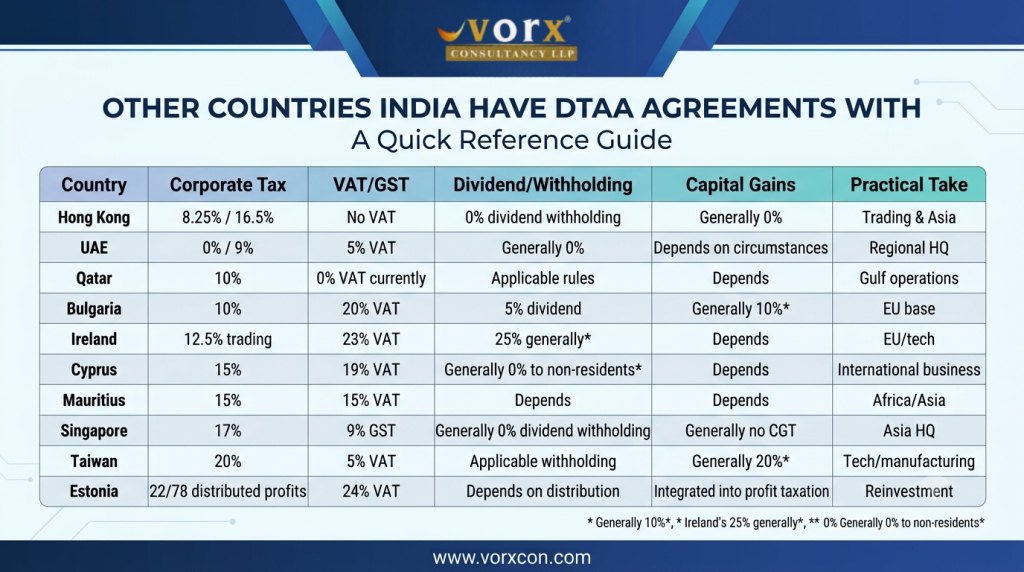
India’s extensive DTAA network provides an important framework for businesses and individuals dealing with international income. However, the most suitable jurisdiction cannot be determined by the DTAA rate alone. Tax residency, corporate structure, nature of income, withholding requirements, treaty conditions and foreign-tax-credit rules all need to be considered together.
For Indian entrepreneurs planning international expansion, reviewing the applicable DTAA before establishing a company or entering into a cross-border transaction can help identify potential tax obligations and avoid unnecessary surprises.