


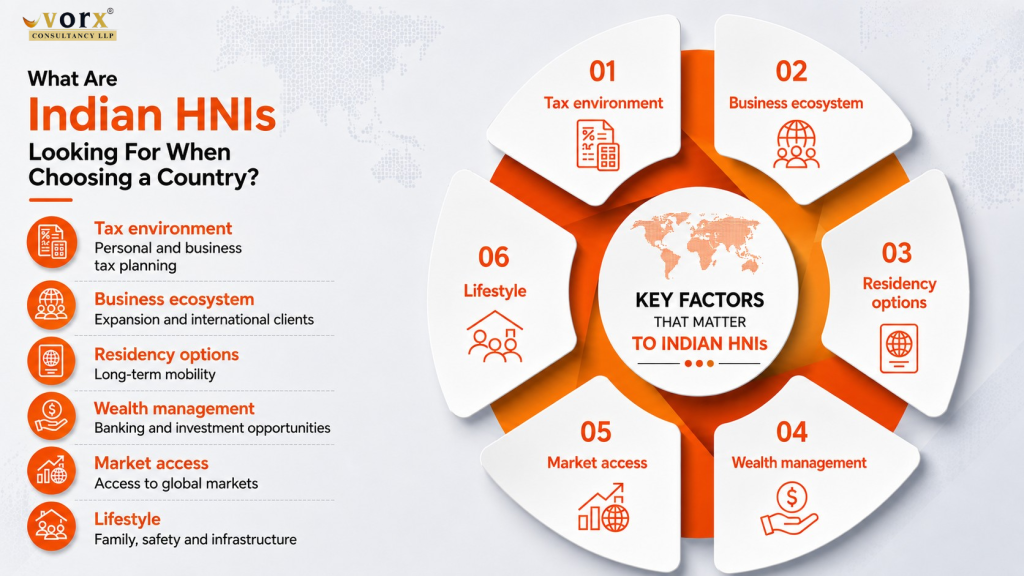
For Indian High-Net-Worth Individuals (HNIs), moving abroad is becoming less about finding a new residence and more about finding a better environment for business, wealth and long-term growth.
The most attractive destinations are not necessarily those with the lowest taxes. They are the countries actively making it easier to invest, innovate, access global markets and build international businesses. From the UAE’s business-friendly tax reforms to Singapore’s innovation incentives and Italy’s investment credits, governments are increasingly competing for globally mobile entrepreneurs.
1. UAE — Tax Efficiency Meets Business Expansion
The UAE has deliberately positioned itself as a global business hub rather than simply a low-tax destination. Its Corporate Tax framework remains competitive, while qualifying Free Zone businesses can benefit from a 0% rate on qualifying income. The government has also built specialised free zones around sectors such as technology, finance, logistics and media.
For Indian entrepreneurs, this combination matters because Dubai and Abu Dhabi provide access to Middle Eastern, African and Asian markets from one location. The country’s rapid rise in Henley’s 2026 residence index further reflects its growing appeal to global wealth.
2. Singapore — Building an Economy Around Innovation
Singapore’s advantage is not simply its 17% corporate tax rate. It is the way the government uses the tax system to encourage companies to innovate, develop intellectual property and expand internationally. Under the Enterprise Innovation Scheme, qualifying businesses can receive enhanced deductions of up to 400% on certain R&D, IP, training and innovation expenditure. Companies expanding overseas can also benefit from a double tax deduction for qualifying internationalisation expenses.
For Indian founders, Singapore can therefore be more than a headquarters; it can become a platform for building and funding an Asian business.
3. USA — Where Scale Can Matter More Than Tax
The US continues to attract HNIs because it offers something that a low-tax jurisdiction cannot easily replicate. The world’s largest consumer market, deep venture-capital ecosystem and concentration of technology companies make it particularly powerful for businesses in AI, software, healthcare, finance and biotechnology. For a founder building a high-growth company, access to investors, customers and intellectual property can create far greater value than simply reducing the tax bill.
4. UK — Making Investment More Attractive
The UK’s attraction comes from its combination of London finance, professional services, global investors and a mature corporate ecosystem. But the government is also using tax policy to encourage companies to invest. From January 2026, businesses can claim a new 40% first-year allowance for qualifying plant and machinery investments, designed to reduce the tax cost of new investment. The UK is also continuing to use R&D incentives to encourage innovation.
For HNIs, this makes the UK relevant not just as a wealth destination but as a place to deploy capital into a growing business.
5. Portugal — Lowering Business Tax While Building EU Access
Portugal is moving towards a more competitive corporate environment. Corporate Income Tax was reduced to 19% in 2026, with the government targeting 17% by 2028.
The bigger attraction, however, is the combination of European market access, residency opportunities and lifestyle. For an Indian business family looking for a European base, Portugal can offer a softer entry point into the EU while the country continues to improve its business environment.
Recommended Reading
For HNIs expanding across borders, understanding how different jurisdictions interact from a tax perspective is important. Our guide, Global Tax Structuring explores how businesses can approach international tax planning more strategically.
6. Australia — Stability With an Innovation Economy
Australia appeals to entrepreneurs who want to combine business opportunities with Australia is attractive to entrepreneurs who want to combine business opportunities with long-term family stability. Its strengths include technology, healthcare, resources, renewable energy and financial services, as well as its location to access the Asia-Pacific market.
Australia also has a number of innovative initiatives, including tax benefits for angel investors in eligible early-stage innovative companies.
This is likely to be of particular interest to high-net-worth individuals who are looking to move beyond a short-term stay and plan their wealth and family strategy in the long term.
7. Canada — Business Access Beyond Immigration
Canada’s appeal for Indian entrepreneurs goes beyond its established immigration pathways. Its technology ecosystem, natural resources, financial services and proximity to the US create multiple routes for business expansion. The federal corporate tax system also provides a lower rate for qualifying small-business income, showing how policy can be used to support domestic entrepreneurs and growing companies.
For HNIs, Canada can therefore work as a North American diversification base rather than simply a residence destination.
8. Malta — EU Access, Business & Global Mobility
Malta attracts international entrepreneurs with its EU market access, English-speaking business environment and established financial-services sector. Its tax framework and investment incentives can also support qualifying businesses.
For Indian HNIs, Malta can be useful for combining European business expansion, residency planning and international mobility—especially when the goal is to establish a genuine EU presence.
Italy — Incentivising Investment and Innovation
Italy is increasingly interesting for business owners because it is actively supporting investment in technology and productive assets. Its 2026 framework includes incentives for digital transformation, R&D, innovation and advanced manufacturing.
For example, Italy’s investment framework includes tax credits for R&D and innovation, while new 2026 measures support advanced technology and energy-transition investments. This gives Indian entrepreneurs a reason to look at Italy beyond lifestyle: EU market access plus incentives for building real business operations.
10. Netherlands — Innovation as a Business Strategy
The Netherlands has built a strong reputation around international trade, logistics, technology and innovation. Its Innovation Box allows qualifying profits from innovative activities to be taxed at a reduced 9% rate, specifically encouraging companies to invest in research and innovation.
For Indian companies planning European expansion, this can make the Netherlands particularly relevant as an operating and innovation base, rather than simply a holding location.
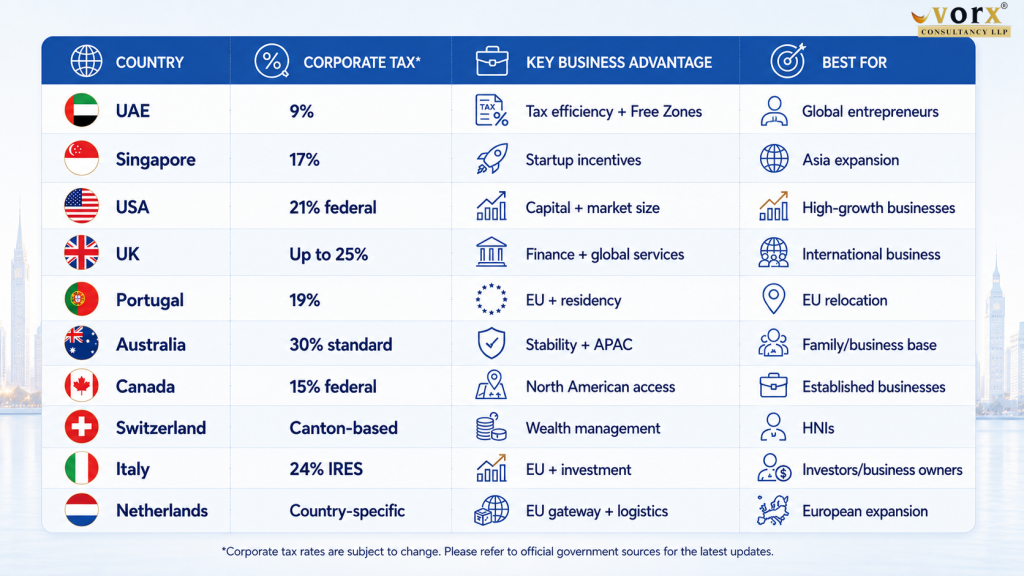
Country comparison - At a Glance:
How Vorx Helps HNIs Build the Right Global Business Strategy?
Choosing a country is only the first step. Vorx Consultancy helps Indian HNIs evaluate the right jurisdiction based on their business model, tax position, residency goals and expansion plans.
From international company formation and corporate banking to residency, tax planning and global business expansion, Vorx helps bring these pieces together into one practical strategy—so the move is built around long-term business objectives, not just a headline tax benefit.
Planning your next global move? Let Vorx Consultancy help you choose the right country.
Book a Strategy Call: (Calendly Link)
Visit: www.vorxcon.com
Email: support@vorxcon.com
Final Thoughts
For Indian HNIs, international relocation is becoming a business strategy rather than simply a lifestyle decision.
The UAE is attractive due to its tax-friendly environment, but Singapore is famed for its innovative environment, the US market is large, the UK is investor-friendly, Italy is embracing its industrial transformation, and the Netherlands has a tax-incentivized environment. Thus, the most suitable country depends on the entrepreneur’s needs to generate, protect, and grow their prosperity most effectively.
The right destination is ultimately the one that helps an entrepreneur create, protect and expand wealth more efficiently.
