
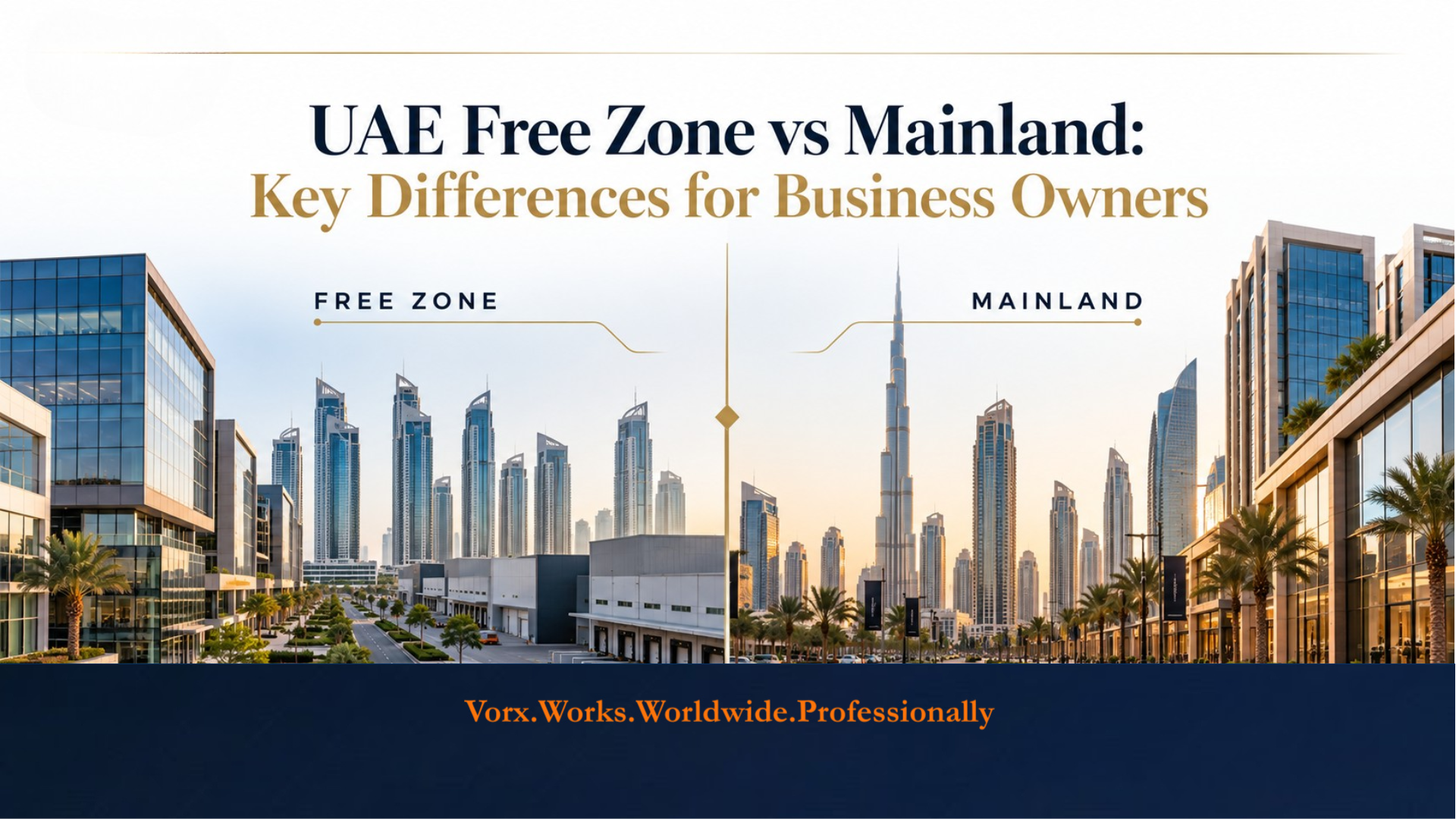
A UAE company setup can look straightforward until you ask one question: where will the business actually find its customers? An Indian consultant serving clients abroad, a retailer opening in Dubai, and a trader supplying UAE shops may all need different licences.
That is why the free zone vs mainland UAE decision deserves more thought than a comparison of registration prices. Your choice affects where you can operate, which activities you can carry out, and what it may cost to grow. Here is how to assess both options.
What Is a Mainland Company in the UAE?
A mainland company is licensed by the economic authority of the emirate where it is established. It is a common choice for businesses planning to operate directly in the UAE market, such as shops, restaurants, local service providers, and companies serving customers across the country.
Many mainland activities now permit 100% foreign ownership, although certain activities have additional rules. So if you are comparing 100% foreign ownership in a mainland vs free zone UAE company, check your specific activity rather than assuming you need a local shareholder.
Planning a UAE company? Speak with Vorx at www.vorxcon.com.
What Is a Free Zone Company in the UAE?
A free zone company is registered and licensed by a particular free zone authority. Free zones offer different activities, facilities, and licence packages. Some may suit a consultant working with international clients; others are designed around trading, logistics, or particular industries.
The important detail is the licence itself. Registering in a free zone does not give a business permission to undertake every activity or operate anywhere it chooses.
Recommended Reading:
Choosing a structure is only the first step. How Can I Register a Company in Dubai Step by Step? explains what happens after you decide on a licence.”
Free Zone vs Mainland: Key Differences
Factor | Mainland company | Free zone company |
Licensing authority | Licensed by the relevant emirate’s economic authority. | Licensed by the chosen free zone authority. |
UAE market access | Can operate directly in the mainland UAE market under its approved licence. | Serving mainland customers may require an additional licence or an appropriate mainland arrangement. |
Business activities | Can carry out the activities approved on its mainland licence. | Can carry out activities available in the chosen free zone and approved on its licence. |
Foreign ownership | 100% foreign ownership is permitted for most activities, with some exceptions. | Generally permits 100% foreign ownership. |
Office space | Premises must meet the requirements for the activity and licensing authority. | Depending on the free zone, options may include a shared desk or a private office. |
Employee visas | Eligibility depends on the company’s setup, premises and approvals. | Allocation depends on the free zone and selected package. |
Corporate tax | Standard UAE corporate tax rates generally apply. | A 0% rate may apply to qualifying income if the company meets the required conditions. |
Setup and renewal costs | Depend on the licence, premises, visas and any additional approvals. | Depend on the free zone package, workspace, visas and renewal fees. |
Can a Free Zone Company Sell to Mainland Customers?
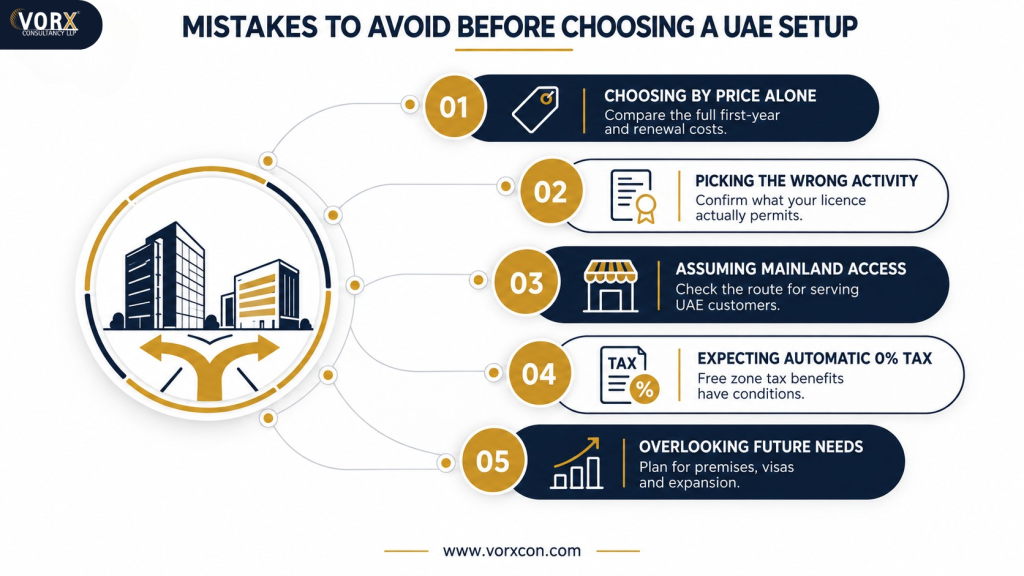
This is where founders should slow down. Selling imported products through UAE retailers, providing services to a local client, and opening a physical shop are different activities. A free zone licence should not be treated as blanket permission to carry out all three on the mainland.
The UAE government explains that selling goods or services locally may require a licensed mainland distributor or a mainland branch or company. The right route depends on the proposed activity and arrangements. Before choosing a free zone, map out who you will invoice, what you will supply, and where the work will take place.
Planning a UAE company? Speak with Vorx at www.vorxcon.com.
Is a Free Zone Company Always Cheaper?
Not necessarily. A low advertised free zone vs mainland licence cost in Dubai may cover only the first step. Visa applications, workspace, activity approvals, renewals, and accounting can change the total considerably. If the business later needs a separate arrangement to reach mainland customers, that also belongs in the budget.
Ask for two figures for each option: the full first-year cost and the expected annual renewal cost. Compare packages that include the facilities and visas your business actually needs.
How Does Corporate Tax Differ?
Corporate tax | Mainland company | Qualifying free zone company |
0% rate | Applies to the first AED 375,000 of taxable income | Applies to qualifying income, subject to conditions |
9% rate | Applies to taxable income above AED 375,000 | Applies to taxable income that does not qualify |
Key point | Tax depends on taxable profit | A free zone licence alone does not guarantee 0% tax |
Example: If a mainland company has AED 500,000 in taxable income, the 9% rate generally applies to AED 125,000—not the full AED 500,000. For a qualifying free zone company, the crucial question is which income qualifies for the 0% rate.
Planning a UAE company? Speak with Vorx at www.vorxcon.com.
Which Option Fits Your Business Model?
A free zone company may suit you if:
- Most of your customers are outside the UAE. For example, you run a consultancy or digital business serving international clients.
- You want a particular free zone’s facilities. Its available activities, workspace and visa package match what your business needs.
- Your business involves international trade or re-exports. The chosen zone has suitable logistics facilities, and you have checked the rules for any goods entering the UAE mainland.
A mainland company may suit you if:
- You plan to serve UAE customers directly. Local sales or services will be a regular part of your business.
- You need a customer-facing location. For example, you intend to open a shop, restaurant or service centre.
- Your growth depends on operating across the UAE. You expect to work at mainland locations or expand your local customer base under the relevant licensed activities.
If you expect both international and UAE customers, list your planned transactions before choosing. Check what the licence permits, whether mainland sales need an additional arrangement, and what the complete setup will cost.
Recommended Reading:
A low licence fee does not always mean a low total setup cost. Business Setup Dubai: Low Cost Company Formation in UAE looks at the other expenses founders should budget for.”
How Vorx Consultancy Can Help with Your Company Setup?
The right UAE setup starts with your business plans, not a licence package. Vorx Consultancy looks at what you intend to sell, where your customers are, and how you expect to operate. We then help you compare free zone and mainland options against those needs, including the costs and requirements you will face after registration.
- Review your business activities and target customers.
- Compare suitable free zone and mainland licence options.
- Explain setup, visa, workspace and renewal costs.
- Guide company registration and document preparation.
- Help you understand ongoing accounting and compliance requirements.
Choosing between a UAE free zone and mainland company? Speak with Vorx Consultancy
Book a Strategy Call: (Calendly Link)
Visit: www.vorxcon.com
Email: support@vorxcon.com
Final Thought
A free zone company may be a good fit for a business focused on international clients. A mainland company may make more sense when serving UAE customers directly is central to the plan. Neither choice should be made from the headline licence fee alone.
Before applying, be clear about your first customers, the activities your licence must cover, and how your business might grow. Compare the full cost of operating each setup, including renewals, visas and compliance. That work upfront can help you choose a structure that supports the business you intend to build.
