


Yes, you can own 100% of a company in Oman as a foreigner. Since January 2020, most business activities have been open to full foreign ownership, with no Omani partner and no fixed minimum capital.
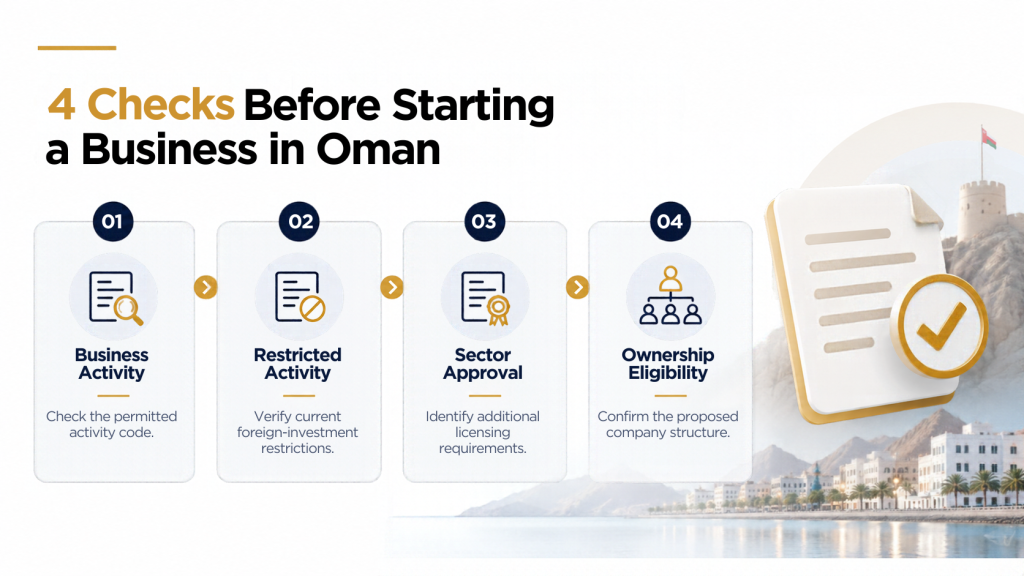
But ownership is only the first question. Your success depends on four factors: first, the type of activity you have selected; second, the form of incorporation; third, the location; and finally, what Oman expects from you when you are trading.
This guide describes all of these tests in simple terms. It’s written for Indian founders and other foreign investors who want a clear picture before they commit time or money.
Planning to Start a 100% Foreign-Owned Company in Oman?
Check your business eligibility, ownership options and registration requirements with Vorx Consultancy.
Can a Foreigner Own 100% of a Company in Oman?
Yes, in most cases. The Foreign Capital Investment Law (Royal Decree 50/2019) entered into force in January 2020 and altered the regulations considerably.
Prior to this, foreign investors would require an Omani business partner, while their maximum ownership share was limited to 70%. Moreover, full foreign ownership required exceptional permission from the Cabinet, along with stringent minimum share capital requirements.
The new law removed the mandatory Omani partner and dropped the fixed minimum capital for foreign-owned companies.
It also gives foreign investors broadly the same incentives and protections as Omani investors, including the right to transfer ownership and repatriate profits.
The main exception is a government list of activities reserved for Omanis. We’ll come to that in Check 1.
Read this guide: Oman Company Formation for Foreigners in 2026 guide.
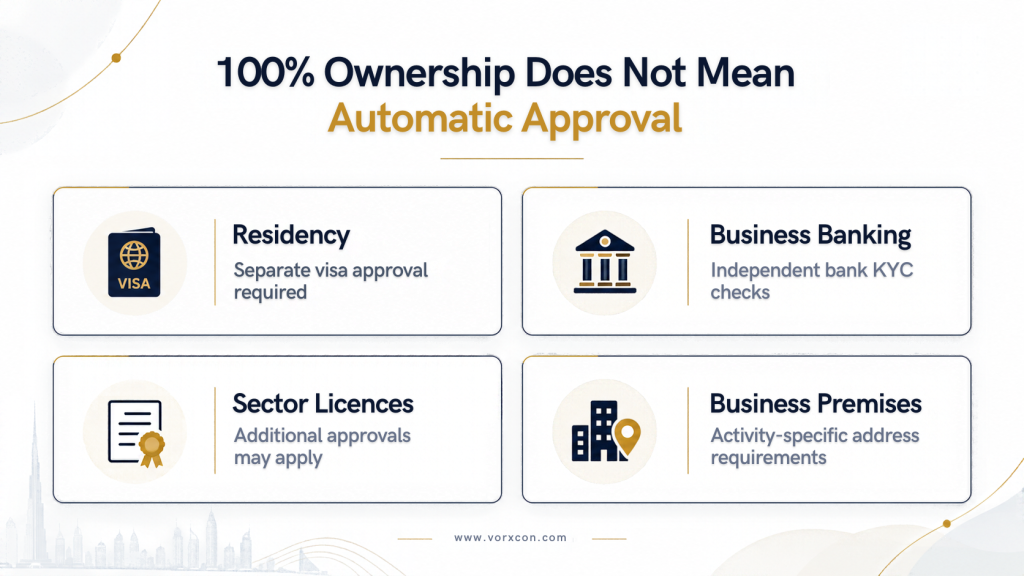
What 100% Ownership Does Not Cover
This is where many founders get caught out. Owning your own company does not necessarily mean you have:
Residency: A residence visa is a different application process, and long-term investor residency has its own requirements for investments.
BANK ACCOUNT: The banks perform their own due diligence on the shareholders, source of funds, and business model.
Approvals for sectors: There are some activities that require licensing by a certain regulatory body apart from business registration.
Assumptions: Some licences may need a registered office or a particular address for conducting the activity.
Plan each of these as its own step. If banking is a concern, sort out your corporate bank account opening strategy early rather than after registration.
Check 1: Is Your Business Activity Open to Foreign Investors?
Every Omani company registers specific activity codes. Those codes decide whether you can be 100% foreign-owned, so this is the first thing to verify.
What sits on the restricted list
The Ministry of Commerce, Industry and Investment Promotion (MOCIIP) provides a list of activities that are closed to foreign investments.
The list was first released in December 2020 and has since then undergone several revisions. The 2024 revision (Ministerial Decision No. 435/2024) has added another 28 activities, bringing the total to 123.
The restricted activities broadly fall into these groups:
- Heritage and crafts, such as Omani Halwa, khanjars, traditional clothing, ceramics, and silverware.
- Retail and services, such as grocery stores, mobile phones shops, souvenirs shops, and Sanad service centers.
- Light automotive services, such as vehicle washing, oil changes, tyre repair and fuel stations.
- Selected real estate, fishing and rental activities, such as real estate brokerage, property management and crane or equipment rental.
A few carve-outs exist. For instance, laundry and barbering activities are permitted within hotels and other tourist-oriented facilities. Nationals from the GCC region are regarded as Omani investors, and hence the categories vary for them.
The list varies, so make sure to compare it with your own activity code on the date that you apply.
Sector regulators add a second layer
Though an activity is open, it may still require authorization by the relevant regulator. Banking, insurance, health care, education, telecommunications, and oil and gas all fall within their own set of regulations. Clearing the restricted list does not mean you’re cleared to operate.
Buying an existing business
Foreign-owned businesses that were set up before an activity was restricted can usually keep operating.
However, selling or transferring them to a new foreign owner needs written ministry approval. If you’re buying a business in Oman, check this before you sign anything.
Getting it wrong is expensive. Breaching the foreign investment rules can lead to heavy fines, and the same penalty can apply to an Omani who fronts a foreign investor.
Not Sure If Your Business Activity Allows 100% Foreign Ownership?
Vorx helps foreign investors review business activity restrictions and registration requirements before applying.
Check 2: Pick the Right Legal Structure
The majority of foreign investors have the choice between four entities according to the Commercial Companies Law (RD 18/2019).
Structure | Owners | Best for | Key limitation |
Single Person Company (SPC) | One individual or one company | Solo founders and parent companies setting up a wholly owned subsidiary | A person can own only one SPC, and an SPC can’t set up another SPC |
Limited Liability Company (LLC) | Two or more shareholders | Co-founders, joint ventures, investor-backed businesses | Needs a clear shareholder agreement |
Branch of a foreign company | The foreign parent | A specific contract or project in Oman | Parent company carries the liability |
Commercial representative office | The foreign parent | Marketing and liaison only | Cannot trade or earn revenue |
For most Indian founders, the choice comes down to an SPC or an LLC. An Indian private limited company can be the sole shareholder of an Omani SPC, which keeps the group structure simple.
Before you choose, remember that each foreign shareholder or authorised signatory usually needs to be registered on the ministry’s online system first.
If you’d like help weighing the options, our international company formation team can map structures to your plans.
Check 3: Mainland or Free Zone?
Both the mainland and the free zones and special economic zones of Oman provide opportunities for businesses.
Starting from 2020, both offer 100% foreign ownership, hence the choice is one of location and the incentives required.
These zones are controlled by the Public Authority for Special Economic Zones and Free Zones (OPAZ).
The main ones are the Special Economic Zone at Duqm and the free zones at Sohar, Salalah and Al Mazunah.
Factor | Mainland company | Free zone company |
Ownership | 100% for most activities | 100% |
Selling in Oman | Can trade directly across Oman | Onshore trading is restricted; usually needs a local distributor or a separate mainland entity |
Tax incentives | Standard corporate tax | Long tax holidays for qualifying activities, depending on the zone |
Customs | Standard duties | Exemptions on goods within the zone |
Omanisation | Standard requirements | Often relaxed in early years |
Best suited to | Services, consulting, local trading, tech | Manufacturing, logistics, export and re-export |
Oman passed the Special Economic Zones and Free Zones Law (Royal Decree 38/2025) in April 2025.
The law provides for all zones in one system and helps protect existing businesses that have been offered incentives. The executive orders for this law should be released after a year, so check on the current zone laws.
Rule of thumb: If most of your customers are from Oman, begin on the mainland. If you are manufacturing or shipping products through Sohar, Duqm or Salalah, you could consider using a zone.
Read this guide: Oman Free Zone vs Mainland Company: How Foreign Investors Should Choose
Mainland or Free Zone — Which Is Right for Your Business?
Get guidance from Vorx on choosing an Oman company structure that matches your business activity and expansion plans.
Check 4: Plan for Your Year-One Obligations
Most books regard this as a mere aside. However, it is the very issue that determines whether your business will maintain its reputation.
The one-Omani-employee rule
In October 2025, Oman added Article 12 bis to the Executive Regulation of the Foreign Capital Investment Law (Ministerial Decision 411/2025).
It requires every foreign-owned company to employ at least one Omani after one year of commercial activity. That employee must be registered with the Social Protection Fund, and the company must also meet any Omanisation ratios set for its sector.
Companies that were already trading for a year or more had six months to comply, counted from their next commercial registration renewal or work permit issue or renewal.
The Ministry of Labour has cautioned that businesses that are not compliant could be banned from their services.
This is not an ownership requirement, but it does impact your staffing strategy and operating expenses. Include it in your year-one budget from the start.
Oman is no longer “tax-free”
Oman has had corporate income tax for years. The standard rate is 15%, with a reduced rate for small businesses that meet strict conditions. VAT also applies to most supplies.
Personal income tax is coming too. Under Royal Decree 56/2025, a 5% tax on high earners starts on 1 January 2028.
Most residents will fall below the threshold, but founders paying themselves large salaries should plan ahead. To see how Oman sits against other options, compare corporate tax rates across countries.
Why Oman Is Worth a Closer Look for Indian Founders
The India-Oman Comprehensive Economic Partnership Agreement (CEPA) became effective on 1st June 2026.
It gives duty-free access to the vast majority of Indian exports to Oman by value.It also involves agreements on service sectors like IT, consultancy, accounting, and engineering, along with easier relocation for intra-firm transferees.
This would have implications for Indian companies. For one thing, an Omani-based company would be able to serve the local market, act as a trading hub, and benefit from ports such as those at Sohar, Duqm, and Salalah.
Example (hypothetical): An Indian software firm based out of Pune wishes to cater to customers in Oman.
It incorporates a mainland SPC with its Indian parent as the owner, applies for an IT services code which is open to foreign investments, and hopes to recruit its first Omani employee within a year.
A Gujarat chemicals exporter, by contrast, might prefer a free zone entity near Sohar port for customs and tax reasons.
If you’re still choosing a base, use our Country Comparison tool to compare Oman with other jurisdictions.
How to Set Up a 100% Foreign-Owned Company in Oman
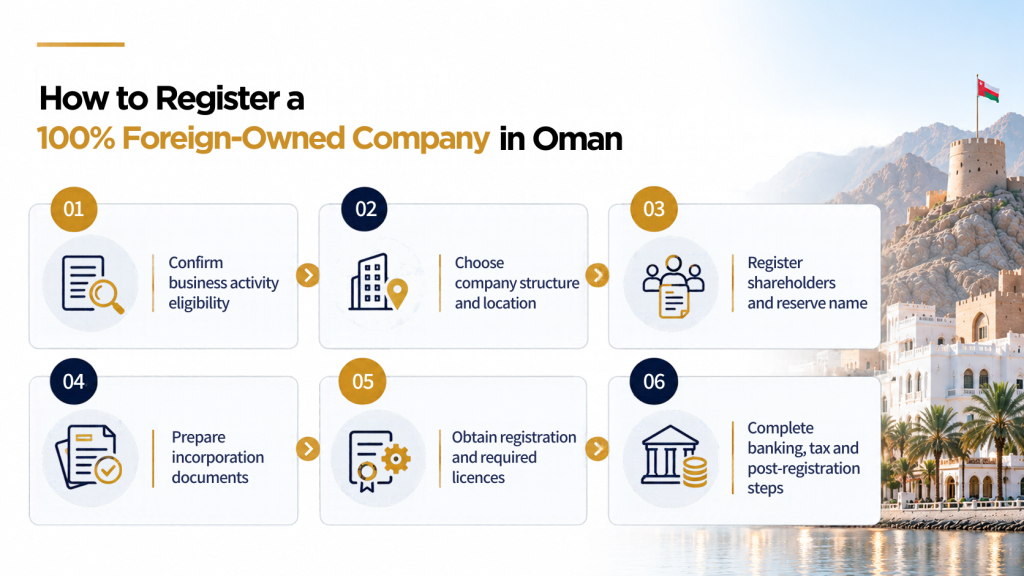
Here’s the typical order of steps for a mainland company. Free zone setups follow a similar path through OPAZ or the relevant zone authority.
- Confirm your activity codes against the restricted list and any sector licensing rules.
- Choose your structure — SPC, LLC or branch and decide on the mainland or free zone.
- Register the registered shareholders and signatories with respect to the Ministry’s web site and secure the company name.
- Documents include passports, parent company documents (which are usually certified) and the constitutive agreement.
- Acquire commercial licensing as well as licenses at the local or industry level.
- Conclude the post-registration procedures: lease premises, open a bank account, register for tax purposes, get visas, and prepare to hire your Omani staff.
What about costs? Setup costs depend on your structure, zone, activity, office and the number of visas you need.
Government fees and incentives also change, so we don’t quote figures here. For a personalised breakdown, try our Business Estimator.
Mistakes That Cost Foreign Investors Time
- Picking a broad activity description and discovering later that the actual code is restricted.
- Choosing a free zone and then finding you can’t sell freely to Omani customers.
- Assuming the company licence comes with residency or a bank account.
- Forgetting the Omani-employee deadline until a permit renewal is blocked.
Final Thoughts
100% foreign ownership in Oman is now the default for most activities. The harder work is choosing the right activity code, structure and location, and planning for obligations like the one-Omani-employee rule from day one.
If you get those four checks right, Oman can be a practical, well-connected GCC base — especially for Indian businesses now that CEPA is in force.
Vorx helps founders check activity eligibility, choose between mainland and free zone, and handle registration, banking and compliance. Book a consultation to get a clear plan for your Oman setup.
Ready to Register Your Company in Oman?
From ownership eligibility and company registration to banking assistance and compliance, Vorx helps you plan your Oman business setup.
