


Spain has become one of the more attractive entry points into the European market for foreign entrepreneurs, Indian business owners, NRIs, and international investors.
A stable legal system, access to the EU single market, and a straightforward company formation process make it a practical base for founders looking to expand beyond their home market. But before setting up a company in Spain, most foreign owners eventually ask the same question:
how does Spain corporate tax actually work when the shareholders and directors are not Spanish residents?
The honest answer is that the core rules are the same for everyone, but the practical experience is not.
A foreign-owned company deals with questions that a purely domestic business rarely thinks about — how profits get taxed when they’re sent back to a parent company abroad, whether local activity accidentally creates a tax presence in Spain, and how a home-country tax treaty changes the numbers.
This guide walks through Spain corporate tax in 2026 specifically from that angle.
This is general information based on current regulations and is not a substitute for advice from a qualified tax advisor, since individual circumstances and requirements can vary.
Read this guide: Spain Company Formation Requirements: A Complete 2026 Guide
What Is Corporate Tax in Spain?
Corporate tax in Spain — Impuesto sobre Sociedades, or IS — is the tax levied on a company’s profits, administered by the Agencia Tributaria (AEAT).
Whether a company falls under this regime depends on tax residency, which is determined by where the company is incorporated, where its registered office sits, or where its effective management actually takes place.
A company that is tax resident in Spain is taxed on its worldwide income. A foreign company without Spanish tax residency, but earning income from Spain, is usually taxed differently through the non-resident income tax regime (IRNR) rather than IS, unless it has a permanent establishment here.
This distinction trips up a lot of first-time foreign owners, so it’s worth getting right before anything else.
Spain Corporate Tax Rates in 2026
The standard corporate tax rate in Spain is 25 percent. However, Spain has been phasing in reduced rates for smaller companies over the past few years, and 2026 continues that trend.
Company Type | 2026 Tax Rate | Key Point |
Standard Companies | 25% | General corporate tax rate |
SMEs | Reduced rate | Lower rates may apply |
Micro-enterprises | Tiered rate | Rate depends on profit level |
Qualifying Startups | 15% | For eligible startups |
Large Multinationals | 15% minimum | Pillar Two minimum rate |
A quick word of caution here: you’ll see slightly different figures across different websites and advisory firms for 2026.
That’s because a temporary decree adjusted some SME and micro-enterprise measures earlier in the year, and part of that decree was later reversed, while the underlying phased reduction written into the corporate tax law continues on its own track.
If a number matters for your specific filing, it’s worth confirming it directly with AEAT or your accountant rather than relying on the first figure you find online.
Who Actually Pays Corporate Tax in Spain?
Any company incorporated in Spain regardless of who owns it is inside the IS regime. So is a foreign company that operates through a permanent establishment here, such as a branch.
What catches people off guard is the third category: a foreign company with no formal presence in Spain but earning Spain-source income.
That company typically falls under IRNR, not IS, and the compliance obligations look quite different.
For a foreign entrepreneur planning to incorporate a subsidiary, this distinction mostly matters at the planning stage; it determines which set of rules you’re building your compliance calendar around from day one.
When Does Business Activity in Spain Create a Tax Presence?
This is one of the most overlooked issues for foreign owners, and it deserves more attention than it usually gets.
A company doesn’t need to formally register in Spain to end up owing Spanish corporate tax. If a foreign company has a fixed place of business here, or an agent who regularly negotiates and concludes contracts on its behalf, tax authorities may consider that a permanent establishment even without a locally incorporated entity.
In practice, this shows up in situations that seem harmless at first: hiring a remote sales representative based in Spain, using a local warehouse for fulfilment, or engaging a long-term consultant who has the authority to sign deals on the company’s behalf.
None of these arrangements are unusual for a growing business, but each one can shift how Spain views the company’s tax obligations.
A short example: An Indian software company hires a Spain-based business development manager to sell into the EU market, working remotely and closing deals directly with clients. Because that employee has authority to negotiate and finalise contracts, Spanish tax authorities could treat this as a permanent establishment, even though the company has no office or registered entity in the country. The fix isn’t complicated, but it does need to be addressed early — usually by adjusting the employee’s contract authority or by formalising the Spanish presence through a proper branch or subsidiary.
Vorx Consultancy Insight: We regularly see founders structure their first hire in Spain around sales targets without thinking about tax presence at all.
It’s a reasonable oversight, but it’s also one of the easier problems to prevent with the right structure from the start.
Branch or Subsidiary: Which Structure Makes Sense?
Foreign investors setting up in Spain usually choose between a branch (sucursal) and a subsidiary, most commonly a limited liability company known as an SL. Both let you operate in Spain, but they behave differently for tax and liability purposes.
Factor | Branch (Sucursal) | Subsidiary (SL) |
Legal status | Extension of the foreign parent, not a separate entity | Separate legal entity |
Liability | Parent company is directly liable | Liability generally limited to the subsidiary |
Setup complexity | Simpler, fewer formation steps | More formal, requires deed of incorporation and registration |
Profit repatriation | Sent to head office; no separate dividend withholding | Dividend withholding tax may apply, subject to treaty relief |
Best suited for | Testing the market or project-based work | Long-term operations, hiring, and building a local presence |
Most Indian and NRI investors we work with end up choosing the SL, mainly because it separates personal and parent-company liability and gives the business more credibility with local banks, suppliers, and clients.
A branch can make sense for a shorter-term project or when a company wants to test the Spanish market before committing to a full local entity but it’s worth weighing the liability trade-off carefully before deciding.
Planning to Set Up a Company in Spain?
Choose the right structure for your business with guidance from Vorx Consultancy.
How Corporate Tax Is Calculated
Spain calculates taxable profit by starting with accounting profit and adjusting it according to tax rules adding back non-deductible expenses and applying available reliefs.
One relief worth knowing about is the capitalisation reserve, which reduces taxable income when a company increases its equity and keeps that increase in place for a set period.
There’s also a system for carrying forward losses to offset future profits, subject to certain limits.
This part of the calculation is fairly standard regardless of who owns the company, so we won’t go deep into it here; the sections that follow matter more for a foreign-owned business specifically.
Dividend Repatriation and Withholding Tax
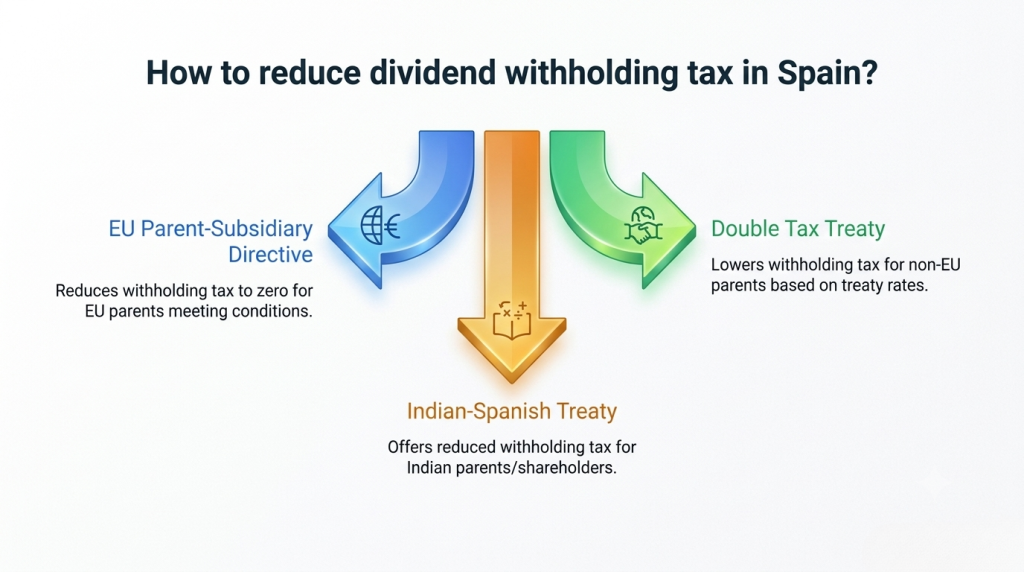
This is usually where the real financial impact shows up for a foreign owner. When a Spanish subsidiary pays a dividend to its foreign parent, Spain applies withholding tax on that payment unless a specific exemption or treaty reduces it.
If the parent company is based in the EU and meets certain ownership and holding-period conditions, the EU Parent-Subsidiary Directive can reduce that withholding to zero.
For parents outside the EU, the applicable double tax treaty between Spain and the parent’s home country usually determines the rate, and it’s almost always lower than the standard domestic withholding rate but only if it’s properly claimed, with the right documentation, including a certificate of tax residency.
For Indian entrepreneurs and NRIs specifically: Spain and India have a double taxation avoidance agreement that sets a reduced withholding rate on dividends paid to an Indian parent company or NRI shareholder, compared to the standard domestic rate.
To benefit from it, the Indian parent or shareholder typically needs to provide a tax residency certificate and the relevant supporting documentation to the paying entity in Spain.
Skipping this step is one of the most common and most avoidable costs we see foreign owners absorb unnecessarily.
Expanding Your Business to Spain?
Get professional guidance on tax, compliance, and cross-border structuring with Vorx Consultancy.
Transfer Pricing for Foreign-Owned Subsidiaries
If your Spanish company does business with related entities abroad paying management fees, licensing intellectual property, or receiving intercompany financing, Spain expects those transactions to be priced at arm’s length, meaning roughly what unrelated companies would charge each other.
Above certain thresholds, companies also need to disclose related-party transactions through a specific filing (Modelo 232) and maintain supporting documentation.
The practical takeaway here is timing. Founders who put proper intercompany agreements and pricing documentation in place from the start have a far easier time than those who try to reconstruct it retroactively during an audit.
Filing Obligations and Compliance Checklist
For a first-year foreign-owned company, the compliance calendar generally includes:
- Registering the company and obtaining a NIF (tax identification number)
- Filing the annual corporate tax return (Modelo 200)
- Making advance instalment payments during the year, calculated against the applicable rate
- Keeping accounting records for the legally required retention period
- Appointing a fiscal representative, where this applies to the entity type
- Disclosing overseas assets where relevant to the company or its owners
None of these steps are unusual on their own, but missing one particularly the instalment payments can create cash flow pressure that catches new foreign owners off guard in the first year.
Read this guide: Spain Company Compliance Requirements
Setting Up as a Foreign Investor: The Tax-Relevant Steps
A full incorporation guide is a separate topic, but a few steps have a direct tax dimension worth flagging here.
Foreign directors and shareholders generally need an NIE (foreigner identification number), and the company itself needs a NIF.
Documents issued outside Spain usually require an apostille or legalisation before Spanish authorities will accept them.
Non-resident shareholders will also need a Spanish business bank account, and certain foreign investments must be declared to the relevant authority as part of the formation process.
Common Mistakes Foreign-Owned Companies Make
A few patterns come up repeatedly with the founders we work with:
- Assuming home-country tax treatment carries over to Spain
- Not realising that local hires or agents can trigger a permanent establishment
- Paying full withholding tax on dividends because treaty relief was never claimed
- Missing transfer pricing documentation until an audit forces the issue
- Underestimating how instalment payments affect cash flow in the first year
Most of these are avoidable with early planning rather than corrections after the fact.
Conclusion:
Spain’s corporate tax system isn’t fundamentally more complicated for foreign owners than for domestic ones — but the areas where it gets complicated (permanent establishment risk, dividend withholding, treaty relief, transfer pricing) tend to be exactly the areas that don’t come up until they become a problem.
Getting the structure and documentation right early on tends to save far more time and money than fixing it later.
At Vorx Consultancy, we help foreign entrepreneurs, Indian business owners, and international investors evaluate the right structure for entering the Spanish market, from choosing between a branch and a subsidiary to setting up compliant, tax-efficient operations from day one.
If you’re weighing your options for expanding into Spain, it’s worth having that conversation before you incorporate rather than after.
Ready to Expand into Spain?
Talk to Vorx Consultancy about setting up a compliant and tax-efficient business structure in Spain.