

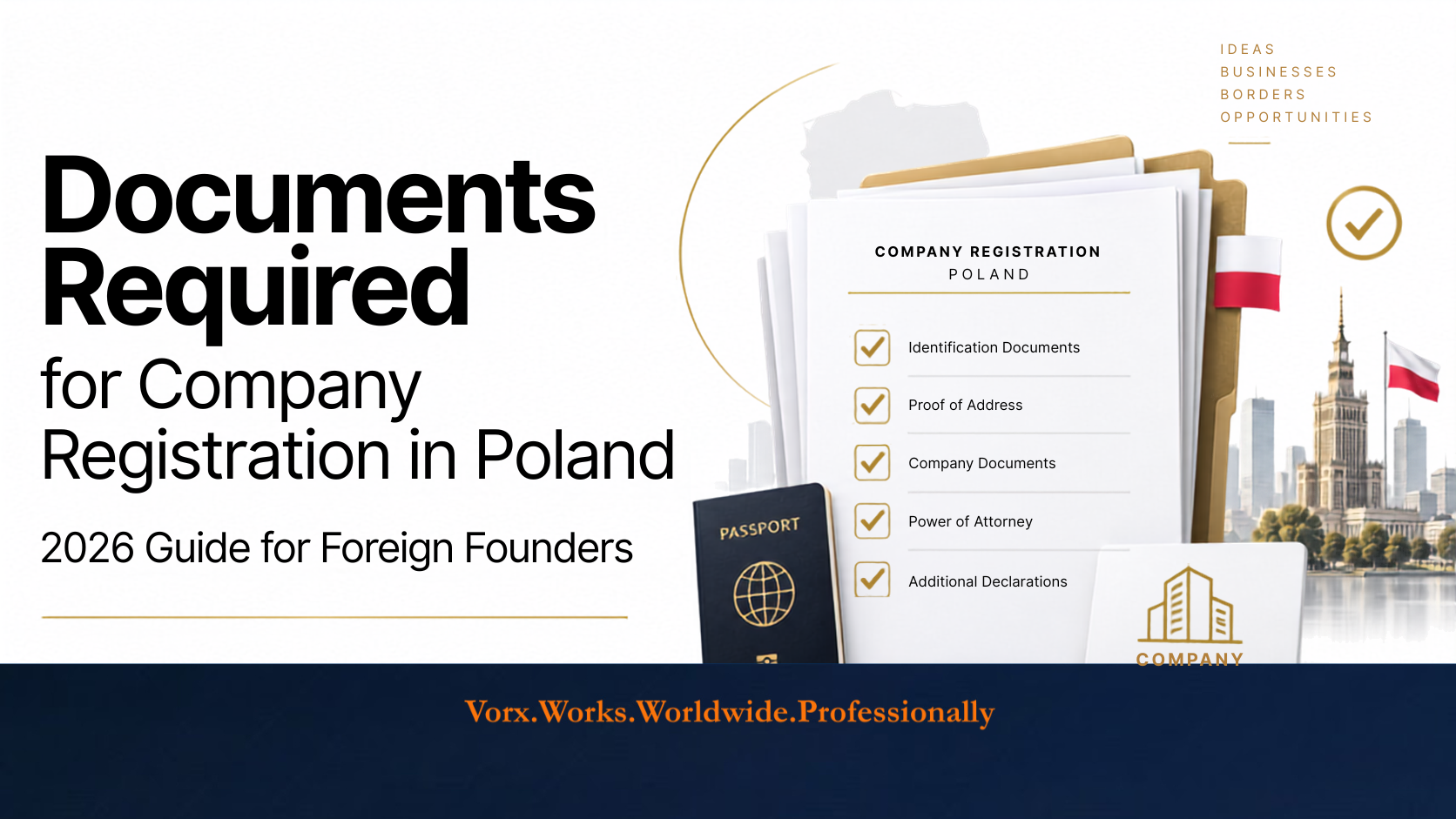
Poland has quietly become one of the more practical entry points into the European Union for founders looking to set up a local company, hire a team, or simply gain a legal presence in an EU market.
It has a stable legal system, a straightforward limited liability structure, and compared to many Western European countries a registration process that doesn’t require months of back and forth.
For Indian entrepreneurs and other non-EU founders, this often makes Poland an attractive base for expanding into the EU without relocating the whole business.
But before any of that becomes real, there’s a more immediate question: what documents do you actually need to get the company registered? This is where most guides fall short.
They list documents as if every founder is in the same situation, when in reality the paperwork depends heavily on who you are, where you’re based, and how you plan to sign things.
This guide breaks the requirements down by founder type, walks through the 2026 changes that non-EU applicants specifically need to know about, and gives you a realistic sense of timelines and costs.
At Vorx Consultancy, we work with founders through exactly this process, so this is written from what actually happens in practice, not just what the regulations say on paper.
Why the Document List Isn't the Same for Everyone
Before diving into checklists, it helps to understand the four things that shape which documents you’ll need:
Whether you’re an individual founder or registering through a foreign company as a shareholder. Whether you’re an EU/EEA national or a non-EU national. Whether you plan to be physically present in Poland or handle everything remotely through a representative.
And whether you register through Poland’s online S24 system or the traditional notarial route.
Change any one of these variables and the document package shifts. A UK-based solo founder filing through S24 will have a noticeably lighter list than an Indian holding company appointing three board members through a power of attorney. Keeping this in mind will make the rest of this guide much easier to apply to your own situation.
What Are the Core Documents Every Sp. z o.o. Needs?
Regardless of who’s behind it, every Polish limited liability company (Sp. z o.o.) the structure most foreign founders choose needs a baseline set of documents and decisions in place before registration:
Articles of association (umowa spółki) — either a standard template if filing through S24, or a custom-drafted version if going through a notary
Proof of a registered office address in Poland — this can be a physical office or a virtual office address, which is common for founders who aren’t yet operating locally
Confirmation of share capital — the statutory minimum is PLN 5,000, split according to the ownership structure
Management board details — board members don’t need to be Polish or even EU citizens
PKD business activity codes — Poland’s classification system for describing what the company actually does
None of this is unusual by European standards, but it’s the foundation everything else builds on. Get this wrong an incomplete address confirmation, for instance and the rest of the application stalls regardless of how well-prepared your personal documents are.
What Documents Does an Individual Foreign Founder Need?
If you’re registering as an individual rather than through an existing company the core requirement is simple on the surface: a valid passport.
Sworn translation of the passport is occasionally requested by banks or specific offices, though it isn’t always mandatory for the registration itself.
Where things diverge is nationality. EU, EEA, and Swiss nationals generally move through the process without additional identity hurdles. Non-EU nationals face an extra layer, which brings us to a change that’s reshaping how non-EU founders need to plan.
Vorx Consultancy Insight: We’ve noticed that founders who assume “a passport is enough” are often the ones most surprised by delays later in the process, usually around banking or tax filings, not the initial registration itself.
Not sure which documents apply to your situation? Vorx Consultancy can help you prepare the correct registration documents for Poland.
The 2026 PESEL Rule Change: What Non-EU Founders Need to Know
This is arguably the most important update in this guide, and it’s one that a lot of older articles simply haven’t caught up with.
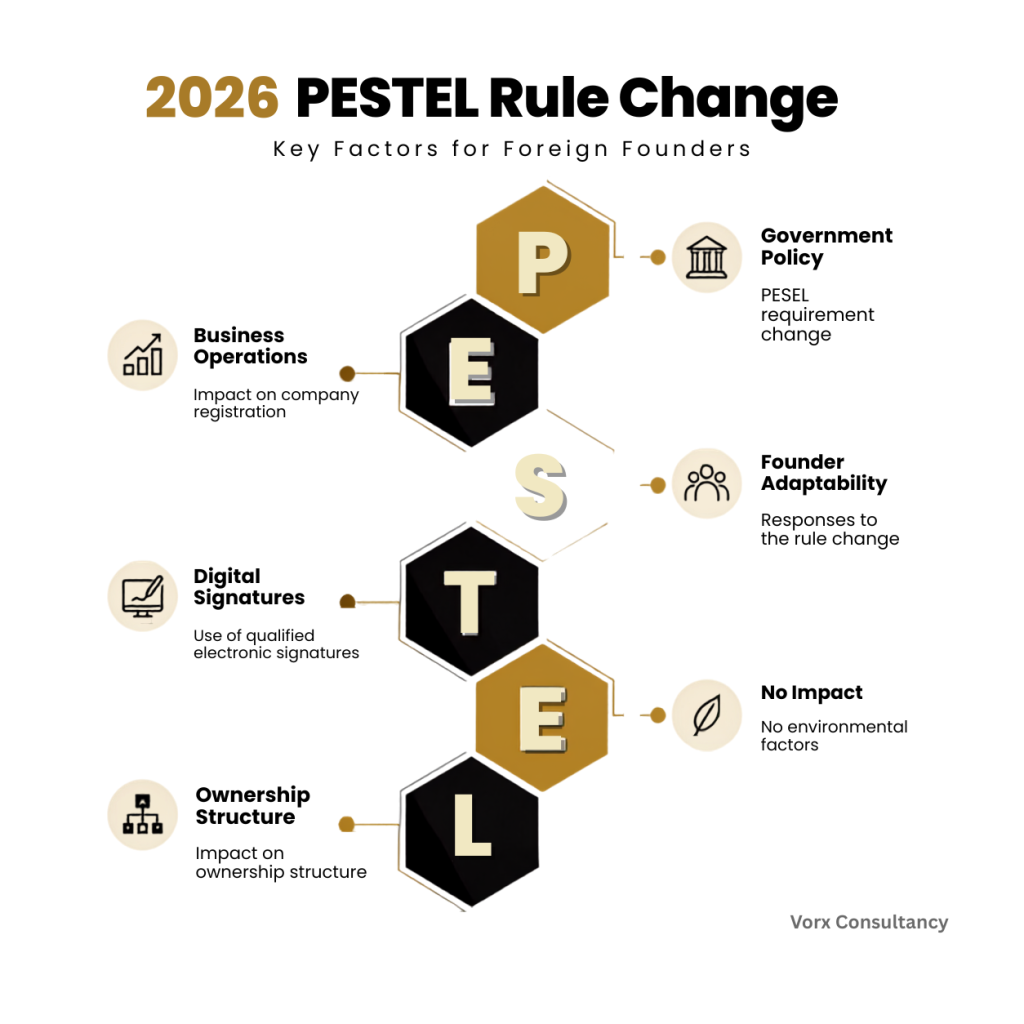
A PESEL number is Poland’s national identification number. It isn’t technically required to register a company, but in practice, it becomes hard to avoid it’s used for signing filings electronically, appearing on the beneficial ownership register, opening a business bank account, and handling ongoing tax reporting.
Until the end of 2025, foreign nationals could obtain a PESEL number through a proxy: send a notarized passport copy and a power of attorney, and a representative in Poland could handle the rest remotely.
As of 1 January 2026, that changed. Foreigners who are not citizens of the EU, EFTA countries, Switzerland, or the UK are now required to appear in person at a Polish municipal office to obtain a PESEL number. A representative can no longer do this on your behalf.
For a founder based in Mumbai, Dubai, or São Paulo, this means one board member may need to physically travel to Poland at some point not necessarily before registration, but likely before the company can operate smoothly on an ongoing basis.
Some founders are responding by appointing an EU-based co-director for administrative continuity, or by relying more heavily on qualified electronic signatures where PESEL isn’t strictly unavoidable.
Neither approach is universally right; it depends on the ownership structure and how hands-on the foreign founder plans to be.
This is a genuine shift in how Poland handles foreign business ownership, and it’s worth factoring into your timeline expectations from the start rather than discovering it midway through registration.
What Documents Are Needed When a Foreign Company Is the Shareholder?
Many international founders don’t register as individuals at all; they set up the Polish company as a subsidiary, with an existing foreign company as the shareholder.
This is common for businesses expanding into the EU under an established parent entity.
In this scenario, the documentation is heavier:
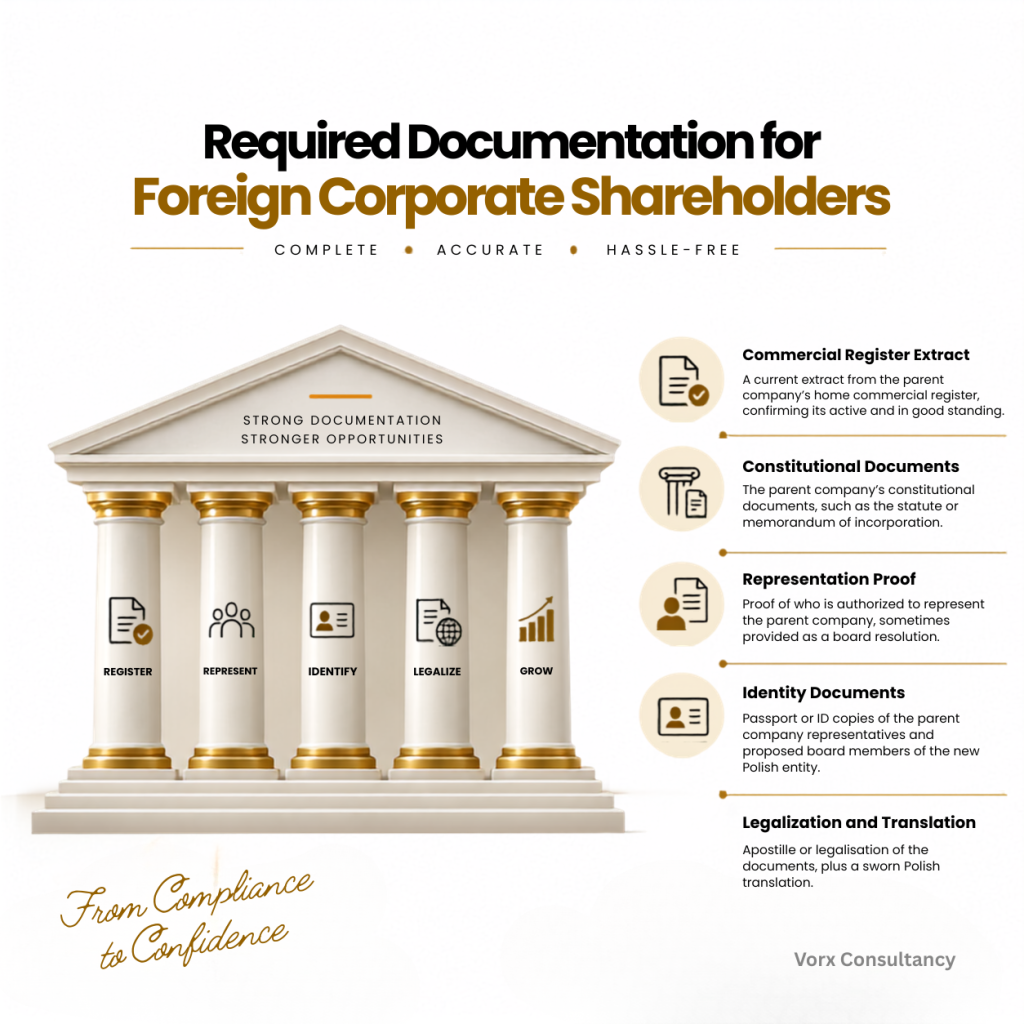
- A current extract from the parent company’s home commercial register, confirming it’s active and in good standing.
- The parent company’s constitutional documents (statute or memorandum of incorporation)
- Proof of who is authorized to represent the parent company — sometimes a board resolution
- Passport or ID copies of the individuals who will represent the parent company, and of the proposed board members of the new Polish entity
- Apostille or legalisation of the above, plus sworn Polish translation
Setting up a Polish subsidiary? We can help with apostilles, translations, corporate documents, and registration.
Example: A Bangalore-based software company wanted to open a Polish subsidiary to serve EU clients directly.
Because the parent company was the sole shareholder, the process required an apostilled extract from India’s Registrar of Companies, a sworn Polish translation of that extract, and a notarized board resolution naming the individual authorized to sign on the parent company’s behalf.
The registration itself moved quickly once the documents were ready; the delay was almost entirely in preparing and translating the paperwork on the Indian side, not in Poland.
This is a pattern worth noting: for corporate shareholders, the bottleneck is rarely the Polish registration process itself. It’s collecting and properly certifying documents from the home country.
Do You Need an Apostille, or Full Legalisation?
This distinction trips up a lot of founders, so it’s worth explaining plainly.
If your home country is a signatory to the Hague Apostille Convention, an apostille a single certification stamp is usually enough to make your documents valid in Poland.
India is a signatory, which works in favor of Indian founders here. If your country isn’t part of the convention, you’ll need full consular legalisation instead, which typically takes longer and involves more than one authority.
Either way, any document not originally in Polish needs a sworn translation completed by a Polish-licensed sworn translator (tłumacz przysięgły).
A certified translation done in your home country usually isn’t accepted on its own; it often needs to be redone by a translator licensed in Poland. This is one of the more common (and avoidable) sources of delay.
When Do You Need a Power of Attorney?
If you’re not planning to be physically present in Poland for the notary appointment, a power of attorney (POA) becomes the document that makes remote incorporation possible at all.
It authorizes a representative, typically a Polish lawyer to sign the deed of incorporation and handle the registration steps on your behalf.
The POA itself needs to be specific. A vague or overly general document can cause problems exactly when your representative needs to rely on it, so it’s worth having it reviewed rather than using a generic template. It also needs to be notarized in your home country, apostilled or legalised, and translated into Polish before it can be used.
Founders who want to avoid this chain of certifications sometimes opt instead for a qualified electronic signature, which allows them to sign registration documents remotely without a POA — though this route has its own setup requirements and works better through the S24 online system than the traditional notarial process.
S24 or Traditional Notarial Registration Which Fits Your Situation?
S24 (Online) | Notarial Route | |
Speed | Faster, often within days | Slower, depends on notary availability |
Articles of association | Standard template only | Fully customizable |
Signing method | Trusted Profile or qualified e-signature | In-person or POA-based notary signing |
Best suited for | Solo founders, simple structures | Multi-shareholder or complex ownership arrangements |
If your ownership structure is simple and you’re comfortable with a standard template, S24 is usually the more efficient path.
If you need custom terms in your articles of association, say, specific voting rights among shareholders the notarial route gives you that flexibility, at the cost of a longer document chain.
Read this guide : How to Register a Company in Poland: Complete 2026 Guide for Foreign Founders
What Happens After Registration?
Getting the KRS entry (Poland’s National Court Register) is a milestone, not the finish line. A few things follow quickly:
The company must be entered into the CRBR (Central Register of Beneficial Owners) within 14 days of KRS registration, which requires clear documentation of who ultimately owns and controls the business.
Tax registration NIP and REGON numbers, and VAT-R if applicable typically follows. And opening a business bank account has, in practice, become its own hurdle: many Polish banks now request a PESEL number or extended KYC documentation from foreign shareholders, independent of what the KRS already required.
This last point catches a lot of founders off guard. The company can be legally registered and still be unable to receive payments simply because the bank account isn’t open yet.
How Long Does This Actually Take?
There’s no single answer, but rough patterns hold up in practice:
An individual founder with a passport and a qualified electronic signature can often be ready to file within days.
A structure involving a foreign corporate shareholder should realistically budget three to six weeks just for document preparation apostilles and sworn translations are usually the slowest part, not the Polish registration itself.
And where a non-EU board member needs a PESEL number under the new 2026 rule, that in-person appointment can add further lead time depending on how quickly a visit to Poland can be arranged.
Conclusion
Registering a company in Poland isn’t complicated in the way people often assume but it does reward preparation.
Founders face fewer delays because of badly prepared documents than due to Polish bureaucracy. For instance, wrongly prepared apostilles, unlicensed Polish translation of documents, and unclear power of attorney.
Knowing your position whether it is an individual shareholder or corporate one, EU or non-EU, remote or physically present before you start preparing documents allows you to progress from smooth registration to problematic one.
Planning becomes more relevant for non-EU founders due to PESEL change in 2026. It will not prevent you from starting a business in Poland, but it will require taking into account some aspects like the board composition, banks, and travel to Poland in advance.
Ready to register your company in Poland? Vorx Consultancy can support you from document preparation to registration and post-registration compliance.
