


Poland has become one of the more practical entry points into the European Union for founders looking to register a company, hire locally, or simply gain a foothold in the EU market.
But there’s a step that surprises a lot of foreign entrepreneurs: getting the company registered is often the easy part. Opening the business bank account that makes the company actually usable is where things slow down.
This isn’t because Polish banks are difficult for the sake of it. Poland follows EU anti-money-laundering rules closely, and banks are required to look harder at companies with foreign owners, foreign directors, or no obvious local footprint.
If you understand what they’re checking for and prepare accordingly, the process is manageable. If you don’t, it can stall for weeks over paperwork that could have been sorted out in advance.
This guide walks through what actually happens, in the order it happens, so you’re not caught off guard partway through.
Why Do Polish Banks Apply Such Strict Checks to Foreign-Owned Companies?
Every EU bank operates under anti-money-laundering (AML) and know-your-customer (KYC) obligations, and Poland is no exception.
When the owner or director of a company isn’t a Polish resident, the bank’s compliance team has less context to work with no local credit history, no easy way to verify the business is genuinely operating, and a higher regulatory expectation to check where the money is coming from.
That’s not a judgment on the founder. It’s simply how the system is built. A bank that skips this step for a foreign-owned entity risks its own licence.
Once you see the process through that lens, requests for source-of-funds documents or a UBO (ultimate beneficial owner) declaration make a lot more sense; they’re not obstacles, they’re the bank protecting its ability to operate.
Vorx Consultancy Insight: We often see founders treat the bank account stage as an afterthought after company registration. In practice, preparing your documentation for both at the same time saves real time later.
Which Legal Structure Should You Register First?
The structure you choose affects how the bank evaluates your application later, so it’s worth getting right from the start.
- Sole proprietorship (JDG): Simple and fast to register, but generally only available to individuals with a Polish residence permit, not the typical route for a non-resident founder.
- Limited liability company (sp. z o.o.): The most common structure for foreign entrepreneurs. It’s the entity type Polish banks are most accustomed to reviewing, which tends to make the account-opening conversation more straightforward.
- Branch office: Useful if you already run an established company abroad and want a Polish extension of it, though banks will look closely at the parent company’s activity too.
- Representative office: Limited to marketing and liaison activities, not full commercial operations, so banking needs are typically lighter.
For most foreign founders building an operating business in Poland, the sp. z o.o. is the practical default.
Read this guide: Documents Required for Company Registration in Poland
Getting the Sequence Right: Company Registration Before Banking
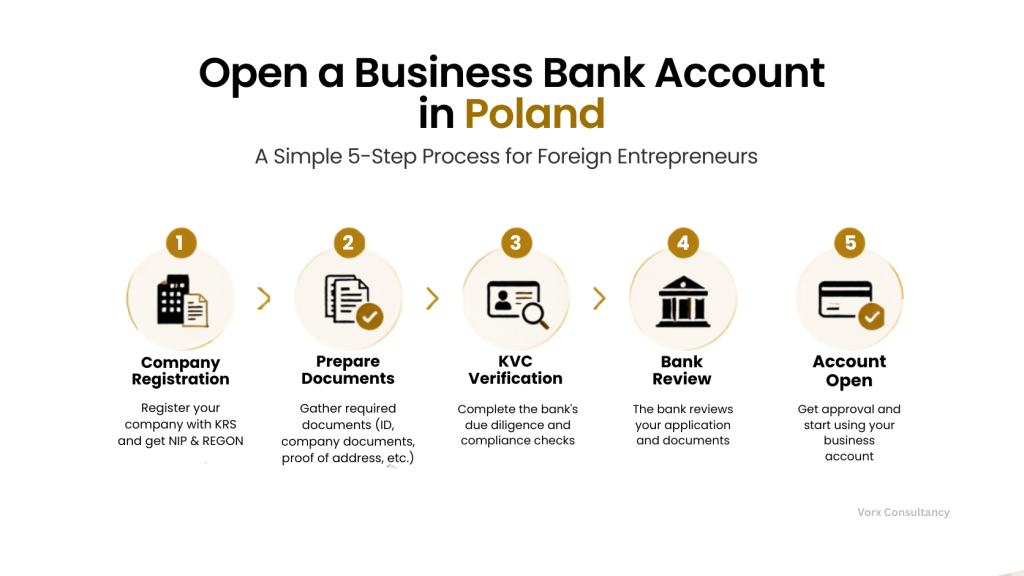
One detail that trips people up is the order of operations. You can’t open a business account before the company legally exists, but some early obligations — like VAT registration — assume you already have one. The realistic sequence looks like this:
- Register the company with the National Court Register (KRS)
- Receive your NIP (tax ID) and REGON (statistical number)
- File beneficial ownership information with the CRBR register
- Apply for the business bank account
- Complete VAT registration, where applicable
Skipping ahead rarely works. Most banks will ask for your KRS extract and CRBR confirmation before they’ll even schedule a compliance interview.
Need Help Setting Up Your Company in Poland?
From company registration to banking and compliance, we help foreign founders manage the process step by step.
What Documents Will the Bank Ask For?
The exact list varies by bank and by how complex your ownership structure is, but plan to have the following ready:
Document | Purpose |
KRS extract | Confirms the company is legally registered |
NIP / REGON certificates | Tax and statistical identification |
Articles of association | Explains company structure and activity |
CRBR confirmation | Verifies beneficial ownership |
Passports of directors and signatories | Identity verification |
Proof of Polish registered address | Confirms local presence |
Source of funds / wealth evidence | Required more often for non-resident owners |
Business plan or contracts/invoices | Demonstrates genuine business activity |
Foreign-issued documents may need a sworn Polish translation, and in some cases, notarization or apostille. It’s worth checking this early — translation delays are a common, avoidable cause of slow applications.
Make Your Application Bank-Ready
Avoid unnecessary delays with the right documents and a properly prepared banking application.
How Does the Application Process Actually Work?
Step 1 — Choose your bank or provider. Not every bank is equally comfortable with foreign-owned companies.
Some require an in-branch visit for every non-resident applicant; a few offer more flexibility through an appointed local representative.
Step 2 — Submit your application and documents. This can happen in person, or in some cases through a facilitator acting under power of attorney.
Step 3 — Compliance interview. Expect questions about your business model, expected transaction volumes, who you’ll be paying and receiving money from, and the source of your initial capital. This isn’t a formality — it’s the core of the bank’s risk assessment.
Step 4 — UBO and source-of-funds review. For companies with layered ownership (holding companies, multiple shareholders), this step tends to take longer.
Step 5 — Account activation. Once approved, the account is opened, though online banking access and cards sometimes follow a few days later.
Read this guide: How to Register a Company in Poland
Example: A founder from India setting up a sp. z o.o. for an e-commerce business typically moves through this process in three to five weeks, assuming documents are translated and ready upfront and the ownership structure is simple.
Add a holding company layer or a nationality flagged for enhanced due diligence, and that timeline can stretch considerably.
Comparing Poland's Major Banks for Foreign-Owned Businesses
Bank | Remote Onboarding | English Support | Typical Fit for Non-Residents |
PKO BP | Limited | Moderate | Large branch network, in-person preferred |
Santander | Partial | Good | Reasonably accustomed to foreign SMEs |
mBank | Limited | Good digital tools | Strong app, but branch visit usually required |
ING | Partial | Good | Popular with foreign-owned startups |
Pekao | Limited | Moderate | Established corporate banking arm |
Millennium | Limited | Moderate | Competitive fees, standard KYC process |
Policies and onboarding options change fairly often, so it’s worth confirming current terms directly with the bank rather than relying on marketing pages, which sometimes overstate how “remote” the process really is.
The Compliance Detail Most Guides Skip: Split Payment and the VAT White List
Two Poland-specific rules catch a lot of foreign founders off guard, and they’re worth understanding before you commit to an account.
Split payment (mechanizm podzielonej płatności): For certain transactions, Polish VAT rules require the VAT portion of a payment to go into a separate, dedicated VAT sub-account linked to your main business account.
That money isn’t fully yours to move freely — it’s restricted for tax purposes. If you’re not expecting this, it can look like a cash flow problem when it’s actually just how the mechanism works.
The VAT White List (Biała lista podatników VAT): Poland maintains an official registry of VAT-registered bank accounts.
If you pay a Polish supplier more than PLN 15,000 into an account not listed on this registry, the expense can lose its tax deductibility, and you may face joint liability for the supplier’s unpaid VAT.
This matters directly for account choice — it’s one reason a purely foreign fintech account may not be the right fit for VAT-heavy B2B operations in Poland.
Vorx Consultancy Insight: Founders sometimes choose an account based on fees and app quality alone, without checking whether it interacts properly with these two mechanisms. It’s a small thing to verify upfront and a costly thing to discover later.
Why Do Banks Reject Business Account Applications?
The most common reasons we see include:
- Lack of local substance — no Polish address, staff, or clear operational footprint beyond the registration itself
- High-risk business activities — crypto, gambling, or forex-adjacent businesses face heavier scrutiny
- Nationality or jurisdiction flags — applicants connected to FATF grey-listed countries often face extended review
- Incomplete UBO or source-of-funds documentation — inconsistent paperwork is one of the fastest ways to trigger a rejection
- Unclear business rationale — if it isn’t obvious why the company needs to be in Poland specifically, compliance teams may treat that as a shell-company signal
None of these are guaranteed dealbreakers, but they’re worth addressing directly in your application rather than hoping they go unnoticed.
Conclusion
Opening a business bank account in Poland as a foreign entrepreneur isn’t complicated once you understand the logic behind it: banks are verifying that your business is real, transparent, and properly structured.
Get your entity type right, prepare your documents before you apply, and understand how split payment and the White List affect your day-to-day operations, and the process tends to move a lot more smoothly than the horror stories suggest.
At Vorx Consultancy, we help founders work through this exact sequence — from choosing the right entity structure to preparing a bank-ready application — so the account isn’t the thing holding your Polish business back.
Ready to Set Up Your Business in Poland?
Vorx Consultancy can help you with company formation, documentation, banking preparation, and compliance — so you can focus on building your business.