

Poland has quietly become one of the more attractive entry points into the European Union for foreign entrepreneurs, particularly for founders building software, manufacturing, or services businesses that need EU market access without the cost base of Western Europe.
For Indian entrepreneurs especially, Poland offers something practical: a large domestic market, a skilled workforce, and a tax system that is more predictable than it looks at first glance provided you understand how it treats foreign ownership specifically.
That last part matters more than most guides admit. A Polish subsidiary owned by a founder in Bangalore, Dubai, or London doesn’t just pay the same corporate tax as a locally owned company.
It sits inside a slightly different set of rules the moment money starts moving between the Polish entity and its foreign parent dividends, loans, royalties, management fees.
This guide walks through what actually applies to you as a foreign owner, not just the general tax code.
Read this guide: How to Register a Company in Poland
What Is the Corporate Tax Rate in Poland?
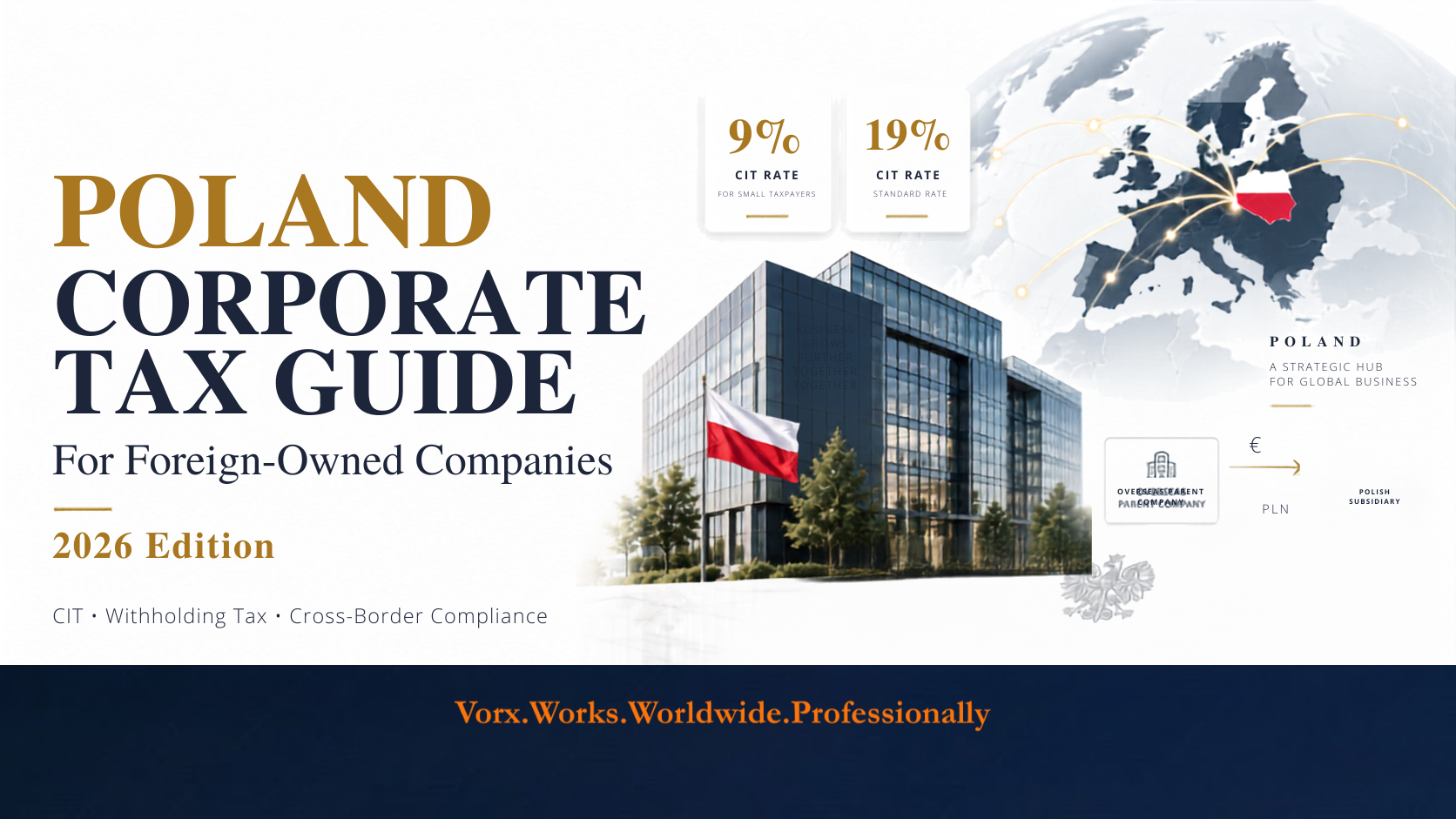
Poland’s standard corporate income tax (CIT) rate is 19 percent, applied to a company’s worldwide income if it’s tax resident in Poland (meaning it has its registered office or place of management there).
A reduced 9 percent rate is available to small taxpayers and newly formed companies, generally where annual revenue stays under the equivalent of EUR 2 million and the company isn’t part of a larger tax capital group or the result of certain restructurings.
This is genuinely useful for early-stage foreign-owned subsidiaries; a founder testing the EU market with a small Polish team can often qualify in the first year or two.
Here’s a practical example. Say a founder incorporates a small Polish sp. z o.o. to handle EU sales for a software product, with projected first-year revenue well under EUR 2 million.
That entity would typically fall under the 9 percent rate, not the standard 19 percent, a meaningful difference when you’re reinvesting early profit into hiring or product development.
One point worth flagging early: the 9 percent rate is not automatic. It depends on meeting the conditions in the year in question, and it’s worth reviewing this annually rather than assuming it continues indefinitely.
Do Foreign Companies Pay Tax in Poland Without a Local Subsidiary?
This is a question we hear often at Vorx Consultancy, usually from founders who assume tax obligations only start once a company is formally incorporated. That’s not quite right.
Poland can tax a foreign company even without a locally registered entity, if that company is considered to have a permanent establishment (PE) in Poland.
A PE can arise from a fixed place of business, a dependent agent regularly concluding contracts on the company’s behalf, or an ongoing construction or installation project past a certain duration.
In practice, this usually catches foreign companies that send staff to work from a Polish office, use a local representative who effectively runs sales, or maintain an ongoing physical presence without setting up a formal branch or subsidiary.
If a PE is triggered, the foreign company becomes liable for Polish CIT on the income attributable to that Polish activity even though it never intended to become a Polish taxpayer.
The safer approach, if you’re planning any sustained activity in Poland, is to get a clear read on whether your model creates a PE before it happens, rather than after the tax office raises the question.
Which Business Structure Should Foreign Founders Choose in Poland?
Most foreign investors end up choosing between a limited liability company (sp. z o.o.), a joint-stock company (S.A.), or a branch of the foreign parent. Each comes with a different tax and compliance profile.
Structure | Tax treatment | Best suited for |
Sp. z o.o. (LLC) | Separate Polish taxpayer, taxed on worldwide income | Most foreign-owned operating subsidiaries |
S.A. (joint-stock) | Same CIT treatment as sp. z o.o., heavier governance requirements | Larger operations planning to raise capital or list |
Branch | Taxed as a permanent establishment of the foreign parent | Companies wanting a Polish presence without a separate legal entity |
Representative office | Generally not permitted to conduct commercial activity, limited CIT exposure | Market research or liaison functions only |
For most founders and mid-sized companies expanding into Poland, the sp. z o.o. remains the practical default; it limits liability, is well understood by Polish banks and tax authorities, and gives you a clean legal entity to contract, hire, and invoice through.
A branch can make sense if you specifically want to keep everything consolidated under the foreign parent’s books, but it comes with permanent establishment complexities of its own.
Incorporation itself requires registering a company name and address, drafting articles of association, defining share capital, and appointing a management board foreign documents typically need translation and, depending on the country, apostille or legalization.
Planning to set up a company in Poland?
Vorx Consultancy can help you choose the right structure and understand the tax and compliance requirements before incorporation.
How Do You File and Pay Corporate Tax in Poland?
Once incorporated, a Polish company files an annual CIT-8 return, alongside monthly or quarterly advance tax payments throughout the year based on running profit calculations.
Filing is done electronically through the e-Urząd Skarbowy platform, and missed deadlines attract late-payment interest.
There’s a newer compliance layer worth knowing about if you’re setting up in 2026: Poland is phasing in JPK_CIT, a structured digital reporting requirement for accounting books, and mandatory e-invoicing through KSeF, with large taxpayers required to comply from February 2026 and the rest of the VAT-registered business population following from April 2026.
If you’re choosing accounting software or an ERP system for your Polish entity now, it’s worth confirming KSeF compatibility upfront rather than retrofitting it later.
What Is the Withholding Tax "Pay and Refund" Rule and Why Does It Matter?
This is one of the most misunderstood parts of Polish tax law for foreign owners, and it deserves more attention than it usually gets.
When a Polish subsidiary pays dividends, interest, or royalties to its foreign parent, withholding tax (WHT) normally applies though tax treaties or EU exemptions can reduce or eliminate it.
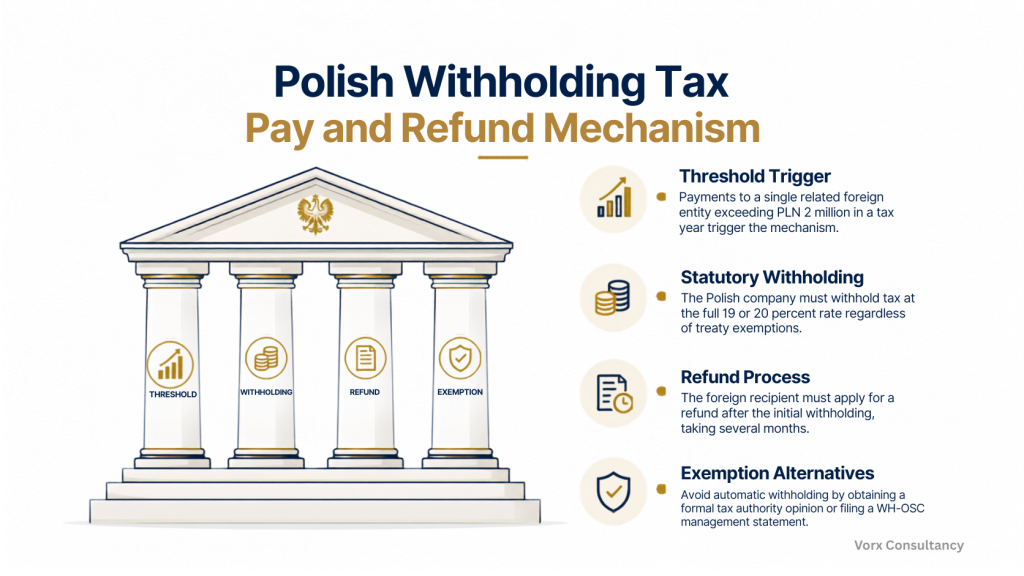
The complication is what’s known as the “pay and refund” mechanism. Once total payments of this kind to a single related foreign entity exceed PLN 2 million in a tax year, the Polish company is required to withhold tax at the full statutory rate (19 or 20 percent) first, regardless of whether a treaty or exemption would otherwise apply.
The foreign recipient then has to apply for a refund afterward, a process that can take several months.
There are two ways around automatic withholding: obtaining a formal opinion from the tax authority confirming the preferential treatment applies, or having the company’s management board file a statement (known as WH-OSC) confirming the conditions for the exemption are genuinely met. Neither is instant, so this needs planning well before a large dividend or interest payment is due.
It’s also worth knowing that the EU parent-subsidiary dividend exemption generally only applies where the parent company is resident in the EU or EEA and holds a minimum shareholding for a continuous period.
A parent company based in India, the UAE, the UK, or the US doesn’t automatically get this exemption; it depends entirely on the applicable double tax treaty, which makes early tax planning genuinely worthwhile rather than optional.
Moving profits between Poland and your foreign parent company?
Get professional guidance on withholding tax, profit repatriation, and cross-border compliance before making payments.
What Is Poland's Minimum Income Tax and Could It Affect You?
From 2024, Poland applies a minimum income tax under Article 24ca of the CIT Act, aimed at companies that report a loss or very thin profitability specifically, an income-to-revenue ratio of 2 percent or lower on non-capital-gains activity.
Here’s why this matters specifically for foreign-owned subsidiaries: many operate on deliberately thin margins for transfer pricing reasons, invoicing the parent company for costs plus a small markup.
That’s exactly the profile this tax was designed to catch. The rate is 10 percent, calculated on a base that includes a portion of revenue, excess debt-financing costs, and certain royalty or intangible service payments made to related parties above a set threshold.
Small taxpayers (broadly, those under the EUR 2 million revenue threshold) and companies in their first three years of operation are generally exempt, which gives newer foreign-owned entities some breathing room but it’s worth modelling this out before your subsidiary’s margins settle into a “thin but stable” pattern long-term.
Are There Tax Incentives for Foreign Investors in Poland?
Poland does offer real incentives, and they’re worth exploring alongside standard CIT planning. The Polish Investment Zone (the successor to the older Special Economic Zones) offers CIT exemptions tied to qualifying investment projects and job creation.
The IP Box regime allows a reduced 5 percent CIT rate on income from qualifying intellectual property, which can be relevant for software and R&D-heavy foreign subsidiaries. There’s also general R&D relief for companies investing in research activity locally.
These incentives can genuinely reduce your effective tax rate, but they come with conditions around documentation and eligibility that are worth reviewing case by case rather than assuming they apply automatically to your business model.
How Do You Repatriate Profits from a Polish Company?
For most foreign owners, this is the question that actually matters day to day: once the Polish entity is profitable, what’s the most efficient way to get that value back to the parent company?
The three common routes dividends, intercompany loan interest, and management or service fees each carry different withholding tax treatment, different documentation requirements (tax residency certificates, beneficial ownership verification), and different interaction with the PLN 2 million pay-and-refund threshold discussed earlier.
Dividends are often the cleanest route where the EU exemption or a favorable treaty rate applies, but timing matters — shareholding period requirements mean an early, rushed first distribution can sometimes forfeit an exemption that a slightly later one wouldn’t.
Read this guide: Documents Required for Company Registration in Poland
What Common Mistakes Do Foreign-Owned Companies Make?
A few patterns come up repeatedly. Founders assume a treaty rate applies automatically once payments cross the PLN 2 million threshold, and get an unwelcome cash-flow surprise.
Subsidiaries run thin transfer-pricing margins without checking exposure to the minimum tax.
Companies treat a short-term project presence or a representative office as tax-free, without realizing it has quietly created a permanent establishment.
And registration for CIT, VAT, withholding tax, and social security is handled as a series of disconnected steps rather than one coordinated onboarding process which is usually where avoidable delays and penalties creep in.
How Vorx Consultancy Helps
Most of the issues covered above aren’t complicated on their own; the challenge is that they interact.
A dividend timed too early can forfeit an exemption. A margin set too thin can trigger the minimum tax. A local hire made without checking the activity can quietly create a permanent establishment.
At Vorx Consultancy, we work with foreign founders, investors, and finance teams through exactly these decision points: choosing the right entity structure, planning the timing and route for profit repatriation, and coordinating registration so CIT, VAT, withholding tax, and social security obligations are handled as one process rather than several disconnected ones.
The goal isn’t to remove complexity from Polish tax law, it’s to make sure you’re making informed decisions before money moves, not after.
Final Thoughts
Poland’s corporate tax system is manageable once you understand where foreign ownership changes the picture and increasingly, it’s a system worth understanding properly rather than assuming it works like your home jurisdiction.
At Vorx Consultancy, we help founders and finance teams evaluate exactly these questions before incorporation: which entity structure fits, how repatriation should be timed, and where the withholding tax and minimum tax rules are likely to apply to your specific business model.
Requirements do shift from year to year, so it’s worth confirming current thresholds and rates before making a final decision, particularly for anything time-sensitive like a dividend distribution or a KSeF compliance deadline.
Expanding your business into Poland?
Vorx Consultancy helps foreign founders and companies navigate company formation, corporate tax, compliance, and cross-border structuring in Poland.
Start your Poland expansion with Vorx Consultancy
