

Poland has become a natural entry point for founders looking at Central and Eastern Europe.
It sits inside the EU single market, has a large skilled workforce, and offers a business registration process that’s genuinely fast by European standards.
But before any of that matters, foreign entrepreneurs face one practical decision: register as a sole proprietor (JDG) or set up a limited liability company (Sp. z o.o.)?
The two structures aren’t just different paperwork; they lead to different tax bills, different liability exposure, and in some cases, different answers to whether you can even register at all.
This guide walks through what actually separates them, specifically from the perspective of someone starting a business in Poland from abroad.
What Are Sp. z o.o. and JDG, in Plain Terms?
JDG (jednoosobowa działalność gospodarcza) is Poland’s sole proprietorship structure. You register as an individual, the business has no separate legal identity from you, and your personal income and business income are effectively the same thing for tax purposes.
Sp. z o.o. (spółka z ograniczoną odpowiedzialnością) is Poland’s equivalent of a limited liability company.
It’s a separate legal entity that can own assets, sign contracts, and be held liable in its own name which is the main reason founders choose it over a JDG.
Vorx Consultancy Insight: We often see founders default to whichever structure their accountant mentions first, without weighing it against their actual plans — solo consulting work looks very different from a business meant to raise investment or hire a team.
Can Foreigners Register a Business in Poland?
This is where the two structures genuinely diverge, and it’s a step that gets overlooked in a lot of generic comparisons.
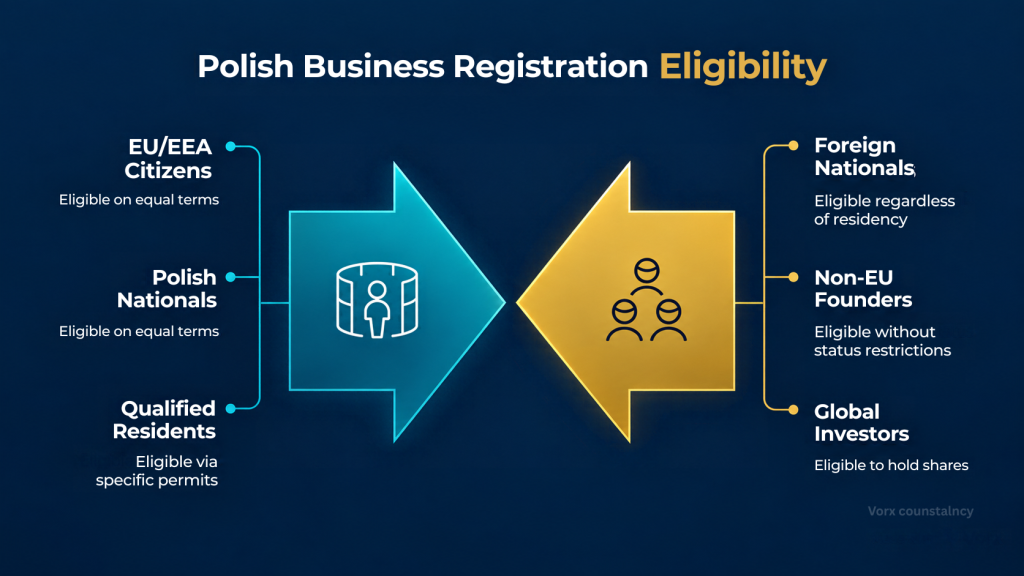
EU, EEA, and Swiss citizens can register a JDG in Poland on broadly the same terms as Polish nationals. Non-EU citizens are a different story. JDG eligibility depends on your residence status.
Having a permanent residence permit, EU long-term resident status, or certain qualifying residence permits generally allows it; a standard tourist stay or many temporary permits do not.
Sp. z o.o. doesn’t carry this restriction. Nationality and residence status don’t determine whether you can hold shares in a Polish company.
This is one reason non-EU founders often gravitate toward Sp. z o.o. by default not necessarily because it’s the better structure for them, but because it’s the one they’re clearly eligible for.
Example: An Indian founder building a small IT consultancy with EU clients found she didn’t qualify for JDG registration under her current residence permit, but could set up a Sp. z o.o. and operated through it while her residency application was still pending.
Requirements around this can change Poland has adjusted JDG access rules for specific nationalities in the past.
It’s worth confirming current eligibility for your specific passport and residence status before assuming either path is open to you.
Read this guide: How to Register a Company in Poland
Do You Need to Be in Poland to Register?
Not necessarily, and this matters if you’re planning the business before relocating.
JDG registration runs through the CEIDG system and generally works best with a PESEL number, which typically requires some form of presence or prior registration in Poland. It’s possible without one in certain cases, but it adds friction.
Sp. z o.o. can be incorporated online through the S24 system, or remotely using a notarized and apostilled power of attorney if the online system doesn’t fit your situation.
Founders who haven’t relocated yet, or who don’t plan to relocate at all, generally find Sp. z o.o. the more workable route for a fully remote setup.
Comparing Liability, Tax, and Structure
Factor | JDG | Sp. z o.o. |
Who can register | EU/EEA/Swiss citizens freely; others depend on residence status | Generally open to foreign founders |
Setup time | Usually faster through CEIDG | Usually takes longer |
Liability | Personal assets may be at risk | Liability is generally limited to company assets |
Tax | PIT applies | CIT applies; dividends may also be taxed |
ZUS | Usually mandatory | Depends on ownership structure |
Best for | Freelancers and solo professionals | Growing businesses, teams, and investors |
The tax line deserves a closer look, because it’s often the deciding factor. JDG income is taxed once, as personal income.
Sp. z o.o. profit is taxed at the corporate level, and taxed again when it’s paid out to shareholders as dividends sometimes described as “double taxation.”
For a solo consultant billing a handful of clients, that second layer can outweigh the liability protection. For a founder planning to reinvest profits rather than draw them out immediately, it matters less.
Not sure whether JDG or Sp. z o.o. is right for you?
Get expert guidance from Vorx Consultancy before setting up your business in Poland.
Get Expert Guidance with Vorx Consultancy
Vorx Consultancy Insight: We generally advise founders to model both tax scenarios against realistic revenue, not just the headline rates — the better structure on paper isn’t always the better structure for your actual cash flow in year one.
What About ZUS Contributions?
ZUS is Poland’s social security system, and it applies differently depending on structure.
Under JDG, contributions are mandatory, though new businesses can access a preferential period with reduced payments before moving to standard rates.
Within the limited liability company (Sp. z o.o.), many things will be based on the company’s structure.
If there is only one shareholder and he or she is the only member of the management board, he or she still may be subject to ZUS payments.
However, if there are several shareholders or the management board consists mainly of managers, sometimes ZUS does not have to be paid.
The issue is rather complex, and depends on your actual shares and company organization. Look at your real situation instead of basing your decision on assumptions.
EU citizens can take advantage of coordination of social security within EU countries and, thereby, avoid double payments of contributions.
Does Setting Up a Sp. z o.o. Help With Residency?
This question comes up constantly, and it deserves a careful answer rather than a hopeful one.
Owning or running a Polish company does not, by itself, guarantee any residence permit, and a residence permit does not automatically lead to permanent residence or citizenship.
What company formation can do is support certain types of business or investor visa applications.
Good planning and organization of the company demonstrate the strength and viability of the idea, and that is important when dealing with such applications.
Yet the outcome will depend on the specific visa you apply for, your particular case and the changing immigration regulations.
In case of moving to Poland being part of your objectives, consider company formation and immigration planning as connected but separate issues, ideally handled by one person.
Read this guide: Documents Required for Company Registration in Poland
Banking and Practical Setup as a Non-Resident
Opening a Polish business bank account without local residency is possible but not always straightforward.
Banks vary in their documentation requirements for non-resident applicants, and some require an in-person visit even when the rest of the incorporation was done remotely.
A registered business address is required for both structures, and a virtual office address is commonly used by foreign founders who don’t have a physical premises in Poland yet.
If you’re selling across borders, VAT-EU or OSS registration may also apply depending on where your customers are based. This is worth planning for early rather than retrofitting once revenue starts coming in.
Starting a business in Poland from abroad?
Vorx Consultancy can help you navigate company formation, banking, and compliance requirements.
Which Structure Actually Fits Your Situation?
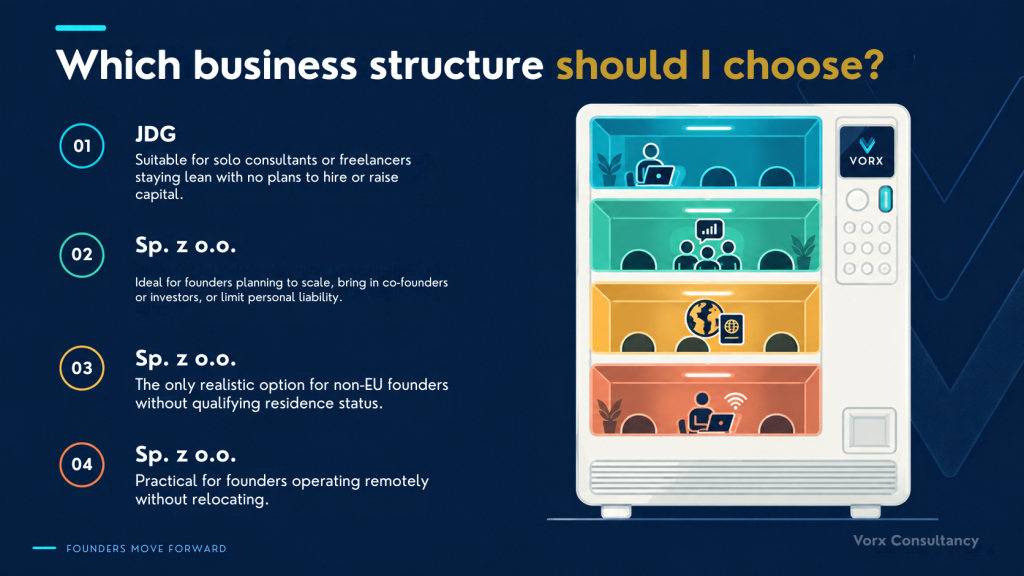
Rather than a universal answer, it helps to think in terms of your own plans:
Solo consultant or freelancer, staying lean, no plans to hire or raise capital JDG is usually simpler and cheaper to run, assuming you’re eligible to register one.
Founder planning to scale, bring in co-founders or investors, or limit personal liability : Sp. z o.o. is generally the stronger fit, despite the higher setup cost and double taxation on distributed profits.
Non-EU founder without qualifying residence status : Sp. z o.o. may be the only realistic option regardless of business size.
Founder who hasn’t relocated and wants to operate remotely: Sp. z o.o. Online and remote incorporation routes tend to be more practical than JDG’s residency-linked process.
None of these are hard rules; they’re starting points for a decision that should also account for your industry, whether it requires specific licenses, and your longer-term plans for the business.
Can You Switch Later?
Yes. Starting as a JDG doesn’t lock you in permanently Poland allows a statutory transformation from JDG into Sp. z o.o. as the business grows, which carries over most contracts and permits under specific conditions.
It’s a separate, fairly involved legal process, so if that’s a path you’re already anticipating, it’s worth factoring into your initial decision rather than treating it purely as a future problem.
Conclusion
There’s no single “better” structure between Sp. z o.o. and JDG there’s the one that fits where your business is now and where you intend to take it.
A freelancer serving a few overseas clients and a founder building a team in Warsaw are solving different problems, and the right entity reflects that.
At Vorx Consultancy, we work with foreign entrepreneurs to weigh eligibility, tax exposure, and long-term plans before recommending a structure, since getting this decision right early tends to save far more time and cost than fixing it later.
Ready to set up your business in Poland?
Talk to Vorx Consultancy and choose a structure that fits your business plans, eligibility, and long-term goals.
