

International bank transfers depend on accurate payment information. One incorrect digit can send a payment for manual review, delay its delivery, or cause it to be returned.
The International Bank Account Number, commonly called an IBAN, was introduced to make cross-border account identification more consistent. It gives banks a standard way to recognise the beneficiary’s country, bank and account before processing a payment.
However, an IBAN is not used everywhere, and it is often confused with a SWIFT code. Understanding how these details work can help individuals and businesses avoid preventable payment problems.
What Is an IBAN?
IBAN stands for International Bank Account Number. It is a standardised combination of letters and numbers used to identify a particular bank account during domestic or international payments in participating countries.
If you are searching for the IBAN number meaning, the simplest explanation is that it acts as an internationally recognised address for a bank account. It helps a payment system determine where the money should be sent.
An IBAN is not a separate account, payment service or bank product. It is an identifier connected to an existing bank account. Banks in countries that use the IBAN system generally generate it automatically for eligible accounts.
What Does an IBAN Number Look Like?
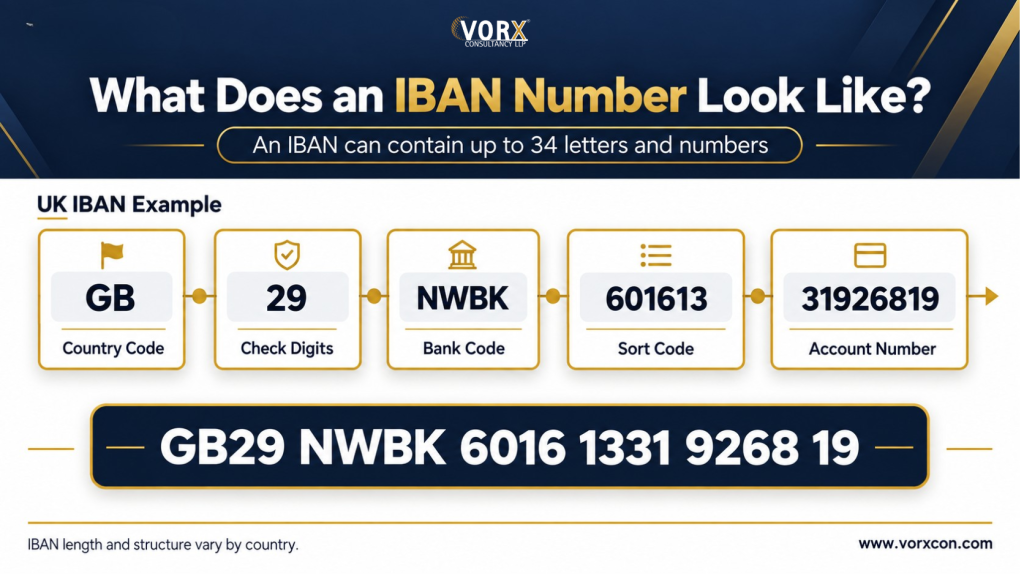
An IBAN can contain up to 34 alphanumeric characters, although its exact length varies by country. Every country follows its own approved IBAN number format within the international standard. A typical IBAN includes:
- A two-letter country code
- Two check digits
- A bank identifier
- A branch identifier, where applicable
- The customer’s account number
Recommended Reading:
Understanding an IBAN is only one part of building the right payment infrastructure. Learn the difference between a merchant account and a business bank account and how each supports business payments.
How Does an IBAN Work in an International Transfer?
When a sender enters an IBAN number for an international transfer, the payment system examines its structure and check digits. This initial validation helps determine whether the number follows the correct format for the stated country.
If the format is valid, the banking information within the IBAN helps route the payment towards the intended account. The transfer may also pass through correspondent or intermediary banks, depending on the currencies, countries and institutions involved.
This explains how an IBAN works, but it does not guarantee that a payment will be completed. Banks may still conduct fraud prevention, sanctions, compliance and beneficiary checks before releasing the funds.
Why Do You Need an IBAN for International Transfers?
The main international bank account number used is to identify the beneficiary’s account in a consistent, machine-readable format. So, why is an IBAN required for certain transfers? Banks in participating countries use it to:
- Identify the correct beneficiary account
- Validate essential payment information
- Reduce errors caused by inconsistent account formats
- Support automated cross-border payment processing
- Lower the risk of payments being rejected or misdirected
Not every international transfer requires an IBAN. Its necessity depends on the recipient’s country, bank and payment network. Where an IBAN is mandatory, leaving it out or entering it incorrectly can delay or prevent the transfer.
Where Can You Find and Verify an IBAN?
If you need to know how to find an IBAN number, check the account holder’s bank statement, mobile banking application, online banking portal or official account documents. The account holder can also request it directly from their bank.
Before authorising a large payment, confirm the IBAN with the beneficiary through a trusted communication channel. To understand how to verify an IBAN number, use an official bank facility or a reputable validation tool.
A format checker may confirm that an IBAN has the correct length and structure, but it may not prove that the account is active or belongs to the person you intend to pay.
Recommended Reading:
If your business regularly sends or receives money internationally, explore these top digital banks and neobanks for international business payments to compare suitable payment options.
IBAN vs SWIFT/BIC: What Is the Difference?
Factor | IBAN | SWIFT/BIC |
Full form | International Bank Account Number | Society for Worldwide Interbank Financial Telecommunication / Bank Identifier Code |
Identifies | A specific bank account | A bank or financial institution |
Format | Up to 34 letters and numbers | Usually 8 or 11 characters |
Main use | Routes funds to the correct account | Directs the transfer to the correct bank or branch |
Availability | Used only in participating countries | Used widely for international transfers |
Example | GB29 NWBK 6016 1331 9268 19 | NWBKGB2L |
In simple terms, the IBAN tells the payment system which account should receive the funds, while the SWIFT/BIC code indicates which bank should handle them. Always confirm the required details with the beneficiary or receiving bank before making a transfer.
Does India Use IBAN Numbers?
A common question is: Does India use IBAN? Indian bank accounts are not generally issued IBANs. International payments to India usually require details such as the beneficiary’s account number, bank name, branch information and SWIFT/BIC code.
However, someone sending money from India to an IBAN-participating country may need the overseas beneficiary’s IBAN. The sender should therefore follow the receiving bank’s instructions instead of assuming that an Indian IFSC code can replace an IBAN.
How Vorx Supports International Business Banking?
Opening and operating an overseas business account can involve more than obtaining an IBAN. Banks may request incorporation records, ownership information, proof of business activity, source-of-funds evidence and details about expected transactions.
Vorx supports international founders with company formation, documentation coordination and guidance around business banking requirements in suitable jurisdictions. Our team helps businesses understand the process and prepare more effectively, although account approval always remains subject to the bank’s eligibility, compliance and risk checks.
Need help setting up the right banking structure for your international business? Connect with vorx consultancy
Book a Strategy Call: (Calendly Link)
Visit: www.vorxcon.com
Email: support@vorxcon.com
Final Thought
An IBAN makes cross-border payments more structured by giving banks a standard method of identifying the recipient’s account. Nevertheless, it is only one part of a successful transfer.
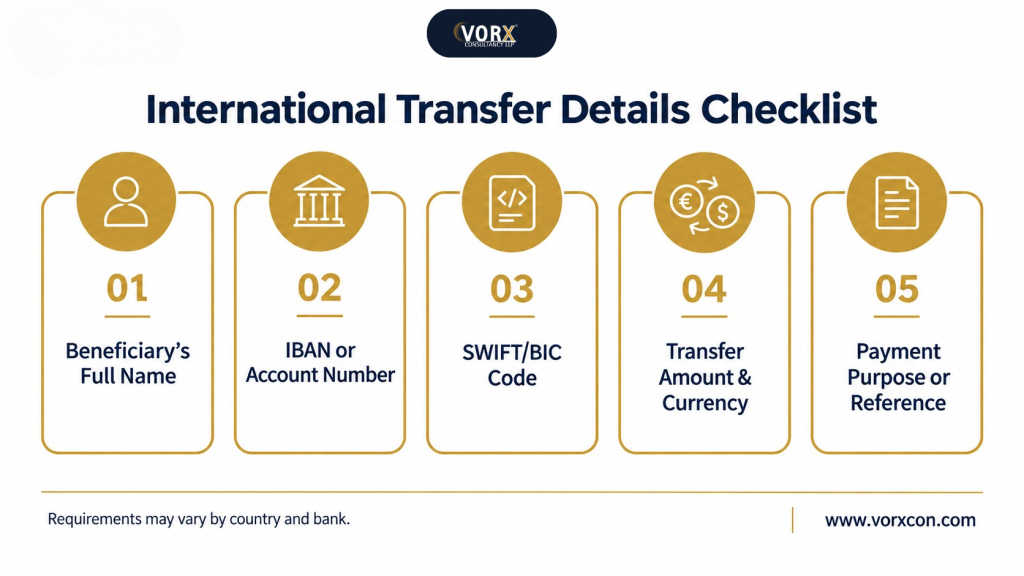
Before sending money, verify the beneficiary’s name, IBAN, SWIFT/BIC, currency and payment instructions. A few minutes spent checking these details can help prevent delays, returned payments and unnecessary charges.