


Poland is the largest economy in Central Europe, it sits inside the EU single market, and its company registry works largely online.
For founders outside the EU, including many Indian entrepreneurs serving European clients, that combination deserves a serious look.
You can register a company in Poland remotely. The registration itself is rarely the hard part, though. Signatures, the bank account and post-registration compliance are where most non-resident founders lose time.
This guide covers the route most foreign founders take, what it costs, and what to plan for afterwards. It reflects the position in September 2026. Rules and fees change, so confirm current figures before you file.
Can You Really Register a Company in Poland Remotely?
Yes, for the most common structure: the limited liability company, known as a Sp. z o.o. Foreign individuals and companies can generally own 100% of the shares, and a Polish resident director is not required.
If you can sign documents electronically, or appoint an attorney to sign for you, you don’t need to visit Poland to form the company.
“Remote” has limits, though. Forming a company does not give you a right to live or work in Poland, and it does not guarantee that a Polish bank will open an account for you. Plan for those separately.
Read this guide: How to Register a Company in Poland.
Who Can Register a Company in Poland as a Foreigner?
Nationality matters less for owning a company than for how you sign and whether you can run a sole proprietorship.
Founder type | Sole proprietorship (JDG) | Sp. z o.o. shareholder | Typical signing route |
EU/EEA citizens | Yes, online via CEIDG | Yes | EU-issued qualified e-signature or Trusted Profile |
Non-EU citizens (India, US, UK, Turkey and others) | Generally only with specific residence rights | Yes | Qualified e-signature arranged remotely, or notary with power of attorney |
Special categories (for example, certain Ukrainian nationals) | Additional options may apply | Yes | Check current rules |
For Indian entrepreneurs, the key consideration is usually the signing method.
If you sign through an attorney, documents from India generally need an apostille and a sworn Polish translation, which adds time and cost. Requirements can vary by applicant, so confirm your position before you commit to a route.
Which Legal Structure Should a Non-Resident Choose?
Structure | Liability | Minimum capital | Best for |
Sp. z o.o. | Limited | PLN 5,000 | Most non-resident founders and operating businesses |
P.S.A. (simple joint-stock company) | Limited | PLN 1 | Startups planning equity for investors or team members |
JDG (sole proprietorship) | Personal, unlimited | None | EU/EEA founders or those with residence rights, starting small |
Branch | Parent company is liable | None | Established foreign companies extending existing operations |
For most non-resident founders, the Sp. z o.o. is the practical choice. It is widely recognised, protects your personal assets and is open to foreign owners.
A branch usually means more paperwork, because you need documents from the foreign parent company.
Read this guide: Sp. z o.o. vs Sole Proprietorship in Poland: Which Business Structure Is Best for Foreign Entrepreneurs?
S24 or Notary: Which Registration Route?
The online S24 system uses a standard template. It is quick and cheap, and it suits a single founder or a simple partnership.
A notary lets you customise the articles of association. That matters if you need different share classes, investor rights or non-cash contributions, and it can be done through a power of attorney.
The rule of thumb: if the ownership is simple, use S24. If you are bringing in investors or need bespoke governance, use a notary.
Changing the articles later is possible but adds cost, so it helps to decide early.
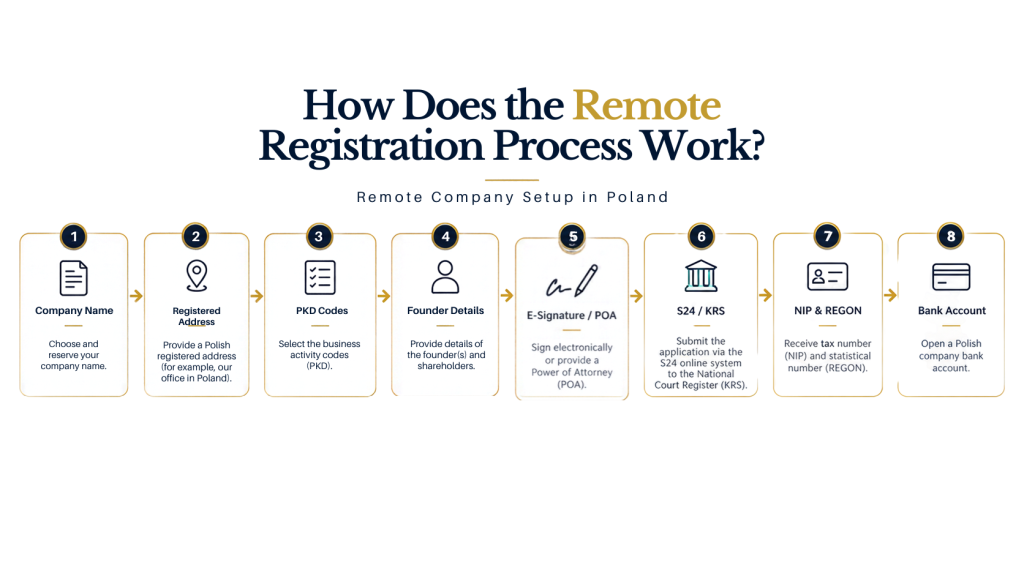
How Does the Remote Registration Process Work?
Choose the company name and check availability. Names that resemble existing companies can be challenged.
Arrange a registered address. A virtual office can work for registration, but banks may ask more questions about it later.
Select your PKD codes. These describe your business activities. Wrong or vague codes are a common cause of delays and later corrections.
Prepare founder and board details. You will need passport information, addresses and the shareholding split.
Set up your signing method. A qualified e-signature, Trusted Profile or power of attorney. This step often takes longer than the filing.
File through S24 and pay the fees. Once the court enters the company in the KRS register, the company exists.
Receive your NIP and REGON numbers, then register for VAT and ZUS. The bank account follows.
Once signatures are ready, S24 entries commonly take a few business days. A realistic end-to-end timeline, from starting to being able to invoice, is closer to two to six weeks, mainly because of signatures, the bank and VAT registration.
Illustrative example: Take an India-based software founder invoicing clients in Germany. The Sp. z o.o. is registered through S24 within about ten working days of the documents being ready.
The bank account then takes longer than the registration, because the bank asks for client contracts and an explanation of why the founder chose Poland. Founders who prepare that explanation before applying often save weeks.
Planning to register your Polish company remotely? Vorx Consultancy can help you structure the setup and registration process correctly from the start.
Can You Open a Polish Business Bank Account Remotely?
Sometimes. Some banks offer video onboarding for non-resident directors, while others still ask for an in-person visit or extra documents. Policies change often, so check current requirements before you apply.
Expect to provide the KRS extract, articles of association, ID, proof of address, and a clear description of your business, ideally with contracts or client evidence.
Applications tend to stall when the business model is unclear, when the only Polish link is a virtual address, or when the bank cannot see where the money comes from. Timelines range from days to several weeks, and approval is never guaranteed.
Fintech business accounts can help with international payments while you wait. They may not handle every Polish tax and ZUS payment smoothly, so ask your accountant what you will need.
Read this guide: How to Open a Business Bank Account in Poland
Vorx Consultancy Insight: Before applying, prepare a one-page business summary covering what you sell, who your clients are and how money will flow. It answers most of the questions a compliance team will ask.
Need support with company setup and business banking in Poland? Speak with Vorx Consultancy before you start your application.
What Happens After Registration?
VAT: Registration depends on your activity and sales. If you invoice EU businesses across borders, you will typically need a VAT-EU number as well.
ZUS: The company and any employees need social security registration, and there may be contribution obligations for board members.
CRBR: Companies must report their beneficial owners, and the deadline is short after registration, so confirm it with your accountant.
KSeF (e-invoicing): Since 1 April 2026, most VAT-registered businesses must issue domestic B2B invoices through KSeF. Receiving invoices through it has been mandatory for all VAT-registered entities since 1 February 2026.
The smallest taxpayers, with monthly sales up to PLN 10,000, start on 1 January 2027. Financial penalties for KSeF errors are currently set to apply from 1 January 2027, and the Ministry of Finance announced on 16 September 2026 that it plans to extend that penalty-free period to the end of 2027.
This is a proposal, not yet law, and the obligation to use KSeF itself is not postponed.
How Is a Remote Polish Company Taxed?
Corporate income tax is 19% as standard, with a 9% rate for eligible small taxpayers (revenue up to EUR 2 million).
Poland also offers the Estonian CIT model, where tax is generally due when profits are distributed, subject to eligibility conditions.
The bigger question for non-residents is where the company is managed. If key decisions are made from abroad, another country’s tax authority may take an interest, and in some cases that could create tax exposure there.
Dividends paid to non-resident owners may face withholding tax, which a tax treaty between Poland and your country may reduce.
Indian residents should also check FEMA and overseas investment rules. Speak to a tax adviser in both countries before you finalise the structure.
Read this guide: Poland Corporate Tax Guide for Foreign-Owned Companies (2026)
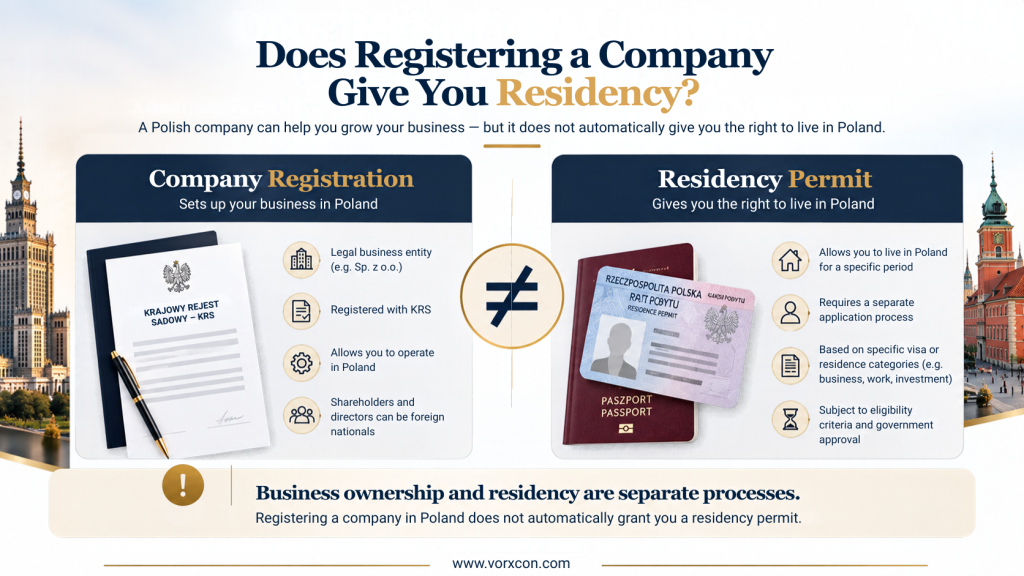
Does Registering a Company Give You Residency?
No. Company formation, a residence permit, permanent residence and citizenship are separate matters with separate requirements.
Owning a Polish company does not automatically entitle you to live or work in Poland. If you plan to relocate later, a different application applies, and the company’s activity and finances may be relevant to it.
Many founders run a Polish company from abroad for years without ever needing a permit.
Should You Do It Yourself or Use a Consultant?
Doing it yourself is realistic if you are an EU citizen with a single shareholder and a simple business.
Professional help tends to be worth considering for non-EU founders, multiple shareholders, tight timelines, or a bank account that needs careful positioning.
At Vorx Consultancy, we help founders evaluate the route, structure and sequencing before anything is filed, because early choices are harder to reverse later.
If you compare providers, ask what the fixed price includes, whether bank account support is included, who handles VAT, ZUS and KSeF afterwards, and how accounting is priced.
Conclusion: What to Do Before You Register
You can register a company in Poland remotely, and for many non-resident founders it is a practical way to enter the EU market without relocating. The route you choose matters more than the filing itself.
EU citizens with a simple ownership structure can often use S24 with minimal help. Non-EU founders, including Indian entrepreneurs, should plan the signing method and bank account early, and founders bringing in investors will usually need the notary route.
Before you file, settle three things: how you will sign, which bank is likely to onboard you, and who will handle VAT, ZUS and KSeF once you are registered. Requirements vary by applicant and change over time, so confirm current rules before you commit.
At Vorx Consultancy, we help founders assess their route and sequence these steps before anything is filed. If you’d like to talk through your situation, you can book a consultation with our team.
Ready to open your company in Poland remotely? Talk to Vorx Consultancy and plan your registration, banking, and compliance requirements with expert support.
