

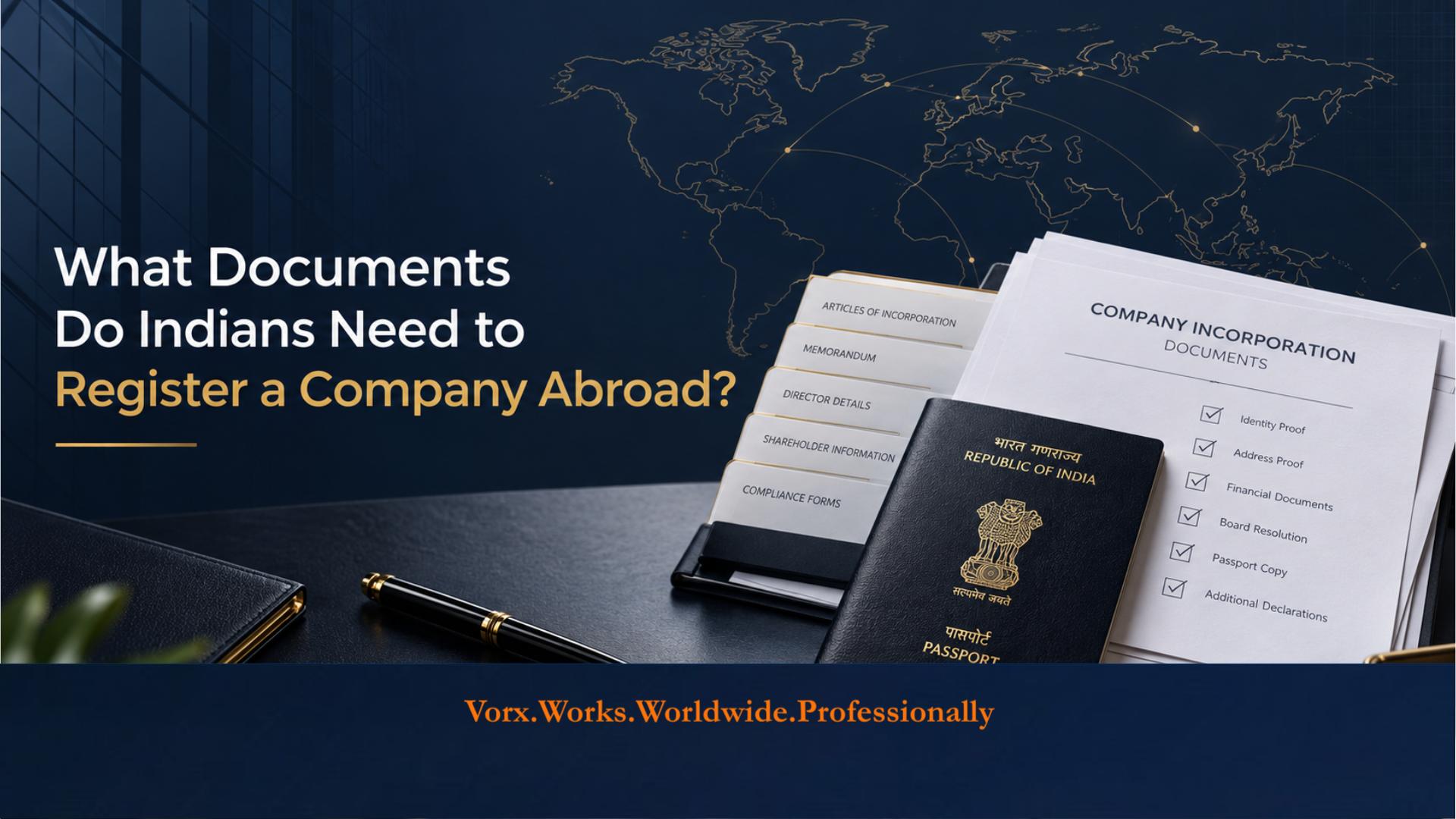
Registering a company abroad can help Indian entrepreneurs reach international customers, access global payment systems and establish a presence in a new market. However, incorporation involves more than submitting a passport and selecting a company name.
Foreign registries, banks and licensing authorities examine different aspects of the proposed business. They may verify the founders’ identities, ownership structure, business activities and source of investment. Although the exact requirements depend on the selected country, most Indian founders will need the following categories of documents.
Personal KYC Documents
Every director, shareholder and ultimate beneficial owner generally needs to complete an identity verification process. The commonly requested personal documents include:
- Valid passport
- PAN card
- Recent residential address proof
- Passport-size photograph
- Tax identification details
- Contact information
- Specimen signature
A bank statement or utility bill issued within the previous three months is commonly accepted as address proof. Aadhaar may support Indian verification, but it is not usually a substitute for a passport in an international application. Names, dates of birth and addresses should remain consistent across all documents. Differences in spelling or an incomplete address can result in additional checks.
Company Formation Documents
Company formation documents establish the proposed entity’s legal identity, ownership and management structure. Depending on the destination, founders may need to prepare:
- Proposed company names
- Incorporation application
- Company constitution or Articles of Association
- Description of business activities
- Director and shareholder details
- Proposed shareholding percentages
- Initial share capital
- Registered-office information
- Director or secretary consent forms
The document names vary between jurisdictions, but their purpose is broadly similar. They explain who will own the company, who will manage it and what activities it intends to conduct. The business description should be specific. A broad statement such as “consulting and trading” may not provide enough information for licensing, tax registration or banking reviews.
Shareholding and Beneficial Ownership Documents
Foreign authorities need to identify both the direct shareholders and the individuals who ultimately own or control the company.
The application should clearly explain each shareholder’s ownership percentage, capital contribution and voting rights. If another company holds the shares, an organisational chart may be needed to trace the ownership structure back to the individual beneficial owners.
Layered ownership or nominee arrangements may face additional scrutiny. Any such arrangement should have a genuine commercial purpose and be supported by transparent documentation.
Recommended Reading:
Before preparing your registration documents, explore 10 Countries Offering 100% Foreign Ownership to Indians to compare ownership rules across leading international jurisdictions.
Registered Office and Local Appointment Documents
Most countries require a locally registered address. Evidence may be provided through a lease agreement, flexi-desk contract, virtual-office agreement or confirmation from an authorised address provider.
Some destinations also require a resident director, company secretary or registered agent. For example, Singapore generally requires a locally resident director and a company secretary. A US company must appoint a registered agent in its state of formation.
Consent letters, appointment forms and identification details for these representatives may form part of the registration file.
Indian Corporate Shareholder Documents
When an existing Indian company will own the overseas entity, additional corporate documents are required.
The Indian company may need to submit its certificate of incorporation, Memorandum and Articles of Association, PAN, registered-office proof and recent financial statements. The authorities may also request its current director, shareholder and beneficial ownership details.
A board resolution should approve the overseas investment and authorise a representative to sign the foreign incorporation documents. Personal KYC will still be required for the relevant directors and ultimate beneficial owners behind the Indian company.
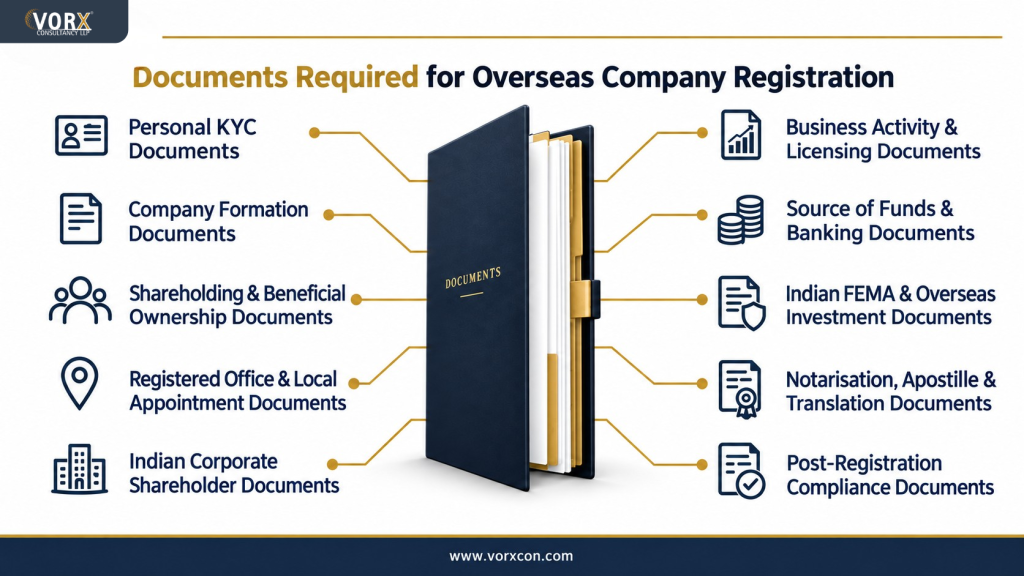
Business Activity and Licensing Documents
An incorporation certificate does not automatically permit a company to undertake every type of business. Activities involving finance, recruitment, healthcare, education, food or payment services may require separate regulatory permission.
The licensing authority may request a business plan, projected revenue, professional qualifications or evidence of relevant experience. It may also examine how the company will operate, where it will provide services and what type of customers it expects to serve.
The correct activity should be selected before incorporation because it can affect the licence, tax treatment, office requirement and banking process.
Source of Funds and Banking Documents
Opening a business bank account is separate from registering the company. Banks conduct their own KYC and anti-money-laundering assessment even when the entity has already been incorporated.
The bank may request personal or corporate statements, evidence of the initial capital, a business plan, contracts, invoices and expected transaction information. Founders may also be asked to explain how the investment was earned and why the particular jurisdiction was selected.
Information given to the bank should remain consistent with the company’s registered ownership and activities. Incorporation approval does not guarantee bank-account approval.
Recommended Reading:
If you already operate a foreign company and want to move it to another jurisdiction, read our guide on the Company Redomiciliation Process, Requirements and Cost to understand the required documents and compliance steps.
Indian FEMA and Overseas Investment Documents
Indian founders must also prepare records relating to the transfer and reporting of their overseas investment. Depending on the investor and business structure, these may include:
- Share-subscription agreement
- Board resolution, where applicable
- Bank remittance forms
- Source and purpose declaration
- Information about the foreign entity
- Proof of shares issued against the investment
- Overseas investment reporting records
- Acknowledgements from the authorised dealer bank
The applicable process depends on whether the investment is being made by an Indian resident or an Indian entity. The ownership percentage, method of investment and activities of the foreign business can also affect the requirements.
Notarisation, Apostille and Translation Documents
Some foreign authorities accept clear electronic copies, while others require documents to be notarised, apostilled or legalised through an embassy or consulate.
Documents not issued in an accepted language may require certified translation. The exact certification standard should be confirmed before processing the papers. Unnecessary legalisation or translation can increase the cost and preparation time.
Post-Registration Compliance Documents
The documentation process continues after the incorporation certificate is issued. The company may still need to complete tax registration, bank-account opening and industry-specific licensing.
It must also maintain accounting records, financial statements, corporate tax returns, beneficial ownership information and licence-renewal records. These responsibilities can apply even when the company is managed remotely from India.
How Vorx Supports Your Overseas Company Documentation?
International company registration requirements can change depending on the jurisdiction, ownership structure and proposed business activity.
Vorx Consultancy helps Indian founders identify the applicable documents, review their ownership structure and coordinate incorporation, banking and compliance requirements. This reduces avoidable errors and gives founders a clearer path from documentation to operational setup.
Final Thought
Registering a company abroad begins with selecting the right jurisdiction, but successful incorporation depends on submitting accurate and properly prepared documents. Personal KYC, company records, ownership disclosures and Indian overseas investment documentation should be organised before the application is filed.
Because each jurisdiction follows different rules, founders should rely on a country-specific checklist instead of a general one. Careful preparation at the beginning can prevent delays during incorporation, licensing and bank-account opening.
