

If you’re deciding where to set up your next company, Cyprus keeps coming up for a reason.
It’s an EU member state with an English-based legal system, a corporate tax rate that’s still competitive by European standards, and a formation process that doesn’t require you to set foot on the island.
For founders expanding out of India, entering the EU market for the first time, or restructuring an existing business, that combination is worth a closer look.
But a lot of what’s published about Cyprus company formation hasn’t caught up with 2026. The corporate tax rate changed this year.
So did the annual levy, the audit rules that apply to small companies, and perhaps most importantly for anyone planning this remotely how long it actually takes to get a business bank account approved.
This guide walks through what’s actually required today, not what was true two years ago.
Read this guide: Cyprus Company Formation for Foreigners: A Complete 2026 Guide
What Does It Actually Take to Register a Company in Cyprus?
At a glance, here’s where things stand in 2026:
Requirement | Current Position |
Minimum shareholders | 1 (individual or corporate, any nationality) |
Minimum directors | 1 (any nationality) |
Minimum share capital | No statutory minimum share capital for a private company |
Company secretary | Mandatory, must be a separate person from a sole director |
Registered office | Must be a physical Cyprus address |
Annual audit | Mandatory for all companies, regardless of size |
Corporate tax rate | 15% |
Typical incorporation time | 5–10 working days |
Typical bank account approval (non-resident) | 6–12 weeks |
That gap between how fast you can incorporate and how long banking actually takes is something we’ll come back to, because it trips up more founders than any legal requirement does.
The Core Legal Requirements, Explained Simply
A Cyprus private limited company (the structure almost every foreign founder uses) needs a few things in place before the Registrar of Companies will approve it.
Shareholders and directors: You need at least one of each, and they can be the same person. There’s no nationality restriction, and no requirement that either party live in Cyprus.
A single Indian founder, for example, can be the sole shareholder and sole director of a Cyprus company without ever relocating.
A company secretary: This one surprises a lot of first-time founders. Cyprus law requires every company to appoint a secretary, and if you’re the sole director, the secretary has to be a different person or entity.
It’s not a ceremonial role; the secretary maintains statutory registers and files annual returns on the company’s behalf.
Most formation providers include this as part of an incorporation package, so it rarely becomes a practical obstacle, but it’s worth knowing it’s a legal requirement and not an optional add-on.
A registered office: Every Cyprus company needs a physical address on the island for official correspondence. A P.O. box won’t satisfy this. If you’re not planning to lease office space immediately, a registered address service handles this.
Share capital: There’s no statutory minimum, so a company can technically be incorporated with a nominal amount.
In practice, most founders set up a modest, round share capital structure rather than the bare legal minimum, simply because it tends to look more credible to banks and business partners reviewing the company later.
The capital also doesn’t need to be paid up at the time of incorporation, which gives founders some flexibility in how they structure ownership early on.
Constitutional documents: A lawyer-prepared Memorandum and Articles of Association is required for filing, along with identification and proof-of-address documents for directors and shareholders.
Vorx Consultancy Insight: The requirements above are genuinely straightforward, and that’s part of why Cyprus is popular.
The real planning happens around what comes after incorporation tax residency, substance, and banking which is where founders benefit most from getting advice early rather than after a bank has already asked for more documentation.
Planning to Set Up a Cyprus Company?
Get professional guidance on the right structure, documentation, and compliance requirements before you start.
What's the Formation Process Actually Look Like, Step by Step?
Once the paperwork is ready, the process itself is fairly linear:
- Name approval with the Registrar of Companies.
- Drafting the Memorandum and Articles of Association, along with the required declaration.
- Collecting KYC documents for directors and shareholders, passports, proof of address and a bank reference letter.
- Filing incorporation forms (HE1, HE2, HE3) with the Registrar.
- Receiving the Certificate of Incorporation, which confirms the company legally exists.
- Registering for a Tax Identification Code with the Cyprus Tax Department, generally required within 60 days of incorporation.
- VAT registration, if your turnover or activity triggers the requirement.
- Registering the company’s beneficial owner on the central UBO register.
That’s usually five to ten working days from start to finish, assuming your documents are complete and where required, properly apostilled.
What isn’t included in that timeline is opening a bank account which is a separate process with its own pace, covered below.
Make Your Cyprus Company Setup Simpler
Vorx Consultancy can support you through documentation, incorporation, tax registration, and ongoing compliance.
What Actually Changed in Cyprus Tax Rules in 2026?
This is the section most existing guides get wrong simply because they haven’t been updated. A few things shifted this year:
The corporate tax rate rose from 12.5% to 15%, bringing Cyprus in line with the OECD’s global minimum tax standard (Pillar Two).
Stamp duty was abolished on most commercial documents.
The Deemed Dividend Distribution rules were removed entirely, which simplifies planning for companies that retain profits rather than distribute them.
The loss carry-forward period was extended from five to seven years, giving newer companies more room to offset early losses.
The flat €350 annual company levy was abolished (from 2024 onward), which slightly reduces the fixed cost of keeping a company active.
Annual statutory audit remains mandatory for every company, regardless of turnover or size. This is worth flagging specifically because it’s different from many other EU jurisdictions, where small companies are often exempt.
If you’re comparing Cyprus to somewhere like Estonia or Ireland, this is a real cost difference to factor in, not a minor line item.
Even with the rate increase, 15% remains competitive within the EU, and the removal of DDD and stamp duty are genuine simplifications. The headline number changed, but the overall position hasn’t weakened much for most structures.

How Long Does It Really Take to Open a Business Bank Account in Cyprus?
Here’s the part that catches non-resident founders off guard: incorporation is fast, banking is not.
The Cyprus banking sector also went through consolidation in 2025 Hellenic Bank merged into Eurobank, and AstroBank was absorbed into Alpha Bank Cyprus. So if an older guide mentions Hellenic Bank as an option, that’s already outdated.
The current tier-one banks considering non-resident-owned company accounts are Bank of Cyprus, Eurobank, Alpha Bank Cyprus and Ancoria Bank all subject to enhanced due diligence for foreign-owned structures.
Realistically, expect six to twelve weeks for a non-resident-owned company to get approved, and that’s assuming a clean application.
With a well-prepared, substance-ready file, it can move faster. Without it, it can take considerably longer, or end in rejection.
The most common reasons applications get rejected or delayed:
- Thin economic substance no office, no local presence, no clear business rationale for banking in Cyprus specifically
- Complex or layered ownership structures without a clear, documented chain
- Gaps in source-of-funds evidence
- Exposure to higher-risk sectors, such as crypto or forex, without a bank that has appetite for that sector
- Incomplete documentation, including missing apostilles
If a traditional bank isn’t a fit right away, e-money institutions (EMIs) are often a faster, more practical starting point for founders who need to start operating before a full banking relationship is in place.
Many companies use an EMI initially and move to a traditional bank once the business has an operating history.
Vorx Consultancy Insight: We generally advise clients to treat banking as a parallel workstream, not a step that happens automatically after incorporation.
Preparing the source-of-funds documentation and business rationale before you apply rather than after a bank asks for it tends to shorten the process meaningfully.
Don’t Leave Banking Until After Incorporation
Prepare your company structure, KYC, and banking documentation early to reduce avoidable delays.
Does Where Your Directors Live Actually Matter?
This is where tax residency and banking credibility start to connect, and it’s worth understanding even though it’s not strictly a formation requirement.
Cyprus determines corporate tax residency largely based on where management and control actually happen, not just where the company is registered.
A company with a majority of Cyprus-resident directors, board meetings held on the island, and key decisions documented there has a much stronger case for Cyprus tax residency, and tends to be viewed more favourably by banks as well.
A company run entirely by non-resident directors from abroad can still be legally valid, but it’s a weaker position both for claiming Cyprus tax residency and for satisfying a bank’s substance requirements.
There’s a genuine trade-off here between cost (a resident director adds expense) and how much substance your structure actually needs, and that trade-off depends on what the company does and how the founder plans to use it.
Is Cyprus a Good Fit for Indian Entrepreneurs and EU Market Entry?
For founders based in India looking at the EU, Cyprus offers a few practical advantages worth naming directly.
The India–Cyprus Double Tax Avoidance Agreement is relevant for structuring dividend and royalty flows between an Indian parent and a Cyprus entity. The entire formation process can be completed remotely, without travel.
And a Cyprus company gives a founder a genuine EU legal presence without the higher setup and compliance costs associated with incorporating directly in some of the EU’s larger economies.
A common structure is an Indian parent company with a Cyprus subsidiary used either for EU trading activity or as a holding vehicle for intellectual property.
That said, banking and substance requirements apply equally regardless of a founder’s nationality. A Cyprus company doesn’t bypass the due diligence process, it just gives you a workable base to build the structure around.
What Mistakes Actually Delay Cyprus Company Formation?
A few patterns show up repeatedly with foreign founders:
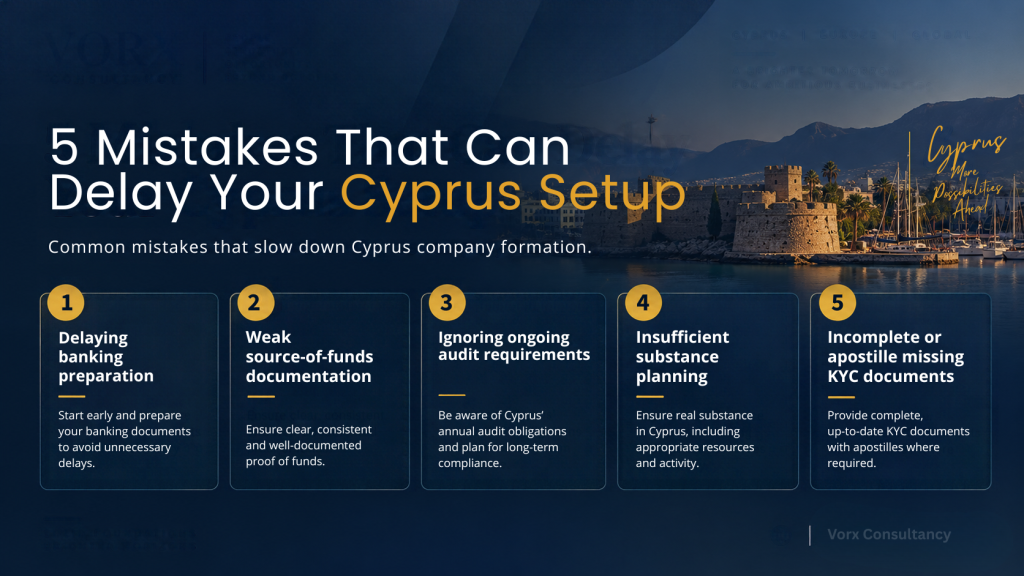
- Assuming the bank account will be ready as quickly as the incorporation certificate
- Not budgeting time or documentation for source-of-funds evidence until a bank asks for it
- Underestimating the mandatory audit as a recurring cost
- Setting up a purely virtual presence when the business model realistically needs some operational substance
- Submitting KYC documents without required apostilles, which causes avoidable delays
None of these are dealbreakers. They’re just the difference between a formation that takes a few weeks longer than expected and one that goes smoothly because the groundwork was done upfront.
Is Cyprus the Right Base for Your Business?
Cyprus continues to work well for holding structures, EU market entry, IP-related businesses, and remote or consulting operations where the founder doesn’t need to relocate.
The legal requirements are genuinely simple. Where founders run into friction is almost always banking and substance, not incorporation itself and that’s a planning problem, not a legal one.
At Vorx Consultancy, we help founders map out the requirements before deciding whether Cyprus is the right structure for their specific situation, and work through the practical parts of banking, substance, and ongoing compliance that determine whether a Cyprus company actually functions the way it’s meant to once it’s set up.
Not Sure If Cyprus Fits Your Business?
Speak with Vorx Consultancy to assess your company structure, banking needs, substance requirements, and ongoing compliance before you proceed.