


Germany is Europe’s largest economy and a serious market for Indian founders in IT, engineering, consulting, manufacturing services and trade.
But when people search for a German business visa for Indians, they often discover a frustrating gap: the visa they can easily get lets them attend meetings, not build a company.
That difference decides whether your plan works or stalls at the first appointment. This guide explains which permit fits which goal, what German authorities expect from a self-employed applicant, and how residency fits in.
It is general information, not legal or tax advice, and rules change, so always confirm current requirements with official German sources.
Read this guide: Germany Corporate Tax 2026: What Indian and Foreign-Owned Companies Actually Pay
Which Visa Do You Actually Need?
Start with what you want to do in Germany, not with the visa name.
Your Goal | Best Route | Work/Business Allowed? |
Meetings, trade fairs, negotiations | Schengen Business Visa | No |
Short market visit | Schengen Visa | No |
Freelancing | Freelance Residence Route | Yes |
Start a company | Self-Employment Route | Yes |
Expand an Indian company | Transfer / Business Route | Depends |
Work as a skilled employee | Blue Card / Skilled Worker Visa | Employment only |
If your answer is anything other than a short trip, read the next section carefully.
Not Sure Which Germany Route Fits Your Profile?
Choosing the wrong visa can delay your business plans before they even begin. Vorx Consultancy can help you assess your business model, background and expansion goals before you apply.
What Is the Germany Business Visa for Indians, and What Can't It Do?
The short-stay business visa is a Schengen visa. It allows stays of up to 90 days in any 180-day period, and it covers activities like attending a trade fair, meeting suppliers or clients, and negotiating contracts.
It does not allow you to start a company, take on paid work, or freelance for German clients. Using it that way can lead to refusals on later applications.
Here is a typical illustrative scenario. A founder from Pune runs an automation software firm and visits Hannover for a trade fair on a short-stay visa. The trip goes well: two leads, one serious. He decides to open a German entity.
The visa did its job, but it can’t be turned into a residence permit to run that entity. He needs a separate application for the right long-term route.
Indian citizens generally apply for that national visa before moving, rather than switching status after arriving in Germany, so plan the sequence.
For a short trip, you will usually need an invitation from a German company or fair organiser, proof of your own business (registration, GST details, recent income tax returns), bank statements, travel insurance and a clear itinerary.
Check the current Schengen fee and VFS service charges on official sources.
Can Indians Get a Self-Employment Residence Permit in Germany?
Yes, Indian citizens can apply. The main legal basis is Section 21 of the Residence Act (AufenthG). In broad terms, the authorities look at three things:
Economic interest or regional need: Does your business benefit the German economy or fill a local gap?
Positive effect expected: Is the concept realistic and likely to contribute, for example through jobs, innovation or demand that isn’t already met?
Secured financing: Can you fund the launch and your living costs through your own capital, a loan commitment or investor backing?
Your qualifications, relevant experience and health insurance coverage also matter. Applicants approaching retirement age may face pension provision requirements.
The decision sits with the local immigration office (Ausländerbehörde), which often consults bodies such as the IHK (Chamber of Industry and Commerce) or professional associations to assess your plan.
Approval is never automatic, and having the money alone is not enough. Germany does not offer a standalone investor visa in which capital alone secures residency.
Freelancer or Business Owner: Why Does the Distinction Matter?
Germany treats these differently for registration, taxes and sometimes the permit itself.
A freelancer (Freiberufler) works in a recognised liberal profession, such as software consulting, engineering, design, translation, architecture or certain teaching and advisory roles.
You typically register with the tax office but not as a trade business, and you generally don’t need a company.
A trade business (Gewerbe) covers commercial activities like trading, e-commerce, hospitality or manufacturing. You register the trade, and may join the IHK.
Take an illustrative case. An IT consultant from Bengaluru with eight years of experience and two signed client letters of intent may fit the freelancer category.
Someone importing Indian textiles will be running a trade business. Choosing the wrong category can delay your application, so confirm the classification before you finalise your plan.
Where Do the Chancenkarte, Blue Card and Company Transfers Fit?
Self-employment is not the only way to build a presence in Germany. These routes can work alongside or before it:
Chancenkarte (Opportunity Card): A points-based permit that lets qualified people enter Germany to look for work.
It is not designed as a self-employment visa, and its permitted activities are limited, so check the current rules before relying on it for a business launch.
EU Blue Card: For university graduates with a qualifying job offer that meets salary thresholds. Some founders take a salaried role first and build their venture later.
Subsidiary or branch of an Indian company: If your existing business is expanding, you may establish a German entity.
Whether staff or directors can relocate depends on the permit category and the structure, so get advice early.
The right choice depends on your profile. A mid-career founder with savings may prefer direct self-employment.
A younger professional with strong credentials might use the Blue Card route to build local experience first.
What Do German Authorities Look For in a Business Plan?
This is where many Indian applicants are weakest. A plan that works in India often doesn’t convince a German reviewer.
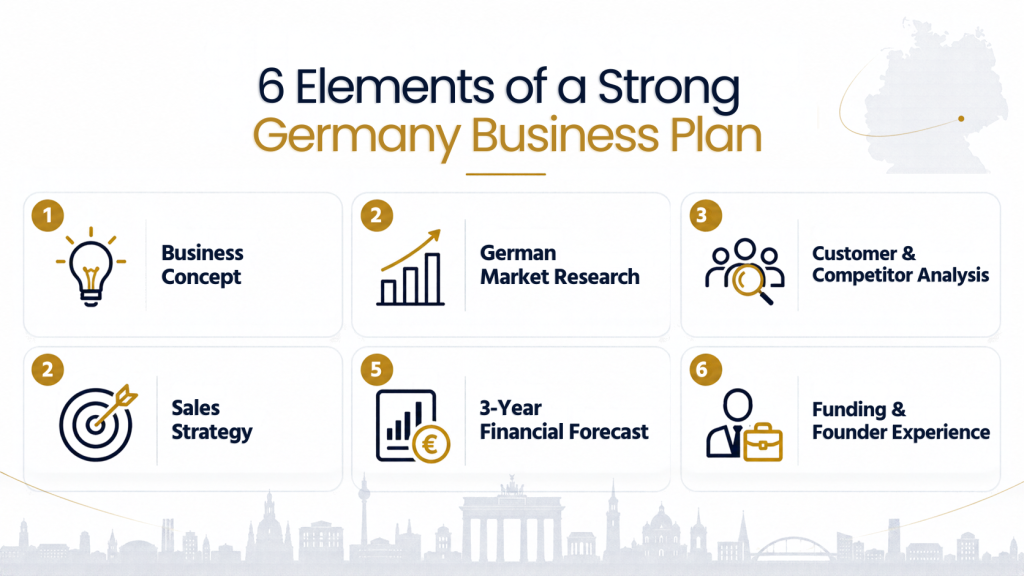
A strong plan usually includes:
A clear business concept you can explain in two minutes.
German market analysis, with real customer segments, competitors and demand evidence, not just general India-to-Europe opportunity statements.
A marketing and sales plan showing how you will actually find German customers.
A three-year financial forecast with realistic assumptions.
Funding evidence, meaning how the launch capital is secured.
Your background, showing why you are the right person to run this business.
Supporting documents help: letters of intent from prospective clients, partner agreements, or a lease for office space. They give the reviewer something concrete to evaluate.
At Vorx Consultancy, we often see plans fail because the market section is copied from a global report.
A well-prepared application can help demonstrate the strength and viability of the business, but only if the numbers and the story actually match.
Build a Germany-Ready Business Application
A strong application needs more than a generic business plan. Get support with route assessment, business planning, documentation and Germany market preparation.
How Does the Process Work From India?
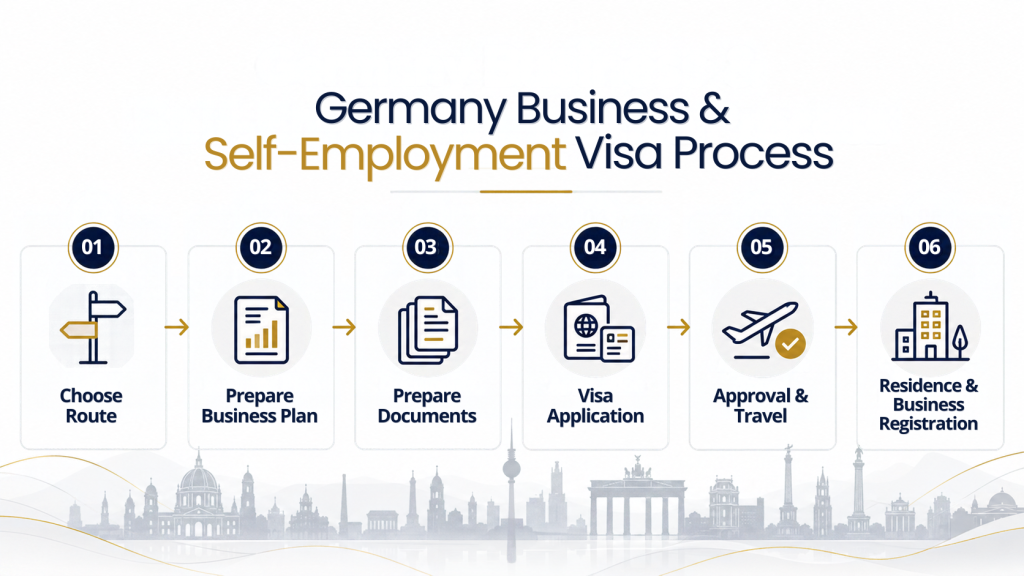
The exact order varies by case, but most founders follow this sequence:
Define your route and business model: Decide between freelance, company, or subsidiary.
Get professional input: A tax advisor (Steuerberater) or immigration lawyer can flag issues early.
Prepare documents: Passport, qualifications, CV, business plan, funding proof, health insurance and any required certificates.
Indian documents may need an apostille from the Ministry of External Affairs and certified German translations.
Book your national visa appointment at the German mission, usually through VFS.
Submit and wait: The mission may forward your file to the local immigration office and consult other bodies, which can take time.
Travel on approval: Register your address (Anmeldung) in your German city.
Complete the residence permit at the local immigration office, then register the business and tax number.
Book your appointment early and submit complete, consistent documents. Gaps in the file, such as unexplained funds or mismatched dates, tend to slow things down.
Read this guide: Company Formation in Germany for Foreigners: Complete 2026 Guide.
How Should You Set Up the Business?
Your legal structure affects liability, credibility and paperwork.
Structure | Best For | Key Point |
Freelancer | Independent professionals | No company required |
Sole Proprietorship | Small businesses | Personal liability |
UG | Early-stage startups | Lower capital, limited liability |
GmbH | Growing / established businesses | Higher capital, strong credibility |
Indian Company Subsidiary | Business expansion to Germany | Indian + German compliance |
Company formation typically involves a notary, commercial register entry, trade registration where applicable, a tax number from the Finanzamt, and a business bank account. A Steuerberater is worth bringing in early.
Remember that forming a company does not itself grant residency; the permit and the company are separate processes that need to support each other.
What India-Side Compliance Should You Plan For?
Most competing guides skip this, but it matters.
Moving money out of India: Personal remittances fall under the Liberalised Remittance Scheme (LRS).
Funding a company abroad can fall under Overseas Direct Investment (ODI) rules under FEMA.
These are different frameworks, and mixing them up can create compliance problems. Speak to a chartered accountant before transferring funds.
Tax residency: Moving to Germany can change your tax residency in both countries.
The India-Germany double taxation avoidance agreement (DTAA) is relevant, and your NRI status and Indian income need careful review.
Documents: Apostille, police clearance and translations take time. Start early.
Citizenship and OCI: India does not permit dual citizenship. If you later naturalise in Germany, you would lose Indian citizenship, but you may be eligible for an Overseas Citizen of India (OCI) card.
Planning to Fund or Expand Your Business From India to Germany?
Company formation, immigration and cross-border compliance need to work together. Get your structure reviewed before transferring funds or starting the application process.
Why Do Applications Get Refused?
The common reasons are practical, and mostly avoidable:
Issue | Why It’s a Problem | What to Do |
Wrong visa type | Activity doesn’t match the permit | Choose the correct visa route |
Generic business plan | Weak proof of market demand | Add German market evidence |
Unclear funding | Financial sustainability is uncertain | Show clear proof of funds |
Experience mismatch | Business background looks weak | Link your skills to the business |
Missing documents | Application appears incomplete | Review all documents carefully |
What About Family, Permanent Residence and Citizenship?
Dependants such as a spouse and children may be able to join you through family reunification, subject to conditions including accommodation, health insurance and sometimes German language requirements for the spouse, with some exemptions.
Spouses’ work rights depend on the permit category, so confirm this for your case.
A self-employment permit does not automatically lead to permanent residence. Self-employed people can become eligible for a settlement permit after a period if the business is successful and conditions such as pension provision are met.
Naturalisation rules have changed in recent years and remain politically debated, so check the current requirements before planning around any citizenship timeline.
Applying From the UAE, UK, USA or Singapore?
You generally apply at the German mission with jurisdiction over your country of legal residence, not necessarily India.
Expect to provide proof of your current residence status, local police clearance and address evidence in addition to the standard documents.
Financial planning gets more complex for Indians abroad, since NRI status affects both transfers and taxation. Take advice before moving funds.
What Has Changed in 2026?
A few developments to watch:
Chancenkarte: Now established; confirm current points criteria and permitted activities.
Citizenship rules: Recent reforms to naturalisation are being refined; verify the latest position.
Schengen travel changes: The Entry/Exit System is being rolled out, affecting border procedures for short-stay visitors.
Application systems: Appointment availability and digital processes through VFS and German missions change often.
Check the Federal Foreign Office, Make it in Germany and German Missions in India websites before applying.
Conclusion: Choose the Route Before You Choose the Visa
For Indian entrepreneurs, the key consideration is simple: match the permit to what you actually plan to do.
A short-stay visa suits market exploration. A residence permit for self-employment suits building something lasting, and it demands a convincing business case, secured funding and careful preparation on both the German and Indian sides.
At Vorx Consultancy, we help founders evaluate which route fits their profile, and we sequence company formation, immigration and India-side compliance so each step supports the next.
If you are weighing your options, a short discussion before you apply can help you avoid a costly mistake.
Planning Your Move or Business Expansion to Germany?
Before you apply, make sure your visa route, business structure, documents and cross-border compliance all support the same plan.
Talk to Vorx Consultancy about your Germany business and residency strategy.
