


When you compare company formation in Hungary versus UAE, you will have most likely spotted one strange thing: the headline tax rates are very similar. Hungary charges 9% corporate tax. The UAE charges 9% too, with a 0% band and free zone incentives on top.
So the tax rate alone will not settle it. The deciding factor when it comes to determining the correct response would be your location of your customers, your future place of residence, and the amount of compliance you are willing to undertake per year.
Here we compare both of these choices based on their market access, cost of compliance and tax, ownership, banking, residency, and even the India-side regulations which are mostly ignored in comparison articles. We conclude this article with three different founder case studies.
The Short Answer: Hungary or UAE?
By way of general rule, go for Hungary when your customers, partners, or investors are in the European Union and you require an authentic presence in the EU.
Brief Overview on Hungary vs UAE
Factor | Hungary (Kft) | UAE (Free Zone or Mainland LLC) |
Foreign ownership | 100% allowed | 100% allowed for most activities |
Minimum capital | HUF 3 million (roughly EUR 7,500) | Set by each free zone or licensing authority |
Corporate tax | 9% flat, plus local business tax up to 2% of adjusted revenue | 0% up to AED 375,000 of taxable income, 9% above; 0% on qualifying free zone income |
Standard VAT | 27% | 5% |
Market access | EU single market | GCC hub; free zones restricted for mainland trade |
Personal income tax | 15% flat | None |
Owner residency | Self-employment permit or Guest Investor Program | Investor or partner visa linked to the licence |
Want to compare more jurisdictions side by side? Vorx’s free Country Comparison tool lets you check up to four countries at once.
Market Access: The Real Deciding Factor
Hungarian Kft is an EU company. Therefore, it can obtain an EU VAT number, make transactions on the single market, and sign contracts with a legal standing recognized by EU procurement groups.
In the case of a SaaS company or agency dealing with German or Dutch customers, this reputation may be more valuable than several percent of taxes.
The UAE plays a different role. It is a solid platform for trading, logistics, and services geared towards Gulf countries, Africa, and Southern Asia; the location offers good connections via air and by sea.
But since it is not an EU member state, exports of any goods/services offered by a UAE company to Europe might require VAT registration in the EU, customs issues, and even demand that you have a European company to do business there.
For trading within the UAE, however, whether a free zone or the mainland will influence your market access. For instance, free zone companies should usually have a mainland subsidiary or agent.If you are unsure which suits your activity, you can find the right UAE free zone by industry and budget.
Hungary vs UAE Corporate Tax: Headline Rates vs Real Cost
Hungary: 9% plus local business tax
Hungary’s 9% corporate income tax is the lowest in the EU. However, three extra layers affect the real bill:
Local business tax (HIPA): municipalities charge up to 2% on adjusted net sales revenue, not profit. For low-margin businesses, this can rival the corporate tax itself.
Minimum tax base: if profit is below 2% of adjusted total income, the company may pay tax on that 2% figure instead.
Innovation contribution: 0.3% on the same base as local business tax, for larger companies.
Smaller companies can also consider KIVA, a simplified small-business tax at 10% that replaces corporate tax and the employer social contribution. Whether it saves money depends on your payroll and profit mix.
UAE: 0%, 9% and free zone conditions
UAE corporate tax is 0% on taxable income up to AED 375,000 and 9% above it. Two reliefs often cause confusion:
Qualifying Free Zone Person (QFZP): a free zone company pays 0% only on qualifying income, and only if it meets every condition, including adequate substance, the de minimis test and arm’s-length pricing.
Non-qualifying income is taxed at 9%. A free zone licence alone does not make you tax-free.
Small Business Allowance: Businesses resident in the UAE, with income of not more than AED 3 million, may choose not to be taxed.
Such a scheme is applicable until the period ends on 31 December 2026 and cannot be extended beyond that date.
In the UAE, all business entities have to register for corporate tax and file their returns.
VAT: 27% vs 5%
The VAT rate of Hungary is the highest at 27% while that of the UAE is 5%. When VAT is recoverable in B2B transactions, the major effect is on cash flow and administration but when it is faced by consumers, it directly impacts prices.
Large groups: the 15% floor
Should your consortium’s revenues total EUR 750 million, then both nations will apply a minimum 15% tax based on the OECD’s Pillar Two provisions. For most founders and SMEs, this will not apply.
Read thai guide: Hungary Company Formation for Foreigners: A Complete 2026 Guide
A worked example (hypothetical)
Example (simplified; before deductions): a consulting company makes EUR 1 million in revenues and EUR 200,000 in profits.
In Hungary: 9% corporation tax equals EUR 18,000; 2% local business tax if the municipality levies it and the bulk of the company’s income is considered part of its local tax base – up to EUR 16,000. In all, EUR 30,000-34,000 could be due.
On the mainland of the United Arab Emirates: AED 860,000 (approximately) in profits is subject to 9% tax only in excess of AED 375,000, making AED 43,650 (approximately EUR 10,000). Revenues in excess of AED 3 million preclude Small Business Relief.
The difference is quite real, but it shrinks for companies with high margins and vanishes if the presence of the EU organization is necessary to obtain clients in the first place.
Hungary Kft vs UAE LLC: Structure, Ownership and Setup
Foreign ownership
Foreign persons and corporations are eligible to hold 100% shareholding in a Kft of Hungary, without any restriction on nationality for shareholders and directors.
In the UAE, foreign ownership of 100% is possible in the free zones from the very beginning. The Commercial Companies Law now allows 100% foreign ownership of mainland companies, except for certain “strategic impact activities” like defense, banking, insurance, and telecommunications from January 2022.
Capital and setup process
A Kft needs share capital of HUF 3 million, a registered seat in Hungary, KFT requires capital of 3 million Hungarian Forints, having registered office in Hungary, and e-registration at the Court of Registration, which is usually done by a lawyer from Hungary. Tax registration comes next.
For the UAE, the selection of the licensing authority takes place first, either the free zone or the department of economic development of the selected emirate.
The list of activities, office requirements, and fees differ in every zone, thus the cost is greatly different in each zone.Vorx can help with UAE company formation across mainland and free zone options.
Planning to Register a Company in Hungary or the UAE?
Choosing the right business structure can affect your taxes, banking, and future compliance. Vorx Consultancy helps international entrepreneurs explore suitable company formation options.
Hungary vs UAE Banking Requirements
In both nations, having a company registered does not mean automatic bank account creation, since the banks conduct their own compliance check, which is where many delays occur.
In the UAE, one can be expected to show the trade license, ownership documentation, business plan, and source-of-funds documentation in the form of three to six months of bank statements.
Published estimates for straightforward applications commonly range from two to eight weeks, but banks decide case by case.
As EU anti-money laundering directives are implemented by Hungarian banks, one can expect the same level of attention to be paid to questions of ownership, origin of funds, and connection of the business to Hungary.
The company which does not have any presence in Hungary will probably encounter reluctance from banks.
Practical tip: prepare your banking file before incorporation, not after. Vorx offers business bank account opening support to help you build a bank-ready application.

Residency and Visas for Company Owners
Owning a Hungarian company does not by itself give you EU residency. The two main routes are:
Guest self-employment permit: for owners or managing directors who need to live in Hungary to run the business.
It is short-term, typically issued for one year and extendable, and the New Delhi embassy’s document checklist for company owners includes evidence of employees and business activity.
Guest Investor Program: a residence permit of up to 10 years for an investment of at least EUR 250,000 in an approved real estate fund (held for five years) or a EUR 1 million donation to a qualifying institution. The direct property purchase option was removed before it took effect.
In the UAE, company owners can usually sponsor their own investor or partner residence visa through their licence, subject to the authority’s quota and requirements. This is often simpler, but it is tied to keeping the company active.
Ongoing Compliance and Running Costs
Compliance in Hungary is similar to that found in the EU. This includes filing annual financial statements, company tax returns due before 31 May for those firms whose fiscal year ends December 31st, value-added tax return filings, local business taxes, and statutory audits when size thresholds are met. A local accountant will almost always be used by foreigners.
The UAE now has a fuller compliance calendar than many founders expect. The filing deadline for corporate tax is nine months from the year-end, VAT applies upon registration, and beneficial ownership records are required to be maintained.
Electronic invoicing will become mandatory on 1 January 2027 for companies with annual turnover of AED 50 million or above and on 1 July 2027 for smaller companies.
Read this guide: Hungary Company Compliance Requirements 2026: Annual Filings, Tax Returns and Deadlines
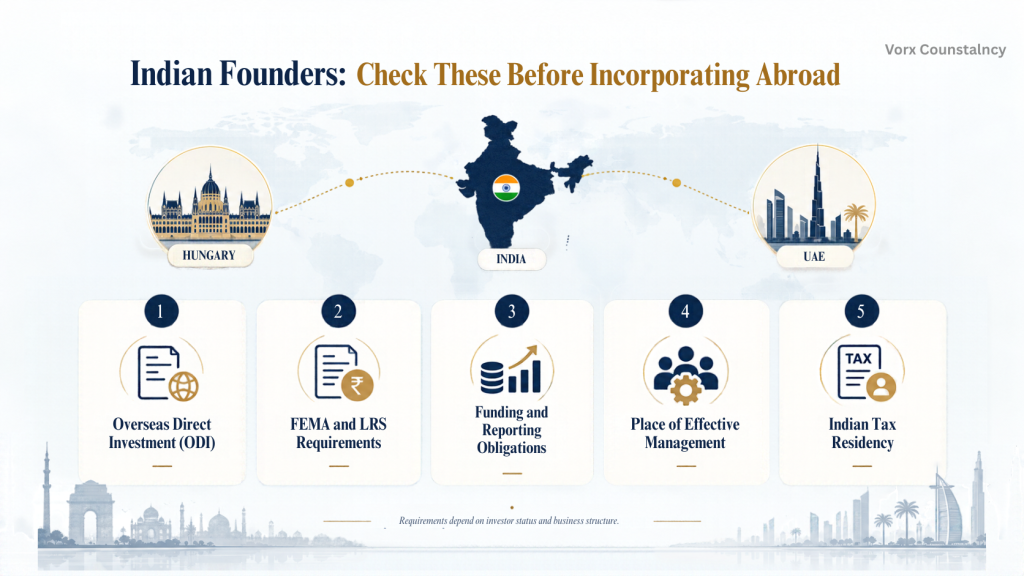
What Indian Founders Must Check First
For Indian residents, the overseas company is only half the structure. The India side decides whether it is set up legally.
Rules for ODI: Establishment or subscription to shares of a foreign company is considered overseas direct investment in accordance with India’s Overseas Investment Rules, 2022.
Foreign investments: The maximum limit of foreign investment allowed to Indian companies is 400% of the net worth and can be made by filing form ODI through an authorized dealer bank before any transfer of funds.
LRS for individuals: Resident Individuals are allowed to make outward remittances of USD 250,000 per financial year, and ODI by individuals is restricted to only operating companies, not financial services.
Company management: If crucial decisions of the company are taken in India, the foreign company may be considered a resident of India by Indian tax authorities, regardless of the foreign tax rate.
Taxation on individuals: As long as you are a tax resident of India, dividends of both companies are taxable in India. India has tax treaties with Hungary and the UAE.
If you are unsure how these rules apply, get advice on FEMA and ODI compliance before you remit funds.
Expanding Your Business from India?
Overseas incorporation involves more than company registration. Vorx Consultancy helps you understand cross-border business setup, banking, and compliance considerations.
Which Should You Choose? Three Founder Scenarios
These are hypothetical examples, not client cases.
Scenario 1: A SaaS entrepreneur from Bengaluru selling into mid-market companies based in Europe.
The enterprise clients demand an entity based in Europe and European VAT. A Hungarian Kft provides her lower taxes on company profits, EU credibility, and flat 15 percent tax on personal income if relocated there. Hungary is likely the stronger fit.
Scenario 2: A Surat-based trader distributing goods across the GCC and East Africa. Logistics, re-export and Gulf customers all point to the UAE.
The key decision is free zone versus mainland, based on whether he sells to UAE mainland buyers. The UAE is the natural choice.
Scenario 3: A founder planning to move abroad with his family. If personal tax matters most and the business is global or digital, the UAE’s zero personal income tax and owner visa are attractive, but only if he genuinely becomes non-resident in India.
If EU schooling and long-term EU residency are the goal, Hungary’s Guest Investor route may justify the higher tax cost.
|
Your situation |
Usually the better fit |
|
Selling B2B services or software to EU clients |
Hungary |
|
Need an EU VAT number and EU-based contracts |
Hungary |
|
Trading, re-export or distribution across the GCC and Africa |
UAE |
|
Digital or consulting business with global clients, founder relocating |
UAE |
|
Want EU residency for family, with capital to invest |
Hungary (Guest Investor route) |
|
Very low-margin, high-turnover business |
Compare carefully (see tax section) |
Final Thoughts: Choose the Market First
The decision between Hungary and UAE is not about 9% versus 9%, but rather where your income comes from and what country you want to live in. Hungary wins because EU access and credibility sells products.
UAE wins because for businesses with a Gulf focus and trading business, as long as you have substance, banking and no Small Business Relief anymore.
Before paying for registration, think about your clients, where you will be living and your Indian obligations.If you would like a second opinion, Vorx offers a free jurisdiction-fit consultation covering structure, banking and compliance for both countries.
Hungary or UAE? Make the Right Move for Your Business.
Not sure which jurisdiction aligns with your expansion goals? Vorx Consultancy can help you evaluate company formation, taxation, banking, and ongoing compliance before you decide.