


Registering a Hungarian Kft. is the easy part. Once the company exists, it runs on a fixed annual cycle of bookkeeping, tax returns, VAT reporting and public filings, and the cycle continues whether the business trades or not. For foreign owners who manage the company from abroad, this is where problems usually start.
This guide addresses the corporate compliance obligations for the Hungary Kft. corporation in 2026, including the filings that need to be made, who will make them, deadlines remaining in 2026, and the closing for 2027 which is 31 May 2027.
If you are an Indian owner, there is also a short section on the filings you owe back home.
Read this guide: Hungary Company Formation for Foreigners: A Complete 2026 Guide
What Are the Compliance Requirements for Companies in Hungary?
There are two types of obligations for every Hungarian Kft. The continuous obligations are monthly or quarterly: VAT declaration, payroll declarations, tax advances, and real-time invoices.
The annual obligations are in respect of the fiscal year: certified annual accounts, corporate tax declaration, and local tax declaration of the business.
These documents are prepared by your Hungarian accountant, but the company together with its managing director (ügyvezető) is legally responsible.
Also, there are decisions to be made by the owners of the company: approval of the accounts, decisions about dividends, and ownership data management.
Requirement | Authority | Frequency |
Bookkeeping | Company / Accountant | Ongoing |
Annual Financial Statements | Company Information Service | Annually |
Corporate Tax (CIT) | NAV | Annually + Advances |
Local Business Tax (HIPA) | NAV / Municipality | Annually + Advances |
VAT Returns | NAV | Monthly / Quarterly / Annually |
Online Invoice Reporting | NAV | Real-time, where applicable |
Payroll Reporting | NAV | Monthly, if applicable |
Beneficial Ownership (UBO) | NAV / Reporting Entities | When details change |

Accounting and Bookkeeping Requirements in Hungary
Double-entry books under Hungarian rules
Companies keep double-entry books under Act C of 2000 on Accounting, using the Hungarian chart of accounts.
The financial statements have to be prepared in Hungarian. Since there are some differences between Hungarian standards and IFRS regarding items like provisions or small value assets, the group that is preparing its financial statements based on IFRS generally reconciles the Hungarian book to the group’s accounting chart.
Organize the invoices, contracts, bank statements and payroll reports during the whole year. Different documentation types have different periods during which they should be kept – in some cases for even eight years.
When a statutory audit is required
This is where many online guides are out of date. Where the financial year begins from and including 1 January 2025, the exemption from mandatory audit of the Kft. applies only where the average net sales turnover in the last two financial years does not exceed HUF 600 million and the average number of staff does not exceed 50. The old revenue limit was HUF 300 million .
Size is not the only trigger. An audit is also required if the company is included in a consolidation, or if it owes more than HUF 10 million in public dues that are over 60 days overdue at the balance sheet date.
Example (hypothetical): An account of Budapest Kft., which belongs to a Bangalore software company, had turnover of HUF 450 million for 2024 and HUF 820 million for 2025, employing 30 people.
Its average over the last two years is HUF 635 million, and therefore an audit of its accounts for 2026 is required.
The Chamber of Hungarian Auditors actively checks this. In early 2026, it sent letters to almost 3,200 firms that had made public accounts without a mandatory auditor’s report.
Annual Financial Statements and Filing Requirements
The annual financial statements include a balance sheet, a profit and loss account and notes.
Depending on size, a company prepares full, simplified or micro-entity accounts. The members’ meeting (or sole member) must approve them within five months of the year-end and decide on profit distribution at the same time .
Approved accounts must be deposited and published electronically by the last day of the fifth month after year-end.
For calendar-year companies, that is 31 May. For the 2025 accounts, the deadline was 31 May 2026; the 2026 accounts are due by 31 May 2027.
Inactive companies are not exempt. A dormant Kft. still prepares accounts and files a CIT return.
The consequences are concrete. NAV can impose a HUF 200,000 default penalty for unpublished accounts, and if the company ignores a second notice, NAV deletes its tax number . Without a tax number, the company cannot invoice legally.
Corporate Tax and Other Annual Tax Filing Obligations
Corporate income tax (CIT) returns
The CIT rate of Hungary is 9%. The payment date is set for the end of the fifth month following year-end. Since the 31st of May, 2026 fell on Sunday, the tax return for 2025 had to be paid till 1st of June, 2026, which was a Monday.
For the current year, companies pay CIT advance payments either on a monthly or quarterly basis, depending on the prior year’s tax return.
The mandatory December “top-up” of CIT advances was abolished from 2019, although eligible companies may still choose to make it. Failing to file a CIT return at all can lead to a default penalty of up to HUF 1 million.
Local business tax (HIPA)
HIPA is a municipal tax of up to 2%, calculated on a base close to adjusted revenue. The annual return shares the CIT deadline.
Advance payments are made in March and September every year; for example, in 2026, payments fell on 16 March and 15 September.
If the net income from the previous year was higher than HUF 100 million, then the company should pay up to the yearly level of HIPA advance until 20 December. In 2026, this day falls on Sunday, so the actual deadline is 21 December 2026.
Innovation contribution and KIVA
The innovation contribution is 0.3% of the HIPA base. Micro and small enterprises are exempt, but size is assessed together with linked companies, so a small Kft. inside a large group may still owe it.
KIVA, the small business tax, is not an extra tax. It is an alternative system that takes the place of CIT and the social contribution tax of the employer for those firms which opt for it.
It is difficult to say whether it is cost-saving or not due to many factors.
Read this guide: Hungary Corporate Tax 2026
VAT Reporting and Online Invoice Compliance
Hungary has no VAT registration threshold for taxable activity, and its standard rate is 27%. New VAT payers generally start on monthly returns.
After that, the filing frequency depends on net VAT payable in the second preceding year:
- Monthly: HUF 1 million or more
- Quarterly: below HUF 1 million, and for any business holding an EU VAT number that does not reach the monthly limit
- Annual: net VAT under HUF 250,000, turnover up to HUF 50 million and no EU VAT number
Monthly and quarterly returns are due on the 20th of the following month. Annual returns are due on 25 February, so the 2026 annual return is due by 25 February 2027 .
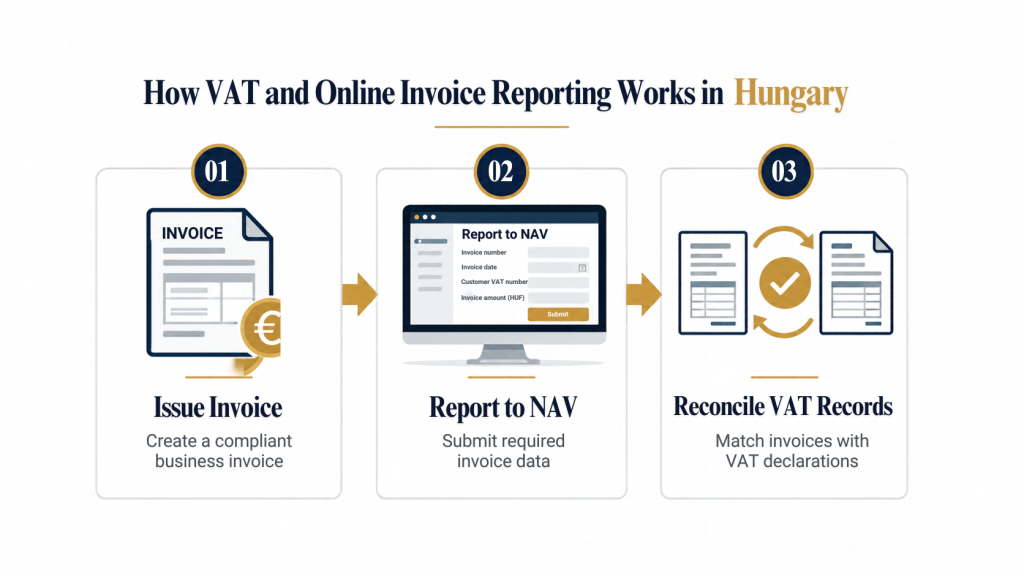
Separately, every invoice issued by a VAT-registered business must be reported to NAV in real time through the Online Számla system, regardless of amount or customer type.
Invoicing software must be connected to NAV, and invoice data should be reconciled against the VAT return each period. Mismatches are a common trigger for NAV queries.
Beneficial Ownership, Company Records and Cégkapu
Hungary’s UBO register is held by NAV and is not publicly searchable. Unlike in many countries, the company does not file UBO data itself.
Account-holding banks and other designated service providers report it, based on what the company tells them.
The company’s duty is to notify those providers within 15 days of any change in beneficial ownership .
Changes to directors, members or the registered office are a separate matter: they must be registered with the Court of Registration, normally through a Hungarian lawyer.
All Hungarian business organisations must also use Cégkapu, the official electronic mailbox for communication with courts and authorities.
A message delivered there is treated as legally served, and the interface is in Hungarian only. If your director lives abroad, authorise a local accountant or lawyer to monitor it.
Hungary Company Compliance Deadlines: October 2026 to May 2027
Dates assume a calendar financial year. When a deadline falls on a weekend or public holiday, it moves to the next working day.
Deadline | Compliance Requirement | Applies To |
12th of each month* | Payroll tax filing and payment | Employers |
20th of following month* | Monthly VAT return | Monthly VAT filers |
20 Oct 2026 | Q3 VAT return and CIT advance | Applicable companies |
21 Dec 2026 | Q4 CIT advance | Quarterly CIT payers |
20 Jan 2027 | Q4 VAT return and KIVA advance | Applicable companies |
25 Feb 2027 | Annual VAT return for 2026 | Annual VAT filers |
31 May 2027 | Annual financial statements | Companies required to file |
31 May 2027 | CIT, HIPA, KIVA and applicable innovation contribution returns | Relevant taxpayers |
Not sure which of these apply to your Kft.? Vorx’s annual compliance support starts with a review of your current filing position.
Not Sure Which Compliance Deadlines Apply to Your Kft.?
Missing a filing can create unnecessary compliance risks. Vorx can help you review your Hungarian company’s reporting obligations and upcoming deadlines.
Extra Filings for Indian Owners
If an Indian resident individual or company holds the Kft. as an overseas direct investment, Hungarian compliance is only half the picture.
RBI Annual Performance Report (APR): filed through your authorised dealer bank by 31 December each year.
Where the foreign entity’s year ends on 31 December, the APR is due by 31 December of the following year. Your Hungarian accounts for 2025 therefore feed the APR due on 31 December 2026.
Indian tax disclosures: resident shareholders report foreign holdings in their Indian income tax return.
Place of effective management (POEM): if all key decisions are taken in India, Indian tax authorities may argue the Kft. is resident in India.
Holding board decisions and keeping management substance in Hungary reduces this risk.
Example (hypothetical): Priya, a Pune founder, owns 100% of a Budapest Kft. Her accountant filed the Hungarian accounts on 28 May 2027.
Those audited figures then go to her AD bank for the APR due by 31 December 2027. If the Hungarian filing slips, the Indian one is at risk too.
Vorx advises on FEMA and overseas investment reporting alongside the Hungarian timetable.
Managing a Hungarian Company from India?
Your compliance responsibilities may extend across both countries. Vorx helps you coordinate Hungarian filing requirements with applicable Indian tax, FEMA and ODI obligations.
Common Compliance Mistakes Foreign Owners Make
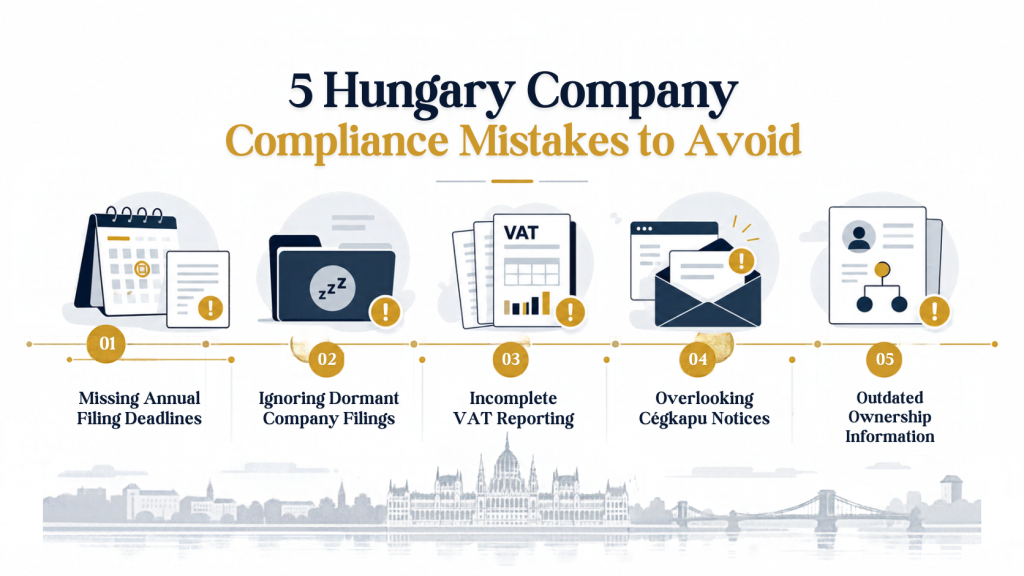
Using the old audit threshold: Checking against HUF 300 million instead of the current two-year HUF 600 million test, or ignoring consolidation as a trigger.
Assuming a dormant company has nothing to file: Accounts and a CIT return are still required.
Treating Online Számla as the accountant’s problem: Invoices issued from your own system must reach NAV in real time.
Not watching Cégkapu: Official notices count as delivered even if nobody opens them.
Forgetting UBO and ownership updates after share transfers, new investors or group restructuring.
How to Keep Your Hungarian Company Compliant: A 4-Step Routine
Monthly: send invoices, bank statements and payroll data to your accountant by a fixed date, and confirm Online Számla submissions.
Quarterly: review VAT and tax advance payments, and check whether your VAT filing frequency is changing.
January to May: run the audit test, schedule the auditor if needed, approve the accounts and confirm filing before 31 May.
Annually: review UBO details, director and member records, Cégkapu access and home-country filings such as the APR.
How Vorx Can Help with Hungary Company Compliance
Vorx works with founders who run overseas companies from India and other home countries.
For a Hungarian Kft., that means reviewing your compliance status against the calendar above, coordinating accounting and bookkeeping and annual filings, and aligning them with your FEMA, ODI and Indian tax obligations, so both sides of the structure close on time.
Keep Your Hungarian Company Compliant — Speak with Vorx
Conclusion
A Hungarian Kft. maintains its compliance by virtue of process and not an ad hoc activity: monthly VAT and invoice reporting, proper advances, and 31 May year-end that all other processes hinge upon.
The next pragmatic move would be to assess your company based on the October 2026 to May 2027 calendar, particularly the audit test and the potential for UBO change.
In case you control the company from India, synchronize the said calendar with RBI and India tax filing right away and not in December. Speak with Vorx for a compliance review of your Hungarian company.
This article provides general information and is not legal or tax advice. Requirements depend on your company’s facts; confirm details with a qualified adviser.
Keep Your Hungarian Company Compliant
From annual financial statements to tax filings and ongoing reporting, Vorx helps foreign business owners stay organised and prepared for their compliance obligations.
