


If you’re a founder reading this, chances are you didn’t land here out of wanderlust. You landed here because something practical is annoying.
Maybe an EU client wants a local invoice, maybe your Indian bank made opening a EUR account feel like a full-time job, or maybe you’re just tired of your net worth sitting entirely inside one country’s economy and one country’s politics.
A Europe Golden Visa for Indians can genuinely help with many of these challenges. Whether you’re looking for easier access to European markets, international banking, or long-term mobility, EU Residency by Investment has become an increasingly popular option for Indian entrepreneurs.
It can’t magically solve all of it. This guide walks through what it actually does for an Indian founder: banking, tax, market entry, the works without the sales pitch.
What a Golden Visa Actually Is (and Isn't)
A Golden Visa is a residence permit obtained through European Residency Investment, allowing eligible investors to live in a participating EU country by making a qualifying investment. For many founders, it serves as a practical pathway to EU Residency by Investment rather than immediate citizenship.
It is not citizenship, and it’s not a single “EU passport” that lets you work anywhere in the bloc. Get a Portugal Golden Visa, and you have residence rights in Portugal, plus Schengen travel for short stays elsewhere. That’s it, until you naturalize years later.
It’s also not the same as Citizenship by Investment (CBI), which is what countries like Grenada or St Kitts offer a passport in months, no residency required.
And it’s not EU Long-Term Resident status, which is a separate EU-wide framework you generally only qualify for after five continuous years living in one member state.
One more thing worth setting straight now: a Golden Visa doesn’t automatically make you a tax resident anywhere, and it doesn’t automatically get you a EUR bank account either. More on both below this is where most guides oversell.
Why Indian Founders Are Actually Looking at This
If you run a SaaS company selling into Europe, enterprise procurement teams often quietly prefer vendors with an EU legal presence; it simplifies their compliance and yours.
If you’re in export-import, having an EU-based relationship (even a residence address) can smooth logistics and invoicing conversations that get awkward when everything routes back to India.
For many founders, European Residency for Indian Entrepreneurs is no longer just about relocation. It has become a strategic business decision that supports international expansion, easier access to European clients, diversified investments, and greater long-term flexibility.
Family offices increasingly treat a second residency as balance-sheet insurance, not a lifestyle purchase spreading risk away from India-concentrated real estate and business exposure.
And if your kids are approaching university age, EU education access becomes a real, if secondary, factor.
None of these are reasons to buy a Golden Visa impulsively. They’re reasons to understand what it can and can’t fix.
The LRS Reality Check Nobody Tells You About
Here’s the part where almost every Golden Visa article skips entirely, and it matters more to you than any comparison table.
India’s Liberalised Remittance Scheme caps how much you can send abroad USD 250,000 per person, per financial year.
A Portugal or Greece Golden Visa can require €250,000 to €800,000. Do the math, and a single LRS limit doesn’t cover most programs in one shot.
What founders actually do: stagger the investment across financial years, or pool LRS limits across family members; your spouse and adult children each get their own USD 250,000 allowance, which can add up fast for a joint family application.
There’s also Tax Collected at Source (TCS) on outward remittances above ₹7 lakh to factor into your real budget, not just the headline euro figure.
Example: A Bengaluru-based SaaS founder targeting Portugal’s €500,000 fund route split the investment across two financial years using his own LRS limit in year one and his spouse’s in year two while keeping meticulous source-of-funds documentation from his ITRs and company financials ready for due diligence.
That planning conversation with his CA started six months before he contacted an immigration lawyer, not after.
This is the single most important planning step for an Indian applicant, and it should happen before you fall in love with a country.
Also Read: Investor Visa vs Employment Visa: Which One Actually Suits Your Goals?
Comparing the Main Routes
When evaluating the Best Golden Visa for Indians, it’s important to compare more than just the investment amount. Physical stay requirements, banking accessibility, taxation, processing timelines, and business opportunities should all influence your decision.
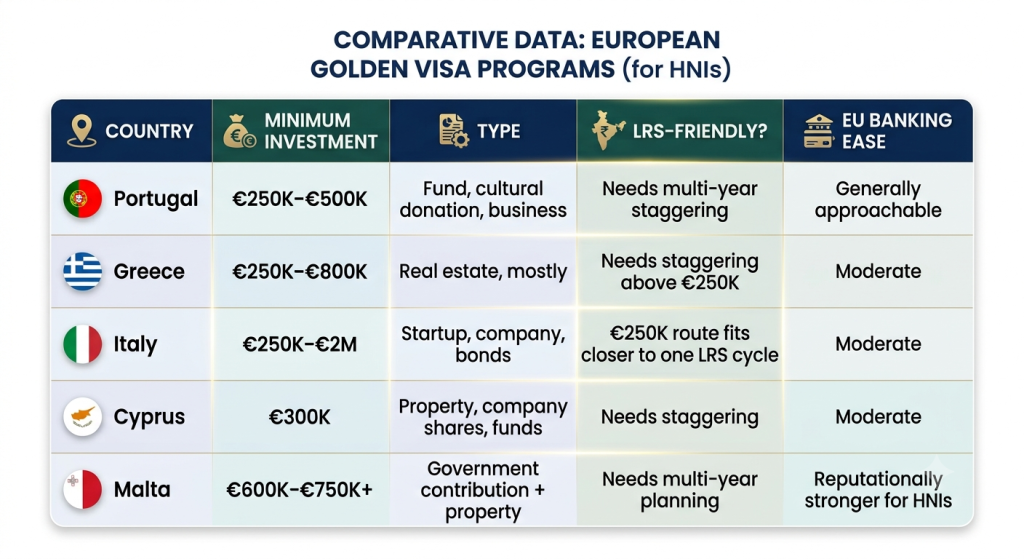
Treat this as a starting map, not gospel thresholds and rules shift often, so confirm the current numbers before committing funds.
Best for EU banking-focused founders: Portugal or Malta tend to be viewed as more approachable for account opening, though nothing is guaranteed.
Best for low physical presence: Portugal around 7 days a year is enough to maintain status. Best for direct real estate exposure: Greece, if you want a tangible asset alongside the residency.
Also Read: What is the Process to Register a Company in Europe (Portugal, Spain, Malta & Cyprus)?
The Real Cost, Not Just the Headline Number
A €250,000 headline never means €250,000 out the door. Add legal fees, due diligence checks, property transfer taxes where relevant, apostille and translation costs for your Indian documents, facilitator commissions, and annual renewal costs.
All-in, budget meaningfully above the headline figure is often 8–15% more, depending on the route and how much of it involves property.
Also worth flagging: a €250,000 Portugal cultural donation, a €250,000 Italy startup investment, and a €250,000 Greek historic-property purchase are not comparable in risk. Same number, completely different asset class.
Does It Actually Get You EU Banking?
Honestly not by itself. Residency status helps with parts of KYC, but EU banks run their own independent checks, and Indian applicants still sometimes face friction even with a valid residence permit in hand.
What genuinely helps is pairing the visa with a local tax ID, a registered address, and ideally an EU company formation entity if banking is your real goal.
If EUR banking access is your primary driver, plan for the company-registration step as part of the same project, not an afterthought.
Tax: What Changes, What Doesn't
A Golden Visa doesn’t switch your tax residency that depends on days spent in-country, permanent home ties, and similar tests, separately from immigration status.
You’ll want to understand how the India-EU tax treaty (DTAA) applies to your specific country, how RNOR status might apply if you’re spending significant time abroad, and that FEMA reporting obligations on foreign assets continue regardless of your visa.
This is genuinely a “talk to a cross-border tax advisor” situation, treating anything here as a starting point, not a substitute for that conversation.
Common Mistakes to Avoid
Don’t wire funds before a program’s final confirmation Spain’s 2025 closure is a reminder these routes can shut with real notice but real finality.
Don’t assume Schengen residency means you can freely invoice or work across every EU state, rights are usually tied to your issuing country.
And don’t leave LRS and FEMA planning until the immigration process is already underway; start that conversation with your CA first.
Conclusion
A Europe Golden Visa for Indians can be much more than a residency permit. When planned correctly, it becomes a gateway to EU Residency by Investment, international banking opportunities, European market access, and long-term business expansion. The right programme depends on your investment goals, business strategy, and long-term residency plans.
Vorx Consultancy helps Indian founders navigate European Golden Visa options with practical guidance on residency, company formation, banking, and international business expansion.