

Australia is one of the favorite destinations for entrepreneurs, start-up companies, and foreign investors, who want to expand their business into the Asia-Pacific region. Prior to registering a company, it is essential to learn the details about the Australia Corporate Tax. Understanding the rules of the corporate tax system in Australia will assist firms in ensuring all requirements are followed while enjoying tax deductions.
For an Australian company owner, foreign investor, or an entrepreneur, who is considering establishing a business in Australia, it is vital to be aware of the corporate tax rate, rules, deductions, and filing procedures, which will minimize the expenses.
The above-mentioned information, which can be complicated to understand, is explained in this Australia Corporate Tax Guide 2026.
What Is Australia Corporate Tax?
Australia Corporate Tax refers to the income tax paid by companies on their taxable profits in Australia. This tax is levied by the Australian Taxation Office on domestic and foreign companies with taxable income in the country.
Unlike individual income tax, corporate tax is calculated as a portion of net profit, i.e., total income minus allowable deductions. For corporations, it is mandatory to conduct all tax calculations, keep records of income and expenses, and submit company tax returns to the tax authority.
The tax liability depends on several variables, including the level of taxable income, company structure, and eligibility for the reduced tax rate, among others.
Australia Corporate Tax Rates (2026)
One of the first questions that any business owner has when they are setting up shop is – ‘what is the tax rate in Australia?’ Depending on the company’s status, the corporate tax rate in Australia can be 25% or 30%.
Company Type | Corporate Tax Rate |
Base Rate Entity (BRE) | 25% |
Other Companies | 30% |
Who qualifies for a 25% tax rate?
Typically, a BRE is an entity that has an aggregated annual turnover of less than $50 million and no more than 80% of its assessable income is passive.
Who is subject to a 30% tax rate?
Otherwise, companies that do not qualify as BREs are subject to a 30% tax rate. This normally applies to large firms that have an aggregated turnover of $50 million or more. It also applies to entities that derive more than 80% of their assessable income from passive sources.
A company’s BRE status is important in determining its tax obligations. In essence, understanding the corporate tax structure is critical to saving on taxable income.
Which Businesses Need to Pay Australian Corporate Tax?
Not every business operating in Australia has the same tax obligations. The requirement to pay corporate tax depends on factors such as the business structure, tax residency, and where income is generated.
Generally, the following businesses may be required to pay Australian corporate tax:
- Australian registered companies
- Companies incorporated overseas but earning taxable income in Australia
- Foreign companies operating through an Australian branch or permanent establishment
- Businesses carrying on commercial activities within Australia
Australian resident companies are generally taxed on their worldwide income, while foreign companies are typically taxed only on income connected with their Australian operations.
Recommended Reading:
Planning to establish a business in Australia? Explore our complete guide to company registration from India, including eligibility, required documents, registration process, costs, and post-incorporation compliance to launch your business with confidence.
How Corporate Tax Is Calculated?
One of the most common questions business owners ask is how to calculate corporate tax in Australia. The process is relatively straightforward once taxable income has been determined. The calculation generally follows these steps:
- Calculate total business income.
- Deduct eligible business expenses.
- Determine taxable income.
- Apply the applicable corporate tax rate.
- Calculate the final tax payable.
Example
Suppose an Australian company reports:
- Annual Revenue: AUD 600,000
- Business Expenses: AUD 380,000
Taxable Income
AUD 600,000 – AUD 380,000 = AUD 220,000
If the company qualifies for the 25% corporate tax rate:
Corporate Tax Payable
AUD 220,000 × 25% = AUD 55,000
This simplified example demonstrates the basic approach. Actual tax calculations may involve additional adjustments, deductions, carried-forward losses, or tax offsets depending on the company’s circumstances.
What Are the Key Corporate Tax Deductions for Businesses?
One of the biggest advantages of Australia’s corporate tax system is that businesses can reduce their taxable income by claiming eligible deductions. These deductions lower the amount of profit on which corporate tax is calculated. Common deductible business expenses include:
- Employee salaries and wages
- Office rent and utilities
- Marketing and advertising costs
- Professional services such as legal and accounting fees
- Business insurance
- Software subscriptions and cloud services
- Office supplies
- Business travel expenses
- Equipment depreciation (where applicable)
- Interest on eligible business loans
However, businesses should ensure that every deduction is properly documented and directly related to business activities. Claiming unsupported or personal expenses may result in penalties or additional scrutiny from the Australian Taxation Office.
How Can You File a Corporate Tax Return in Australia?
Understanding the filing process is no less important than being aware of the tax rates. Any company operating in Australia needs to meet its tax obligations by virtue of properly keeping all the financial records and timely submitting tax returns to the Australian Taxation Office (ATO). The standard procedure for a corporate tax filing includes the following:
- registration for an Australian Business Number (ABN) if applicable and mandatory,
- keeping all the financial documents and records,
- preparing financial statements,
- calculating corporate tax liabilities,
- submitting tax returns to ATO,
- settlement of tax liabilities by the due date.
Furthermore, any growing business tends to employ professional tax accountants to ensure that their filings are correct and that no compliance mistakes are made. In addition, it is always a good idea to plan your tax strategy to make sure the filing process is not stressful.
What Are the Australia Corporate Tax Deadlines?
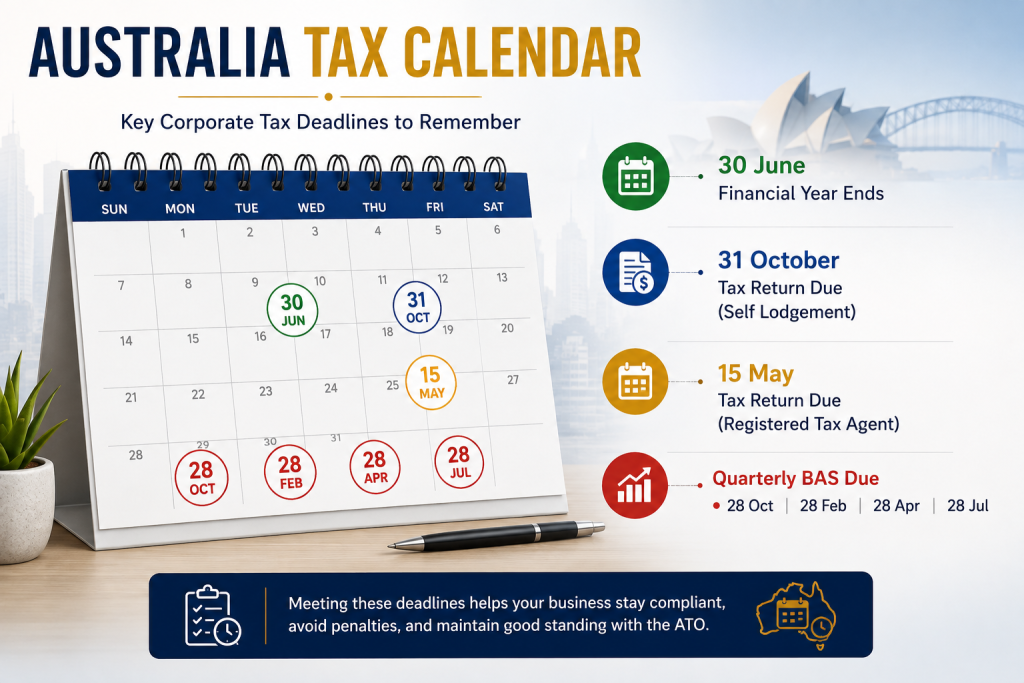
Understanding Australia Corporate Tax Deadlines is essential to avoid late filing penalties and interest charges. Australia follows a financial year from 1 July to 30 June, and tax return due dates depend on how your company lodges its return and whether you use a registered tax agent.
Key Lodgement Deadlines
Filing Requirement | Typical Due Date |
Financial Year Ends | 30 June |
Self-Lodged Company Tax Return | 31 October |
Company Tax Return (Registered Tax Agent) | Up to 15 May of the following year (subject to ATO eligibility) |
Quarterly BAS (if applicable) | 28 October, 28 February, 28 April and 28 July |
PAYG Instalments
Many companies pay their income tax through Pay As You Go (PAYG) instalments instead of making a single annual payment. Depending on the company’s size and tax obligations, PAYG instalments are generally paid quarterly, while some larger businesses may be required to make monthly payments.
Note: Actual due dates may vary depending on your company’s ATO lodgement program and compliance history. Registered tax agents may receive extended lodgement dates for eligible businesses.
What are the Compliance Requirements?
Paying corporate tax is only one part of running a compliant business in Australia. Companies are also expected to follow various record-keeping and reporting requirements throughout the year. Some of the most important Australia Corporate Tax Requirements include:
- Maintaining complete and accurate accounting records.
- Retaining supporting documents for business income and expenses.
- Keeping payroll and employee records where applicable.
- Reporting business income correctly.
- Lodging tax returns and required statements on time.
- Paying taxes by the applicable due dates.
- Responding promptly to any requests from the Australian Taxation Office.
Good compliance practices not only reduce the likelihood of penalties but also improve business transparency and make future audits or funding applications much easier to manage.
Recommended Reading:
Already registered a company in Australia? Learn everything about the ASIC Annual Review, including annual review fees, solvency resolution, company details verification, due dates, and compliance requirements to keep your company in good standing and avoid late penalties.
Penalties for Non-Compliance with Australia Corporate Tax
Failure to pay taxes at the time that is stipulated by the Australian tax laws results in a fine and interest. The amount for the fine depends on the nature of a penalty, a time when a company fails to pay, and the company’s size.
Failure to Lodge (FTL) Penalty
If a company fails to lodge its corporate tax return by the due date, the ATO may apply a Failure to Lodge (FTL) penalty. From 1 July 2026, the penalty is based on AUD 364 per penalty unit for each 28-day period (or part thereof) that the return remains overdue, up to a maximum of 5 penalty units.
Business Size | Penalty Every 28 Days | Maximum Penalty |
Small Entity | AUD 364 | AUD 1,820 |
Medium Entity | AUD 728 | AUD 3,640 |
Large Entity | AUD 1,820 | AUD 9,100 |
General Interest Charge (GIC)
If corporate tax is not paid by the due date, the ATO applies a General Interest Charge (GIC) on the outstanding amount. The GIC is compounded daily, meaning the longer the tax remains unpaid, the more interest accumulates. As of April–June 2026, the annual GIC rate is 10.96%.
Note: ATO penalty amounts and interest rates may change over time. Always check the official Australian Taxation Office (ATO) website for the latest updates before making tax or compliance decisions.
India–Australia DTAA: What Indian Businesses Should Know Before Expanding
For Indian entrepreneurs and businesses looking to expand internationally, understanding the India-Australia Double Taxation Avoidance Agreement (DTAA) is very important. The DTAA aims to reduce the chances of the same income being taxed in both India and Australia. While the agreement does not remove tax obligations, it helps clarify which country can tax specific situations and may provide relief from double taxation when applicable.
For instance, if an Indian company starts operations in Australia, it may face corporate tax obligations in Australia based on the business structure and where the income comes from. At the same time, the company might also have tax reporting obligations in India. The DTAA offers a framework to prevent unnecessary double taxation and allows for smoother international business operations.
Because each business has a unique structure, companies expanding between India and Australia should assess their tax situation before starting operations. Early tax planning can guide businesses in choosing an effective structure, understanding compliance responsibilities, and avoiding unexpected tax issues later.
Common Mistakes Businesses Should Avoid
Even profitable businesses can face unnecessary tax issues due to avoidable compliance mistakes. Understanding these common errors can help companies manage their corporate tax obligations more effectively.
1. Missing Filing Deadlines
Late lodgement of company tax returns or delayed tax payments can lead to penalties and interest charges.
2. Poor Record Keeping
Incomplete invoices, missing receipts, or inaccurate accounting records make it difficult to calculate taxable income correctly.
3. Claiming Ineligible Deductions
Only genuine business expenses should be claimed as deductions. Personal or unsupported expenses may trigger compliance issues.
4. Ignoring Tax Planning
Many businesses focus only on filing their returns rather than planning throughout the financial year. Proactive tax planning often leads to better financial outcomes.
5. Confusing GST with Corporate Tax
GST and corporate income tax are separate obligations. Understanding the difference helps businesses avoid reporting errors.
6. Overlooking International Tax Implications
Businesses with overseas operations should consider cross-border tax rules and applicable tax treaties instead of assuming domestic tax rules apply everywhere.
Avoiding these common mistakes can save businesses significant time, money, and administrative effort while reducing the risk of ATO investigations.
How Vorx Consultancy Can Help?
Expanding into Australia is more than just registration. Getting Australia Corporate Tax, compliance guidance, or the right business structure advice at the initial stages could make all the difference.
Vorx Consultancy helps entrepreneurs, start-ups, and international businesses with company registration, business structuring, compliance guidance, and international tax planning assistance in Australia. We help you identify and execute options that make your business operations seamless and stress-free.
Whether you are a start-up, expanding your international business footprint, or just seeking guidance on Australia Corporate Tax to ensure compliance, our expert consultants will assist you every step of the way.
Are you planning to expand your business operations to Australia? Get in touch with Vorx Consultancy experts to find the best-suitable business structure, understand your corporate tax requirements, and set your international business operations right from day one.
Need Strategic Guidance?
Book a Strategy Call: (Calendly Link)
Visit: www.vorxcon.com
Email: support@vorxcon.com
Final Thoughts
Understanding Australia Corporate Tax is crucial for any individual or organization that wants to establish or expand their presence in Australia. It is necessary to know the subtleties of taxation, which mainly include the choice of organizational form, the size of the corporate tax rate, and the nuances of document preparation and deadlines. This knowledge will reduce the risks of tax violations and help the owner save money.
For foreign investors, especially those from India, it is critical to determine their tax liabilities ahead of time and prepare the necessary documents correctly to make the expansion process smoother and optimize their tax payments.
Vorx Consultancy experts are ready to help you register and launch your business in Australia and take care of all the intricacies of corporate tax compliance for you.
