


Australia is one of those enticing regions for expanding any foreign business. This country offers a stable economy, a reliable legal system, professional skills, and great trade opportunities. These favorable conditions attract many start-ups and multinational companies.
Nevertheless, as in any other country, you cannot simply arrive in Australia and register a company right away. All nations have their own particular legal, tax, and business requirements that need to be studied and understood before opening any business.
Many foreign firms focus too much on the company incorporation process and forget about other essential aspects of doing business in Australia. If you are considering entering the Australian market, make sure to read this guide and review the following checklist of things every foreign business owner should know before setting up their operations in Australia.
Have You Researched the Australian Market Before Expanding?
The initial step towards the success of any business expansion is to know the market rather than getting caught up in paperwork. Australia, although regarded as a single market, can have different consumer demands, customer behaviour and business opportunities in various states and cities. What works for Sydney may not work for both Perth and Brisbane. Thus, market research should always be the first step on the path of entering the Australian market.
Instead of thinking that your business will find demand on the Australian market, one should study the local environment. Analyze your competition, identify your target audience, estimate the pricing policy, understand how competitors in your field position themselves.
Besides, it is necessary to think about doing business in a certain city. Various big cities of Australia boast different economic advantages. While Sydney is a center of finance and technology, Melbourne is famous for its professional services. Brisbane keeps developing in the sphere of infrastructure and logistics and, finally, Perth is known for the mining sector.
Is Your Business Prepared for the Australian Market?
It is easy to get caught up in the excitement of entering the Australian market and forget about the hard work that needs to be put into it. Many companies that want to enter the Australian market underestimate the effort and dedication needed for foreign business expansion. They overlook critical steps, such as proper planning, and set themselves up for failure.
Before you embark on your business expansion journey, it is essential to understand whether your company is ready for international growth. Do you have enough financial power to operate in Australia? Are you willing to invest time and effort into research and planning? Can your current business structure handle international expansion?, or will you need to make some structural changes first?
Remember that entering the Australian market is a long-term commitment. Therefore, it is essential to set realistic expectations and have a well-structured business plan.
Are You Choosing the Right Business Structure?
One of the first critical decisions that you will have to make as a foreign business owner is to choose the legal structure of your company in Australia.
It is essential to understand that every structure has its own advantages and disadvantages. In addition, not all structures are suitable for every business, so you need to do your research before making your choice. The most popular business structures in Australia are:
Proprietary limited company Pty Ltd: This is a popular choice among foreign business owners due to its flexibility and limited liability.
Branch office: A great option for international companies that do not want to incorporate a local entity.
Partnership: It is a common structure for businesses with multiple founders.
Remember that choosing the right business structure is a strategic decision. Therefore, it is essential to consult with experts and understand how your choice will impact your taxes, liabilities, and long-term plans in Australia.
Have You Completed the Essential Business Registrations?
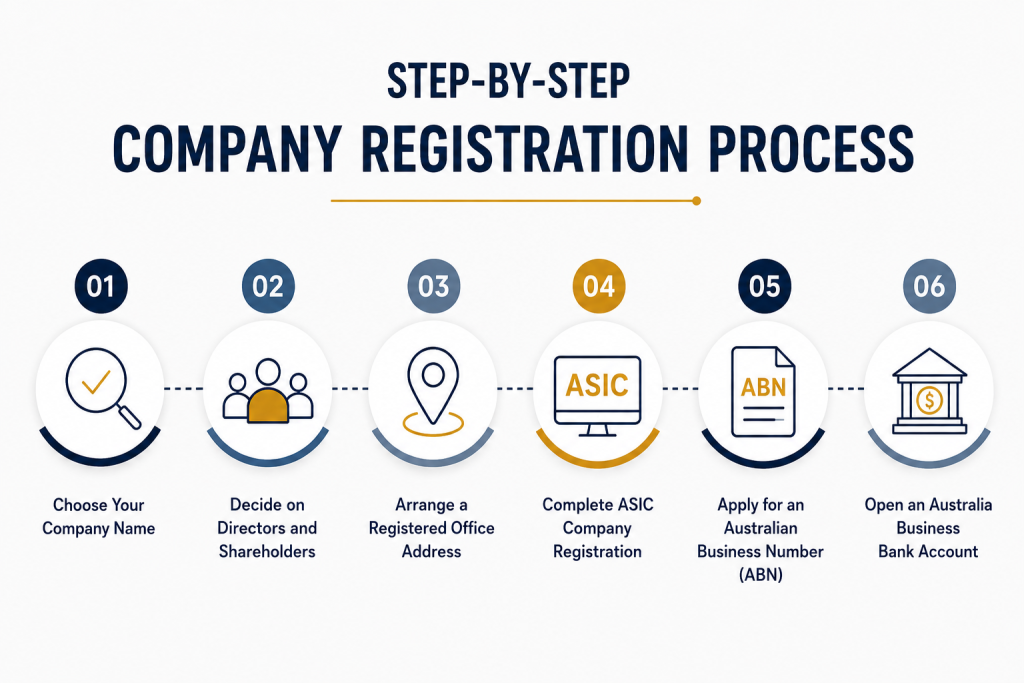
Once you have chosen the business structure, you will need to make sure that your company is properly registered in Australia. This step is often overlooked, which can lead to significant financial losses. In addition, many foreign business owners fail to complete all required registrations, which puts their operations at risk.
The exact registration requirements will depend on the type of your business and the industry in which it operates. Nevertheless, there are certain steps that every foreign company must take before launching its operations in Australia. They include:
ACN registration: Every company that operates in Australia must have an Australian
Company Number (ACN). It is a unique identification number issued by the Australian Securities Exchange (ASIC).
ABN registration: Every business entity must also have an Australian Business Number (ABN). It is an 11-digit number that identifies a company for tax purposes.
GST registration: Most businesses must register for Goods and Services Tax (GST) and collect it from their customers.
Business licenses and permits: Many industries require additional licenses and permits before they can operate lawfully in Australia.
Completing these registration steps from the beginning reduces delays, and helps your business start operations on a compliant foundation.
Do You Understand Your Tax and Financial Obligations?
One of the most challenging aspects of doing business in Australia is understanding your tax and financial obligations.
Although Australia has a transparent tax system, many foreign business owners fail to meet their tax obligations, which can be extremely costly. Remember that tax reporting is an ongoing obligation, so it is essential to keep accurate financial records at all times.
The main tax obligations in Australia include:
Corporate tax: Most business structures are subject to corporate tax, so make sure to understand your tax liabilities.
GST: If your business is registered for GST, you will need to account for it when invoicing your customers.
Record-keeping: It is essential to maintain accurate financial records to ensure tax compliance.
Payroll: If you hire employees in Australia, you will also have to account for their salaries and superannuation.
As your business grows, so will your tax obligations. Therefore, it is essential to develop the proper accounting system to stay on top of your financial commitments.
Recommended Reading:
Read our comprehensive Australia Corporate Tax Guide to learn about corporate tax rates, GST, reporting obligations, and key tax compliance requirements for foreign businesses.
Is Your Brand Protected in Australia?
When starting to run a business, one may spend a lot of time choosing the company name and forget about trademarks. At the same time, it is vital to understand that the organization’s name and trademark are two different things.
Therefore, one should know the difference between a company’s trading name and its trademark. First, a registered company’s name is what the organization is known as, and a trademark is what actually protects the business. Second, registering a trademark is critical for any organization that wants to trade in Australia.
One should remember that anyone may register a trademark in Australia, so it is vital to do all necessary research to ensure no one has trademarked the desired name. It may also be worth registering the domain name for the company.
Are You Ready to Hire Employees Legally?
Hiring employees is one of the most thrilling moments in a company’s growth, yet, it is also among the most challenging experiences for a business owner. When hiring personnel, it is essential to remember legal responsibilities that a company has when hiring employees in Australia.
In most cases, local laws are created to safeguard employees; thus, a business owner must remember to comply with applicable regulations to avoid legal problems. Some of the critical regulations when hiring employees in Australia include employment agreements, work health and safety, award, wages, and superannuation.
Before building a team in Australia, it is essential to make sure that there is a compliant framework for the hiring process so that the business owner can avoid legal issues and foster the company’s positive culture from day one.
Do You Know Your Ongoing Compliance Responsibilities?
A number of foreign business owners make the mistake of thinking that company incorporation concludes their compliance responsibility. On the contrary, incorporation is only the beginning of a company’s compliance journey because the owner must make sure that their business operates according to the law. Therefore, it is essential for a foreign business owner to be aware of their legal responsibilities in Australia. The most common compliance obligations when running a business entity in Australia include:
ASIC review: Almost all business entities incorporated in Australia require an annual review by ASIC.
Tax and BAS reporting: All companies operating in Australia should prepare and submit tax returns and Business Activity Statements.
Record-keeping: It is mandatory for a company to store all invoices, receipts, and other relevant financial documents.
Renewing licenses and permits: Some industries require businesses to renew licenses or permits periodically.
Updating company records: A company must update its details with ASIC if there are changes in the company profile.
In case of default on compliance obligations, a company may be forced to pay hefty penalties. Therefore, it is essential to have an understanding of compliance requirements and make sure that a company is always compliant with applicable laws.
Do You Understand How Business Culture Works in Australia?
Understanding the local business culture is one of those aspects that many foreigners fail to research when entering the marketplace. It is crucial to take time and do proper homework in order to avoid burning bridges with clients, suppliers, and business partners.
In Australia, business persons appreciate a good open and honest approach to communication. Furthermore, most Australians are actually quite pragmatic. In addition, learning about local customs and etiquette will provide you with an upper hand against other foreign competitors.
Finally, knowledge of local expectations will allow you to negotiate more efficiently and build stronger business relationships.
Recommended Reading:
Before starting your expansion, read our detailed guide on Australia Company Registration from India to understand the registration process, eligibility, required documents, and compliance requirements.
Are You Prepared for the Risks of Doing Business in Australia?
Before launching your business in Australia, it is crucial to assess the risks and challenges that you may encounter. Remember that no matter how attractive the local market is, it is always important to be prepared for the worst-case scenario. Some of the most common business risks include:
Contract risks: poorly drawn or poorly negotiated agreements with suppliers, customers, or other business partners;
Regulatory risks: failure to comply with Australian business law requirements;
Cybersecurity and data privacy: appropriate technology security measures and compliance with Australian data privacy laws if dealing with customer data;
Insurance: coverage for public liability, professional indemnity, and workers’ compensation, if applicable.
Are You Planning Beyond Company Registration?
Many foreign business owners make the mistake of thinking that incorporating their company in Australia is the end of their journey. In reality, it is only the beginning. To truly succeed in Australia, you need to think about your long-term growth strategy. It is essential to make sure that your business practices and financial planning are aligned with your expansion plans.
Rather than rushing into the next phase of your growth, it is a good idea to develop a strategic roadmap and set realistic expectations for the next 12-24 months. This will give you a clear understanding of your business needs at different stages of development. As your business expands, regularly review:
- Business Performance: Measure growth, profitability, and operational efficiency.
- Compliance Obligations: Keep up with reporting deadlines, licence renewals, and regulatory updates.
- Tax Planning: Review your tax strategy as revenue, staffing, and business activities.
- Expansion Opportunities: check whether entering new states, launching new services, or hiring additional staff aligns with your growth goals.
How Can Vorx Help You Expand into Australia?
Expanding your business in Australia can be challenging, especially if you are unfamiliar with the local market and regulations and business process. However, you do not have to face these difficulties on your own.
Vorx Consultancy offers end-to-end support to foreign business owners who want to enter the Australian market. Our team of experts can help you incorporate your company, navigate the local market, and comply with all regulations so that you can focus on your business goals.
Whether you are a first-time foreign business owner or an experienced entrepreneur, Vorx Consultancy can help you achieve your goals. We are committed to helping you build a strong foundation for your business in Australia.
Need Strategic Guidance?
Book a Strategy Call: (Calendly Link)
Visit: www.vorxcon.com
Email: support@vorxcon.com
Final Thoughts
Australia has a high level of attractiveness as a potential destination for foreign direct investment. The country has a stable economic, legal, and market environment which is fundamental for the successful operation of any activity on its territory. Nevertheless, it is not enough to register a company in Australia in order to take advantage of the benefits its market offers. The right decisions must be made at the right time in order to obtain a competitive advantage and ensure compliance in the process of business development in Australia.
That is why one needs to research the market properly and to develop understanding of the specifics of the taxation system, branding, and the employment laws that operate in the country. Choosing the proper organizational structure of the company and complying with the legislation of Australia are among the main points to be considered for the successful running of the business in Australia.
