
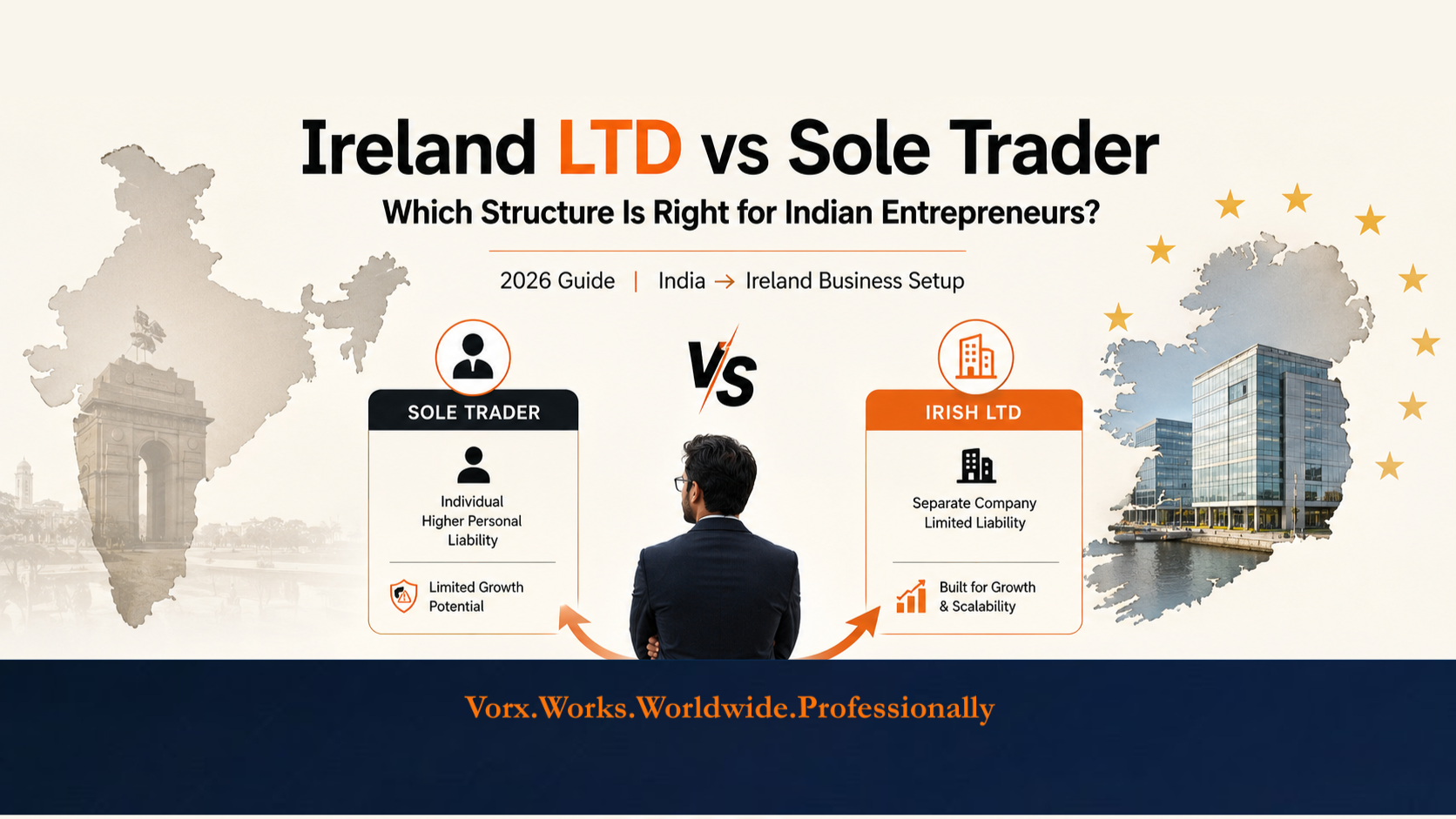
If you’re an Indian founder looking at Ireland, you’ve probably already hit this question early on: should you register as a Sole Trader or set up an Irish LTD company?
It sounds like a small administrative decision, but it actually shapes how much tax you pay, how much personal risk you’re carrying, whether investors will take you seriously, and even whether you can open a business bank account without flying to Dublin.
This guide walks through both structures specifically from an Indian entrepreneur’s seat not a generic “here’s what a limited company is” explainer, but the practical stuff: PPS numbers, non-resident banking, the EEA director rule, and what actually happens when your business straddles India and Ireland at tax time.
Who This Guide Is For
This is written for a fairly specific set of people, and if you fall into one of these buckets, keep reading:
Indian entrepreneurs planning to register a company in Ireland, whether you’re based in India or already there.
Freelancers and consultants who want to invoice EU clients through an Irish entity.
Startup founders eyeing the EU market and thinking Ireland could be the entry point.
Non-resident Indians (NRIs) who want to set something up in Ireland without relocating.
Anyone currently stuck comparing “LTD vs Sole Trader” and getting generic answers that don’t account for being based outside Ireland.
One thing to get straight before anything else: registering a company in Ireland and getting permission to live or work there are two completely separate things.
A lot of founders conflate them, and it causes real confusion down the line. We’ll come back to this.
Ireland LTD vs Sole Trader — Quick Comparison
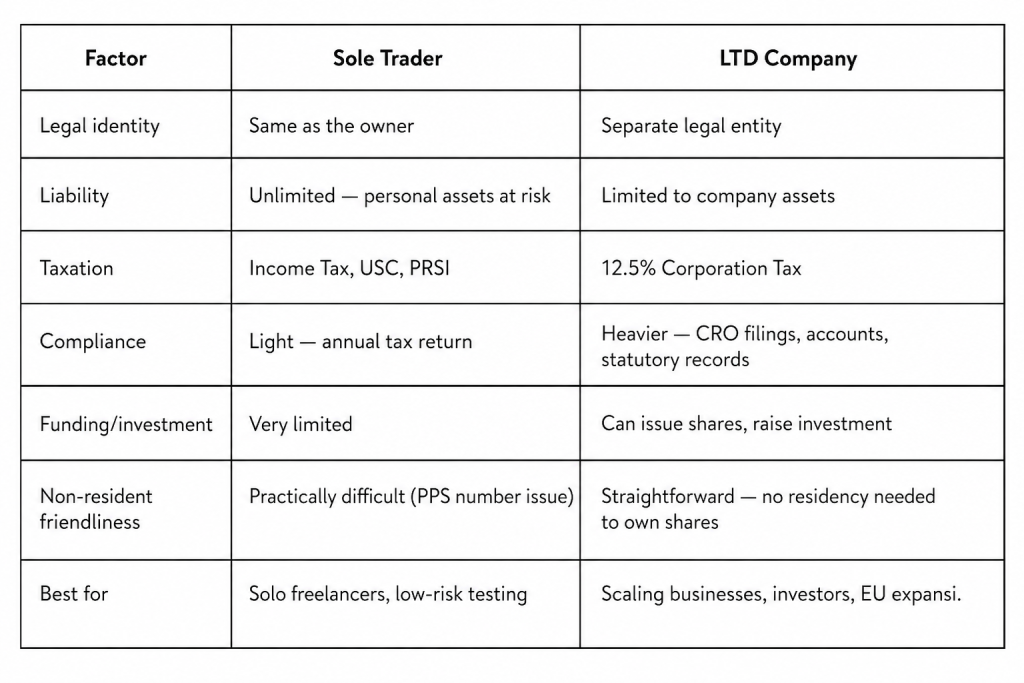
Quick verdict, if you want it upfront: most Indian founders who aren’t already living in Ireland end up going with an LTD not necessarily because it’s “better” in the abstract, but because the sole trader route has a practical bottleneck that trips up non-residents. More on that below.
Not sure which structure fits your business?Get a Free Structure Recommendation.
What Is a Sole Trader in Ireland?
A sole trader is the simplest form a business can take legally, you are the business. There’s no separation between you and the company.
You register with Revenue (Ireland’s tax authority), you invoice clients under your own name or a registered business name, and profits are taxed as your personal income.
It works well for freelancers, consultants, and small service providers who want minimal paperwork and don’t need to raise outside money.
Here’s the part most guides skip: to register as a sole trader with Revenue, you typically need a PPS number (Personal Public Service number) Ireland’s equivalent of an Aadhaar-linked tax ID.
Getting one usually requires either Irish residency or a documented reason to be physically present in Ireland.
If you’re operating from India with no Irish address history, this becomes a real obstacle not impossible in every case, but frustrating enough that most non-resident founders quietly rule it out and go the LTD route instead.
What Is an Irish LTD Company?
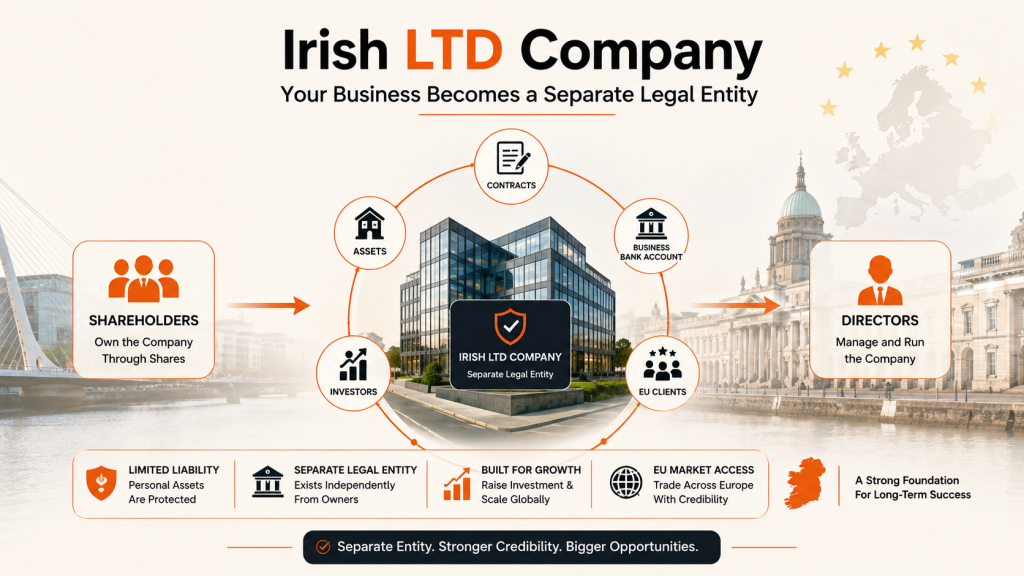
An LTD (Private Company Limited by Shares) is a separate legal entity from its owners. It can own assets, sign contracts, sue and be sued independent of you personally.
You and any co-founders become shareholders; the people running day-to-day operations are directors; and every Irish LTD needs a company secretary (this can be an individual or a corporate service provider).
Registration happens through the CRO (Companies Registration Office), and once incorporated, the company pays Corporation Tax on its profits, not you directly.
You only get taxed personally on what you draw out as salary or dividends. This structure suits founders who want to scale, bring on investors, hire a team, or build something that isn’t tied to one person’s continued involvement.
Ireland LTD vs Sole Trader: Key Differences
Legal Structure & Liability
This is the big one. As a sole trader, if the business runs into debt or gets sued, your personal assets, savings, property, whatever you own are on the line.
There’s no legal wall between “you” and “the business.” With an LTD, liability is generally limited to what the company owns.
If the company fails, your personal finances are usually protected (barring cases where you’ve given a personal guarantee, which banks sometimes ask for on loans regardless of structure).
If you’re testing a small consulting gig with low risk, unlimited liability might not worry you much.
If you’re building something with contracts, clients, or inventory involved, it’s worth taking seriously.
Taxation
Sole traders pay Income Tax, USC (Universal Social Charge), and PRSI (social insurance) on business profits in the same bands as any employee, and at higher income levels this adds up fast (marginal rates can reach around 52%).
LTD companies pay 12.5% Corporation Tax on trading profits. This is where people get overly excited, so let’s be clear: 12.5% corporation tax does not mean you personally pay 12.5%.
The company pays that rate on its profits. When you take money out as salary, it’s taxed as personal income like anyone else’s salary.
When you take it as dividends, there’s a separate tax treatment on that too. The 12.5% is genuinely attractive for retained profits money you leave in the company to reinvest but it’s not a personal tax hack.
VAT registration kicks in once you cross Ireland’s turnover thresholds, and this applies to both structures.
Registration & Setup
Sole trader registration with Revenue is quick; you can often be set up within days once you have the required documentation (and, for non-residents, once the PPS number question is resolved).
LTD incorporation through the CRO typically takes a few weeks end-to-end once documents are in order. Budget roughly for:
- CRO incorporation fee (a modest one-time government fee).
- A registered office service (you need an Irish address most non-resident founders use a third-party provider for this).
- Company secretary service, if you’re not appointing one yourself.
- The EEA-resident director requirement which either costs you a nominee director fee or a Section 137 bond (explained below).
None of these individually are expensive, but they add up to a real setup cost that a sole trader registration simply doesn’t have.
Compliance & Administration
Sole trader compliance is light: file an annual Income Tax return, keep basic records, done.
LTD compliance is heavier and ongoing: annual returns to the CRO, statutory financial statements, a Corporation Tax return, and proper statutory records (registers of directors, shareholders, and so on).
Most founders hire an accountant for this budget for an ongoing retainer, not a one-time cost.
Funding & Investment
This is where the two structures really diverge. A sole trader can’t issue shares if you want outside investment, an LTD is essentially the only option.
If you’re a startup thinking about angel investment, VC funding, or even just bringing on a co-founder with equity, you need a company structure with shares to work with, full stop.
Business Growth, Credibility & Banking
Clients, especially larger EU or corporate ones, often trust an LTD more than an individual invoicing them as a sole trader. It signals permanence.
Here’s a gap most articles on this topic skip entirely: business banking as a non-resident. Traditional Irish banks can be genuinely difficult for non-residents to open accounts with many still wanting in-person verification and proof of local address history, which defeats the purpose if you’re running this from India.
In practice, most non-resident founders start with fintech business accounts Wise Business, Revolut Business, or N26 Business which are far more accommodating to non-residents and can usually be set up remotely with your company’s incorporation documents.
It’s worth knowing this before you assume “opening a bank account” is a quick step.
Payment processing follows a similar pattern: Stripe and PayPal business accounts are generally more accessible to an incorporated LTD with proper documentation than to a sole trader operating without an Irish presence.
Also Read this Guide: How to Register a company in Ireland.
Can an Indian Entrepreneur Register an Irish LTD From India?
Yes. You don’t need to be a resident of Ireland, or even visit, to own 100% of an Irish LTD. Indian founders regularly incorporate Irish companies while based entirely in India.
A few requirements to know about:
Registered office : every Irish company needs a registered address in Ireland. You’ll almost certainly use a third-party service for this rather than having a physical office.
Director residency rule : Irish company law requires at least one director to be resident in the EEA (European Economic Area). If none of your directors meet this, you have two options:
- Section 137 bond : an insurance bond (typically valid for two years, then renewable) that acts as a financial guarantee to the Irish state in place of an EEA-resident director. It has a cost, but it lets you keep full control of the board with non-EEA directors.
- Appoint an EEA-resident nominee director : someone based in the EEA takes a formal director role, often through a corporate services provider, usually at an ongoing fee.
Neither option is complicated, but budget for one of them it’s an easy thing to overlook until you’re mid-incorporation.
Company secretary : required for every LTD; can be an individual or a service provider.
Can the whole process be done remotely?
Largely yes. Document signing, CRO filing, and registered office/director arrangements can all be handled without you setting foot in Ireland.
Some banking steps may still require additional verification, which is where the fintech-first approach helps.
Handling the EEA-director requirement and CRO filing yourself can get complicated.
Can an Indian Entrepreneur Operate as a Sole Trader in Ireland?
Technically, yes but practically, this is where the PPS number issue we mentioned earlier becomes a real constraint.
Registering as a sole trader with Revenue generally assumes you have some Irish residency footprint, which most India-based founders won’t have.
It’s also worth separating two different questions clearly:
- Can I register a business in Ireland? : largely yes, especially via LTD.
- Can I live and work in Ireland day-to-day? : that’s an immigration question entirely separate from company registration, governed by Irish immigration policy on work permits and visas.
Ireland doesn’t currently offer a dedicated “startup visa” style route the way some countries do, and immigration policy changes fairly often so if actually relocating is part of your plan, check the current rules directly with Irish immigration authorities or a qualified immigration advisor rather than relying on this article.
Owning an Irish company gives you zero automatic right to live or work there. This trips people up more than almost anything else on this list.
Ireland vs Other Jurisdictions — Why Founders Compare
If you’re evaluating Ireland, you’re probably also glancing at the UK, Estonia’s e-Residency program, a Delaware LLC, or a Dubai free zone. Briefly:
UK Ltd — similar structure and process to Ireland, but outside the EU since Brexit, which matters if EU market access is your goal.
Estonia e-Residency — fully digital, popular for solo digital businesses, but doesn’t give you the same physical EU presence or banking ease that Ireland offers.
Delaware LLC — the default for US-facing startups, but not an EU entity, and doesn’t give you EU market access.
Dubai free zones — attractive tax environment, but a different regulatory and market context entirely, and not EU-facing.
Ireland’s specific pull for Indian founders is the combination of English-speaking business environment, EU single-market access, and the 12.5% corporate tax rate on trading profits, a combination that’s genuinely hard to match elsewhere.
ALso Read This guide: Ireland Company Formation Requirements.
India-to-Ireland Tax & Compliance Considerations
This is the part where a blanket answer would do you a disservice, so treat this as a map, not a verdict.
On the Irish side, your company owes Corporation Tax on profits, potentially VAT if you cross the turnover threshold, and PAYE/PRSI if you’re running payroll.
On the Indian side, your own tax residency status matters enormously — where you’re considered a tax resident determines what India expects you to declare, including foreign income and foreign assets.
If you’re an Indian resident setting up or investing in a company abroad, FEMA (Foreign Exchange Management Act) rules around overseas investment come into play too, and these have specific reporting requirements.
Dividend repatriation is where cross-border tax gets genuinely complicated — if you pay yourself dividends from the Irish company back to India, there’s Irish withholding tax to consider on the outbound payment, and the India-Ireland Double Taxation Avoidance Agreement (DTAA) governs how that income is treated so you’re (ideally) not taxed twice on the same money.
None of this has a one-size-fits-all answer. It depends on your residency status, how you’re drawing money out, and your specific business structure.
This is genuinely a case where a conversation with a cross-border tax advisor pays for itself; don’t treat any blog post, including this one, as the final word on your personal tax position.
When Should You Switch From Sole Trader to LTD?
If you started as a sole trader (or were considering it), here are the signals that it’s time to incorporate:
- Revenue is growing and the tax savings on retained profit start to matter.
- You’re taking on contracts big enough that unlimited liability feels genuinely risky.
- You want to hire employees.
- An investor or co-founder wants equity, not just a handshake deal.
- You want to reinvest profits in the business rather than draw everything out personally.
- You’re planning to expand into other EU markets and need a more formal structure to do it.
Common Mistakes Indian Entrepreneurs Should Avoid
Assuming company registration equals Irish residency — it doesn’t; they’re entirely separate processes.
Choosing LTD purely because of the 12.5% tax headline — without understanding that money you personally withdraw is taxed separately.
Underestimating non-resident banking friction — plan for a fintech-first approach rather than assuming a traditional bank account is quick to open.
Ignoring FEMA and Indian reporting obligations — these apply even if your Irish company is fully legitimate and compliant on the Irish side.
Mixing personal and company finances — especially tempting for solo founders, but it undermines the very liability protection an LTD is meant to give you.
Forgetting to budget for the EEA-director requirement — whether it’s a bond or a nominee director, this cost surprises people who didn’t plan for it upfront.
How Vorx Consultancy Can Help
Figuring out the right structure is only half the job — actually setting it up as a non-resident is where most Indian founders get stuck:
the EEA-director requirement, a registered office, opening a bank account, and staying compliant with both Irish and Indian regulations at the same time.
Vorx Consultancy helps Indian entrepreneurs handle exactly this end-to-end Irish company formation, registered office and company secretary services, EEA-director/Section 137 bond arrangements, and guidance on the India-Ireland compliance side, so you’re not piecing it together from scattered forum threads.
Whether you’re still deciding between an LTD and a sole trader or ready to incorporate, it’s worth a quick conversation before you file anything.
Conclusion:
If you’re an Indian entrepreneur planning to scale, bring on investors, or use Ireland as a base for EU expansion, an LTD is generally the more workable structure not just because of the tax treatment, but because sole trader registration has a real practical barrier for non-residents through the PPS number requirement.
If you’re a freelancer or consultant testing a low-risk service, still based primarily in India, and you don’t need an Irish entity to operate, a sole trader setup might be more administrative weight than you actually need right now.
Either way, the right call depends on your liability tolerance, how you’re planning to draw income, your tax residency status, and where you see the business in two or three years, not just which structure sounds more “official.”
If you’re weighing this decision for a real business rather than a hypothetical one, it’s worth getting a proper consultation before you file anything.
Ready to register your Irish LTD? Get a personalized recommendation for your business.