
If you’ve spent the last few evenings googling “Malta company registration” and ending up more confused than when you started, you’re not alone.
Most guides either drown you in generic EU jargon or oversimplify things so much that you find out the hard way three weeks into the process that you’re missing a document nobody mentioned.
This guide is different. It’s written specifically for Indian founders, investors and professionals who are seriously evaluating Malta, not just window-shopping.
We’ll walk through exactly who needs to be involved (directors, shareholders, company secretary), what paperwork you’ll actually need to gather, and the India-specific details like RBI remittance limits and apostille requirements that most Malta-focused articles skip entirely because they’re written for a global, not Indian, audience.
By the end, you’ll know exactly what to prepare before you even talk to a formation agent.
What Are the Basic Requirements to Register a Company in Malta?
Here’s the shortest possible summary, before we go deep into each piece:
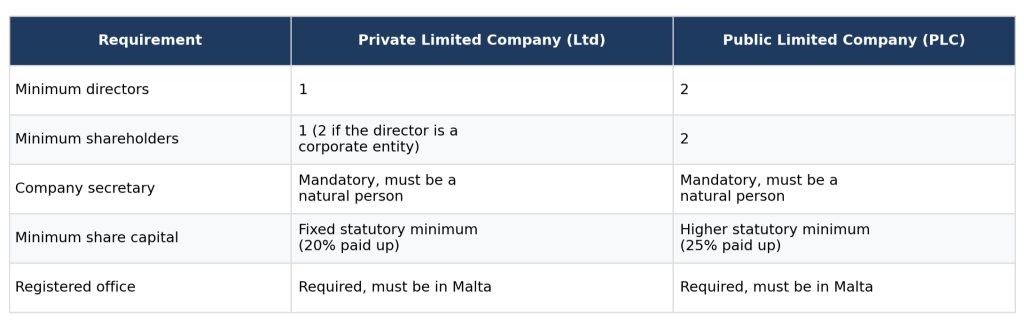
For most Indian entrepreneurs SaaS founders, consultants, trading businesses, holding structures the private limited company (Ltd) is the right structure.
It covers roughly 95% of use cases we’re discussing here, so that’s what the rest of this article focuses on.
Now let’s unpack each requirement properly, because the devil is genuinely in the details.
Director Requirements for Malta Company Formation
You need at least one director to form a private limited company in Malta. That’s it no requirement that this person be Maltese, EU-based, or even physically present in the country.
An Indian resident sitting in Bangalore can be the sole director of a Maltese company without ever setting foot on the island.
A director can be:
- A natural person (an individual, like you)
- A corporate entity (another company acting as director)
Here’s where most articles stop and where the real nuance lives. If your director is a corporate entity instead of an individual, Malta requires a minimum of two shareholders, not one.
So if you’re planning a simple, single-founder setup where you’re both the director and the sole shareholder, make sure your director is a natural person.
This one detail changes your entire ownership structure, and getting it wrong midway through the process means redoing your Memorandum of Association.
There’s also a subtler point worth knowing before you get too deep into tax planning: Malta’s attractive effective tax rate (we’ll touch on this later) depends partly on where the company is actually managed and controlled from.
If every single director lives outside Malta and there’s zero local decision-making happening on the island, tax authorities both in Malta and potentially in India can start asking questions about where the company is genuinely “resident” for tax purposes.
This doesn’t mean you need a Maltese director on day one, but it’s a factor many formation agents mention only after you’ve already incorporated. Better to know it upfront.
Every director, regardless of nationality, goes through a Know Your Customer (KYC) check as part of the registration process. We’ll cover exactly what that involves in the documents section below.
Shareholder Requirements for Malta Company Formation
A shareholder is simply someone who owns shares in the company and Malta is refreshingly flexible here.
Minimum 1 shareholder is allowed. Malta has permitted single-member companies since 2003, so you don’t need to find a co-founder just to satisfy a legal formality.
Shareholders can be individuals or companies, Indian or foreign there’s no residency or nationality restriction.
As mentioned above, if your director is a corporate entity, you’ll need at least 2 shareholders instead of 1.
Corporate shareholders : say, an Indian private limited company that wants to hold shares in the Maltese entity needs to submit additional documents: certificate of incorporation, certificate of good standing, and KYC on the parent company itself. We’ll list these precisely in the documents section.
One thing worth knowing if it comes up in your research: nominee shareholder arrangements are legal in Malta.
This means someone else’s name can appear on the share register while you retain actual beneficial ownership through a separate agreement.
It sounds appealing for privacy reasons, but here’s the catch: most people’s nominee status still has to be disclosed to the Malta Business Registry through the Beneficial Ownership register.
You’re not hiding ownership from authorities; you’re just keeping it off certain public-facing documents. If privacy is your main driver for considering this, talk to a Maltese corporate lawyer before assuming it does what you think it does.
Company Secretary — The Often-Overlooked Requirement
Every Maltese company, no exceptions, needs a company secretary. This role gets buried in most guides, but it’s a genuine legal requirement, not an optional nicety.
Two things to know:
The secretary must be a natural person — a corporate entity cannot fill this role, unlike the director position.
A director can also serve as company secretary in a private limited company, so you don’t necessarily need to bring in a third person.
That said, many Indian founders end up appointing a local corporate service provider as secretary anyway, simply because the role involves ongoing administrative duties maintaining statutory registers, filing annual returns, keeping the company compliant with the Malta Business Registry and having someone locally based who already knows Maltese procedure saves a lot of back-and-forth.
The Malta Business Registry itself requires that the secretary have “requisite knowledge and experience” to handle these responsibilities, so it’s not purely a rubber-stamp position.
Documents Required for Malta Company Formation
This is the part everyone actually wants to know, so let’s get specific. Instead of one long undifferentiated list (which is how most articles present it, and which honestly doesn’t help you prepare), here’s what’s needed broken down by who it applies to.
Documents for Individual Directors & Shareholders
- Certified copy of your passport
- Proof of residential address — typically a utility bill or bank statement, usually not older than 3 months
- Bank reference letter confirming your financial standing
- A brief professional background or CV, used for compliance screening
Documents for Corporate Shareholders
If a company (rather than an individual) is going to hold shares:
- Certificate of incorporation of the parent company
- Certificate of good standing
- Register of directors and shareholders of that parent entity
- KYC documents on the parent company’s own directors and ultimate owners
Core Constitutional & Registry Documents
- Memorandum and Articles of Association (MoA/AoA) — the foundational documents describing your company’s structure, share capital, objects clause, and governance rules
- Form BO1 — this declares your Beneficial Owners to the Malta Business Registry. Anyone owning or controlling 25% or more of the company (directly or indirectly) generally needs to be declared here. This register isn’t fully public, but it is accessible to Maltese authorities.
- Proof of paid-up share capital, usually a bank deposit slip
- Confirmation of your registered office address in Malta
A Note Specifically for Indian Applicants: Apostille, Not Notarization
Here’s a detail that saves real time if you know it in advance. India and Malta are both members of the Hague Apostille Convention.
That means your Indian-origin documents, passport copies, address proof, bank references typically need to be apostilled, not embassy-legalized.
This is a simpler, faster, single-step certification process compared to what applicants from non-Hague-Convention countries have to go through.
Get your documents apostilled in India before you start the formal submission process.
It’s a one-time trip to the relevant apostille authority (usually routed through the Ministry of External Affairs’ authorized centers), and doing it early prevents your file from sitting in a queue waiting on paperwork that could’ve been sorted out weeks earlier.
Minimum Share Capital Requirement
For a private limited company, Malta’s minimum authorized share capital is €1,164.69 — an oddly specific number that comes from converting the old Maltese lira minimum into euros.
You don’t need to pay this entire amount upfront: only 20% needs to be paid up at the time of incorporation, meaning roughly €233 in actual funds deposited before you can register.
If you’re forming a Public Limited Company or entering a regulated sector financial services, gaming, or similar expect significantly higher capital requirements and additional licensing from bodies like the MFSA (financial services) or MGA (gaming).
Step-by-Step Malta Company Registration Process
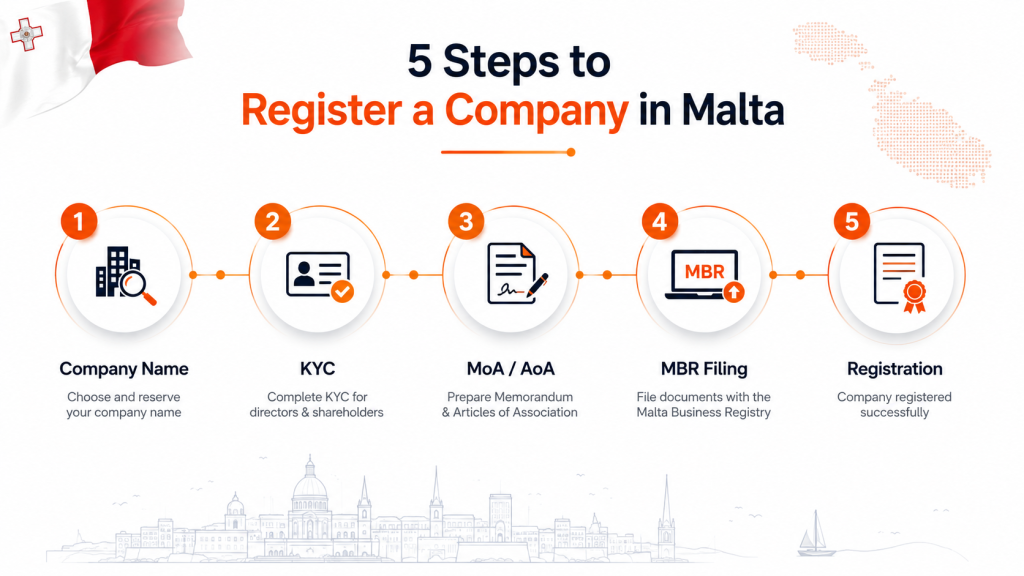
Once your documents are ready, here’s how the process actually unfolds:
Reserve your company name with the Malta Business Registry — approval typically takes a few days, and the reservation holds for up to 3 months.
Complete due diligence and KYC for every director, shareholder, and beneficial owner. This is usually the slowest step, and we’ll explain why below.
Draft and sign the Memorandum and Articles of Association, setting out your company’s structure and rules.
Submit everything to the Malta Business Registry, along with your registration fee.
Receive your Certificate of Registration once the Registrar approves the filing.
Handle post-incorporation steps: apply for a tax identification number, register for VAT if applicable, and open a corporate bank account.
That last step, the bank account deserves its own mention, because it often takes longer than the incorporation itself.
Read this guide: How to Register a Company in Malta from India: Complete 2026 Guide
How Long Does Malta Company Registration Actually Take?
Most sources will tell you “2 to 3 weeks,” and that’s technically true for the registration filing itself. But here’s the honest breakdown:
Document collection and KYC review: 3–10 days, though this stretches significantly if documents aren’t apostilled or certified properly upfront
Incorporation filing and certificate issuance: about 1 week once documents are submitted
Corporate bank account opening: 1–2 weeks typically, but Maltese banks apply enhanced due diligence for applicants outside the EU, so Indian founders should budget closer to 3–4 weeks here, especially if the bank requests additional source-of-funds documentation
The real lesson: the registration process itself isn’t your bottleneck document readiness is.
If your passport copies, proof of address, and apostilles are sorted and correctly formatted before you submit anything, you can realistically be incorporated within two to three weeks.
If they’re not, expect delays that have nothing to do with Malta’s bureaucracy and everything to do with paperwork sitting incomplete in a folder somewhere.
Common Reasons Malta Company Registration Applications Get Delayed or Rejected
Formation agents rarely publish this list, but it’s genuinely useful to know what trips people up:
Outdated proof of address : a utility bill older than 3 months typically gets rejected
Missing apostille or certification on foreign documents, especially common among first-time applicants who assume a plain photocopy is enough
Incomplete Form BO1 : missing beneficial ownership details, particularly when the ownership chain runs through multiple entities
Company name conflicts : names too similar to existing Maltese companies, or containing restricted words (like “bank” or “insurance”) without the relevant license
Mismatched information across documents a spelling variation between your passport and your bank reference letter is a surprisingly common cause of delay
None of these are dealbreakers. They’re just avoidable if you know to check for them before submission rather than after a rejection notice.
Ready to Start Your Malta Company Formation?
Don’t let missing documents, incorrect certifications, or an unclear ownership structure delay your incorporation.
Vorx Consultancy can help you prepare the right documents, structure your Malta company, coordinate apostille requirements, and manage the registration process from India.
Malta Company Formation for Indian Entrepreneurs — What Else to Know
This is the section most Malta-focused content skips entirely, because it’s written for a generic international audience. If you’re remitting money from India to fund this company, a few RBI and FEMA rules directly affect you.
The Liberalised Remittance Scheme (LRS) allows Indian residents to remit funds abroad for permissible purposes, including setting up an overseas company, within an annual limit set by the RBI.
Once your remittance in a financial year crosses a certain threshold, Tax Collected at Source (TCS) applies on the amount above that threshold.
This isn’t a loss you can claim it back while filing your Income Tax Return, and it shows up in your Form 26AS. But it does affect your short-term cash flow, so it’s worth factoring into your planning rather than being surprised by it at the time of remittance.
In practice, this means the timing and structuring of your remittance matters. Founders who plan their transfer in advance knowing which portion will attract TCS and budgeting for that temporary deduction avoid the last-minute scramble that catches most first-time applicants off guard.
If your investment plans grow beyond what LRS comfortably covers, larger structured investments may need to go through the Overseas Direct Investment (ODI) route under FEMA instead, which has its own reporting requirements through your Authorized Dealer bank.
There’s also the India–Malta Double Taxation Avoidance Agreement (DTAA), which becomes relevant once your Maltese company starts generating profits and you’re repatriating dividends back to India.
It’s designed to prevent you from being taxed twice on the same income, but how much benefit you actually get depends on your specific structure and residency status.
None of this replaces proper advice from a chartered accountant familiar with cross-border structuring. This section is here so you walk into that conversation already knowing the right questions to ask, instead of learning these terms for the first time from your CA.
How Vorx Consultancy Helps You Through the Process
Everything above is doable on your own, but most Indian founders hire a consultancy anyway; one missed detail (an apostilled document, the wrong director-shareholder combination, an outdated proof of address) can cost weeks of back-and-forth with the Malta Business Registry.
That’s the gap Vorx Consultancy fills:
Structuring guidance : flags issues like the director-shareholder rule before your MoA is drafted, not after
Document & apostille handling : manages certification end-to-end so nothing sits in a queue
KYC and compliance review : prepares director/shareholder documentation against Malta’s actual standards
MoA/AoA drafting and MBR filing : handled directly, no learning-curve delays
Bank account support : works with banks already familiar with Indian applicant files, shortening due diligence time
India-side compliance : LRS/TCS structuring and FEMA/ODI coordination with your CA
Post-incorporation compliance : tax, VAT, and annual MBR filings after registration
In short: you decide if Malta is right for you Vorx consultancy handles the paperwork and timelines. A quick consultation can give you a realistic timeline based on your actual documents, not a generic estimate.
Planning to Register a Company in Malta from India?
You don’t need to figure out the director, shareholder, documentation, apostille, KYC, and India-side compliance requirements on your own.
Vorx Consultancy coordinates the Malta company formation process from initial structuring to incorporation, banking support, and post-registration compliance.
Get a clear understanding of your requirements, documents, and next steps before you begin.
Conclusion:
Malta’s appeal for Indian entrepreneurs is real EU market access, a workable tax structure, and an incorporation process that, once you know what’s actually required, isn’t nearly as complicated as it first appears.
The friction most people hit isn’t Malta’s bureaucracy; it’s walking in without knowing the director-shareholder nuance, without apostilled documents ready, or without accounting for RBI remittance rules until the last minute.
If you’ve read this far, you’re already ahead of most applicants. The next step is simply gathering your documents, passport, address proof, bank reference and getting them apostilled while you finalize your company structure. From there, the rest of the process moves a lot faster than the internet tends to make it sound.
Ready to Set Up Your Malta Company?
Have your documents ready, but not sure what comes next?
Vorx Consultancy helps Indian entrepreneurs navigate Malta company formation, documentation, KYC, banking, and cross-border compliance all through one coordinated process.
Start Your Malta Company Formation Journey with Vorx Consultancy.