


If you’re an Indian founder who’s already registered a company in Malta, or you’re seriously considering it, you’ve probably hit the same wall everyone else does: incorporation was the easy part. Getting a bank to actually open your business account is where the real work starts.
Most guides on this topic are written for a generic “non-resident” reader — someone who could be from the UK, the UAE, or Singapore.
They skip the part that actually matters if you’re sitting in India: the RBI rules you have to follow before you can even send money to Malta, the extra documents Indian banks and Malta banks both want to see, and the tax reporting that follows you home. This guide covers all of that, in plain language, with real numbers.
Can Indian Entrepreneurs Open a Business Bank Account in Malta?
Yes — but with a condition most people miss. Malta banks and EMIs will open accounts for non-resident, non-EU founders, including Indians.
What they won’t do is open an account for a person with no Malta entity behind them. In almost every case, you need a registered Malta company first, and the bank will evaluate your business (not just you personally) before approving anything.
Malta also gives you something practical that a lot of jurisdictions don’t: it’s in the EU, it uses the euro, and English is one of its two official languages, which means your compliance calls, KYC forms, and account documentation are all in a language you’re already comfortable with.
One thing worth addressing directly, because it comes up in every founder WhatsApp group discussing Malta: yes, Malta was once on the FATF’s list of jurisdictions under increased monitoring — commonly called the greylist.
It’s since been removed after the FATF confirmed the country had made real progress tightening its anti-money-laundering oversight.
That history is worth knowing, but it’s not a reason to avoid Malta today. If anything, it means the banks are now more careful, not less trustworthy which affects how thorough your documentation needs to be, more than it affects whether Malta is a legitimate place to bank.
Why Indian Founders Are Actually Choosing Malta
This isn’t a theoretical exercise for most people reading this — there’s usually a specific business reason Malta is on the table.
If you run an e-commerce business selling into Europe, a Malta entity with a euro account removes the currency conversion friction you’d otherwise eat on every transaction, and it makes you look like a local business to EU marketplaces and payment processors that are picky about non-EU sellers.
If you’re a consultant or freelancer billing European clients, invoicing in EUR from a Malta account is simpler for your clients’ accounts payable teams than receiving international wires into an Indian account, and it avoids the back-and-forth over FIRC certificates and forex conversion timing.
If you’re an investor or holding-company owner, Malta’s corporate tax structure and its EU treaty network make it a common base for structuring investments into European assets or companies.
Whichever bucket you’re in, the banking step is where the plan either works or stalls — so let’s get into the part nobody else explains properly.
RBI Rules Indian Residents Must Know Before Sending Money to Malta
This is the part every other Malta-banking guide skips, because most of them aren’t written for an Indian reader. Before you fund your Malta account, you need to know which route applies to you: LRS or ODI.
The Liberalised Remittance Scheme (LRS) is what most individual founders use. It lets a resident Indian remit funds abroad for permitted purposes, including opening and funding a bank account, without needing prior RBI approval as long as you stay within the annual limit.
If you’re an individual promoter personally capitalizing your Malta company, this is almost certainly your route.
The Overseas Direct Investment (ODI) route is different — it applies when an Indian company, not an individual, is investing in a foreign entity.
The reporting obligations here are stricter and follow their own timelines, so if your Indian company is the one funding the Malta entity, this is the framework you’re operating under.
Here’s where founders trip up most often: funding your Malta company personally under LRS creates a completely different compliance trail than routing the same funds through your Indian company’s books under ODI.
Picking the wrong one creates paperwork headaches later, so if you’re not sure which applies to you, it’s worth a quick call with a CA who’s actually handled LRS or ODI filings before.
On the paperwork side, your Indian bank will typically want your PAN card, a KYC-compliant Indian bank account to remit from, a completed Form A2, and the LRS declaration form.
Malta-focused guides never mention this Indian-side paperwork they only cover what Malta wants from you, not what your own bank needs first.
One more option worth knowing about, even if you end up not using it: Indian residents can now open foreign currency accounts through International Financial Services Centres like
GIFT City, letting them hold foreign currency domestically without a Malta entity in the mix. It’s not a substitute for a Malta corporate account if you genuinely need EU banking rails, but it’s worth comparing if your real need is simply holding foreign currency without repeated conversion.
Quick example: A solo consultant in Bangalore setting up a Malta company to bill EU clients would typically fund the account personally under LRS and file Form A2 with their Indian bank.
If instead an existing Indian consulting company were setting up the Malta subsidiary, the ODI route and its separate reporting timeline would apply instead.
Documents Required to Open a Malta Business Bank Account (India-Specific Checklist)
Malta banks and EMIs will ask for the standard KYC package, and separately, having your Indian paperwork ready in advance will save you weeks.
Malta-side documents:
- Valid passport
- Proof of residential address (utility bill or bank statement, usually within 3 months)
- Malta company registration certificate
- Memorandum & Articles of Association
- UBO (Ultimate Beneficial Owner) declaration
- A business plan describing your activity, expected transaction volumes, and client geography
India-side documents banks increasingly ask for, and competitors don’t mention:
- Income Tax Return (ITR) copies for the last 2–3 years
- GST returns, if you already run a registered Indian business
- A CA-certified net worth or source-of-funds statement
- A reference letter from your existing Indian bank
- Apostille or attestation on Indian-issued documents where the bank requires it — check this per bank, since requirements vary
A quick tip that saves real time: get your CA to prepare the source-of-funds statement before you start the bank application, not after the bank asks for it. Compliance teams move faster when the paperwork arrives the first time.
Read this Guide: Malta Company Formation in 2026Requirements, Documents & Process
Need help preparing your Malta company and banking documents? Let Vorx Consultancy handle the process from India to Malta.
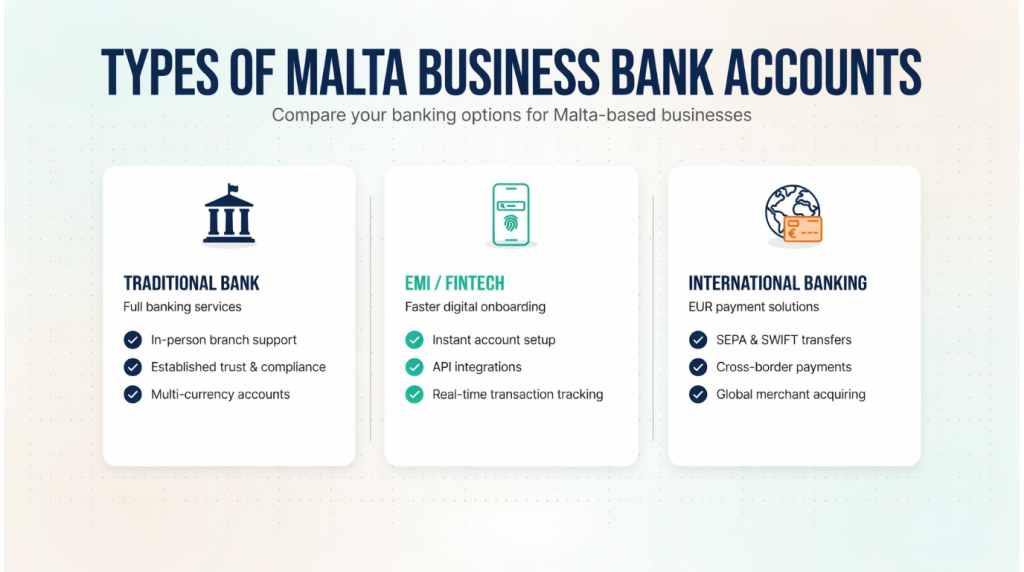
Types of Malta Business Bank Accounts Available to Indian Founders
Not every “Malta bank account” is the same product, and this distinction matters more for non-resident applicants than it might seem.
Traditional Malta banks offer the full suite multi-currency accounts, trade finance, merchant services but they also run the slowest, most document-heavy onboarding, and some are genuinely cautious about first-time non-EU applicants with no prior Malta banking history.
EMIs (Electronic Money Institutions) and fintech-style providers licensed in Malta tend to onboard faster, often fully remotely, and are generally more open to first-time non-resident founders.
The trade-off is a narrower product set: you’re getting solid payments and IBAN functionality, not a full-service commercial bank relationship.
Correspondent and international banking arrangements, where a bank outside Malta provides EUR account functionality through a Malta-based structure, are a third option some founders use, particularly if they already bank with an institution that has a European presence.
For most first-time Indian applicants, especially e-commerce and consulting businesses that mainly need to receive and send EUR payments, starting with an EMI while building banking history is often the more realistic path; you can always add a traditional bank relationship once your Malta company has a track record.
Which Malta Banks Accept Applications from Indian Nationals?
This is the question founders actually search for and rarely get a straight answer to.
Bank risk appetite toward non-EU, India-based applicants shifts fairly often based on internal compliance policy, so treat any list including this one as a starting point, not gospel, and confirm directly with the bank or your corporate service provider before applying.
What tends to hold true across most Malta banks and EMIs:
Video-based KYC is increasingly standard, especially at EMIs, which means an in-person visit to Malta usually isn’t mandatory to open the account though some traditional banks still request one, particularly for higher-risk profiles or larger initial deposits.
Banks weigh your business substance heavily. A Malta company with a real registered office, a clear business plan, and demonstrable trading activity gets a very different reception than a company that looks like a shell.
Minimum deposit requirements vary widely : some EMIs have no meaningful minimum, while traditional banks can require deposits well into five figures (EUR).
Because named bank policies change, your best move is to work with a Malta-based corporate service provider or licensed introducer who has current, first-hand knowledge of which institutions are actively accepting Indian applicants this quarter. This single step saves more time than anything else in the process.
Step-by-Step Process to Open a Malta Business Bank Account Remotely from India
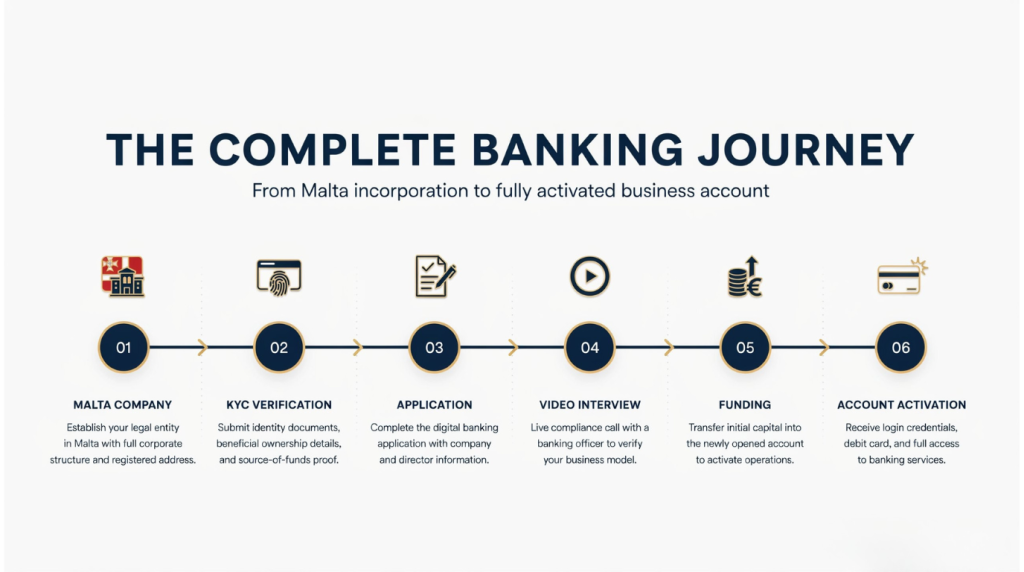
Here’s the realistic sequence, in order:
Register your Malta company first. Almost no bank will open a corporate account without a registered Malta entity already in place. Company formation isn’t optional prep, it’s the prerequisite.
Prepare your KYC and Enhanced Due Diligence (EDD) package : both the Malta-side and India-side documents listed above, ready before you apply, not gathered piecemeal after a bank asks.
Submit your bank or EMI application, choosing based on your business type and how fast you need the account live.
Complete the compliance interview, which is now commonly done over video call rather than in person be ready to explain your business model, expected transaction volumes, and where your funds are coming from in plain terms.
Fund the account via LRS or ODI, following whichever route applies to you from the RBI section above, and keep your Form A2 and remittance documentation on file.
Account activation, after which you can start receiving and sending payments.
Realistically, from a standing start no Malta company yet you’re looking at company formation (a few weeks), followed by bank onboarding (anywhere from a few days at a fast EMI to several weeks at a traditional bank), followed by the actual remittance and account funding once your Indian paperwork clears.
Most competitor guides only quote the Malta-side banking timeline and leave out the India-side remittance processing time, which understates how long the whole thing actually takes.
Read this guide: How to Register a Company in Malta from India.
Ready to open your Malta business bank account from India?
Talk to Vorx Consultancy about your company formation and banking setup.
How to Improve Your Approval Odds as an Indian Applicant
Banks and EMIs aren’t rejecting Indian applicants because they’re Indian they’re rejecting applications that look thin. A few things consistently move the needle:
Show real business substance. A Malta company with a genuine registered office, an actual business plan (not a template), and a believable connection to the EU market gets taken seriously.
Have your source-of-funds story ready before they ask. If your compliance officer can explain, in one clear paragraph, where the money is coming from and why it’s moving from India to Malta, you’re already ahead of most applicants.
Work with a Malta-based corporate service provider. Someone who has an existing relationship with the bank’s compliance team can often get your application looked at faster and flag issues before submission, not after rejection.
Be upfront about the LRS or ODI route you used. Banks doing enhanced due diligence on Indian applicants specifically look for a clean, explainable funding trail walking them through your remittance route proactively removes a common friction point.
Common Mistakes Indian Founders Make When Opening a Malta Bank Account
A few patterns show up again and again:
Remitting funds before understanding LRS vs. ODI. Sorting out which route applies to you after you’ve already sent money is far harder than sorting it out before the paperwork trail needs to match the route from the start.
Applying to a bank without checking its appetite for non-EU applicants first. A rejection doesn’t just cost time.
It can make subsequent applications elsewhere look more suspicious, since banks sometimes ask if you’ve been declined before.
Underestimating source-of-funds documentation. “I’ll explain it if they ask” is the wrong approach. Have the CA-certified statement ready before you apply, not after.
Assuming Malta incorporation guarantees a bank account. It doesn’t. Plenty of founders register the company first and only then discover how document-heavy the banking step is planned for both from day one.
How Vorx consultancy Helps Indian Founders Open a Malta Business Bank Account
Everything above is doable on your own. The founders do it every day. But if you’ve read this far, you’ve probably noticed the real difficulty isn’t any single step, it’s that the process sits across two systems at once: Indian regulatory compliance and Malta banking compliance, run by different institutions, on different timelines, each with its own paperwork that the other side doesn’t care about.
Most delays happen at that seam, not inside either process individually.
That’s the gap Vorx consultancy is built to close.
- Company formation and bank introductions, handled together. We connect you with banks and EMIs actively accepting Indian applicants right now.
- RBI paperwork done right the first time. We help you pick LRS or ODI, and prepare your Form A2 and source-of-funds documentation.
- Compliance interview support. We prep you for the bank’s questions and join the call where needed.
- Ongoing compliance after account opening. CRS reporting and filing deadlines — we help you stay ahead of them.
In short: you focus on running the business, and we handle the parts that require knowing both Indian FEMA rules and Malta banking practice in the same sitting.
Conclusion
Opening a business bank account in Malta from India isn’t hard because Malta makes it hard, it’s hard because nobody explains the Indian side of the equation.
Get your Malta company registered, know whether you’re using LRS or ODI before you send a single rupee, have your source-of-funds documentation ready before any bank asks for it, and pick a bank or EMI that’s actually open to Indian applicants right now rather than guessing.
Do those four things in order, and the rest of the process: the KYC, the compliance interview, the account activation moves a lot faster than the horror stories suggest.
If you’d rather not manage both sides of this yourself, that’s exactly where Vorx comes in, reach out and we’ll walk you through what your specific setup needs, before you send any money anywhere.
Ready to Start Your Malta Business Setup?
Get expert support for Malta company formation, business banking and India-side compliance with Vorx Consultancy.
Talk to a Malta Banking Expert