

Setting up a company in Malta is usually the easy part. Founders from India, the UAE, the UK, Singapore and Australia are drawn to Malta for the same reasons: EU market access, a competitive tax refund system and a jurisdiction that’s genuinely open to non-resident ownership.
What tends to catch people off guard is what comes after incorporation: the year-round rhythm of filings, tax deadlines, VAT returns and beneficial ownership updates that keep a Malta company in good standing.
This isn’t a one-time formality. A Malta company answers to three different authorities: the Malta Business Registry, the Commissioner for Revenue and depending on the ownership structure, the beneficial ownership framework tied to Malta’s AML regime and each runs on its own calendar.
Miss one deadline and the consequences range from a modest late fee to the company losing its good standing certificate, which can quietly derail a bank account renewal or a commercial contract months later.
This guide walks through what Malta company compliance actually involves in 2026, including a significant regulatory update to the beneficial ownership regime that came into force this year and that most founders researching this topic haven’t seen covered anywhere else yet.
Whether you’re managing a Malta company from India, Dubai or London, the goal here is the same: understand what’s due, when, and why it matters, so compliance stops feeling like guesswork.
What Does Malta Company Compliance Actually Involve?
Strip away the legal terminology and Malta company compliance comes down to four recurring obligations that repeat every year, plus a handful that are triggered only when something in the company changes.
The four recurring pillars are:
- Corporate registry filings with the Malta Business Registry (MBR) your Annual Return and separately, your audited accounts.
- Corporate tax compliance with the Office of the Commissioner for Revenue (CFR) your annual tax return and provisional tax instalments.
- VAT compliance, also administered by the CFR, if your company is VAT-registered.
- Beneficial ownership reporting, which sits under the Companies Act but is closely tied to Malta’s anti-money laundering framework.
On top of these, event-driven filings apply whenever something changes a new director, a change of registered office, an increase in share capital, or a transfer of shares.
Each of these has its own short filing window, usually 14 days, and each is easy to overlook if you’re not actively tracking company changes as they happen.
The reason this trips up so many non-resident founders isn’t the individual requirements; they’re each fairly straightforward on their own. It’s that the deadlines don’t align with each other.
Your Annual Return is due on your company’s incorporation anniversary, not your financial year end. Your tax return follows a completely different clock.
Treat them as one combined calendar and compliance becomes manageable. Treat them as separate boxes to tick as they come up, and something eventually slips.
Read this guide: Malta Company Tax Guide 2026: Rates, Refunds and Rules for Indian Entrepreneurs
Malta Business Registry Filing Obligations
What Is the Annual Return and When Is It Due?
Every company registered in Malta must file an Annual Return with the Malta Business Registry within 42 days of the anniversary of its registration, not its financial year end, and not the calendar year.
This is the single most common source of confusion for founders, because it’s natural to assume compliance deadlines follow the accounting year. They don’t, at least not for this filing.
The Annual Return confirms the company’s current particulars: registered office, share capital, and the details of directors and the company secretary. It can be filed electronically or in paper form and must be signed by a director or the company secretary.
Missing the 42-day window triggers a late filing penalty, and the penalty compounds the longer the return remains outstanding.
Persistent non-compliance can eventually lead to the Registrar restricting further filings or, in extreme cases, striking the company off the register which is a far more disruptive outcome than the original filing itself would have been.
A practical example: say a company was incorporated on 14 March. Its Annual Return will be due every year by 25 April 42 days later regardless of whether its financial year runs January to December or April to March. Founders who track only their accounting deadlines often miss this one entirely because it doesn’t show up on a typical finance calendar.
What Other Filings Does the MBR Require?
Beyond the Annual Return, the MBR needs to be notified whenever something structural changes about the company. The common ones include:
Change of directors or company secretary — filed on Form K, within 14 days of the change.
Change of registered office address — filed on Form Q, also within 14 days.
Increase in share capital — filed on Form H, along with supporting documentation such as a bank deposit slip.
Transfer or transmission of shares — notified within 14 days for a standard transfer, or one month in the case of transmission following a death.
None of these filings are complicated on their own. The risk is simply forgetting they exist, particularly for founders managing the company remotely who might make a decision appointing a new director, say without realising it triggers a separate statutory notification with its own clock running.
What Changed in Malta's Beneficial Ownership Rules in 2026?
This is the part of Malta compliance that has genuinely moved in 2026, and it’s worth understanding even if your company structure is simple.
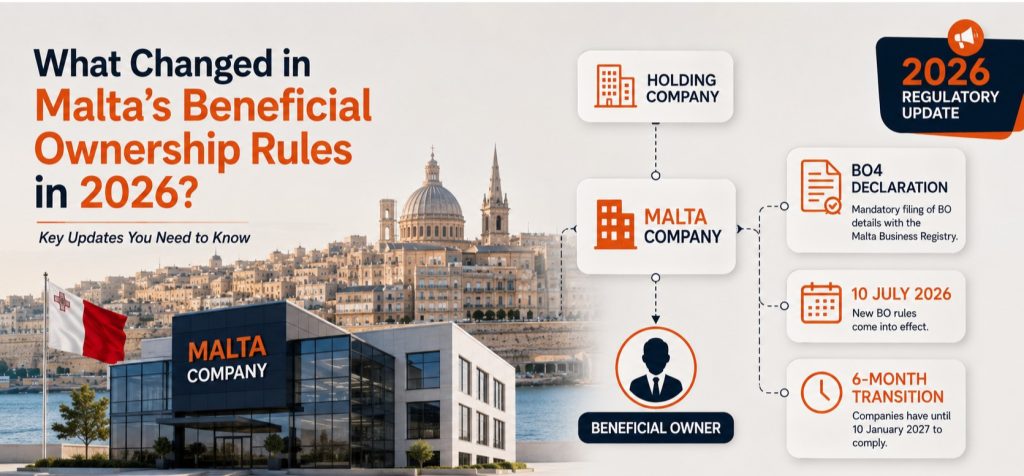
On 10 July 2026, Malta brought into force the Companies Act (Register of Beneficial Owners) (Amendment) Regulations, 2026, introduced through Legal Notice 184 of 2026. The amendment aligns Malta’s beneficial ownership framework more closely with the EU’s updated anti-money laundering directive (Directive (EU) 2024/1640), and it changes two things in particular.
First, access to beneficial ownership information now works on a three-tier system. Previously, access to a company’s beneficial ownership data was relatively uniform.
The new framework distinguishes between different categories of requestors, competent authorities, obligated entities carrying out due diligence, and the general public each with a different level of access and, in some cases, a fee attached.
Second, companies with more complex ownership structures now face an additional filing: the BO4 Declaration. Companies with straightforward, direct ownership may continue to fall under a simplified reporting regime.
But where ownership is layered through holding entities, nominee arrangements, or where control is exercised through means other than direct shareholding the company will likely need to file the new BO4 Declaration, which requires more detailed identification and control information than before.
The Malta Business Registry has given companies a six-month transitional period from 10 July 2026, effectively pushing the practical compliance deadline to January 2027.
That sounds like a comfortable runway, but it isn’t as far off as it looks, especially for founders with layered structures who need time to gather documentation on beneficial owners who may not be directly involved in day-to-day management.
Why this matters for non-resident-owned companies specifically: a lot of Malta companies set up by Indian, UAE and Singapore-based founders involve some form of layered ownership: a personal holding company, a family trust, or co-investors structured through a separate entity.
These are exactly the structures the new rules are designed to capture more thoroughly. If that describes your setup, it’s worth reviewing now rather than waiting until closer to the transition deadline.
The obligations that already existed remain in place alongside this update: an initial beneficial ownership filing at incorporation, notification of any change in beneficial ownership within 14 days, and an annual confirmation return even where nothing has changed.
The Registrar also retains the power to refuse other filings including the Annual Return if a company’s beneficial ownership information is incomplete or inaccurate, which is one more reason this shouldn’t be treated as a background task.
Is Your Malta Company Affected by the New BO4 Rules?
If your company has layered ownership, holding entities or nominee arrangements, now is the right time to review your beneficial ownership structure.
Get Your Malta BO4 Compliance Review with Vorx Consultancy
Financial Statements, Audit and Filing of Accounts
Every Malta company is required to prepare annual financial statements, and this responsibility sits with the directors, not with an external accountant on their behalf.
Most companies prepare their accounts under IFRS, though smaller companies may qualify to use Malta’s simplified accounting framework (GAPSE) instead.
Whether a statutory audit is required depends on the company’s size. The Maltese authorities offer an exemption for smaller firms on audit requirements where the company meets certain criteria concerning turnover, balance sheet size, and number of employees.
However, should your company fail to meet these criteria or if you are not sure about meeting them, you must establish this as soon as possible, as you might end up with very little time left for appointing an auditor.
Filing deadlines for accounts are tied to the company’s financial year end, and the exact timeline differs between private and public companies, with private companies generally given a longer window.
In actual practice, most organizations ought to be considering appointing an auditor well before year-end, since the same applies for Malta as in other countries where audit firms become busy as the filing period draws near, with initiating the discussions earlier making the whole process easier.
Regarding cost, audit and accounting expenses for a small business in Malta vary from a few thousand euros up, depending on the transaction level and nature of the business in question, whether it is just a holding company or a trading company, and whether accounting is done by the company itself or outsourced.
It’s a genuine line item to budget for, not an afterthought.
Non-compliance here carries real weight. Beyond financial penalties payable to the MBR, companies with a pattern of late or missing filings can face restrictions on their directors and company secretaries, including limits on holding those roles in other Maltese companies. That’s a consequence that extends well beyond the company itself.
What Are Malta's Corporate Tax Requirements?
Malta’s corporate tax system is one of its main attractions for international founders, and it’s built around a full imputation system with a refund mechanism available to shareholders on distributed profits — a detail worth exploring separately in more depth, since the mechanics genuinely matter for structuring decisions.
For compliance purposes, here’s what a Malta company needs to stay on top of each year:
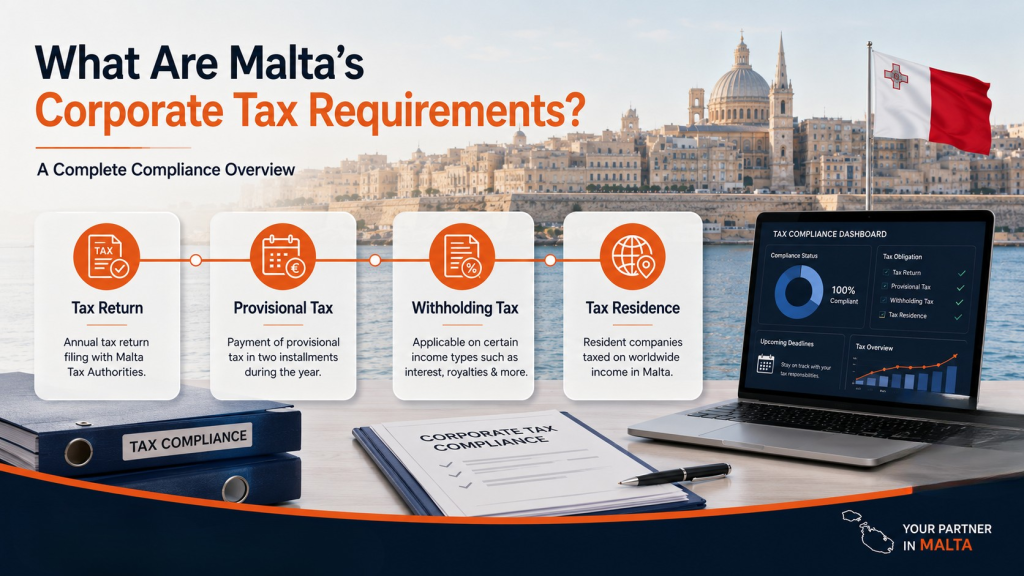
Annual corporate tax return, filed with the Commissioner for Revenue, reporting the company’s income and computing tax due.
Provisional tax, paid in three instalments across the year (commonly in April, August and December), based on an estimate of the current year’s tax liability.
Withholding tax, where applicable, on certain payments to non-residents — this depends heavily on the nature of the payment and any relevant double taxation treaty.
Tax residence certification, which non-resident-owned companies often need to request separately in order to access treaty benefits or satisfy a foreign bank or tax authority that the company is genuinely tax resident in Malta.
For Indian founders specifically, the India-Malta double taxation agreement is a relevant consideration when structuring how profits eventually flow back to shareholders.
This is genuinely a case-by-case question. The right approach depends on your personal tax residency, how the company is owned, and what the funds are ultimately used for, so it’s worth a proper conversation with a tax advisor rather than assuming a general rule applies to your situation.
If the company has directors or employees on a Maltese payroll, there are two further recurring obligations: the Final Settlement System (FSS) for payroll tax deductions, and social security contributions. Many non-resident-owned holding companies don’t have local payroll at all, in which case these simply won’t apply but it’s worth confirming rather than assuming either way.
Malta VAT Compliance: What You Need to Know
Not every Malta company needs to register for VAT, but a meaningful number do, particularly companies engaged in trading, consulting, or providing services to EU clients.
VAT registration becomes mandatory once your taxable turnover crosses the relevant threshold, though many companies register voluntarily earlier, particularly if they’re reclaiming VAT on setup costs or dealing primarily with VAT-registered business clients.
Once registered, VAT-compliant companies typically file quarterly VAT returns, though filing frequency can vary depending on the nature of the business. Late filing or late payment triggers penalties, and as with most Malta compliance matters the penalty grows the longer it goes unresolved.
A few areas worth understanding if they apply to your business:
The reverse-charge mechanism, which shifts VAT accounting responsibility to the recipient for certain cross-border B2B services relevant for consulting or advisory companies working with clients across the EU.
Recapitulative Statements (EC Sales Lists), required when a company makes intra-EU supplies of goods or services, reporting these separately from the standard VAT return.
VAT treatment for holding companies, which is a genuinely different picture from a trading company.
A pure holding company with no taxable supplies often has limited or no VAT obligations at all but the moment it starts providing management services to subsidiaries or earning fee income, that can change.
This distinction gets glossed over in a lot of general compliance guides, and it’s worth clarifying for your specific structure rather than assuming either way.
Ongoing Governance Obligations Beyond Filings
Compliance in Malta isn’t only about what gets submitted to a registry or a tax authority; there’s a layer of ongoing corporate governance that applies throughout the year, separate from any filing deadline.
Every company is expected to hold an Annual General Meeting, pass shareholder resolutions where required, and keep proper accounting records that support whatever gets filed.
Directors carry ongoing statutory duties that exist independently of any specific filing acting in the company’s best interest, avoiding conflicts of interest, and maintaining accurate records among them.
Practically, two requirements matter a lot for non-resident owners: every Malta company must have a registered office address in Malta, a genuine address, not just a mailbox and must appoint a company secretary, a role that carries real statutory responsibility rather than being purely administrative.
If your company operates in a regulated sector financial services under the MFSA, or gaming under the MGA, for example there’s an additional compliance layer specific to that regulator, on top of everything covered here.
Those requirements are substantial enough to deserve their own dedicated guide rather than a passing mention, so if that applies to you, it’s worth treating this article as the general foundation and looking into the sector-specific rules separately.
Compliance Considerations for Non-Resident and Foreign-Owned Companies
Most of what’s covered above applies to every Malta company regardless of who owns it.
But there are a few things that specifically affect founders managing a company from outside Malta, and they’re worth addressing directly rather than assuming they’ll sort themselves out.
Banking as a non-resident. Opening a Maltese business bank account as a non-resident director is possible, but it typically involves a more thorough due diligence process than a resident-owned company would face and expect the bank to ask detailed questions about the source of funds, the nature of the business, and the beneficial ownership structure.
This is one more reason accurate, up-to-date beneficial ownership records matter beyond just MBR compliance banks checking them too.
Managing meetings and signatures remotely. AGMs, resolutions and most statutory documents can generally be handled without being physically present in Malta, using electronic signatures and remote participation.
It’s not a barrier to compliance, but it does mean setting up a reliable process for signing and returning documents on time, rather than letting them sit in an inbox while you’re travelling or focused on other parts of the business.
Why a local company secretary matters more than it might seem. For a founder based in Delhi or Dubai, having someone in Malta who’s actively tracking Annual Return dates, event-driven filing windows, and now the beneficial ownership transition deadline isn’t a luxury; it’s usually the difference between compliance running quietly in the background and compliance becoming a recurring source of stress.
Common mistakes we see among foreign-owned companies:
Assuming the Annual Return follows the financial year rather than the incorporation anniversary.
Not realising that a change in the ownership structure back home, say, restructuring a holding company in India can trigger a Maltese beneficial ownership notification requirement too.
Underestimating how much documentation the new BO4 regime may require for layered ownership structures.
Treating compliance costs as a one-time setup expense rather than a genuine annual line item.
Managing Your Malta Company From Abroad?
You don’t have to track every Malta filing deadline yourself. Vorx Consultancy supports foreign-owned companies with ongoing compliance, corporate filings, tax coordination and banking support.
Staying Compliant Without the Guesswork
Malta company compliance isn’t complicated once you see it as four connected pieces rather than a pile of separate deadlines: registry filings, tax, VAT, and beneficial ownership reporting — the last of which just went through its most significant update in years with Legal Notice 184 of 2026.
What trips founders up isn’t usually a lack of information; it’s the fact that these obligations run on different clocks, administered by different authorities, and it’s easy for one to fall through the gap while you’re focused on running the business itself.
For Indian and international entrepreneurs managing a Malta company from outside the country, the practical answer is usually the same: build a calendar around your specific incorporation date and financial year end, know what your ownership structure means under the new beneficial ownership rules, and budget for compliance as a genuine annual cost rather than an afterthought.
At Vorx Consultancy, we help founders set up and manage Malta companies with exactly this kind of structure in mind from initial incorporation through to ongoing compliance, tax, and banking support.
If you’re weighing up a Malta company as part of your international expansion, or you already have one and want a clear view of where things stand under the 2026 rules, it’s a conversation worth having before a deadline forces it.
Need Help With Malta Company Compliance?
From Annual Returns and tax filings to VAT, beneficial ownership and the new BO4 requirements, Malta compliance works best when every deadline is planned in advance.
Vorx Consultancy helps international entrepreneurs manage Malta company compliance with practical, end-to-end support.
