


For an Indian founder weighing where to build a European presence, Malta usually enters the conversation for one reason: the corporate tax refund system.
It is one of the few EU jurisdictions where a company can legally bring its effective tax rate down to around 5 percent, while still operating inside the EU single market with full access to its banking, payments and trade infrastructure.
That combination of EU membership plus a genuinely competitive effective tax rate is rare, and it explains why Malta comes up repeatedly when Indian SaaS companies, IT consultancies, e-commerce brands, and trading businesses start scoping international expansion.
But the headline numbers only tell part of the story. Malta’s tax system is built around a refund mechanism, not a low headline rate, and for an Indian shareholder, what happens after that refund reaches your hands in India matters just as much as what happens in Malta.
This guide walks through both halves: how Malta company tax actually works in 2026, and what it means once the money, or the compliance obligation, crosses back to India.
What Is Malta Company Tax?
Malta company tax runs on a full imputation system. The corporation pays a normal corporate tax of 35 percent, while the shareholders receive a refund on the distribution of profits, which means that the actual tax rate falls to about 5 percent for most trading companies.
It’s not a loophole; it’s how the tax system in Malta has functioned ever since its accession to the European Union.
The mechanics of how it operates, and not the 35 percent tax, are the key to understanding.
Malta Corporate Tax Rate 2026: Where Things Stand
The 2026 Budget kept the corporate tax rate in Malta unchanged.
The Minister of Finance made it clear that no reduction will be made on the face value of this rate but opted to assist companies by implementing some targeted relief packages which will include increased tax deductions for investment in Artificial Intelligence, automation, digitalization, and cybersecurity, together with a 175% deduction for qualifying research and development expenditures starting from the year of assessment 2027.
Category | Rate |
Standard corporate tax rate | 35% |
Effective rate after 6/7ths refund (trading income) | ~5% |
Effective rate after 5/7ths refund (passive interest, royalties) | ~10% |
Effective rate for holding companies (participation exemption) | 0% |
New elective flat rate (FITWI, where applicable) | 15% |
For an Indian entrepreneur comparing jurisdictions, the practical takeaway is that Malta’s tax position in 2026 is stable rather than newly attractive or newly restrictive.
What has changed is around it compliance disclosure requirements, and the competitive landscape with neighbouring jurisdictions, both covered below.
How Does the 6/7ths Refund System Actually Work?
This is the part most first-time readers find counterintuitive, so it is worth walking through the mechanics step by step, in proportional terms rather than fixed figures the logic holds regardless of the size of your company’s profit.
- The company pays corporate tax at the standard rate of 35 percent on its full trading profit.
- The after-tax balance is distributed to the shareholder as a dividend.
- The shareholder then applies for a refund equal to six-sevenths of the tax the company paid.
- What the Malta treasury retains, once that refund is paid out, works out to roughly one-seventh of the original 35 percent which is where the commonly quoted 5 percent effective rate comes from.
- The net result is that the shareholder ends up retaining most of the original profit, with only the effective rate deducted overall.
The refund is not automatic and it is not instantaneous. It is claimed by the shareholder after the dividend has been distributed and the relevant tax return filed, and it typically takes a matter of weeks to a few months to be paid out, depending on the completeness of the filing.
For an Indian founder managing cash flow across two currencies and two banking systems, this timing gap is worth building into your financial planning from day one; it is a genuine, if temporary, drag on liquidity rather than a same-day rebate.
Other refund rates apply depending on the nature of the income:
Income Type | Refund | Effective Rate |
Trading income (general) | 6/7 | ~5% |
Passive interest and royalties | 5/7 | ~10% |
Income relieved by double tax relief | 2/3 | Varies |
Holding company income (participation exemption) | Full exemption available | 0% |
A note worth flagging early: the refund is paid to the shareholder, not retained by the company.
If that shareholder is an Indian tax resident, the refund and the underlying dividend both have Indian tax consequences, which is a step several generic guides skip entirely. We come back to this under the India-Malta treaty section.
Want to know if your business can benefit from Malta’s 5% effective tax rate?
Get professional guidance on Malta company formation, tax structure, and shareholder refund eligibility.
Explore Your Malta Setup Options
Fiscal Unit and Holding Structures: A Simpler Alternative
For founders who want the 5 percent effective rate without the wait for a refund claim, Malta also permits a fiscal unit structure, where a parent and subsidiary elect to be taxed as a single unit at the lower rate directly, rather than paying 35 percent and reclaiming later.
It requires the parent to hold at least 95 percent of the subsidiary and involves its own compliance obligations, so it tends to suit groups with an established Malta holding structure rather than a first-time single-company setup.
It is worth raising with an advisor once your Malta entity is established and generating consistent profit, rather than at the initial company formation stage.
Malta’s two-tier structure, a Maltese holding company sitting above the operating company, is common for exactly this reason.
Dividends flowing up from the operating company to the Maltese holding company can, in many cases, qualify for participation exemption, meaning no further Malta tax is due on that income at the holding level.
This is the structure most relevant to Indian founders building a group with operations in multiple EU markets, rather than a single Malta entity in isolation.
The New 15 Percent Flat Tax (FITWI): Does It Apply to You?
Malta introduced an elective flat tax regime, generally referred to as FITWI, which allows certain companies to opt into a straightforward 15 percent rate instead of the standard 35-percent-with-refund system.
There has been some confusion online suggesting this is Malta’s response to the OECD’s global minimum tax rules that is not accurate.
FITWI is a separate, elective regime, and it is unrelated to the large group-revenue threshold that triggers Pillar Two obligations.
For the overwhelming majority of Indian founders and SMEs setting up a single Malta company or a small group structure, Pillar Two simply does not apply that threshold well beyond the scale of a typical startup or mid-sized consultancy.
FITWI may be relevant if your business model benefits from a flat, predictable rate rather than the refund mechanism, for instance where distributing dividends regularly would be operationally awkward.
For most early-stage founders, though, the standard 6/7ths refund route remains the more commonly used path, and it is worth discussing both against your specific cash flow pattern before choosing.
Malta vs UAE, Singapore and the UK: Where Does It Actually Stand in 2026?
Indian entrepreneurs evaluating international expansion are rarely choosing Malta in isolation; the real comparison set usually includes the UAE and Singapore, and sometimes the UK.
Jurisdiction | Effective Corporate Tax | EU Market Access | Language | Typical Fit |
Malta | ~5% (after refund) | Yes | English | EU-facing SaaS, consulting, trading |
UAE | 0–9% | No | English (business) | Middle East/Asia trade, holding structures |
Singapore | ~17% headline, with exemptions | No (but strong Asia access) | English | Asia-Pacific operations |
UK | 25% | No (post-Brexit) | English | UK-specific market entry |
One relevant shift for 2026: Cyprus, historically Malta’s closest EU competitor on tax, raised its standard corporate tax rate from 12.5 percent to 15 percent from 1 January 2026.
That changes the comparison meaningfully Malta’s effective 5 percent rate now sits well below Cyprus’s new headline rate, even before accounting for Cyprus’s own refund and exemption mechanisms.
If your expansion planning included a Malta-versus-Cyprus comparison from a year or two ago, it is worth revisiting with current figures.
Vorx Consultancy Insight: These jurisdictions aren’t interchangeable, and tax rate shouldn’t be the only deciding factor.
An EU-facing SaaS business has different considerations (VAT, GDPR, payments) than a trading company using a holding structure.
At Vorx Consultancy, we encourage founders to start from where their customers and operations will actually sit, then test the tax outcome against that.
Does India Have a Tax Treaty With Malta?
Yes. The India-Malta Double Taxation Avoidance Agreement has been in force, along with its protocol, since February 2014, replacing an earlier treaty that had been in place since 1995.
The purpose of the treaty is straightforward: to prevent the same income from being taxed twice once in Malta and again in India and to provide a structured basis for the two tax authorities to exchange information.
For an Indian founder, the treaty is relevant in two directions. It generally governs how dividends, interest and royalties flowing from the Malta company back to an Indian shareholder are treated for Indian tax purposes, and it provides a mechanism for claiming relief where tax has already been paid in Malta.
The exact rates and relief mechanisms depend on the nature of the income and your personal tax residency status in India, so this is genuinely a point to confirm with a cross-border tax advisor rather than estimate from a blog post treaty provisions and their interaction with India’s domestic tax law are not something to get approximately right.
Setting up a Malta company from India requires more than understanding Malta’s tax rate.
Get guidance on the India–Malta tax position, cross-border structuring, and compliance considerations before you incorporate.
Talk to a Cross-Border Business Expert
Place of Effective Management (POEM) and GAAR: The Risk Most Guides Skip
This is, in our experience, the single most important consideration for Indian founders that generic Malta tax guides consistently leave out.
India’s tax law includes a Place of Effective Management test. In simple terms, if a foreign company including a Malta company is, in substance, managed and controlled from India, Indian tax authorities can treat it as an Indian tax resident regardless of where it is incorporated.
If that happens, the company’s global income could become subject to Indian corporate tax, which defeats the purpose of setting it up in Malta in the first place.
India’s General Anti-Avoidance Rules, in effect since assessment year 2018–19, work alongside POEM to allow tax authorities to look through arrangements that appear designed primarily to obtain a tax benefit without genuine commercial substance.
In practice, this means the structure needs to reflect where key management decisions are genuinely made, where board meetings are actually held, and where strategic direction actually comes from.
A Malta company that exists on paper while every meaningful business decision is made from an office in Bengaluru or Mumbai is exactly the scenario POEM and GAAR are designed to catch.
This connects directly to Malta’s own substance requirements, discussed further below — the two sets of rules point in the same direction, and satisfying one generally supports satisfying the other.
Vorx Consultancy Insight: Incorporating in Malta doesn’t automatically shift tax exposure there the company needs real substance, genuine management activity, and where relevant, a Malta presence for the structure to hold up. This is a conversation to have early, not retrofit later.
What About RBI Rules on Sending Money Out of India?
Setting up and funding a Malta company from India is also subject to Reserve Bank of India regulations, principally the Liberalised Remittance Scheme for individuals and the Overseas Direct Investment framework for companies making outbound investments.
These rules govern how much capital can legally leave India for this purpose and what reporting is required.
Current limits and procedures change periodically, so this is a point to confirm with a chartered accountant familiar with RBI compliance before initiating any transfer, rather than relying on a figure that may be out of date by the time you read it.
Read this guide: How to Open a Business Bank Account in Malta from India: Complete 2026 Guide.
Planning to fund your Malta company from India?
Make sure your company formation, banking, tax, and India-side compliance are aligned before moving funds.
Plan Your Malta Company Setup
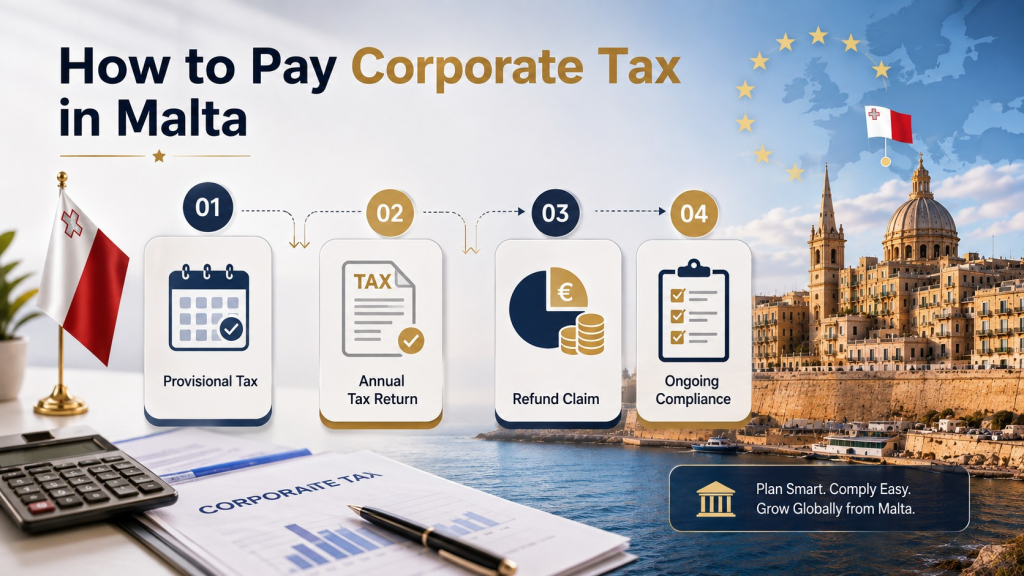
How to Pay Corporate Tax in Malta: The Practical Process
- Provisional tax payments are made during the year based on estimated income, in instalments set by the Malta Tax and Customs Administration.
- The annual tax return is filed after year-end, declaring actual profit and settling any balance owed beyond the provisional payments already made.
- The refund claim is submitted by the shareholder following the dividend distribution, referencing the tax already paid by the company.
- Ongoing compliance includes annual financial statements, audit requirements (Malta companies are generally required to have audited accounts regardless of size), and VAT filings where applicable.
One change specific to 2026 is worth flagging directly: the Malta Tax and Customs Administration introduced TRA 135, a new transfer pricing disclosure attachment that now forms part of the year of assessment 2026 corporate tax return.
Companies within the scope of Malta’s transfer pricing rules must now disclose, on the return itself, the methodology used to price cross-border transactions with related parties, the arm’s length outcome, and any adjustments made.
This is directly relevant to any Indian founder running a Malta company alongside an Indian parent, subsidiary, or group entity, since intercompany transactions management fees, licensing arrangements, intra-group financing are exactly what this disclosure targets.
Read this guide: How to Register a Company in Malta from India
Transfer Pricing: What It Means If You Have an India-Malta Group Structure
Malta’s transfer pricing rules require related-party cross-border transactions to be priced as they would be between independent parties dealing at arm’s length.
The rules generally do not apply to companies below certain revenue and capital thresholds set out in the regulations.
Many single-entity Malta startups will sit comfortably below these thresholds, but any founder operating a Malta company alongside an Indian entity for example, where the Indian company invoices the Malta company for services, or vice versa should have this assessed rather than assumed.
Malta Company Setup Timeline for Indian Founders
Legal incorporation of a Malta company can typically be completed within one to two weeks once documentation is in order.
Becoming fully operational meaning the company has a functioning business bank account usually takes longer, often one to three months, and banking tends to be the longest step in the process rather than incorporation itself.
Non-EU applicants, including Indian founders, should generally expect additional know-your-customer and source-of-funds documentation as part of bank onboarding, since this is standard practice for non-resident applicants across most EU banking institutions, not specific to Malta.
Step | Typical Timeframe |
Company name reservation and incorporation | 1–2 weeks |
Tax and VAT registration | 1–3 weeks |
Business bank account opening | 4–12 weeks |
Fully operational company | 1–3 months overall |
Read this guide: Malta Company Formation in 2026: Requirements, Documents & Process
Substance Requirements: Why a Letterbox Company Will Not Work
Malta, as an EU member state, applies economic substance expectations that go beyond simply registering a company and appointing a nominee director.
Tax authorities generally expect evidence of genuine activity, local management involvement, real decision-making connected to Malta, and operations that reflect an actual business rather than a registered address.
This matters for two reasons: it affects whether Malta’s tax benefits hold up under scrutiny, and, as covered above, it directly supports the case against India’s POEM and GAAR provisions being applied to treat the company as Indian-resident.
Founders coming from a UAE free zone mindset, where a registered address and minimal local presence can sometimes be sufficient, should treat Malta as a different, and generally stricter, standard.
Company or Self-Employed: Which Fits Your Situation?
A Malta limited company generally suits founders building a business intended to scale, raise investment, or operate with EU customers and contracts at meaningful volume the SaaS, e-commerce and consulting profiles most common among Indian entrepreneurs exploring Malta.
A solo consultant with a small, stable client base and no near-term plan for EU market expansion may find the compliance overhead of a Malta company audited accounts, provisional tax, ongoing filings disproportionate to the benefit, and worth weighing against simpler alternatives before committing.

Common Mistakes Indian Entrepreneurs Make With Malta Company Tax
Assuming 35 percent is the real tax burden and ruling Malta out before understanding the refund mechanism.
Continuing to run all meaningful management and decision-making from India, creating POEM exposure without realising it.
Sending capital to fund the Malta company without first confirming RBI/LRS or ODI compliance.
Underestimating the refund timing gap and its effect on short-term cash flow.
Treating economic substance as optional rather than central to the structure holding up.
Who Should and Should Not Set Up a Malta Company
Malta tends to be a strong fit for founders building genuine EU-facing operations: a SaaS business selling into European markets, a consultancy serving EU clients, or a trading company that benefits from EU-based invoicing and banking.
It is a weaker fit for founders looking purely for a low-tax mailing address with no real EU activity, since substance requirements and India’s own anti-avoidance rules are both designed to look past exactly that kind of arrangement.
Planning to Set Up a Malta Company From India?
Malta can offer an attractive EU business environment and tax framework, but the right structure depends on your business model, ownership, management, and India-side tax and regulatory position.
Vorx Consultancy can help you assess the complete setup — from Malta company formation and banking to tax, compliance, and cross-border structuring.
Conclusion
Malta’s appeal for Indian entrepreneurs rests on a genuine structural advantage EU membership combined with an effective corporate tax rate that few other EU jurisdictions can match.
But the number that matters most for an Indian founder is not the 5 percent effective Malta rate in isolation; it is how that structure holds up against India’s POEM and GAAR provisions, and how cleanly the money moves under RBI rules.
Getting the Malta side right and overlooking the India side is one of the most common and most costly mistakes we see in cross-border structuring.
Planning to expand into Europe through Malta? Speak with Vorx Consultancy to understand the right company formation, banking, tax, and compliance pathway for your specific business.
