
Choosing where to incorporate an international business is no longer just a question of where company registration is easiest or where the headline tax rate looks lowest.
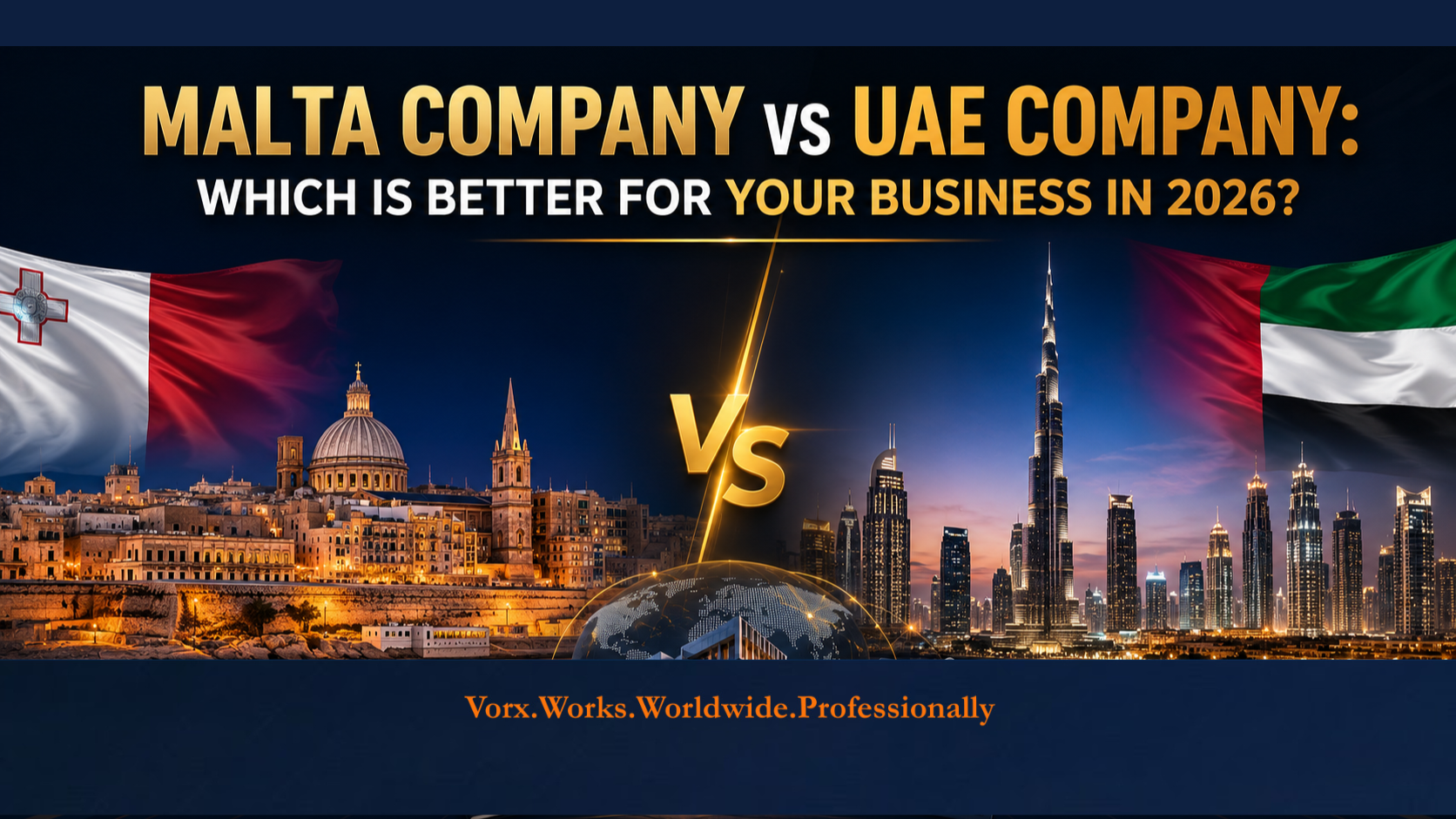
For founders comparing a Malta company vs UAE company, the more important question is: which jurisdiction fits the way your business actually operates?
Malta and the UAE offer very different strategic advantages. Malta gives businesses an EU base and access to a European regulatory and commercial environment.
The UAE offers a strong Middle East business hub, multiple Free Zone options, foreign ownership flexibility and a competitive corporate tax framework.
For example, imagine an Indian SaaS founder whose customers are mainly in Germany, France and the Netherlands. An EU-based company may make more strategic sense than choosing a jurisdiction purely because of its headline tax rate.
Now consider a trading entrepreneur whose customers and suppliers are concentrated across Dubai, Saudi Arabia and other GCC markets. A UAE company may be the more natural operating base.
So, is Malta or UAE better for business in 2026?
There is no universal winner. Malta is often the stronger fit for an EU-focused business, while the UAE can be more suitable for businesses targeting the GCC, Middle East or international markets from a UAE base.
The right choice depends on your target market, business activity, tax position, ownership structure, banking requirements and long-term expansion plans.
Malta Company vs UAE Company: Quick Comparison
| Factor | Malta Company | UAE Company |
|---|---|---|
| Best for | EU-focused businesses | GCC & global businesses |
| Market access | European Union | UAE & wider Middle East |
| Corporate tax | 35% headline rate* | 0% / 9% framework |
| Foreign ownership | Available, subject to applicable rules | 100% available in many structures |
| Free Zones | No UAE-style Free Zone system | Multiple Free Zone options |
| Key advantage | EU business presence | Regional & international business hub |
| Best choice if… | Europe is your priority | GCC/MENA is your priority |
The table gives you the broad picture, but it should not be used as a substitute for structuring advice.
In both jurisdictions, the tax and compliance result can depend on what the company does, where it operates, who owns it and where key management decisions are made.
What Makes a Malta Company Attractive in 2026?
Malta’s biggest strategic advantage is not simply its tax system. It is its position as an EU jurisdiction.
For a company that wants to build a European presence, that distinction can matter more than the difference between two headline tax rates.
EU Market Access
Malta provides an EU corporate base for businesses that want to operate with European customers, suppliers and partners.
This can be particularly relevant for:
- SaaS and technology businesses targeting Europe
- consulting firms serving European clients
- international groups establishing an EU presence
- businesses planning wider European expansion
- companies that want a euro-based European operating environment
For example, if a founder is building a B2B software company and expects most customers to come from Germany, France and Italy, having an EU business structure may align more naturally with the company’s commercial strategy.
That does not mean a Malta company automatically makes every EU transaction easier or more tax efficient. The specific activity, contracts, VAT position and operating model still need to be assessed.
Malta’s Corporate Tax System
Malta has a standard corporate tax rate of 35% on company income and capital gains.
However, Malta’s tax system also provides a shareholder refund mechanism following dividend distributions, meaning the headline 35% rate does not necessarily represent the final effective tax outcome for every qualifying structure.
This is one of the areas where comparing Malta with the UAE purely by headline percentages can produce a misleading conclusion.
A founder should look at the complete structure:
- How the company earns income
- Where the business is managed
- How profits are distributed
- Whether shareholder refunds are available
- The owner’s tax residence
- Applicable treaty and cross-border rules
- Ongoing compliance requirements
The calculation should be done before incorporation rather than after the company is already operating.
Also Read this : Malta Company Tax Guide 2026
The Euro and European Business Environment
For businesses dealing regularly with European customers and suppliers, Malta’s European setting can also be commercially relevant.
The euro may simplify certain transactions for businesses whose financial activity is already centred around the eurozone, although the practical benefit depends on where the company’s customers, suppliers and banking relationships are located.
Who Is Malta Best Suited For?
A Malta company may be worth considering when the business strategy is Europe-first.
That could include a founder who:
- wants an EU corporate presence
- expects a significant European customer base
- plans to expand across EU markets
- works with European suppliers or partners
- needs a European operating structure for long-term growth
The important point is that Malta should be selected because it fits the business strategy—not simply because someone describes it as a “low-tax jurisdiction.”
What Makes a UAE Company Attractive in 2026?
The UAE approaches international business from a different direction.
Instead of being an EU gateway, it has developed into a major regional hub connecting businesses with the GCC, Middle East, Asia and international markets.
The UAE also gives foreign investors significant ownership flexibility. The UAE Ministry of Economy and Tourism states that investors of all nationalities can establish and fully own companies, subject to applicable rules and exceptions for certain strategic activities.
Free Zone Options
One of the biggest differences between Malta and the UAE is the UAE’s extensive Free Zone ecosystem.
The UAE currently has more than 40 Free Zones offering different business environments and licensing options.
This gives founders choices based on:
- Business activity
- Location
- Licensing requirements
- Office requirements
- Visa needs
- Customer base
- Operational model
The choice of Free Zone should therefore come after understanding the business, not before it.
Choosing a Free Zone simply because it has a particular advertised package may create problems later if the licence does not match the company’s actual activities or banking requirements.
UAE Corporate Tax
The UAE introduced its federal corporate tax regime in 2023. Under the current framework, corporate income can be subject to a 9% corporate tax rate, while qualifying Free Zone income may benefit from a 0% rate, subject to specific conditions.
However, this should not be interpreted as meaning that every Free Zone company automatically pays zero corporate tax.
The applicable treatment depends on the nature of the income, the company’s activities and whether it meets the requirements for qualifying Free Zone treatment.
This distinction is important when comparing the UAE with Malta. A business should look beyond headline tax rates and consider eligibility, business activities, compliance requirements and its overall structure before choosing a jurisdiction.
The UAE’s Free Zone corporate tax rules have also evolved over time, including clarification around qualifying and excluded activities.
Foreign Ownership
Foreign ownership is another major UAE advantage.
The UAE government states that investors of different nationalities can establish and fully own companies under the applicable legal framework, with certain strategic activities subject to specific rules.
For an international founder, this can make the UAE attractive when the goal is to maintain control of the business while establishing a regional operating base.
Who Is the UAE Best Suited For?
A UAE company may be a stronger fit when the business is focused on:
- UAE customers
- GCC markets
- Middle East expansion
- international trading
- regional consulting
- cross-border services
- founders planning a genuine UAE operating presence
It can also be relevant for entrepreneurs who want to combine a business structure with a broader UAE relocation or residency strategy. However, company ownership and residence status are separate matters and should not be treated as automatically connected.
Malta vs UAE: Tax Comparison
Tax is usually one of the first reasons founders compare Malta and the UAE.
But it should not be the only reason.
Malta
Malta’s standard corporate tax rate is 35%. Its system also provides shareholder refunds in qualifying circumstances following dividend distributions.
This means the effective tax position can differ from the headline rate depending on the company’s structure and circumstances.
UAE
The UAE operates a federal corporate tax system. Companies may be subject to corporate tax depending on their taxable income, business activities and applicable tax rules.
Qualifying Free Zone Persons may benefit from 0% corporate tax on qualifying income, subject to meeting the relevant conditions.
However, Free Zone status alone does not automatically mean that all company income qualifies for this treatment.
Therefore, when comparing Malta and the UAE, founders should consider the applicable tax rules, business activities, company structure and eligibility requirements, rather than relying only on headline tax rates.
So Which Has the Lower Tax?
At the headline corporate tax level, the UAE generally appears more tax-competitive.
But that does not automatically make the UAE the better jurisdiction for every business.
A company also needs to consider:
- The owner’s personal tax residence
- Management and control
- Where business activity actually takes place
- Dividend flows
- VAT
- Withholding tax
- Transfer pricing
- Substance
- Double-tax treaty considerations
- Reporting and compliance
A company incorporated in a low-tax jurisdiction does not automatically eliminate tax obligations in the founder’s home country.
That is particularly important for founders operating internationally from India or another country where they remain tax resident.
Malta vs UAE: EU Access or Middle East Access?
This is perhaps the simplest way to understand the strategic difference.
Malta: Europe First
Malta can make more sense when your business strategy revolves around Europe.
For example:
India → Malta → EU customers
A technology company, professional services business or international group may consider Malta when European market access and an EU corporate presence are central to its plans.
UAE: GCC and Middle East First
The UAE can make more sense when your business strategy is centred around:
India → UAE → GCC/MENA markets
For example, a trading company selling into Saudi Arabia, the UAE, Oman and other regional markets may find a UAE operating base more commercially aligned with its expansion plans.
Neither structure automatically gives a business access to every market or removes the need to comply with local rules. The value comes from choosing a jurisdiction that matches where the business actually intends to operate.
Malta vs UAE: Which Is Better for Your Business?
The answer becomes clearer when you stop asking, “Which country has the better tax rate?” and start asking, “Where does my business need to be?”
Choose Malta if your priority is Europe
Malta may be the better fit if:
- Your target customers are primarily in Europe
- You want an EU corporate presence
- European suppliers and partners are important
- Your expansion strategy is focused on EU markets
- You want a European base for long-term business development
Choose UAE if your priority is the GCC or Middle East
The UAE may be the better fit if:
- Your customers are concentrated in the GCC
- You want to establish a UAE operating presence
- Your business benefits from Free Zone options
- You are expanding into Middle Eastern markets
- UAE-based operations or relocation are part of your long-term strategy
What if you are not sure?
This is where many founders make the wrong decision.
If you have not yet determined where your customers will be, where management will take place, how profits will be distributed or whether you need an EU or GCC base, incorporating immediately may be premature.
A company structure should support the business plan—not define it after the fact.
Not sure whether Malta or the UAE fits your business?
The right jurisdiction depends on your target market, business activity, ownership structure and long-term expansion plans.
Vorx Consultancy can help you compare your options and identify the structure that aligns with your business goals.
Talk to Vorx Consultancy about your international business setup.
How Vorx Consultancy Can Help
At Vorx Consultancy, we look at Malta and the UAE from a business-planning perspective rather than focusing on one factor such as tax.
The right jurisdiction depends on where the business operates, who its customers are, how it is structured and where the founder plans to expand.
For international entrepreneurs, our approach is to understand these requirements first and then evaluate the company structure, market access, tax considerations and compliance obligations that may apply in Malta or the UAE.
Final Verdict: Malta or UAE?
So, Malta company vs UAE company—which is better in 2026?
The better jurisdiction depends on what you are trying to build.
Malta is often the stronger strategic choice for an EU-focused business. Its value comes from its European position, corporate framework and suitability for businesses that want to develop a presence connected to the EU.
The UAE can be the stronger choice for GCC, Middle East and internationally oriented businesses. Its ownership flexibility, Free Zone ecosystem and corporate tax framework can make it attractive for founders building a genuine UAE or regional operation.
The mistake is choosing based on one number.
A better decision considers market access, tax, ownership, substance, banking, compliance and long-term expansion together.
At Vorx Consultancy, we help international founders evaluate jurisdictions based on their business model, target market, ownership structure and long-term plans before moving into company formation.
For a founder comparing Malta and the UAE, that analysis can be more valuable than simply asking which jurisdiction is “cheaper.”
Need Help Choosing Between Malta and UAE?
Your company structure should support your business strategy not limit it.
Vorx Consultancy helps entrepreneurs and international businesses evaluate company formation options, tax considerations, market access and compliance requirements before incorporation.Planning your next international business setup?
Get Expert Guidance