


If you have set up a company in Cyprus, or you are weighing it up as part of a wider expansion plan, the paperwork side of things is not something you can leave until later.
A Cyprus company is attractive for good reasons: an EU footprint, a competitive tax regime, and straightforward incorporation but that ease of setup can create a false sense of security about what comes after.
Compliance is where many foreign owners, including a growing number of Indian entrepreneurs using Cyprus as a base for European operations, run into trouble.
Not because the rules are unreasonable, but because they are scattered across three different authorities and nobody hands you a single list.
This guide brings those obligations together as they stand in 2026, with a particular eye on what changes when the owner is not physically based in Cyprus.
What Does "Compliance" Actually Mean for a Cyprus Company?
It helps to think of Cyprus compliance as three separate tracks rather than one long checklist. The Registrar of Companies wants an accurate, up-to-date record of who owns and runs the company.
The Tax Department wants returns and payments filed on time. And a separate beneficial ownership register wants confirmation of who ultimately controls the business, for anti-money-laundering purposes.
Most of the confusion we see at Vorx Consultancy comes from owners treating these as one obligation instead of three filing the annual return, for example, and assuming that covers the ownership register too. It does not, and we will come back to that.
One quick correction before going further: several guides still list a €350 annual levy as a standing cost of running a Cyprus company.
That levy was abolished from 2024 onward. If you are budgeting for a Cyprus entity in 2026, you can drop it from your calculations more on why this myth persists further down.
Read this guide: Cyprus Company Formation for Foreigners: A Complete 2026 Guide
What Is the Annual Return (Form HE32) and When Is It Due?
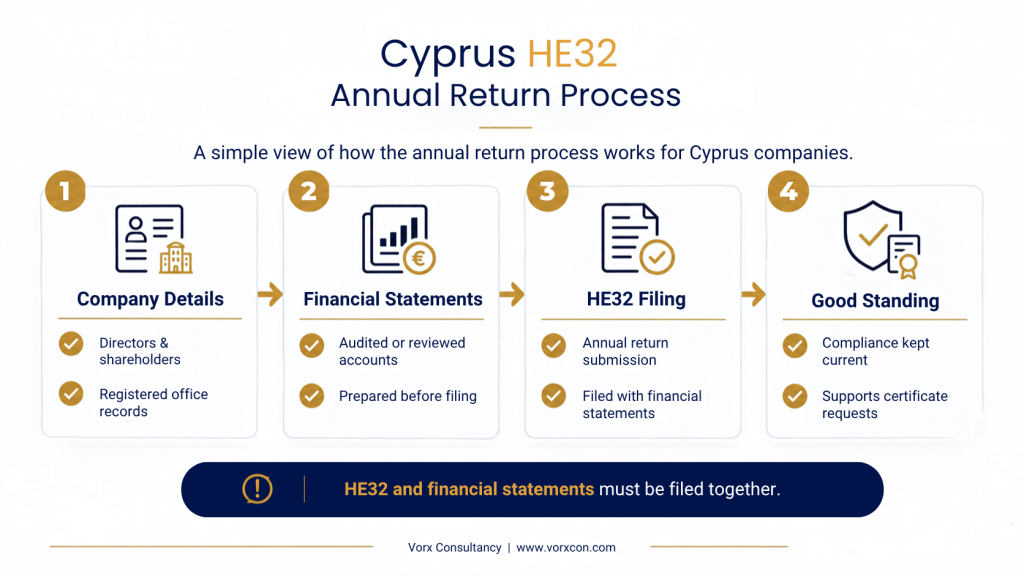
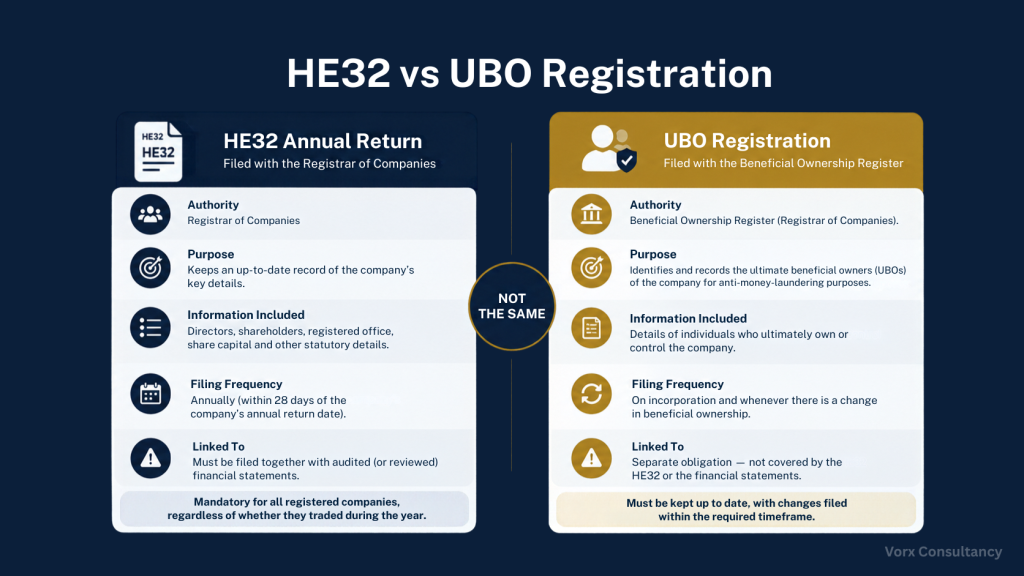
The HE32 is essentially a yearly snapshot of the company: its directors, shareholders, registered office, and share capital. Every registered company files one, regardless of whether it traded during the year.
It must be submitted within 28 days of the company’s annual return date, and it has to be filed alongside the audited (or reviewed) financial statements the two cannot be separated.
A newly incorporated company gets some breathing room, with its first return due 18 months after incorporation; after that, it settles into an annual rhythm.
Miss the deadline and a filing penalty applies immediately, increasing the longer the delay continues, though it is capped after a point.
The real damage sits behind that number. The Registrar periodically runs strike-off campaigns against companies with overdue returns, and a company that has been struck off loses its legal existence, with its assets passing to the state.
Restoring a struck-off company is far more expensive and time-consuming than filing on time would have been.
There is also a quieter consequence that catches foreign owners off guard: a company with an outstanding HE32 often cannot obtain a Certificate of Good Standing, which is exactly the document a foreign bank or business partner will ask for.
Do You Need Audited Financial Statements Every Year?
Yes, in almost every case. Cyprus requires annual financial statements to be audited (or, for smaller companies, reviewed) before they can accompany the HE32 or support the tax return.
A useful update for smaller foreign-owned entities: a turnover threshold of €300,000 now determines whether a company can use a lighter review engagement rather than a full statutory audit.
If your Cyprus company is a modest holding vehicle or a small trading operation, it is worth checking with your accountant whether you now qualify for the reduced-scope option; it can meaningfully lower your annual accounting bill.
One practical point worth remembering: the audit has to be finished before either the HE32 or the corporate tax return can be filed.
A delay at the audit stage does not stay contained to the audit — it pushes back everything downstream.
Need help managing your Cyprus company’s annual filings?
Vorx Consultancy can help you coordinate accounting, reporting, and ongoing corporate compliance so important deadlines don’t get overlooked.
What Changed With the Corporate Tax Return (TD4) Deadline?
This is the update most likely to catch existing Cyprus company owners by surprise.
For financial years ending 31 December 2026 and beyond, the corporate tax return deadline has moved permanently to 31 January of the second year following the tax year two months earlier than the previous 31 March cutoff.
Financial Year | TD4 Filing Deadline |
FY2023 | 31 March 2026 |
FY2024 | 30 November 2026 |
FY2026 onward | 31 January of the second following year |
So a company with a 31 December 2026 year-end will have its tax return due by 31 January 2028, not 31 March.
If you manage your Cyprus company’s compliance calendar yourself, this is worth flagging to whoever prepares your accounts now, rather than discovering it when a deadline has already passed.
Companies with related-party or intra-group transactions also need to file a Summary Information Table alongside the TD4.
There is no minimum value threshold for this; a common assumption is that small transactions do not need reporting, which is not correct.
VAT and Provisional Tax: What Else Is on the Calendar?
If your Cyprus company trades selling services, invoicing EU clients, or moving goods VAT registration and quarterly VAT returns will likely apply, alongside monthly VIES reporting for intra-EU transactions.
Provisional tax works alongside this: an estimate of the year’s tax liability is paid in two instalments, with the second instalment giving you a chance to revise the estimate if the business has performed differently than expected. Underestimating significantly can trigger a penalty, so this is not a figure to guess at casually.
Why Do Owners Keep Confusing HE32 With UBO Registration?
This is the single most common mix-up we encounter, and it is worth its own section rather than a passing mention.
The HE32 annual return and the Ultimate Beneficial Owner (UBO) register are entirely separate filings, sitting under different legislation. Submitting one does not satisfy the other.
New companies must register beneficial ownership details within 90 days of incorporation. Any change in ownership must be reported within 45 days of the company becoming aware of it.
And every company, regardless of whether anything has changed, must reconfirm its UBO details each year during the window between 1 October and 31 December.
Missing this is not treated as a minor administrative slip. Because it sits within anti-money-laundering legislation rather than ordinary company law, the consequences can extend beyond a fine and affect how banks and regulators view the company.
What Should Foreign and Non-Resident Owners Pay Special Attention To?
A few compliance questions apply specifically to owners who are not based in Cyprus, and they rarely get the attention they deserve.
Tax residency depends on where the company is actually managed, not just where it is registered: Cyprus tax residency generally follows the concept of “management and control” where board decisions are genuinely made.
This is one reason many foreign-owned Cyprus companies appoint a Cyprus-resident director: not as a formality, but to help demonstrate that management decisions are being taken locally.
Vorx Consultancy Insight: this does not automatically guarantee tax residency status, and it should be structured properly rather than treated as a box-ticking exercise.
Filing remotely is entirely workable, but it needs the right setup in advance: Access to the CY Login government portal, digital signatures, and a properly drafted power of attorney for your local accountant or corporate services provider all make a difference when you are managing filings from India, the UAE, or elsewhere without visiting Cyprus regularly.
Sector matters: If your Cyprus company operates in forex, gaming, or crypto-related activity, expect an additional layer of CySEC or sector-specific regulatory compliance on top of the standard Companies Law obligations described in this guide.
For Indian entrepreneurs specifically: the interaction between Cyprus company profits and Indian tax residency rules is a conversation worth having with a cross-border tax adviser before assuming a Cyprus structure changes your Indian tax position. A Cyprus company on its own does not resolve Indian tax residency questions for its owner.
Read this guide: Cyprus Company Formation Requirements: A Complete 2026 Guide
Managing a Cyprus company from India or another country?
Vorx Consultancy can help you understand your filing obligations, organise remote compliance support, and keep your company’s statutory requirements on track.
Common Mistakes We See Foreign Owners Make
- Filing the HE32 without realizing it depends entirely on the audit being finished first
- Assuming UBO registration is covered once the annual return is filed
- Budgeting for the €350 levy, which no longer applies
- Skipping the Summary Information Table because related-party transactions seem too small to matter
- Assuming Cyprus company registration alone establishes tax residency, without addressing management and control
Staying on Top of It as a Non-Resident Owner
None of these obligations are complicated in isolation. What makes Cyprus compliance genuinely difficult for foreign owners is the number of separate tracks running at once, each with its own deadline and its own authority.
A missed HE32 deadline, a UBO filing nobody remembered, or an outdated assumption about the annual levy can each cause disproportionate friction relative to how small the original task was.
At Vorx Consultancy, we help founders and business owners structure their Cyprus compliance calendar around their actual situation whether that means setting up remote filing access, reviewing whether a company now qualifies for a lighter audit, or simply keeping track of deadlines that shift, as the TD4 date has for 2026.
If you are managing a Cyprus company from outside the country, having someone local track these dates is usually less about convenience and more about avoiding the kind of gaps that are expensive to unwind later.
Need help staying compliant in Cyprus?
Let Vorx Consultancy help you manage your company’s ongoing compliance with confidence.
