
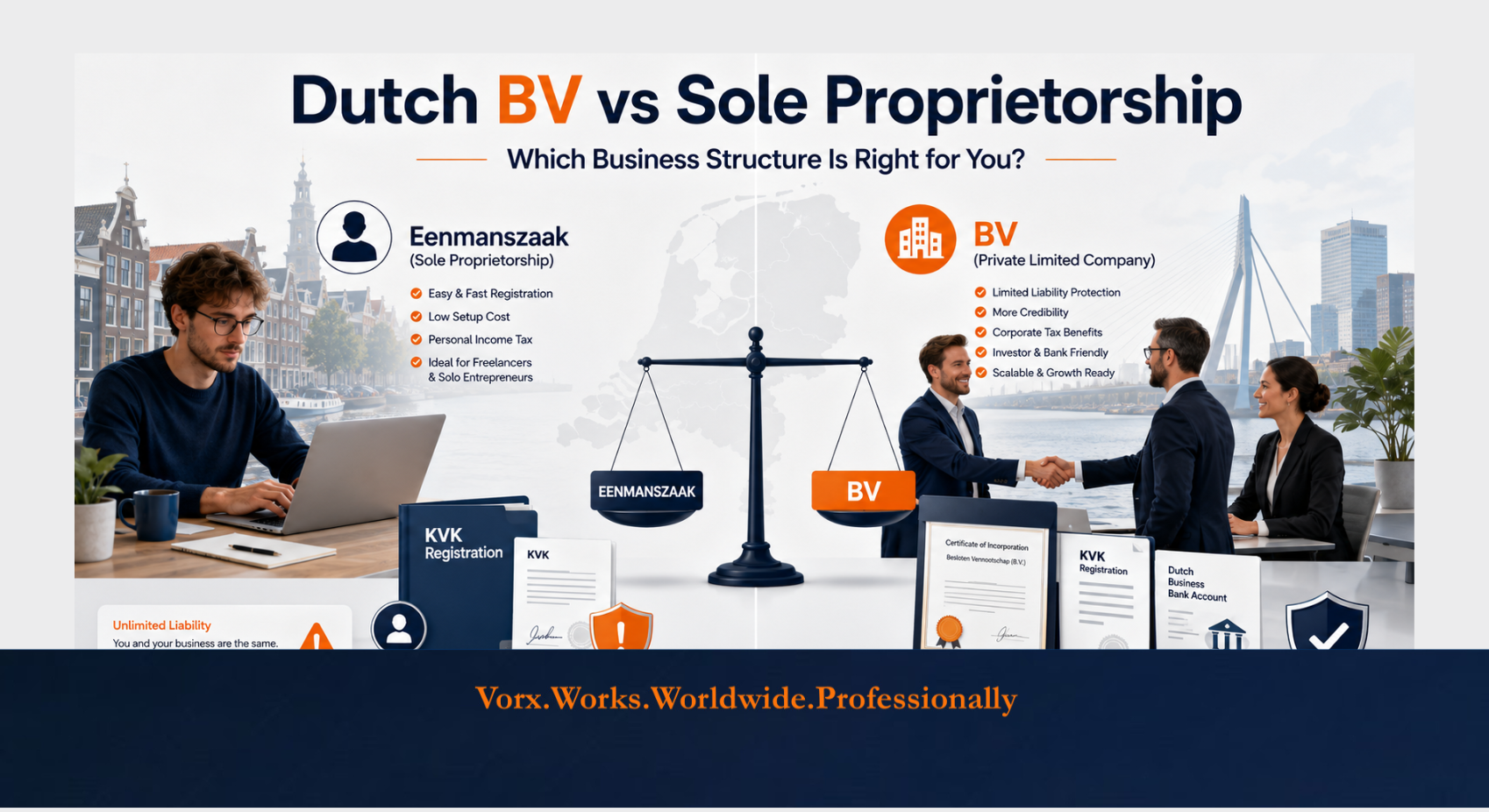
If you’re planning to set up a company in the Netherlands, this question will land on your desk in the first week: Sole Proprietorship (eenmanszaak) or BV?
It may seem like a minor administrative decision, but in reality, it influences your tax situation, your exposure to risk, and how seriously banks and investors will treat you from day one.
There is no single correct approach in this situation; it depends on the level of risk you carry, your anticipated earnings, and whether you want to get funding or a team.
This guide walks through both structures in plain language, with real numbers, so you can make the call with confidence instead of guessing.
Netherlands Business Structure Overview Where BV and Eenmanszaak Fit
The Netherlands recognizes several legal structures Sole Proprietorship (Eenmanszaak) , VOF (partnership), BV, NV, and branch offices of foreign companies.
But if you’re a solo founder, freelancer, or small team entering the Dutch market, you’ll almost always be choosing between two: the eenmanszaak (sole proprietorship) and the BV (private limited company).
The core difference comes down to one idea: with a Sole Proprietorship (Eenmanszaak) , you are the business legally, there’s no line between you and it.
With a BV, the company is its own legal entity, separate from you personally. That single distinction is what drives nearly every other difference between the two liability, tax, and how much paperwork you’ll be dealing with.
What Is a Dutch Sole Proprietorship (Eenmanszaak)?
A Sole Proprietorship (Eenmanszaak) is the simplest way to start doing business in the Netherlands.
You register with the KVK (Dutch Chamber of Commerce), and within a day you’re legally trading no notary, no minimum capital, no separate bank account required (though it’s smart to have one anyway).
Here’s what that looks like in practice:
Registration cost: a small one-time fee payable to KVK
Liability: unlimited. If the business runs into debt, creditors can come after your personal assets your savings, your car, potentially your house
Taxation: profits are taxed as personal income under box 1, alongside any other income you have
Deductions: this is where an Sole Proprietorship (Eenmanszaak) gets genuinely attractive — you can claim the zelfstandigenaftrek (self-employed deduction), startersaftrek (starter’s deduction) if it’s your first few years, and the MKB-winstvrijstelling (SME profit exemption), which shields a meaningful chunk of profit from tax
VAT: a BTW number is issued automatically once you register
Worth knowing: the zelfstandigenaftrek has been shrinking year over year as part of a deliberate government policy shift, so the tax advantage of staying a sole proprietor is smaller than it was five years ago and it’ll keep shrinking through 2027.
This structure suits freelancers, consultants, and solo founders testing an idea before committing to something more formal.
Foreigners including non-EU residents can register one too, though you’ll need a valid address in the Netherlands and, in most cases, a BSN.
What Is a BV Company in the Netherlands (Besloten Vennootschap)?
A BV is a private limited company, a separate legal entity that can own assets, sign contracts, and be sued in its own name, independently of you.
This is the structure most foreign startups, e-commerce brands, and SaaS founders eventually land on.
A few things that surprise first-time founders:
Minimum capital is €0.01. Since the Flex-BV Act came into effect, the old €18,000 requirement is gone. You genuinely can incorporate with a single cent of share capital.
You need a notary. Incorporation happens through a notarial deed; this is the one step you can’t skip or DIY.
Corporate tax applies instead of personal income tax: 19% on profit up to €200,000, and 25.8% above that (confirm current brackets at time of filing, as these are reviewed annually).
Dividend tax (box 2) kicks in when you pay yourself dividends from company profit currently 24.5% up to a threshold and 31% above it.
The DGA salary rule (gebruikelijk loon): if you’re the director and majority shareholder, tax authorities require you to pay yourself a “customary” market-rate salary; you can’t just leave all profit sitting in the company to dodge income tax.
UBO registration is mandatory; you’ll need to declare who ultimately owns and controls the company.
The upside that draws most founders in: limited liability, and a level of credibility that banks, investors, and even B2B clients simply take more seriously than a Sole Proprietorship (Eenmanszaak).
Read This guide: How to Register a Company in the Netherlands
Dutch Company Registration Process — BV vs Eenmanszaak Side by Side
For a Sole Proprietorship (Eenmanszaak), registration is almost anticlimactic: book a KVK appointment, show up with ID, walk out registered, BTW number waiting in your inbox within days.
A BV takes more coordination:
- Check and reserve your company name
- Draft the deed of incorporation with a notary
- Register with KVK (the notary typically handles this)
- Open a Dutch business bank account
- File your UBO declaration
Realistically, this takes one to two weeks, sometimes longer if you’re a non-resident, because Dutch banks have become notably stricter about opening business accounts for founders without a Dutch address or BSN.
This is one of the most common bottlenecks foreign entrepreneurs run into, and it’s worth sorting out before you commit to a notary appointment date.
Tax Comparison Sole Proprietorship vs BV
The numbers make this decision real in a way that general advice cannot.
Here’s an idea of how take-home pay varies at different profit levels (these are illustrative figures; always confirm the current year’s tax slabs and deductions with an accountant before filing your taxes):
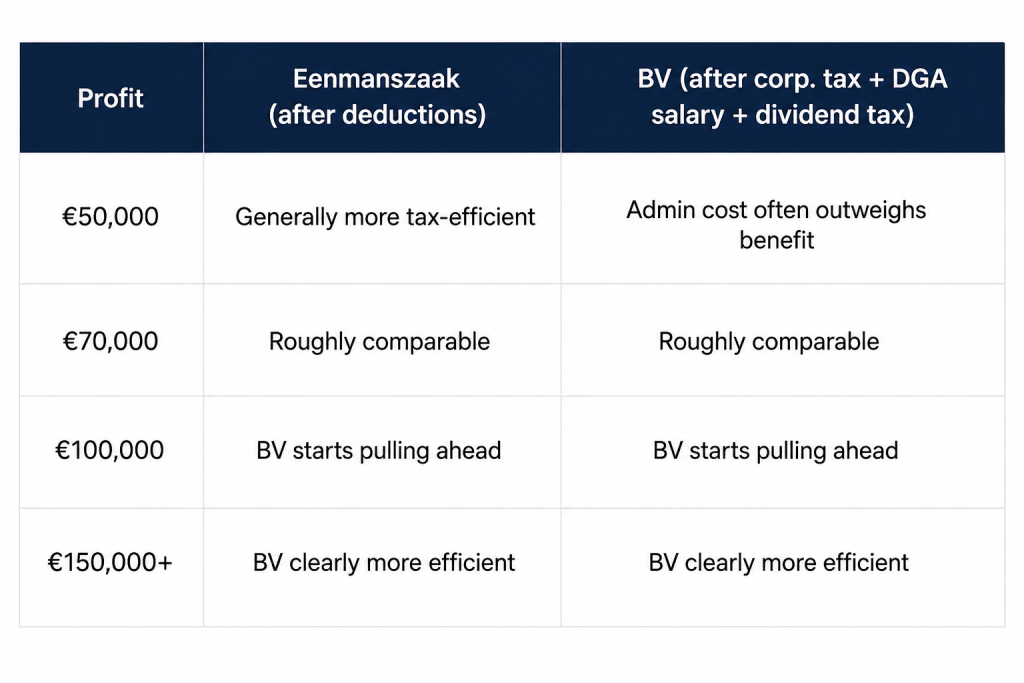
Numbers look different for every founder. Get a personalized tax comparison from Vorx Consultancy based on your actual expected profit not a generic table.
The commonly cited break-even point sits somewhere around €70,000–€100,000 in annual profit, but it’s not a fixed line; it shifts depending on your specific deductions, whether you have a partner also drawing income, and how much you plan to pay yourself as a DGA salary versus leaving in the company.
This is genuinely one area where a half-hour with an accountant pays for itself.
Liability and Risk — Which Structure Actually Protects You?
A Sole Proprietorship (Eenmanszaak) offers zero separation between you and your business debts.
If a client sues you or a supplier isn’t paid, your personal assets are on the table and depending on your marital property regime, your partner’s assets can be exposed too.
A BV limits liability in principle but doesn’t treat that as absolute protection. There are real exceptions:
- Banks often require personal guarantees from founders before lending to a new BV, which quietly reintroduces personal liability
- Directors can be held personally liable for mismanagement or bestuurdersaansprakelijkheid (director liability) if things go badly and negligence is shown
- Certain tax debts can still follow the director personally
So the honest framing is: a BV meaningfully reduces your risk, but “fully protected” is a myth worth retiring.
Administrative Burden — What Changes When You Incorporate a BV
Sole Proprietorship (Eenmanszaak) keeps bookkeeping light track income and expenses, file one annual income tax return, done.
A BV adds real ongoing obligations: annual accounts, a separate corporate tax return, payroll administration if you’re paying yourself a salary, and UBO register upkeep.
Budget for higher accountant fees annually, and expect to spend more monthly hours on admin than you would running things solo.
Which Structure Should You Choose?
Freelancers and consultants — Sole Proprietorship (Eenmanszaak) is usually the sensible starting point.
One flag: if you’re working almost exclusively for a single client, be aware of VBAR enforcement around false self-employment, which regulators are watching more closely in 2026.
Indian startups and foreign founders entering the EU — a BV tends to make more sense early, mainly for credibility and investor-readiness.
E-commerce and SaaS founders — usually a BV, both for liability protection and the ability to issue shares to co-founders or investors later.
SMEs entering the European market — a BV, particularly if a holding structure or further EU expansion is on the roadmap.
Investors comparing structures — a BV is required if you intend to hold or issue shares.
Read This Guide: How to Start a Business in Netherlands
Can You Convert From Eenmanszaak naar BV Later?
Yes, and it is important to know this beforehand because it significantly reduces the pressure associated with this decision.
Many founders start out as sole proprietors (*Eenmanszaak*) and convert once they cross the profit break-even point.
The conversion can happen tax-neutrally (geruisloze inbreng) under the right conditions, and your existing contracts, BTW number, and KVK history carry forward through the process. Nothing about starting as a sole proprietor locks you out of becoming a BV down the line.
How Vorx Consultancy Can Help
Reading about zelfstandigenaftrek thresholds and DGA salary rules is one thing, applying them to your actual numbers, industry, and residency status is another.
This is usually where founders get stuck, not because the concept is hard, but because the details are specific to their situation.
Vorx Consultancy works with foreign entrepreneurs, freelancers, and startups at exactly this decision point. Here’s where the team typically adds the most value:
Structure selection — reviewing your expected revenue, risk exposure, and growth plans to tell you plainly whether an eenmanszaak or BV fits, instead of a generic recommendation
End-to-end registration — handling the KVK process for a sole proprietorship, or coordinating the notary, incorporation deed, and KVK filing for a BV, so you’re not chasing appointments yourself
Non-resident bank account support — this is the single biggest bottleneck foreign founders hit, and Vorx helps navigate bank requirements so it doesn’t stall your launch timeline
Tax planning — working out DGA salary levels, dividend timing, and available deductions so you’re not leaving money on the table or accidentally under-declaring
Ongoing compliance — annual accounts, corporate tax returns, and UBO register upkeep for BVs, so admin doesn’t quietly eat your week every quarter
Conversion planning — if you start as a Sole Proprietorship (Eenmanszaak) and outgrow it, Vorx can manage the geruisloze inbreng conversion when the timing makes sense for your numbers
If you’d rather get a straight answer for your specific situation than keep researching in the abstract, a short consultation with Vorx Consultancy is usually the fastest way to move from “which structure?” to “registered and trading.”
Conclusion
If you’re a solo freelancer with low liability exposure and modest revenue, a Sole Proprietorship (Eenmanszaak) gets you trading fast with minimal overhead.
If you’re scaling, carrying real liability risk, planning to raise investment, or need the credibility a registered entity brings with EU clients and banks, a BV is worth the extra setup effort.
And since converting later is entirely possible, starting simple isn’t a decision you’re stuck with, it’s just a starting point.
If you’re still weighing this against your specific numbers and plans, a short consultation with a Dutch company formation advisor is usually the fastest way to get a definitive answer rather than a general one.