


Germany is the largest economy in Europe, and for many Indian founders it’s the obvious place to set up an EU base.
Getting the company registered is the easy part. Compliance becomes the problem area for foreign investors since Germany requires that the necessary paperwork be done on time, correctly, and often in German.
This guide covers the main Germany company compliance requirements for 2026 and the mistakes we see most often.
It’s written for GmbH and UG directors, Indian entrepreneurs, and investors planning a German subsidiary.
What Are the Main Compliance Requirements for a German Company?
Most German companies deal with six areas on an ongoing basis:
Area | What it involves | Main authority |
Company records | Keeping the commercial register current | Handelsregister (commercial register) |
Annual accounts | Preparing and publishing financial statements | Bundesanzeiger (Federal Gazette) |
Tax | Corporate tax, trade tax, VAT, payroll tax | Finanzamt (tax office) |
Bookkeeping | Compliant records and retention | Tax authorities |
Employment | Payroll, social insurance, contracts | Social insurance carriers |
Data protection | GDPR and website rules | Data protection authorities |
Directors are personally responsible for all of this. That point matters more than any single deadline, and we come back to it below.
Do Compliance Rules Differ for a GmbH, UG or Branch?
Yes, though less than people expect. A GmbH needs €25,000 in share capital. A UG (Unternehmergesellschaft, often called a “mini-GmbH”) can start with as little as €1, but it must set aside 25% of its annual profit as a reserve until it reaches the GmbH capital level. Both are limited liability companies with the same core filing, tax and bookkeeping duties.
A branch (Zweigniederlassung) is different. It isn’t a separate legal entity, so the foreign parent’s liability and, in some cases, its accounts come into play. For most Indian founders who want to limit risk, a GmbH or UG is the more common route.
Vorx Consultancy Insight: A UG looks cheap at the start, but banks and larger clients sometimes treat it more cautiously. Choose the structure based on your banking, client and funding plans, not just the capital requirement.
What Should You Do Right After Incorporation?
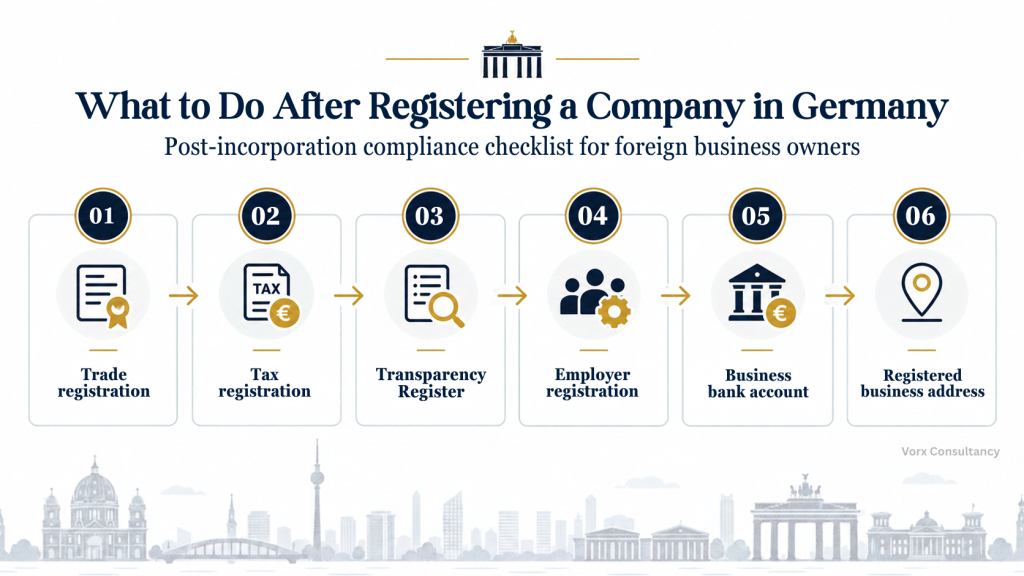
The company isn’t “done” when the notary signs. In the first weeks you’ll typically need to:
Register the trade (Gewerbeanmeldung) with the local trade office, if your activity requires it.
Complete the tax registration questionnaire with the Finanzamt, which leads to your tax number and, where relevant, a VAT ID.
Update the Transparency Register with the company’s beneficial owners (the real people who ultimately own or control it). Layered foreign ownership makes this harder, so keep ownership documents ready.
Register as an employer with social insurance carriers before the first hire.
Open a business bank account. German banks often ask foreign-owned companies for detailed ownership and business-plan documents, and this can take longer than founders expect.
You also need a valid German business address. A real office or a service provider’s address can work, but the address must be one where mail is reliably received and handled.
Read this guide: Company Formation in Germany for Foreigners: Complete 2026 Guide
What Extra Issues Do Indian and Other Foreign Owners Face?
That’s where generic compliance guidance falls flat.
Documents from India: Powers of attorney, and even corporate documents, are often required to be notarized, apostilled, and sworn in German.
Work that into your timeline; failure to apostillize can cause weeks-long delays in registration.
Foreign directors: A non-citizen may be appointed as a managing director for a German firm, although practical concerns arise such as bank onboarding, tax residency status, and whether the person can manage the business abroad.
Visa/work permit regulations apply independently, and simply being a director does not grant any rights to reside in or work in Germany.
Intercompany transactions: If your German company receives services or makes payments to the parent company in India, you will need agreements and arm’s-length pricing of the payment, and German tax authorities check it.
India-Germany Tax Treaty: Depending on your intercompany structure, withholding rate on dividends, interest and royalty may be affected by the India-Germany Tax Treaty.
Also, Indian-side investments are covered by FEMA reporting requirements.
Both are subject to changes, so consult a German Steuerberater and Indian chartered accountant.
Example of a typical issue: an Indian founder manages the GmbH remotely and Finanzamt sends a letter in German language with a 30 days’ response period.
It sits unread in a mailbox for six weeks. The fix is simple, but only if someone is assigned to open, translate and act on official mail from day one.
At Vorx Consultancy, we often see this as the single biggest practical gap for first-time foreign owners. It’s rarely a knowledge problem. It’s a “who is watching the mailbox” problem.
Managing a German Company From India?
Avoid cross-border compliance complications. Get expert guidance on German company filings, tax obligations and ongoing compliance with Vorx Consultancy.
What Annual Filing Requirements Apply?
Every GmbH and UG has to produce annual accounting statements in accordance with the German Commercial Code (HGB).
Simplified regulations apply for small businesses, whereas large organizations are audited depending on the specific size criteria, which are periodically revised; make sure you know the current criteria.
Then the statements have to be made public in the Bundesanzeiger within 12 months after the fiscal year end.
This is the deadline foreign owners miss most often. The Federal Office of Justice monitors it and can issue fines, typically starting in the low thousands of euros. Confirm the current range before relying on any figure.
Shareholders also need to formally approve the accounts and decide how profits are used, and this should be documented in written resolutions.
Any change to directors, address or shareholders must be reported to the commercial register, usually through a notary.
Are Your German Company Filings Up to Date?
Missed annual accounts and statutory deadlines can lead to penalties. Let Vorx help you coordinate your company’s filing and reporting obligations.
How Does Tax Compliance Work?
The four important taxes are:
Corporate income tax: 15% and an additional solidarity surcharge of 5.5% on top of that. The German government has enacted legislation for gradual rate cuts in future years, so one should always refer to the prevailing rates.
Trade tax (Gewerbesteuer): Depends on each individual municipality, and hence the total tax liability varies from city to city. Hence one must check the tax rate applicable to his area.
VAT (Umsatzsteuer): The standard rate is 19% and the reduced rate is 7%. The filing will either be done monthly or quarterly depending on turnover; usually new companies pay VAT monthly.
Most filings go through ELSTER, the official online tax portal. Setting up an ELSTER certificate can take several days by post, so start early rather than the week a return is due.
E-invoicing is the big change to plan for. From 2025, German businesses must be able to receive structured electronic invoices.
Issuing obligations phase in from 2027, depending on turnover, with full coverage planned for 2028. Check current thresholds, then make sure your accounting software can handle the format.
Read this guide: Germany Corporate Tax 2026: What Indian and Foreign-Owned Companies Actually Pay
What Are the Bookkeeping and Record Retention Rules?
Under German legislation, it is necessary to use double entry accounting for GmbH firms and the records should comply with the GoBD guidelines, which include completeness, traceability, and protection against any unauthorized alterations. Digital records must be available to tax auditors on request.
Retention periods are shorter than before in some categories:
Annual accounts and books: 10 years
Booking vouchers (receipts, invoices): reduced to 8 years under recent reforms, so confirm how this applies to your records
Business letters: 6 years
Practical tip: pick accounting software that is explicitly GoBD-compliant, and decide early who holds the records, you or your accountant. Many foreign owners ask their accountant to keep a mirrored copy.
What GDPR and Website Rules Apply?
When you process personal data about your customers, employees, or visitors to your website, the GDPR is applicable. You must at least have a privacy policy, a record of processing activities, data processing agreements with third-party processors, and a breach reporting procedure within 72 hours.
For Germany, a Data Protection Officer is needed in certain situations, most notably where 20 or more persons systematically process personal data automatically. Verify the current threshold.
A German website needs an Impressum (company contact information page), a compliant privacy policy, and effective cookie consent. The reason? The Abmahnung – a cease and desist letter.
Such letters are sent by competitors and lawyers due to the lack of Impressum, privacy notice, and functioning cookie consent. The founder of an Indian company having a German website developed on a worldwide template is often the target.
In case you sell any product via your website, make sure to comply with the EU General Product Safety Regulation, LUCID packaging registration, and consumer withdrawal rights.
And in case you transfer personal data to India, you must have appropriate protections (Standard Contractual Clauses).
What Employment and Payroll Duties Come With Hiring?
Hiring in Germany means more than a contract. Registration with social insurance companies and contributions for pensions, healthcare, unemployment, long-term care, and accident insurance will be needed.
Participation in these contributions by employees is also required, and payroll withholding is done by you.
Additional considerations:
Minimum wage : €13.90 per hour as of January 2026. This amount may be subject to adjustment in the future.
Conditions of employment should be stated in writing.
Working-time recording: Record hours worked in line with current court and legal requirements.
Whistleblower channel: Firms that have 50 or more employees must maintain an internal channel for reporting.
Mini-Jobs/Midi-jobs: Unique rules exist along with income threshold limits that vary from time to time.
In case you intend to send Indian employees to Germany, special requirements will be applicable such as work permit/EU Blue Card and/or A1 certificate/posting requirements.
Firm ownership is not a substitute for anything and the outcome may vary depending upon individual cases.
What Is a Managing Director Personally Liable For?
This is the part that surprises most founders. The GmbH structure protects shareholders from liabilities, but there are instances where managing directors face personal liabilities:
Delay in filing for insolvency: A firm should file an application for insolvency if it fails to settle its debts within three weeks; or, for over-indebtedness, within six weeks.
Tax evasion on value-added tax (VAT), wage tax, or social security: The authorities may hold the directors accountable directly.
Carelessness in duties: The directors are expected to act in a prudent businesslike manner, and poor documentation could be costly.
Let’s consider this case: a new firm is lacking in funds, and the director holds back payment of social security to cater to suppliers before declaring insolvency.
Authorities can hold the director personally responsible for those contributions. D&O insurance can help in some cases, but it won’t cover everything, so read the exclusions.
What Happens If You Miss a Deadline?
Obligation | Typical consequence |
Late Bundesanzeiger publication | Administrative fine from the Federal Office of Justice |
Late tax returns | Late-filing surcharge and possible estimated assessment |
Late VAT returns | Surcharges, interest, closer scrutiny |
Unpaid social security | Surcharges and potential director liability |
Missing Impressum or privacy notice | Abmahnung with legal costs |
Delayed insolvency filing | Personal liability, possible criminal exposure |
Exact amounts vary by case and change over time, so confirm them with official sources or your advisor.
What Does a 2026 Compliance Calendar Look Like?
Timing | Typical task |
Monthly | Payroll tax filing; VAT return (if monthly) |
Quarterly | VAT return (if quarterly); advance tax payments |
Within 12 months of year-end | Publish annual accounts in the Bundesanzeiger |
Annually | Shareholder resolutions; annual accounts and tax returns |
As needed | Register changes, update Transparency Register |
Your own calendar depends on your financial year, turnover and employees, so build it with your accountant at the start of the year.
Don’t Let Compliance Deadlines Catch You Off Guard.
Stay organised with expert support for accounting, tax filings and statutory compliance.
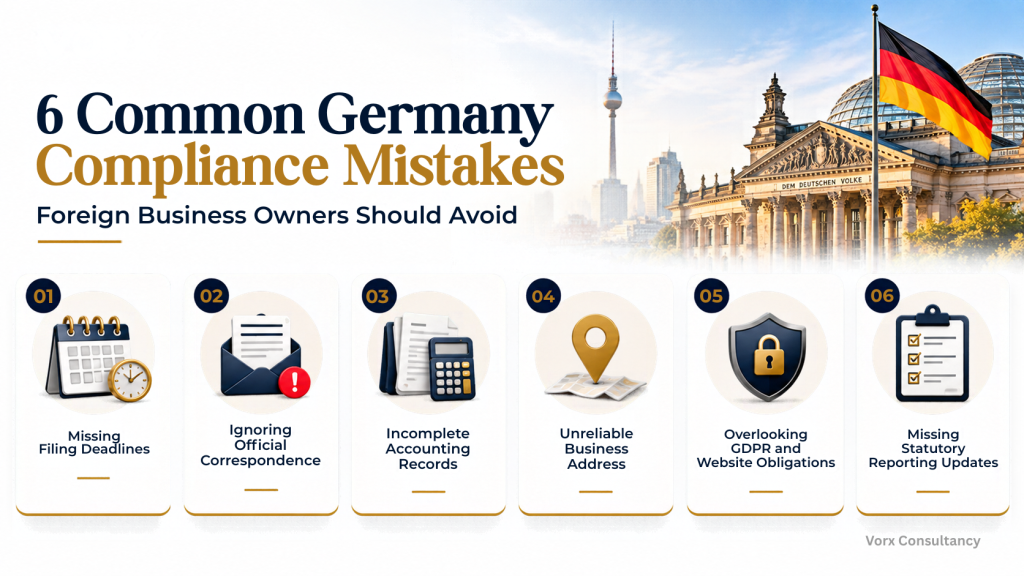
What Mistakes Do Foreign Owners Make Most Often?
- Ignoring German-language letters from the Finanzamt
- Missing the Bundesanzeiger deadline
- Having no reliable local contact or address
- Keeping weak or non-compliant bookkeeping
- Launching a website without an Impressum or privacy policy
- Misclassifying freelancers who work like employees
- Not tracking insolvency duties when cash gets tight
Each is avoidable with a simple routine and the right local support.
Do You Need a Steuerberater or Compliance Provider?
Yes, for most foreign enterprises, in most cases. The laws are comprehensive, the language issue is a reality, and there can be heavy costs for any errors.
Your service provider must do bookkeeping, payroll, value-added tax, annual accounts, and filing, as well as preferably speak English and understand India-Germany specifics.
Before you choose an accountant to work with, inquire about flat rates, timeframes, and the way they deal with correspondence on your behalf.
At Vorx Consultancy, we assist founders with structure evaluation both pre- and post-incorporation and liaise with local accountants and attorneys where necessary.
The list is subject to change depending on your specific case, so please consider this checklist a preliminary one only.
Your German Business Deserves Reliable Compliance Support.
From company filings to tax and accounting coordination, Vorx Consultancy helps foreign business owners manage their German compliance obligations with support from relevant professionals.
