
Germany is Europe’s biggest economy and one of the most attractive markets for companies from Indian IT and engineering industries, manufacturers and consultancies.
But before signing your first German client and hiring your first employee, you need to make a decision on how your business will exist there.
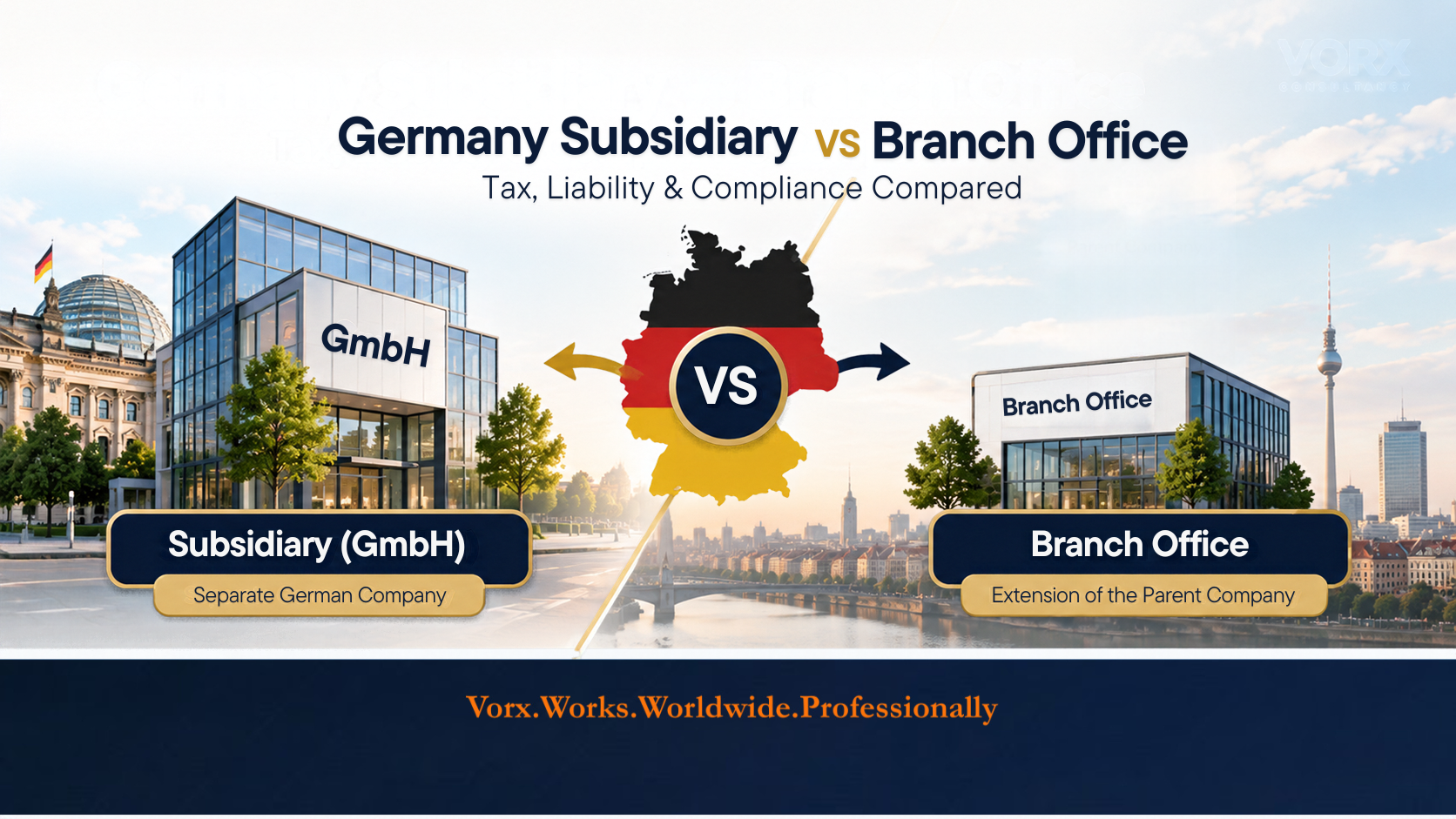
The Germany subsidiary vs. branch office question affects your liability, tax position, reporting duties and how German partners view you.
This guide compares the two structures in plain language, so that you can choose based on your business plan rather than on what looks to be easiest to start with.
Not Sure Which Germany Structure Fits Your Business?
Get clarity on whether a branch or subsidiary aligns with your expansion plans.
Subsidiary or Branch Office: What Is the Short Answer?
A subsidiary (usually a GmbH) is generally the safer choice if you:
- plan to stay in Germany for the long term,
- want to hire local staff, or
- want to protect the parent company from German liabilities.
A branch office can work if you want a lighter presence controlled by the parent, and you are fine with the parent carrying full responsibility.
Most foreign companies that plan to stay and grow end up with a GmbH. The rest of this article explains why, and when a branch still makes sense.
What Is a Branch Office in Germany?
A branch office (Zweigniederlassung) is not a separate company. It is an extension of the foreign parent. It is registered in the German commercial register (Handelsregister) and works under the parent’s legal identity.
Key points:
- There is no minimum share capital requirement.
- The parent company is directly responsible for the branch’s debts and obligations.
- The branch is usually run by a branch manager who acts on behalf of the parent.
- For tax purposes, the branch is treated as a permanent establishment (Betriebsstätte) of the parent.
Branches are common for sales offices, serving a few clients, and testing the market. They are also common in regulated sectors like banking and insurance, where a branch may be the expected structure.
What Is a Subsidiary (GmbH) in Germany?
A subsidiary is a separate German company owned by the foreign parent. The most common type is the GmbH (Gesellschaft mit beschränkter Haftung). It has its own accounts, its own tax identity and its own management.
Core requirements:
- Minimum share capital of €25,000. At least half must be paid when the company is formed. This is a legal requirement, not a fee.
- At least one Managing Director (Geschäftsführer).
- Articles of association signed in front of a German notary.
- Registration in the commercial register.
You may also hear about the UG (haftungsbeschränkt), sometimes called a “mini-GmbH”. It needs less capital.
It is a valid option for small ventures, but German banks and larger customers often see it as less established. So it is rarely the first choice for a serious market entry.
Germany Subsidiary vs Branch Office: Side-by-Side Comparison
Factor | Subsidiary (GmbH) | Branch Office |
Legal status | Separate German company | Part of parent company |
Parent liability | Generally limited | Parent directly liable |
Management | German company management | Branch manager |
Tax | Taxed as German company | Taxed on German branch profits |
Accounting | Separate German accounts | Branch-level German records |
Profit transfer | Usually via dividends | Transfer to head office |
Local presence | Stronger independent presence | Direct extension of parent |
Exit | Sale or liquidation | Deregistration |
How Does Liability Differ in Practice?
This is where the two structures diverge most.
With a branch, there is no legal wall between the German operation and the parent. If a customer wins a contract dispute in Germany, or a former employee brings a claim, the creditor can pursue the parent company, including assets outside Germany.
With a GmbH, liability is generally limited to the company’s own assets. A dispute in Germany stays in Germany, which is why many CFOs treat the GmbH as a form of risk insurance.
There are exceptions. Managing directors carry personal duties under German law, including the obligation to file for insolvency promptly if the company can no longer pay its debts.
Failing to do so can create personal exposure. A GmbH protects the parent, but it does not remove responsibility from the person running it.
How Are Subsidiaries and Branches Taxed in Germany?
Both structures are taxed on German-source profits, so neither is a tax-free route. The differences are in the details.
Corporate taxes: A GmbH pays corporate income tax at 15%, a solidarity surcharge of 5.5% on that tax, and municipal trade tax, which depends on the city.
A branch is taxed on profits attributable to its German permanent establishment, with a broadly similar combined burden.
Germany has also legislated a gradual reduction of the corporate tax rate in the coming years, so check the current schedule with a tax advisor before modelling your numbers.
Profit repatriation: Dividends paid by a GmbH to a foreign parent can be subject to German withholding tax, though double taxation treaties or EU rules may reduce or remove it.
A branch transfers profits to its head office without dividend withholding in most cases. For Indian companies, the India-Germany tax treaty sets reduced dividend rates, and the tax credit available in India will depend on the company’s own position.
Losses: Branch losses may be offset against the parent’s profits, depending on the parent’s home-country rules.
A GmbH’s losses stay inside the GmbH and can only be used against its future German profits.
Transfer pricing: If a GmbH buys services from, or pays fees to, its parent, those dealings need to be at arm’s length and documented. Tax authorities look closely at this, and it is a frequent audit topic.
The tax result is rarely about which structure is “cheaper”. It is about where profits and losses will arise, and how you plan to move money back to the parent.
Plan Your Germany Expansion Before You Register
Understand the tax, compliance and structural implications before choosing your setup.
What Are the Compliance and Accounting Obligations?
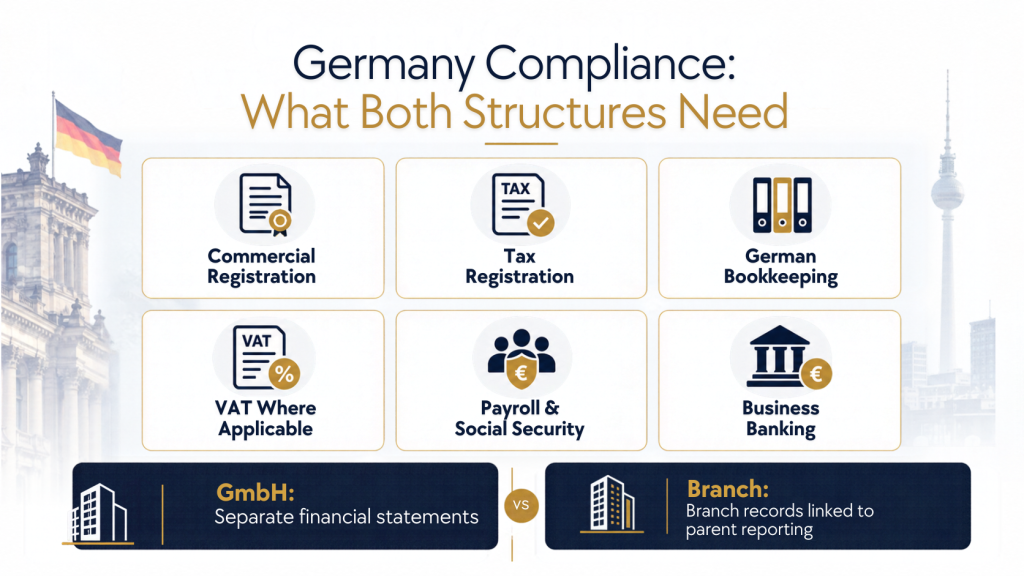
Both structures require a similar set of registrations: the commercial register, the trade office (Gewerbeamt), the tax office (Finanzamt), and social security and payroll registration if you employ people. A GmbH must also enter its beneficial owners in the transparency register.
The reporting load differs:
Subsidiary: Prepares full annual financial statements under German commercial law (HGB), files them for publication, and may need an audit depending on its size.
Branch: Keeps German books for its activities and meets tax filing obligations, while the parent’s own accounts remain central to reporting.
Two practical hurdles catch many founders off guard. First, documents from the parent country usually need to be notarized, apostilled and translated into German.
Second, opening a German business bank account can take time, particularly for non-resident owners, because banks carry out detailed checks.
Start that process early, and don’t assume the account will be ready the day the company is registered.
Read this guide: Germany Company Compliance Requirements
Which Structure Gives You More Control and Credibility?
A branch gives the parent direct control. Decisions go straight from head office to the branch manager, with no separate corporate governance in Germany.
A GmbH works differently. The managing director holds legal authority to act for the company, so the parent exercises control through the articles of association and shareholder resolutions. It takes a little more structure, but it is manageable with clear internal rules.
On credibility, German customers, procurement teams and banks are used to dealing with local GmbHs.
A GmbH with German accounts is easier to assess than a foreign company’s branch, and it usually has an easier path to local financing and grants.
If your clients are large German corporations, this matters more than most founders expect.
Which Structure Is Right for Your Business?
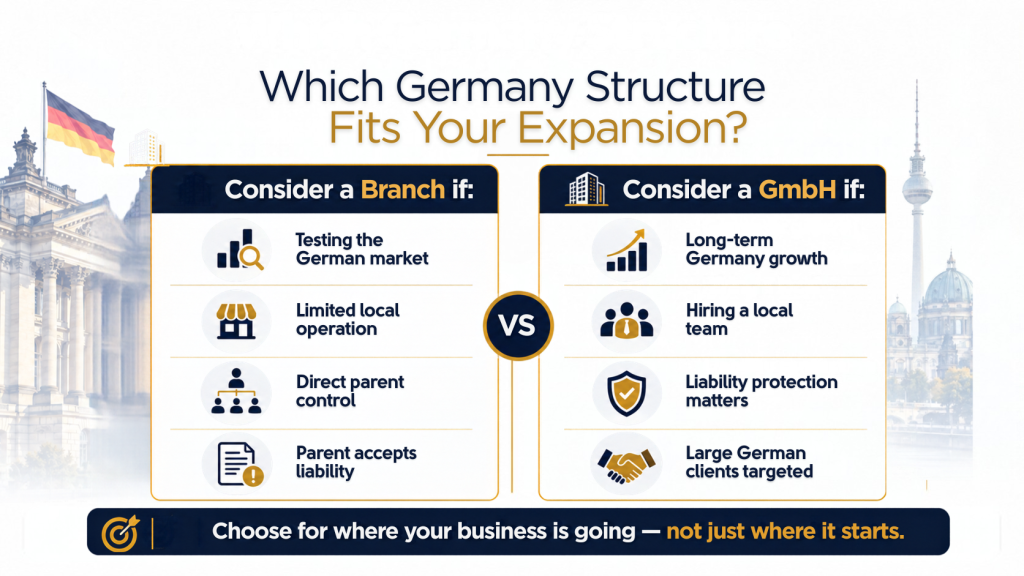
A branch usually fits if:
- You are testing the market or running a limited, short-term project.
- The parent can comfortably absorb German liabilities.
- You want direct, simple control from the head office.
- Your sector expects a branch, such as certain financial services.
A subsidiary usually fits if:
- You plan long-term growth in Germany.
- You will hire a local team.
- You want to ring-fence legal and financial risk.
- You need local financing or want to win large corporate contracts.
Branch or GmbH? Choose Based on Your Growth Plan.
Vorx Consultancy can help assess your business model, liability exposure and long-term Germany requirements.
A short example. Consider a mid-sized IT services company from Pune that has won a pilot project with a German automotive supplier. It registers a branch to get started quickly, with two consultants on site.
Within a year, the client offers a multi-year contract and the company plans to hire eight German employees.
At that point, its legal team raises two concerns: the contract carries significant liability exposure, and the client’s procurement team prefers a German entity.
The company moves its operations into a GmbH. The branch worked for the pilot, but the growth plan called for a different structure. (This is an illustrative scenario, not a specific client case.)
The lesson is to choose where the business will be in two to three years, not just for the first contract.
Vorx Consultancy Insight: Indian founders often choose a branch because it feels like a natural extension of the home company.
We usually ask a different question first: what happens if something goes wrong in Germany? If the answer affects the whole group, a GmbH is worth a serious look.
What Happens If You Need to Close or Change Structure?
Closing a branch means deregistering it, settling German obligations and winding down local operations. The parent remains responsible for any outstanding liabilities.
Closing a GmbH requires a formal liquidation, which includes a creditor notice period, so it takes time.
The advantage is that a GmbH can also be sold as a going concern, giving you an exit route that a branch does not offer.
Changing structure later is possible. Moving a branch’s business into a GmbH is a recognised path, but it needs careful tax planning, because transferring assets and contracts can have tax consequences.
If you suspect you’ll need a GmbH eventually, it is often simpler to plan for it from the start.
Read this guide: Company Formation in Germany for Foreigners complete guide in 2026.
Conclusion:
A branch is the lighter, parent-controlled route. A GmbH offers protection, credibility and room to grow.
For most foreign companies with a long-term Germany plan, the subsidiary is the more resilient choice, but the right answer depends on your liability appetite, tax position and growth plans.
Requirements and tax rules change, so confirm current details with qualified advisors before you commit.
If you’re weighing both options for your own business, the team at Vorx Consultancy can help you assess which structure fits your plans.
Planning to Expand Your Business to Germany?
Get support with structure selection, company setup and ongoing compliance.
