
Being the most powerful economy in Europe, Germany is an actual choice for startups that need access to European Union customers and partners.
One of the first major choices facing an Indian founder is GmbH vs. UG – which one should the company be?
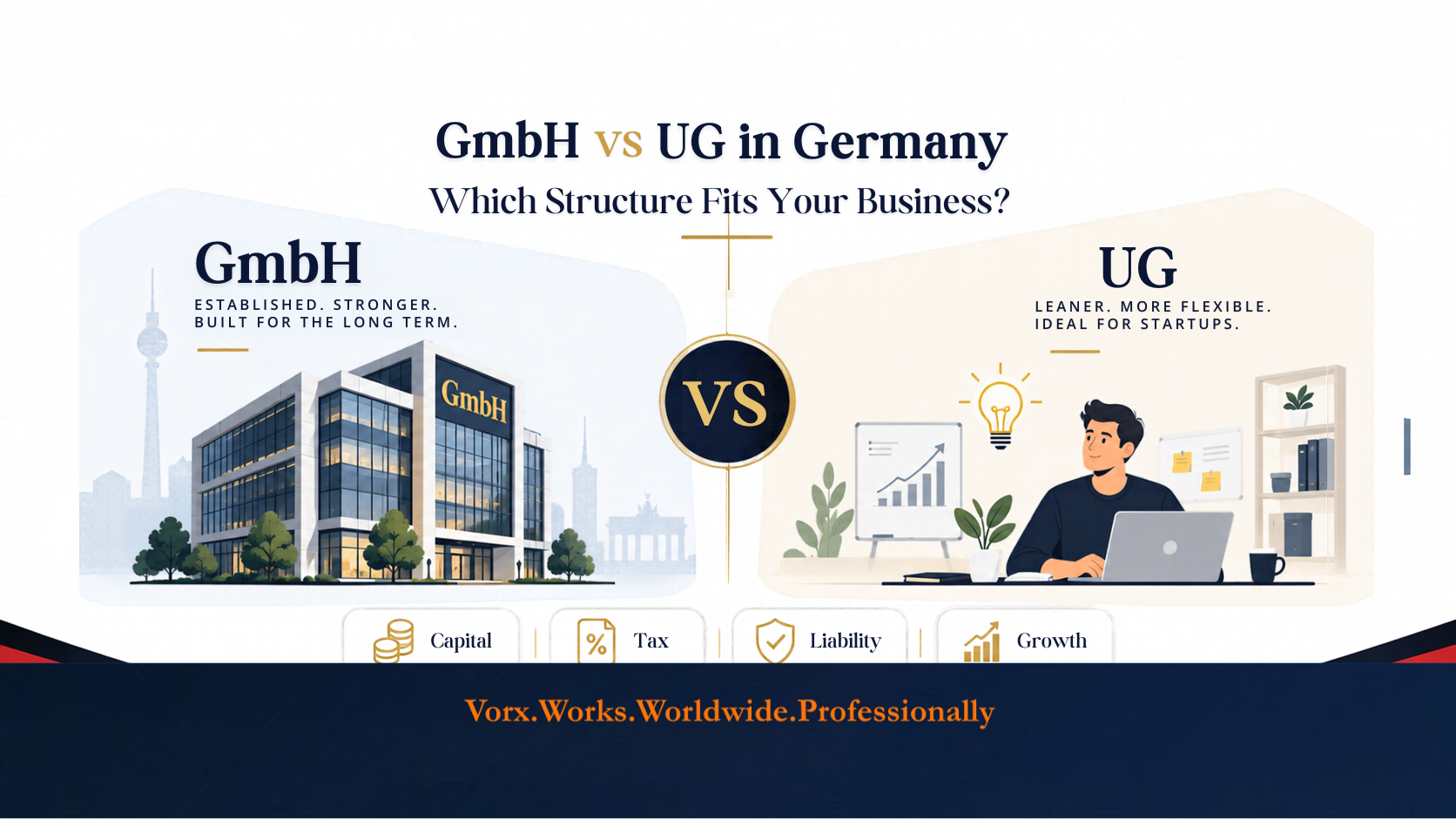
A GmbH and a UG provide the same legal protection and can operate in all kinds of industries. The two structures differ in capital investment, image among banks, investors, and immigration officers, as well as flexibility.
This guide will explain GmbH vs. UG in Germany clearly, giving an example of tax calculation to help you pick the right structure based on your vision and not just budget.
A GmbH will do best when the founders need initial credibility with banks, investors, or immigration officers. A UG can be a better solution for early-stage, agile startups that will eventually turn into a GmbH.
Read this guide: How to register a company in Germany in 2026.
What Is the Core Difference Between a GmbH and a UG?
A UG (haftungsbeschränkt) is not a separate company type. It is a variant of the GmbH with a lower entry threshold and one important restriction: it must build up a reserve from its profits.
Factor | GmbH | UG |
Capital | €25,000 | From €1 |
Paid at registration | Min. €12,500 | Full amount |
Profit reserve | Not required | 25% until €25,000 |
Company name | GmbH | UG (haftungsbeschränkt) |
Market perception | More established | Entry-level structure |
Banking | Usually easier | More scrutiny possible |
Best for | Growth-focused businesses | Startups & testing |
Most of the practical differences sit in the last three rows. Let’s look at why.
What Is a GmbH and How Does It Work?
GmbH (Gesellschaft mit beschränkter Haftung) is the common limited liability company in Germany.The company is an independent legal entity; therefore, its creditors have the right to claim against the property of the company but not against your personal property.
There are three positions that should be mentioned. First, there are the owners of the company called shareholders.
The second are the managing directors (Geschäftsführer) who manage the company and conclude contracts. They can be one and the same person.
The articles of association have to be legalized and the company is recorded in the commercial and transparency registers.
The €25,000 minimum capital requirement is more than just a formal issue. This is the signal for banks, clients, and government agencies that the company is financially sound.
Besides, the funds are not frozen: they belong to the company and can be used for the company’s purposes.
What Is a UG (haftungsbeschränkt) and Where Does It Fall Short?
The UG allows the creation of an entrepreneurial company starting from only €1, that’s why it attracts lone entrepreneurs and side projects.
The catch is the reserve requirement under 5a GmbHG: the 25% share of each year’s profit must remain with the company until the reserve reaches the level of €25,000.
Here are some practical things:
Musterprotokoll (sample protocol): an easy way to create the company with up to three founders and one managing director.
It is quick, but doesn’t allow much flexibility. Vesting, special voting rights, or a second managing director require additional articles.
Name: it should say “UG (haftungsbeschränkt)” or “Unternehmergesellschaft (haftungsbeschränkt)”. The name “UG” is prohibited.
Capital: it should be paid in full at registration.
A UG with €1 capital is legitimate but cash-strapped. A single late payment from a client may lead it into a state of over-indebtedness, and then your obligations as a managing director begin.
How Are a GmbH and a UG Taxed?
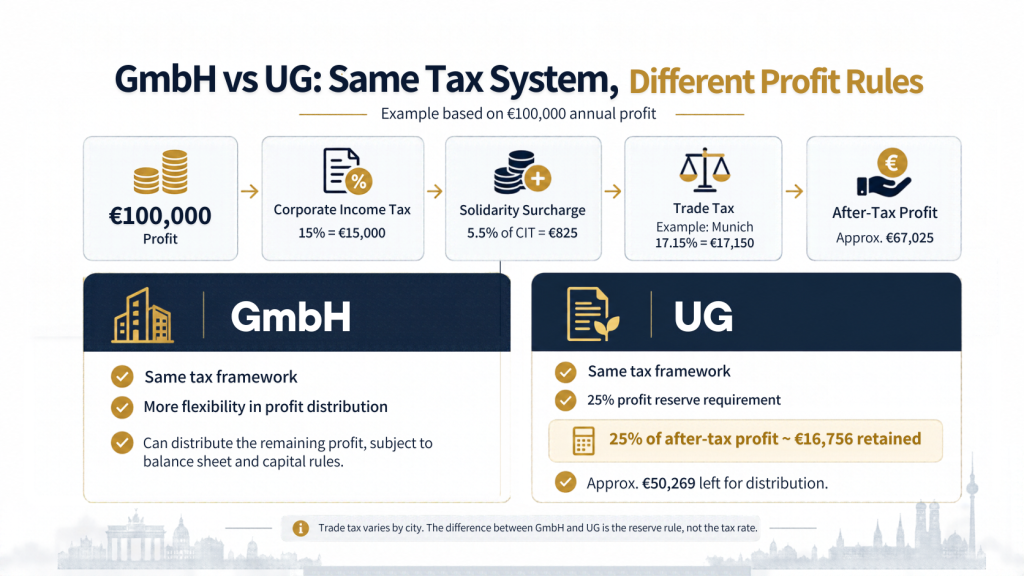
Both forms are taxed identically. The UG’s difference is the reserve, not the rate. Here is what €100,000 in annual profit looks like in Munich:
- Corporate income tax: 15%, or €15,000
- Solidarity surcharge: 5.5% of that tax, or €825
- Trade tax (Gewerbesteuer): 3.5% × Munich’s 490% municipal rate = 17.15%, or €17,150
- Total company-level tax: about €32,975, leaving roughly €67,025
Trade tax depends on the city. At Berlin’s 410% rate, the same profit carries about €30,175 in total tax. Location is a real planning variable.
In a UG, 25% of that remaining profit, about €16,756, goes into the reserve, leaving roughly €50,269 to distribute. A GmbH can distribute the full amount, subject to its balance sheet and capital rules.
How you pay yourself also matters. A managing director salary is deductible for the company and taxed as personal income, with payroll obligations attached. Dividends carry a 25% withholding tax plus solidarity surcharge, an effective 26.375%.
For Indian shareholders, the India-Germany tax treaty (DTAA) can reduce German withholding on dividends, generally to 10%, though the reduction usually has to be claimed, and the income also needs to be treated correctly in India.
One regulatory change is worth tracking: Germany has legislated a gradual cut in the corporate income tax rate, from 15% in 2027 down by one percentage point a year starting in 2028, to reach 10% in 2032.
It applies to both structures, but confirms the current position with a tax advisor, since this is exactly the kind of detail that gets amended.
This is general information, not tax advice.
Read this guide: Germany Corporate Tax 2026
How Much Protection Does Limited Liability Really Give?
Both forms limit your liability to the company’s assets. In practice, several situations can reach you personally:
Personal guarantees: Banks and landlords often ask founders to guarantee loans and leases, particularly for thinly capitalized companies. For that debt, limited liability effectively falls away.
Insolvency duties: Directors must file for insolvency within three weeks of illiquidity and six weeks of over-indebtedness. Missing the deadline can create personal liability.
Taxes and social security: Unpaid payroll taxes and social contributions can be pursued against the director.
Mixing funds: Treating company money as personal money weakens the separation courts rely on.
A UG is more exposed to the second point simply because it has less cushion. Clean bookkeeping, separate accounts and, once you hire staff or take investors, director and officer (D&O) insurance are sensible safeguards.
Which Structure Do Banks and Investors Prefer?
Investors tend to prefer GmbH. They expect clean articles, a clear cap table, option pool provisions and no restructuring step before a funding round.
A UG isn’t a dealbreaker, but it often prompts the question of when you plan to convert.
Banks look more closely at UGs with minimal capital. Expect requests for a business plan, revenue assumptions and sometimes personal guarantees.
Customers, particularly large corporations and public tenders, may read “UG” as an early-stage or unproven business. That isn’t always fair, but it happens.
Some startups raise the “Delaware flip”, adding a US parent for American venture capital. It can make sense for specific plans, but it adds legal complexity and is a question for corporate lawyers, not a default step.
Read this guide: How to Open a Germany Business Bank Account as an Indian Founder (2026 Guide)
Can Indian and Non-EU Founders Set Up a GmbH or UG?
Yes. Neither form requires German nationality or residency for shareholders. But forming a company is not the same as gaining the right to live or work in Germany. Those are separate processes with separate requirements.
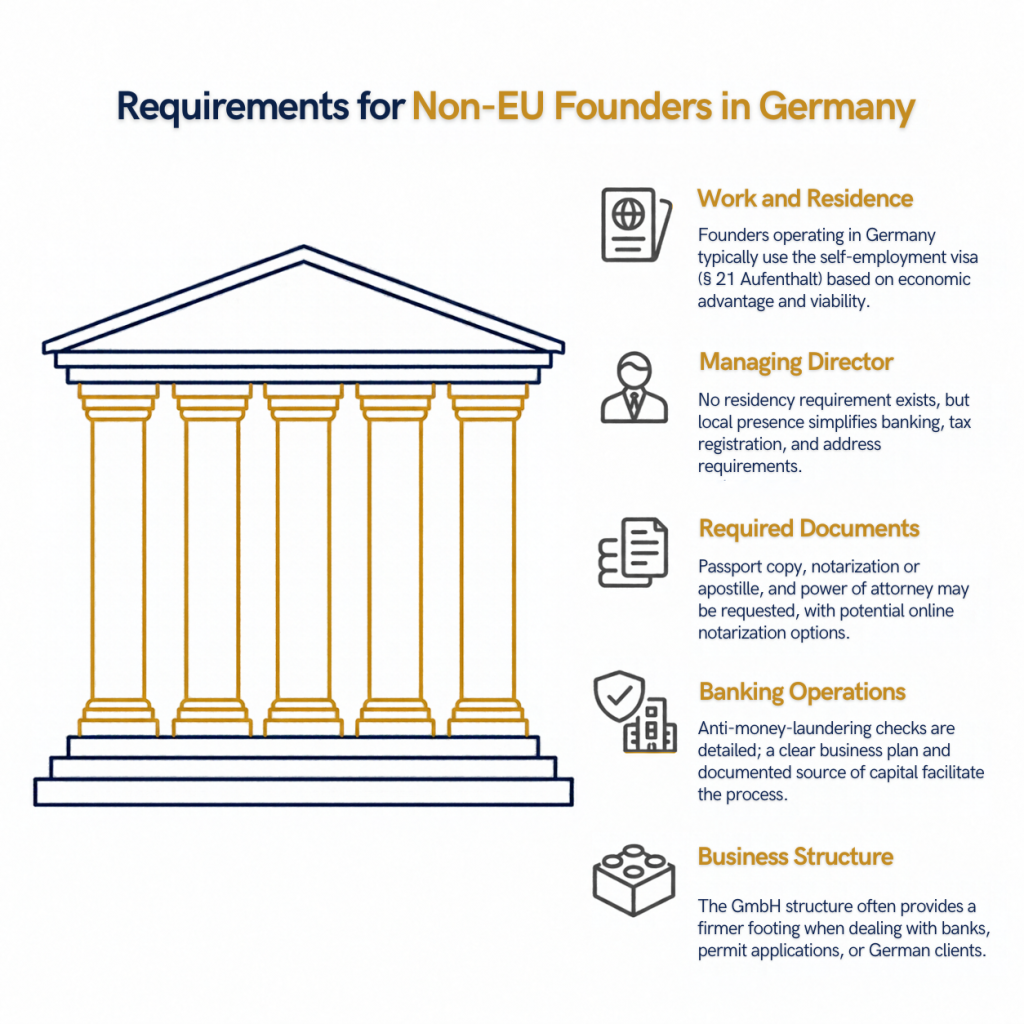
Work and residence permit: For founders who come to Germany to operate their company, the common way to obtain a permit is by using the self-employment visa (§ 21 AufenthG).
Here the authorities assess the economic advantage as well as whether the company is viable and funded.
Other types of permits have different requirements: It is possible that an excellent business plan and a well-funded company could be a decisive factor in obtaining a permit, however, it depends on the specific case and current rules.
Working abroad: In general there is no residency requirement for a managing director, however, practically speaking, having the presence of a managing director could make certain things, such as banking operations, tax registration and German address for the company easier.
The non-EU citizen who works as a director in Germany should have a permit for doing so.
Documents: Passport copy in English language, notarized or apostille and if required translation and power of attorney may be requested.
In some cases notarization online is available. Non-EU founder’s identity verification may be an extra step and should be discussed with the notary ahead.
Funding from India: The investment into a foreign company is regulated according to Overseas
Banking: Anti-money-laundering checks can be more detailed for foreign founders. A clear business plan, proof of address and a documented source of capital make the process smoother.
Vorx Consultancy Insight: for Indian entrepreneurs, the key consideration is usually what the company needs to demonstrate to third parties.
If a bank, a permit application or a German client will judge the business on its structure, the GmbH tends to give a firmer footing.
Planning to Start a Company in Germany?
Choosing between a GmbH and UG affects more than your starting capital. Get guidance on company structure, banking, tax and setup requirements.
Can You Convert a UG into a GmbH?
Yes, and many founders plan for it. There are two routes. You can raise the share capital to at least €25,000 through a shareholder resolution, which must be notarized and entered in the commercial register.
Or, once the reserve and capital together reach €25,000, you can convert the reserve into share capital.
After conversion, update your bank, contracts, invoices, website and email signatures. Old “UG” references cause confusion with customers and counterparties.
Which Structure Fits Your Business?
For instance, take the case of Meera, an entrepreneur based in Pune who has software to sell analytics to German companies.
Her initial customers will be medium-sized firms performing supply checks and she intends to seek a self-employment permit.
She could have started early through UG, but since her application for the permit is going to depend on a well-capitalized company, a GmbH would be ideal.
Compare the case to a consultant working in Germany and requiring a liability protection structure without having any investor, employees, or large revenues.
Founder Type | Best Fit |
Fundraising startup | GmbH |
Residence permit founder | GmbH |
Holding / real estate | GmbH |
Solo consultant | UG / Sole proprietorship |
Low-budget market test | UG |
There are alternatives too.A GmbH & Co. KG (or UG & Co. KG) is a combination of a partnership structure and a corporation acting as a general partner.
A branch of an Indian company is legally one with the parent company, whereas a subsidiary, which is typically a GmbH, is independent.
Not Sure Whether GmbH or UG Fits Your Business?
Vorx can help you compare both structures based on your capital, business model, banking needs and future plans.
What Mistakes Do Founders Commonly Make?
Choosing a €1 UG but then having trouble at the bank: The capital has to fit how the business is going to be run.
Omitting the 25% reserve from cash-flow forecasts: Profit cannot be withdrawn.
Relying on the Musterprotokoll for a business requiring individual terms: Unbalanced co-founders, vesting, or an additional director calls for custom articles.
Overlooking a shareholders’ agreement: Conflicts between the co-founders are a frequent source of delay for start-ups.
Underappreciating the importance of accounting: Both entities have to maintain their accounts and file their annual financial statements.
Thinking the company ownership grants work and residence permits: Being the owner of a German company is no guarantee of being allowed into the country.
Which Structure Should You Choose?
The GmbH provides a more robust framework if the banks, investors, clients, or immigration authority will be assessing your business from the outside.
The UG would be a sensible option if there isn’t sufficient capital available and a plan exists for conversion at some point. In any case, there are different needs according to the applicant which evolve over time.
At Vorx Consultancy, we assist founders with company structuring, banking, tax and residency issues all at once, since these are intertwined in Germany.
A discussion prior to signing the articles of association tends to be easier than restructuring afterwards.
Start Your Germany Company Setup with Vorx consultancy
From choosing the right structure to company formation, banking, tax and ongoing compliance, Vorx helps international founders plan their Germany setup correctly.