


The choice between a golden visa and a permanent residency can be a difficult one for those who need legal presence in another country. This dilemma exists due to substantial differences in eligibility, investment, validity, physical residence and other factors. A golden visa is typically a type of investment immigration that is meant to be temporary, contrasting the long-term residency option.
Understanding these differences is essential before committing capital or planning an international move.
What Is a Golden Visa?
Golden visa is a residence program that gives foreigners the right to live in a country of choice as an investor. This immigration path allows foreigners and their dependents to reside in another country temporarily after meeting specific investment requirements, as well as other norms.
Depending on the specific country, golden visas may only be valid for a limited period, after which investors need to renew their visas or invest in the local economy again. As it can be seen, visas differ in their benefits, requirements, eligibility and other specifics. A golden visa may only be a fraction of the solution for someone’s international residency wishes.
What Is Permanent Residency?
Permanent residency is a long-term legal status that grants a foreign national the right to live in a country indefinitely, typically with more security than a temporary residence permit and more rights to employment, business and local services.
Permanent residency can be obtained through various means, including legal long-term residence, employment, family reunion, business activities and investment.
Although the status is generally indefinite, the physical residence card may need to be periodically renewed and extended absences from the country may affect the status in some jurisdictions.
Recommended Reading:
Applicants comparing long-term settlement routes can also explore the easiest countries for Indians to get permanent residency in 2026 to understand which destinations offer structured PR pathways.
Can a Golden Visa Lead to Permanent Residency?
In some countries a Golden Visa can eventually lead to permanent residency, provided the investor continues to meet the programme’s conditions, such as maintaining the qualifying investment and completing the required residence period.
However, not every Golden Visa programme leads to PR and the timeline is different for each country. The same caution applies to the Golden Visa citizenship pathway: investment does not guarantee citizenship and investors may need to satisfy additional requirements like physical presence, language, tax and/or integration tests.
Golden Visa vs Permanent Residency: Key Differences
The practical Golden Visa and PR difference becomes clearer when both routes are compared individually.
Eligibility Basis
- Golden Visa: Eligibility is primarily based on making a qualifying investment and passing financial and background checks.
- Permanent Residency: Eligibility may arise from employment, family ties, long-term residence, business activity or investment.
Investment Requirement
- Golden Visa: A qualifying investment is generally compulsory and must often be retained for a minimum period.
- Permanent Residency: An investment may not be required when the applicant qualifies through employment, family or years of legal residence.
Validity and Renewal
- Golden Visa: Usually issued for a fixed period and renewed if the applicant continues to meet the conditions.
- Permanent Residency: The immigration status is normally indefinite, although the residence card may need periodic replacement.
Physical Presence
- Golden Visa: Many programmes have relatively limited stay requirements, making them suitable for investors who cannot relocate immediately.
- Permanent Residency: Applicants may need to spend more time in the country, especially while qualifying for PR.
Work and Business Rights
- Golden Visa: Business and employment rights depend on the programme and may be restricted.
- Permanent Residency: Generally offers broader rights to work, run a business or become self-employed.
Family Inclusion
- Golden Visa: A spouse and dependent children can often be included, while some programmes also accept parents.
- Permanent Residency: Family reunification is usually available, but eligibility and sponsorship conditions depend on national law.
Citizenship Prospects
- Golden Visa: It may create a route toward citizenship, but approval is not automatic.
- Permanent Residency: PR is commonly a more established step toward naturalisation, subject to local requirements.
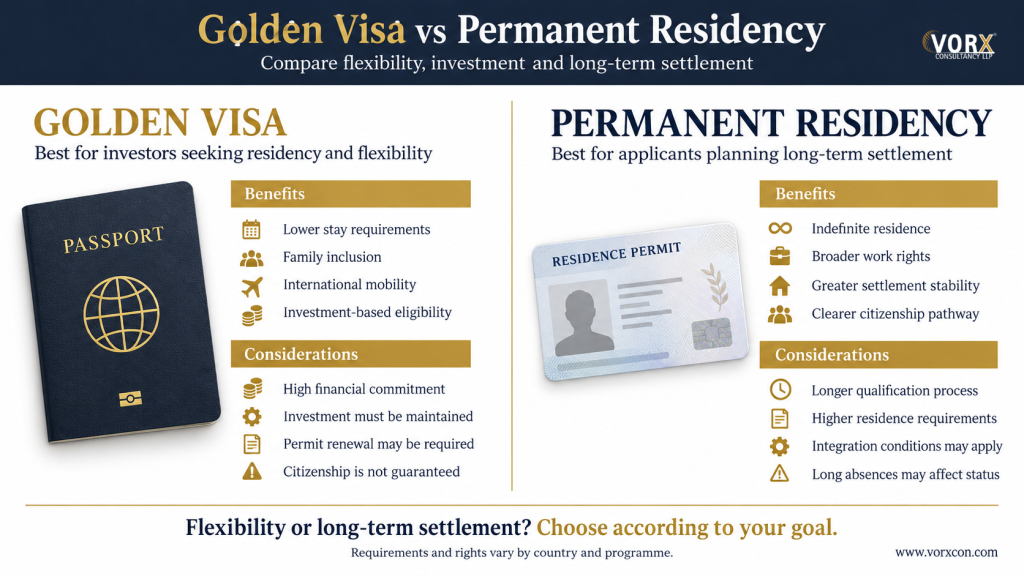
Golden Visa and Permanent Residency Requirements
Golden Visa Requirements
Applicants generally need to make a qualifying investment, demonstrate a lawful source of funds and pass background checks. They may also need to maintain the investment and meet the programme’s minimum-stay conditions.
Permanent Residency Requirements
Applicants usually need a valid basis for permanent settlement, such as long-term residence, employment, family ties or investment. Financial stability, a clean immigration record and language or integration requirements may also apply.
Which Option Matches Your Objective?
Your objective | More suitable route |
Residency without immediate relocation | Golden Visa |
Long-term overseas settlement | Permanent Residency |
Investment-based eligibility | Golden Visa |
Broader local work rights | Permanent Residency |
A structured citizenship pathway | Permanent Residency |
A Golden Visa for Indian investors may be suitable for those seeking international mobility, family security or overseas investment exposure. Similarly, a Golden Visa for business owners may provide access to new markets without requiring immediate full-time relocation.
Recommended Reading:
Indian entrepreneurs considering the UAE should also compare the top UAE free zones for Indian businesses before connecting their business setup with a suitable residency strategy.
Factors to Check Before Applying
The programme name should never be the only basis for a decision. First examine the total financial commitment, government charges, investment holding period and expected returns. Applicants should also review whether the investment can be sold later and what happens to their residence status if its value falls.
Three areas require particular attention:
- Minimum physical-presence and renewal conditions
- Family eligibility and local work rights
- Tax residency, permanent residency and citizenship implications
A professional review of Golden Visa eligibility can help identify whether the applicant’s funds, personal background and long-term goals meet the programme’s conditions.
How Can Vorx Consultancy Help You Choose the Right Residency Path?
Choosing between a Golden Visa and Permanent Residency requires a careful assessment of your investment capacity, relocation plans, family needs and long-term objectives. Vorx Consultancy helps you evaluate suitable residency programmes by reviewing their eligibility conditions, investment commitments, stay requirements, renewal obligations and potential pathways to permanent settlement or citizenship.
From initial programme comparison and document preparation to application coordination and ongoing compliance guidance, our team supports you throughout the process so you can make a well-informed decision with greater clarity and confidence.
Compare your residency options with Vorx Consultancy and choose the right pathway for your future.
Book a Strategy Call: (Calendly Link)
Visit: www.vorxcon.com
Email: support@vorxcon.com
Final Thoughts
In light of this, the choice is clear: golden visa vs permanent residency programs can only be selected for the most appropriate fit and eligibility. If a foreigner wants to reside as an investor for a certain amount of time, a golden visa is usually the most viable option. On the contrary, people should consider a long-term resident visa to stay in another country continuously. Lastly, everyone should make sure to research their choices according to their value and vision. This is especially true for investment-related residence permits in different countries: their conditions, liabilities, and benefits should be discussed in detail with relevant authorities.
