

Hong Kong is one of Asia’s premier business hubs, but what makes it attractive for foreign direct investment in 2026 is the combination of established financial and commercial infrastructure, together with cutting-edge developments in artificial intelligence, robotics, life sciences, high-tech manufacturing, and digital finance. In other words, for international investors, Hong Kong offers an unrivaled combination of China exposure, Asian reach, tax benefits, financial services, common law, and technological innovation.
Meanwhile, for Indian investors, Hong Kong may offer an attractive platform for further penetrating the Chinese market, as well as the broader Asia-Pacific region, and the wider world.
So, the question is not whether Hong Kong is a good place to register a company, but whether your business development plans align with the strategic location’s unique value proposition.
Why Is Hong Kong a Strategic Business Location?
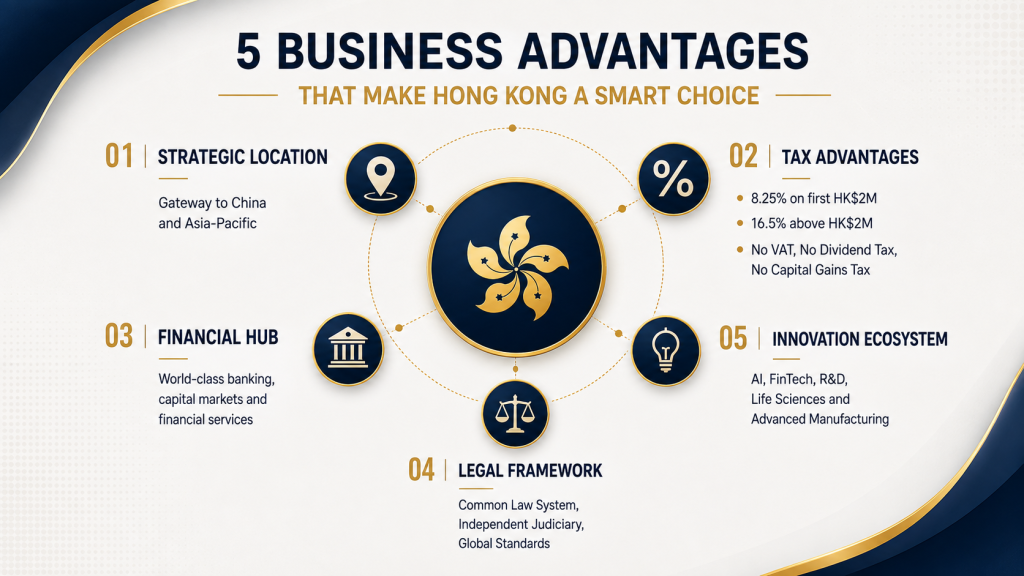
Location is one of Hong Kong’s greatest attractions for any business, as the region is both conveniently located near the mainland while also being international and highly connected. Similarly, Hong Kong’s position within the wider context of the greater bay area allows it to act as a distribution center and a convenient place to operate for other nearby financial and technological hubs like Shenzhen and Guangzhou.
Thus, it can serve as a bridge between local and international markets by facilitating the flow of customers, suppliers, investment, and professional services. The benefits of Hong Kong’s location as a business include:
- Well-developed international connections
- Proximity to continental Asian markets
- Availability as a distribution center for the greater bay area
- Access to professional services and logistics infrastructure.
As such, it can be particularly advantageous to do business in Hong Kong for companies that intend to operate both locally and internationally rather than focusing exclusively on a domestic market, as those businesses will find themselves in a uniquely advantageous position to operate in both markets simultaneously and facilitate the exchange of goods and services.
How Does Hong Kong Connect You to China?
The access of China is among the most compelling reasons to establish a company in Hong Kong. Hong Kong’s proximity to Mainland China both in terms of geography and economic ties makes it a preferred partner gateway. In addition, Hong Kong is an international business hub. The competitiveness of Hong Kong as a launchpad for Mainland China investments is particularly attractive for technology-driven enterprises, manufacturers, and those involved in supply chains, distribution, or looking to diversify their financing sources. Shenzhen, for instance, is a major technological and innovative pole located only a stone’s throw away from Hong Kong.
Furthermore, Hong Kong serves as an international bridge for Mainlanders looking to make their way into the global business world. This is why Hong Kong Company Registration is so compelling for multinational corporations as well: companies which want to do business in China can use Hong Kong as a bridge and a beachhead in their expansion. At the same time, international companies are desirable partners for Chinese ones, as they facilitate their access to new markets and finance.
Thus, for companies which want to do business in China, Hong Kong Company Registration presents an opportunity to operate in China more effectively instead of only from the periphery. However, it is crucial to note that while a company incorporated in Hong Kong can participate more actively in the Mainland China business environment, it still may need to navigate additional administrative and regulatory requirements in order to conduct certain operations in Mainland China.
What Are Hong Kong’s Tax Advantages?
Tax is another major reason why Hong Kong remains competitive for international businesses. Its system is relatively straightforward and follows a territorial approach, although the actual treatment depends on the business activities and source of profits.
For corporations, the current two-tier profits tax rates are:
- 8.25% on the first HK$2 million of assessable profits
- 16.5% on assessable profits above HK$2 million
These rates are confirmed by Hong Kong’s Inland Revenue Department for the two-tiered profits tax system.
Other features that attract international businesses include:
Territorial taxation: Hong Kong generally charges profits tax on profits arising in or derived from Hong Kong, subject to the applicable rules.
No VAT or sales tax: Hong Kong does not operate a conventional VAT or GST system.
No separate capital gains tax: Capital gains are generally not taxed as a separate category under the standard system, although the treatment of particular gains depends on the facts.
No dividend tax: Hong Kong does not generally impose a separate dividend tax.
For qualifying activities, Hong Kong also provides certain concessionary tax regimes and incentives.
What Are Hong Kong’s Banking and Finance Advantages?
Hong Kong’s position as a financial hub is another major advantage. International banks, investment firms, insurers, asset managers and professional advisers operate within the same financial ecosystem. This can be particularly useful for companies dealing with international customers and suppliers or looking for more sophisticated financial services.
Businesses can benefit from:
- Multi-currency banking and international payments
- Trade and corporate finance
- Access to investors and capital markets
Hong Kong is also expanding its financial ecosystem beyond traditional banking. The 2026–27 Budget places further emphasis on RMB business, asset management, corporate treasury, fintech and digital assets.
For entrepreneurs considering Hong Kong company formation, however, incorporation and banking should be treated as two different processes. A bank will normally assess the company’s ownership, business activity, source of funds and expected transactions before deciding whether to open an account.
Recommended Reading:
Before opening a corporate account, it is important to understand the documentation, banking requirements and due diligence involved. Read our guide on how to open a business bank account in Hong Kong to understand the process in more detail.
What Makes Hong Kong Business-Friendly?
Hong Kong combines an open economy with a mature legal and professional-services environment. Its common-law framework, international business practices and free flow of capital make the jurisdiction familiar to many overseas companies. The city is also a free port, which supports international trading activities. Businesses can work with established legal, accounting, corporate and financial-service providers without having to build these networks from scratch.
Another advantage is the international nature of its workforce and business community. English remains widely used in commercial and professional settings alongside Chinese, making communication with international partners more practical.
These conditions have helped Hong Kong maintain a large international business ecosystem rather than relying only on its local market.
Planning to establish a business in Hong Kong? Contact Vorx Consultancy to understand the setup, compliance and banking requirements before you begin.
What Makes Hong Kong Different From Other Asian Hubs?
Hong Kong stands out because several business advantages come together in one market. It combines close access to Mainland China with international finance, a common-law legal framework, an open trading environment and a growing technology ecosystem. For companies planning to expand across Asia, this combination can make Hong Kong more than a company registration destination.
Factor | Hong Kong | Why It Matters |
China Access | Direct connection with Mainland China and the Greater Bay Area | Useful for China-facing businesses and supply chains |
International Finance | Major banking, capital-market and RMB centre | Supports international payments, funding and investment |
Tax Structure | Territorial taxation with a two-tier profits tax system | Can make cross-border business planning more competitive |
Trade Environment | Free-port economy with no general customs tariff on imports | Helpful for trading and distribution businesses |
Legal System | Common-law framework | Familiar to many international businesses and investors |
Currency Environment | Hong Kong Dollar linked to the US Dollar | Provides a stable currency framework for international transactions |
Innovation Ecosystem | AI, robotics, life sciences, fintech and advanced manufacturing | Creates opportunities beyond traditional trading and finance |
R&D Network | Universities, research centres and InnoHK laboratories | Supports technology development and international collaboration |
Regional Connectivity | Strong links with China, ASEAN and global markets | Useful for companies building an Asia-Pacific presence |
Professional Services | Established legal, accounting, banking and corporate-services ecosystem | Makes it easier to build and manage an international operation |
What Are Hong Kong’s Latest Innovation Developments?
Hong Kong is moving from being primarily a finance-and-services centre towards a more innovation-led business ecosystem. In 2026, the focus is increasingly on turning research into commercial products, developing new technology infrastructure and attracting companies in emerging industries.
1. Hong Kong AI Research and Development Institute
One of the most important 2026 developments is the planned Hong Kong AI Research and Development Institute, which is expected to begin operation in the second half of 2026. The institute is designed to help connect AI research with industry adoption
Business relevance: This could give AI companies, technology investors and industry partners a stronger platform for developing and applying AI solutions in Hong Kong.
2. The $10 Billion I&T Industry-Oriented Fund
Hong Kong is launching a HK$10 billion Innovation and Technology Industry-Oriented Fund in 2026. Rather than simply funding research, the fund is intended to attract and support investment into strategic technology industries.
Business relevance: This is particularly interesting for technology companies looking for capital, partnerships or a pathway into Hong Kong’s expanding innovation ecosystem.
3. Hetao and the Northern Metropolis Are Becoming Technology Infrastructure
Hong Kong’s innovation strategy is also being built around physical locations. The 2026 Budget includes major investment for the Hetao Hong Kong Park and San Tin Technopole, with the Northern Metropolis being developed as an important base for innovation, technology and advanced industries.
The interesting part is the connection with Shenzhen: Hong Kong can contribute its international finance, legal and professional-services strengths while the wider area provides access to manufacturing and technology capabilities.
4. Embodied AI and Quantum Technology
Hong Kong’s 2026 strategy is not limited to conventional software AI. The government has specifically identified embodied AI, quantum technology and new materials as areas for stronger R&D and application.
Business relevance: These are longer-term technology opportunities that could attract specialised startups, research teams and investors rather than only traditional SaaS or fintech companies.
This is why Hong Kong’s business story has become more interesting in 2026. The city is investing heavily in an innovation and technology ecosystem that extends beyond its traditional financial strengths.
Which Businesses Can Benefit Most?
Hong Kong is not equally useful for every type of company. Its advantages are strongest for businesses that need international connectivity, China access, financial infrastructure or a regional operating base.
Trading and sourcing businesses can benefit from proximity to Chinese suppliers and Asian supply chains.
E-commerce businesses can use Hong Kong’s international trade and logistics environment while serving customers across different markets.
Technology and SaaS companies may find opportunities through Hong Kong’s growing startup and R&D ecosystem.
FinTech businesses can benefit from the combination of financial expertise and technology development.
Professional service firms can use Hong Kong as a base for serving international clients and managing regional operations.
The point is simple: Hong Kong works best when the business can actually use the ecosystem around it.
Why Does Hong Kong Make Sense for Indian Entrepreneurs?
For Indian entrepreneurs, Hong Kong can be particularly relevant when the next stage of growth involves China, Southeast Asia or international customers. An Indian founder may already have a successful operation in India but need a regional structure for international trading, technology services, sourcing or expansion. Hong Kong can potentially sit between the existing Indian business and the wider Asian market.
Some practical reasons to consider it include:
- Access to China and wider Asia from a recognized international business centre.
- International banking and payment infrastructure
- Proximity to Asian suppliers and customers
- A potential base for regional operations and expansion
However, an overseas structure also creates responsibilities on the India side. Depending on the structure and transactions, entrepreneurs may need to consider FEMA, Indian tax, reporting and transfer-pricing requirements.
That is why Hong Kong business for Indian entrepreneurs should be evaluated as part of a complete cross-border strategy rather than as a standalone incorporation decision.
Is Hong Kong Right for Every Business?
Not necessarily, Hong Kong makes the most sense when a company has a genuine commercial reason to use its international network, China access, financial ecosystem or technology opportunities. It may not be suitable for someone who simply wants to establish a low-tax entity without meaningful business activity.
Before starting a Hong Kong business setup, consider:
- Whether Hong Kong fits your actual business model
- How the company will be operated and managed
- Banking and source-of-funds requirements
- Ongoing accounting and compliance
- India-side tax and regulatory implications
Choosing the jurisdiction should come after understanding the business objective, not before it.
Recommended Reading:
Choosing the right structure is an important first step before setting up a company. You can explore the different types of business entities in Hong Kong and understand which option may suit your business model.
How Can Vorx Help You Set Up in Hong Kong?
At Vorx Consultancy, we look at Hong Kong company formation as part of the wider business strategy. For Indian entrepreneurs, the process can involve more than incorporation. It may include selecting the appropriate structure, coordinating company formation, arranging the registered office and company secretary, supporting the corporate banking process, and coordinating accounting, tax and compliance requirements.
More importantly, Vorx focuses on how the Hong Kong entity fits into the owner’s existing business and international expansion plans. The goal is not simply to create a Hong Kong company. It is to build a structure that makes commercial sense for the business behind it.
Need Strategic Guidance?
Book a Strategy Call: (Calendly Link)
Visit: www.vorxcon.com
Email: support@vorxcon.com
Final Thoughts:
As of 2026, Hong Kong offers more than a prestigious financial hub for international business. The special administrative region’s tax-friendly policy, international banking infrastructure, connectivity to Mainland China, common law legal framework, and developed network of goods and trade infrastructure are still appealing for businesses. Yet, the allocation of investments into artificial intelligence, advanced manufacturing, research and development, semiconductors, and other strategic areas is creating an innovation-driven business ecosystem.
For Indian investors, Hong Kong is interesting as a launchpad for distributing products and services in Asian markets, engaging in research and development collaborations with Chinese partners, and establishing international business networks. However, using the special administrative region as a base for any business activities should be evaluated in context of specific goals and strategic priorities. Hong Kong is not a guaranteed solution for business success in the region due to its status as a competitive market for private and state-led enterprises.
In 2026, Hong Kong is positioning itself as a bridge between China, Asia, and the world. Therefore, if the strategic fit is appropriate, businesses can benefit from using the region as a bridgehead for expanding international business networks.
