

Opening a Hong Kong company is only the beginning. Once the company is incorporated, you still need a banking setup that can support its day-to-day operations, international payments and future growth. If you are researching How to Open a Business Bank Account in Hong Kong, it is important to understand that company incorporation and bank account approval are two separate processes.
Hong Kong offers a well-established banking environment, with traditional banks and digital financial providers serving different business needs. However, banks do not simply approve an account because a company has been incorporated. They need to understand the company’s ownership, business activities, source of funds and expected transactions. This makes preparation an important part of the application.
In this guide, we explain the Hong Kong Business Bank Account opening process, the documents you may need, options for non-residents, banking choices and practical considerations for international and India-based business owners.
What Makes Hong Kong Business Banking Attractive?
Hong Kong has long been a financial centre for businesses operating in Asia and beyond. For companies dealing with overseas clients and suppliers, a local business account can provide an accessible way to make commercial payments while keeping business and private finances separate.
A Hong Kong business account can also be useful for companies that receive or make payments in different currencies. Depending on the provider, businesses may have access to international transfers, multi-currency services, online banking and other corporate banking facilities.
But the value of Hong Kong banking is not simply about having an account in a well-known financial centre. The real benefit comes from choosing a banking arrangement that fits the company’s actual operations. A trading company, technology startup and professional services business may have very different payment patterns and banking requirements.
Can Non-Residents Open a Hong Kong Business Bank Account?
Yes, non-resident founders and foreign-owned companies can apply for business banking in Hong Kong. However, being eligible to apply does not mean that every bank will approve every application. For overseas founders, banks may need to understand the company’s ownership, the location of its directors and beneficial owners, the nature of its business and the countries involved in its transactions. The HKMA states that banks are expected to identify and take reasonable measures to verify the beneficial owners and understand a corporate customer’s ownership and control structure.
A Hong Kong Business Bank Account for Non-Residents may therefore involve additional questions or verification. Before applying, non-resident founders should be prepared to provide:
- Passport or other accepted identification.
- Proof of residential address.
- Details of directors and shareholders.
- Ultimate beneficial ownership information.
- Company incorporation documents.
- Business activity information.
- Source-of-funds information.
- Expected customer and supplier markets.
Nationality alone should not be treated as an automatic approval or rejection factor. Banks assess customers using a risk-based approach and consider factors including business and product risk.
What Type of Hong Kong Business Account Do You Need?
The choice between different account types depends on the company’s needs. A conventional corporate account at a bank offering an extended range of services, global presence or long-term relationship support may be a good fit for a company with diversified financial needs. For an international business looking to make day-to-day operations seamless, a digital or fintech business account offering quick and convenient onboarding, advanced payment tools and multi-currency processing capabilities may be a better option.
Before choosing an account, think about where your money will come from, where it will go and which currencies you are likely to use. Your expected transaction volume, international payment needs and requirement for branch or corporate card services can also influence the decision.
The best banking solution is therefore not necessarily the most famous bank. It is the one that fits the company’s business model.
What Do Hong Kong Banks Check Before Approval?
A bank wants to understand the commercial story behind the company. For example, Standard Chartered’s published business account information requirements include company history, source of capital, ownership structure, business nature, principal operating location, products and services, expected turnover, major suppliers and buyers, source of funds and anticipated banking activities.
In practice, expect questions around:
Ownership: Who owns and controls the company?
Business activity: What does the company sell and how does it generate revenue?
Source of funds: Where does the company’s capital come from?
Transaction profile: What payments will enter and leave the account?
Commercial purpose: Why is Hong Kong relevant to the company’s operations?
This is why preparing a clear business profile before applying can be just as important as collecting the formal documents.
What Documents Are Needed for a Business Account?
The exact Hong Kong Business Bank Account Requirements vary by bank and business profile. There is no single checklist that applies to every application.However, companies should generally be prepared with corporate documents, identification records and information that supports the commercial purpose of the business.
Document | Purpose |
Certificate of Incorporation | Confirms the company has been incorporated |
Business Registration Certificate | Confirms Hong Kong business registration |
Articles of Association | Provides information about the company’s structure |
Passport or ID | Verifies relevant directors, shareholders and UBOs |
Proof of Address | Supports residential verification |
Ownership Structure | Shows ownership and control |
Board Resolution | Confirms authority to open the account |
Business Profile | Explains the company’s activities |
Source of Funds Evidence | Supports the origin of business funds |
Contracts or Invoices | Can demonstrate genuine commercial activity |
Customer/Supplier Information | Helps explain expected transactions |
Depending on the company, a bank may request additional documents or clarification. Overseas documents may also require specific forms of verification or certification.
The important point is to prepare a complete and consistent document set, rather than submitting documents one by one as questions arise.
How to Open a Business Bank Account in Hong Kong?
1. Understand Your Banking Requirements:
Start by deciding what the company needs from its account. Consider currencies, international payments, expected transaction volumes and the countries where the business will receive or send money.
2. Choose the Right Provider:
Research traditional banks and digital or fintech providers based on your company’s requirements. Check their eligibility criteria before beginning the application.
3. Prepare the Documents:
Organise your corporate documents, identification records, ownership information and supporting commercial evidence. Make sure the information is consistent across all documents.
4. Prepare Your Business Information:
Be ready to explain the company’s business model, customers, suppliers, markets, expected transactions and source of funds. This is particularly important for newly incorporated and internationally owned companies.
5. Submit the Application:
Depending on the provider, the application may be completed online, through an appointment or using a combination of digital and physical verification.
6. Complete KYC and Due Diligence:
The bank or provider will review the company’s ownership, directors, beneficial owners and business activities. Additional information may be requested during this stage.
7. Respond to Follow-Up Questions:
Answer questions accurately and consistently. If the bank asks for additional evidence, provide it promptly.
8. Activate the Account:
Once approved, complete the activation requirements and arrange online banking access, authorised signatories and any additional services you require.
Can You Open a Business Bank Account Without Visiting Hong Kong?
Sometimes, but there is no universal rule that allows every foreign founder to Open a Hong Kong Business Bank Account Remotely. Some digital providers may support remote onboarding for eligible businesses, while traditional banks may have different verification procedures. The requirement can depend on the bank, company structure, ownership, business activity and risk assessment. Before applying remotely, confirm:
- Whether non-resident applicants are accepted.
- Whether directors must attend in person.
- Whether video verification is available.
- Whether original or certified documents are required.
- Whether your industry and business structure are supported.
Remote onboarding should therefore be viewed as an available route for certain businesses, not as a guarantee of approval.
Can a Newly Incorporated Company Open a Business Account?
Yes, a newly incorporated company can seek a business account even if it does not yet have a long operating history. The challenge is usually demonstrating what the company intends to do. A new company can support its application with a clear business model, founder background, website, client or supplier agreements and evidence explaining how it will be funded.
A technology startup, for example, may not have years of financial statements, but it can still explain its product, target market, revenue model and expected transactions. The bank does not necessarily need a long operating history. It needs enough information to understand the company’s intended commercial activity.
How to Prepare a Strong Business Profile for the Bank?
Your business profile should give the bank a straightforward explanation of how the company operates. It is important to describe the company’s core business and customer base, as well as the markets it operates in, its suppliers, revenue streams and expected cash flows. If the business is expecting international transactions, details on the countries and currencies involved should also be provided.
The reason for choosing Hong Kong is also worth addressing. If Hong Kong is being used as an Asia-Pacific operating base, regional trading hub or international business centre, explain that clearly.
Recommended Reading:
Opening a business bank account is only one part of managing a Hong Kong company. After incorporation, businesses must also stay on top of annual filings and ongoing statutory obligations. Learn more in our guide to Annual Compliance Requirements in Hong Kong.
Traditional Bank vs Digital/Fintech Business Account
Both options can work, but they are not designed for exactly the same requirements.
Factor | Traditional Bank | Digital/Fintech Account |
Physical presence | May be required | Often more digitally focused |
Online banking | Available | Usually a core feature |
International payments | Available | Often a key feature |
Multi-currency services | Available depending on account | Commonly available |
Branch access | Available | Usually limited |
Onboarding | May involve detailed verification | Often more digital |
Suitable for | Broader or more complex banking needs | Digitally operated and international businesses |
Businesses should also check the provider’s regulatory status and understand whether they are dealing with a traditional bank or a regulated payment/financial services provider.
What Are the Best Banks for Business Accounts in Hong Kong?
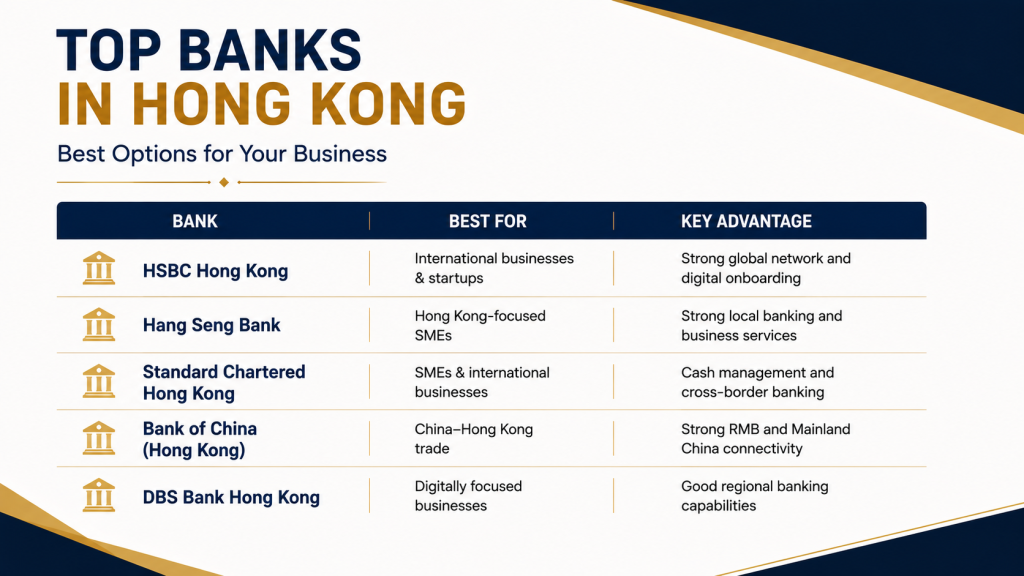
If you’re choosing a bank for a Hong Kong business account, the best option depends on your company structure, where the owners/directors are based, expected transaction volume, and whether you need international payments or trade finance. Here are some :bank which you can consider while opening a business bank account in hongkong
HSBC Hong Kong:
HSBC is a popular choice for international businesses because of its strong global network and multi-currency banking services. It can be suitable for Indian entrepreneurs dealing with overseas clients, suppliers and international payments.
Hang Seng Bank:
Hang Seng Bank is a strong option for businesses with a focus on Hong Kong and Greater China. It offers business banking services in multiple currencies and is well suited to SMEs with regular local transactions.
Standard Chartered Hong Kong:
Standard Chartered is suitable for businesses that need international banking and cash-management solutions. It can be a good choice for established SMEs involved in cross-border trade and international transactions.
Bank of China (Hong Kong):
Bank of China (Hong Kong) can be particularly useful for businesses working with Mainland China. Its banking services make it worth considering for companies handling RMB transactions, China-related trade or Hong Kong–China business.
DBS Bank Hong Kong:
DBS is a good option for businesses with regional operations across Asia. It offers digital banking and business solutions that can suit companies looking for convenient management of their accounts and cross-border activities.
How Long Does It Take to Open a Business Account?
The timeline can vary depending on the bank, company structure and the level of compliance checks required. For most overseas-owned businesses, it is practical to allow 1–3 weeks for the complete process.A typical application may involve:
- Document submission: Company incorporation documents, identification, proof of address and business details are submitted to the bank.
- KYC & compliance review: The bank reviews the ownership structure, business activities, source of funds and expected transactions.
- Additional verification: Overseas directors or shareholders may be asked for extra information or supporting documents.
- Account approval: Once the bank is satisfied with the information provided, the account is approved and activated.
For entrepreneurs, having a clear business model and complete, consistent documentation can help avoid unnecessary back-and-forth and delays.
Why Are Hong Kong Business Bank Applications Delayed?
Applications can be delayed when the bank cannot clearly understand the business or verify the information provided. A vague description of the company’s activities, incomplete ownership information, weak source-of-funds evidence or inconsistent details across documents can all create additional questions. International businesses may also face more scrutiny when their transaction flows involve multiple jurisdictions.
Another common issue is failing to respond properly to follow-up questions. If the bank asks for clarification about customers, suppliers or expected payments, a clear and commercially sensible answer is usually more useful than a generic response.
What Are the Common Mistakes to Avoid?
One of the biggest mistakes is applying to a bank before understanding what the business actually needs. The second is treating the application as a simple document-submission exercise.
Businesses should also avoid using overly broad descriptions of their activities, submitting inconsistent information or assuming that a newly incorporated company does not need to provide evidence of its planned operations.
Finally, do not assume that remote onboarding means automatic approval. The provider still has to complete its own due diligence.
What Should Indian Business Owners Know?
Hong Kong can be attractive for Indian entrepreneurs building businesses with international or Asia-Pacific operations. However, the Hong Kong banking decision should be considered alongside the Indian side of the structure. Depending on the ownership and funding arrangement, Indian individuals and companies may need to consider FEMA, overseas investment rules, remittance procedures, tax implications and reporting requirements.
For example, the way an Indian resident funds a Hong Kong company may have different implications from the way an Indian company makes an overseas investment. The relevant rules depend on the structure and transaction, so founders should not assume that a Hong Kong account can simply be funded without considering the applicable Indian requirements.
For Indian business owners, the best approach is to plan the Hong Kong company, banking arrangement and India-side compliance position together.
Recommended Reading:
Before opening a business bank account, it is important to understand the incorporation process, structure and registration requirements. Read our complete guide on How to Register a Company in Hong Kong to understand the process step by step.
What Happens After Your Account Is Approved?
Once the account is active, the company may need to manage:
- Online banking access
- Authorised signatories
- Corporate cards
- Payment permissions
- Updated KYC information
- Changes in directors or shareholders
- Accurate corporate records
- Ongoing transaction monitoring
Hong Kong companies also have continuing statutory obligations. The Companies Registry requires registered companies to maintain and file relevant corporate records and statutory documents, including annual returns where applicable. Keeping the company’s corporate information accurate and up to date can therefore support both compliance and smoother banking administration.
How Can Vorx Help With Your Hong Kong Business Banking ?
At Vorx Consultancy, we look at Hong Kong business banking as part of the wider company setup rather than as an isolated application. We can help international founders assess their Hong Kong structure, prepare corporate and business information, organize banking documentation and understand suitable banking routes. For non-resident founders, we can also help coordinate the company formation and banking preparation process.
For India-based entrepreneurs, our support can extend to coordinating the Hong Kong setup with the broader cross-border requirements that need to be considered. The goal is simple: your company documents, business profile and banking application should all tell the same story.
Need Strategic Guidance?
Book a Strategy Call: (Calendly Link)
Visit: www.vorxcon.com
Email: support@vorxcon.com
Final Thoughts:
Opening a business bank account in Hong Kong is not as simple as picking a bank and submitting a form. For overseas entrepreneurs, this step in establishing their presence in Hong Kong should be approached strategically so that the company structure, activity, and documents match the requirements to open a business bank account.
Therefore, for Indian entrepreneurs, who want to set up a company from India and maintain control over its operations, careful preparation when applying for a business bank account is essential. Having a clear understanding of the business and providing complete documentation will facilitate the process and save time and effort. Furthermore, an appropriately selected bank and well-prepared documents will remove any obstacles to doing business in Hong Kong.
The right choice of a bank depends on the anticipated volume of transactions, the company’s business model, international business needs, and strategic goals. Hence, the selection of a bank and preparation for the KYC procedure should not be underestimated and may become a significant step toward banking success in Hong Kong.
