
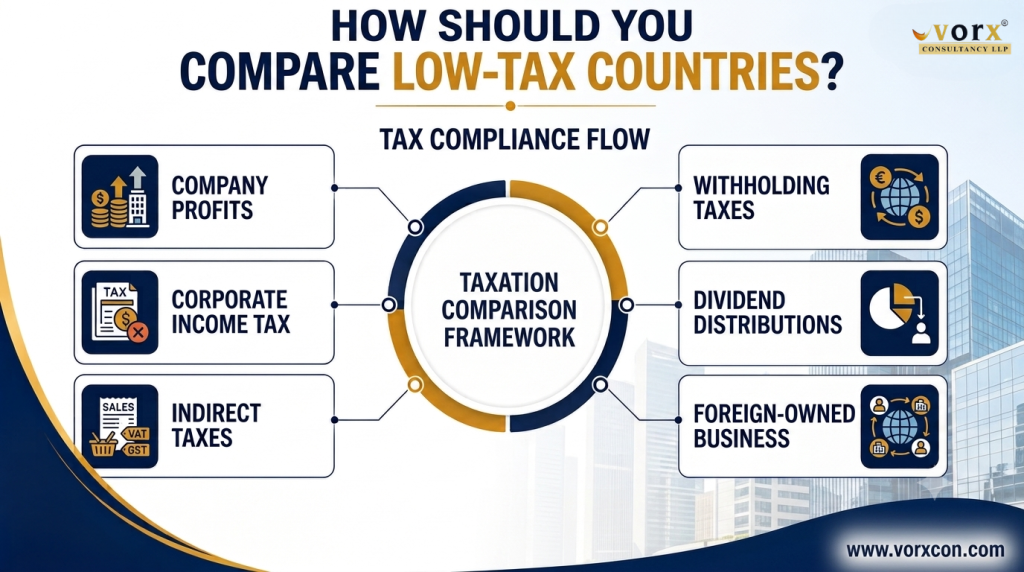
When businesses search for the lowest corporate tax countries, the headline rate is usually the first thing they compare. But corporate tax is only one part of the real tax cost. VAT or GST, dividend withholding, capital gains and the way a country taxes retained profits can make a significant difference to the final structure.
For 2026, therefore, comparing the countries with the lowest corporate tax rates means looking at the wider tax system rather than simply choosing the country with the smallest percentage. Here are 10 jurisdictions that deserve attention.
Looking for a tax-efficient country for your business? Vorx can help you compare jurisdictions based on your business model, markets and compliance needs.
1. Hong Kong
Hong Kong applies a two-tier profits tax system: 8.25% on the first HK$2 million of assessable profits and 16.5% above that. It also has no general VAT or sales tax, while dividends paid by Hong Kong companies are generally not subject to withholding tax.
This combination makes Hong Kong particularly attractive for international trading and service businesses. Its territorial approach to taxation is another important factor because the source of business profits can determine whether they fall within Hong Kong profits tax.
For companies dealing with Asia, the tax system and the commercial ecosystem make Hong Kong more than just a low-tax jurisdiction.
2. UAE
The UAE’s corporate tax system generally applies 0% to taxable income up to AED 375,000 and 9% above that threshold. Certain qualifying Free Zone income can also benefit from a 0% rate when the relevant conditions are satisfied. Alongside corporate tax, businesses need to account for the UAE’s 5% VAT. The UAE generally does not impose withholding tax on dividends, interest and royalties paid to non-residents under its domestic regime.
For an international entrepreneur, this creates an interesting combination: low corporate taxation, moderate VAT and a strong regional business hub. However, the exact Free Zone tax treatment depends on the company’s income and activities.
3. Qatar
Qatar generally taxes taxable income at 10%, while oil and petrochemical activities can face a 35% rate. The country also applies 5% withholding tax on certain payments to non-residents and generally 10% capital gains tax on specified Qatar-source real estate and securities transactions. Qatar does not currently operate a broad VAT system, which can make the overall indirect-tax environment attractive for certain businesses.
The important distinction is between a normal commercial company and businesses operating in sectors such as energy. For international founders, Qatar is therefore more compelling when there is a genuine Gulf-market or industry reason to establish operations there.
Look beyond the headline tax rate. Compare setup costs, dividend taxation, banking and annual compliance before choosing your jurisdiction.
4. Bulgaria
Bulgaria has a 10% corporate income tax rate, one of the lowest headline rates in the EU. Its standard VAT rate is 20%, so the difference between corporate and indirect taxation is significant. Dividends can also create an additional tax consideration, with a general domestic dividend withholding rate of 5% subject to applicable exemptions and treaty provisions.
For entrepreneurs wanting an EU company, Bulgaria can therefore be interesting because the 10% corporate rate is combined with access to the European market. The decision should be based on the company’s actual European operations rather than the tax rate alone.
5. Ireland
Ireland taxes trading income at 12.5%, while non-trading income is generally taxed at 25%. Its standard VAT rate is 23%, and Irish companies generally operate a 25% Dividend Withholding Tax system, although exemptions and treaty provisions can apply.
That distinction between trading and non-trading income is important. A company cannot simply assume that all profits will qualify for the 12.5% rate.
For technology, SaaS, professional services and internationally traded businesses, Ireland can still be one of the more attractive European choices because tax competitiveness comes alongside a developed corporate ecosystem.
Recommended Reading:
Choosing a low-tax country is only one part of an international expansion strategy. If you are also exploring visa routes to establish or operate a business overseas, see our guide to Top 10 Business Visa Options for Indian Entrepreneurs.
6. Cyprus
Cyprus increased its corporate income tax rate from 12.5% to 15% from 1 January 2026. Its standard VAT rate remains 19%. The country also changed its dividend taxation in 2026, with the Special Defence Contribution on actual dividend distributions reduced from 17% to 5% for relevant cases.
That makes Cyprus particularly interesting for companies where dividend distribution is an important part of the structure. However, shareholder residence, domicile and the company’s tax status can affect the final outcome.
7. Mauritius
Mauritius generally operates with a 15% corporate income tax rate and a 15% VAT rate.
The country’s attraction is closely linked to international investment and its position between African and Asian markets. For businesses using Mauritius as part of an international structure, dividend taxation, treaty access and the type of income being earned can be just as important as the 15% corporate rate.
In other words, Mauritius tends to make more sense when the company has a genuine commercial or investment reason to use the jurisdiction.
8. Singapore
Singapore has a 17% corporate income tax rate and a 9% GST rate. The country generally does not impose withholding tax on dividends paid by Singapore companies.
Singapore’s headline corporate rate is higher than several countries above, yet it remains one of the best low tax countries for business because of its broader business environment. In 2026, Singapore is also providing a 40% corporate tax rebate for qualifying tax paying companies for YA 2026.
For technology, trading, financial and regional-headquarters structures, the overall tax and business environment can therefore be more relevant than simply finding a 10% corporate rate elsewhere.
9. Taiwan
Taiwan generally applies a 20% corporate income tax rate, with a standard 5% VAT/business tax framework. Dividends paid to non-resident companies are generally subject to 21% withholding tax, although treaty provisions can reduce the rate in eligible cases.
Taiwan is therefore not necessarily a choice for businesses searching for the lowest possible tax bill. Its stronger proposition is commercial: technology, electronics, manufacturing and R&D.
For companies connected to these sectors, access to the local supply chain and industrial ecosystem may be more valuable than a lower corporate tax rate elsewhere.
Recommended Reading:
Tax efficiency is also becoming an important factor in global relocation decisions. For a broader look at where Indian high-net-worth individuals are moving in 2026, explore Top 10 Countries Indian HNIs Are Moving To in 2026.
10. Estonia
Estonia takes a different approach to corporate taxation. In 2026, corporate income tax is 22/78 on distributed profits rather than being imposed on ordinary retained profits as they arise.
This distinction can make Estonia particularly interesting for companies that intend to keep profits inside the business and reinvest them. Tax generally arises when profits are distributed through dividends or other taxable distributions.
Estonia’s model is therefore a good reminder that international business tax rates cannot always be compared using a simple corporate-tax percentage.
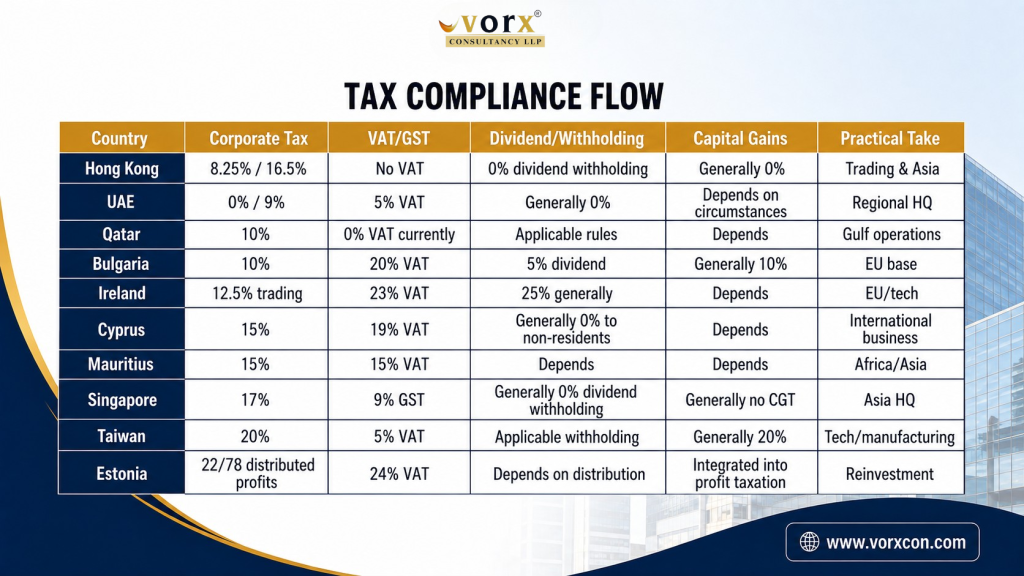
Countries Corporate Tax in a Glance
What Should Indian Entrepreneurs Look At?
For Indian entrepreneurs, comparing low tax countries for Indian entrepreneurs requires looking at both sides of the structure. An overseas company does not automatically remove Indian tax or regulatory considerations. FEMA/ODI requirements, tax residency, POEM, transfer pricing, reporting and movement of funds can all become relevant depending on the structure.
So, the right question is not simply, “Which country has the lowest corporate tax rate?” It is:
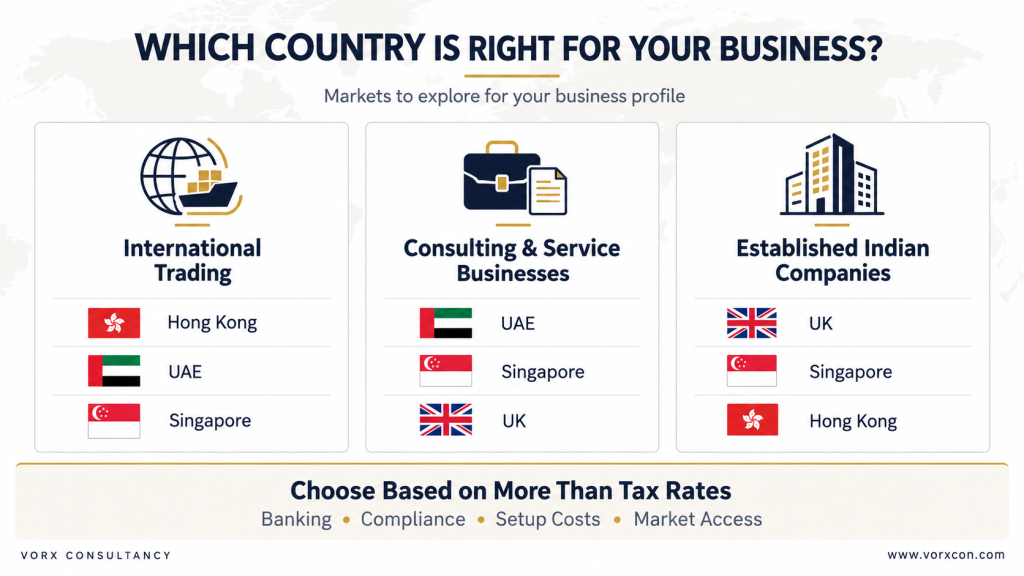
“Which jurisdiction gives my business the most suitable combination of tax efficiency, market access, banking and compliance?”
How Vorx Consultancy Helps You Choose the Right Low-Tax Jurisdiction?
Vorx Consultancy helps entrepreneurs evaluate international business structures before they commit to a particular jurisdiction. Whether the objective is establishing a company in the UAE, entering the European market through Ireland or Bulgaria, or creating an Asia-focused structure through Hong Kong or Singapore, the analysis should begin with the business model.
Corporate tax, VAT/GST, dividend taxation, banking, ownership and compliance should be considered together. This approach helps businesses avoid choosing a jurisdiction simply because it appears on a list of best countries to start a business with low tax.
Planning your international business setup? Talk to Vorx Consultancy today.
Book a Strategy Call: (Calendly Link)
Visit: www.vorxcon.com
Email: support@vorxcon.com
Final Thoughts
The lowest corporate tax countries in 2026 offer very different advantages. Hong Kong combines low profits tax with no general VAT, the UAE offers a 9% standard corporate tax regime with 5% VAT, while Qatar combines a 10% corporate rate with no broad VAT system currently.
European options such as Bulgaria, Ireland and Cyprus bring EU market access with competitive tax rates, while Singapore, Taiwan and Estonia demonstrate that a country’s broader business and tax structure can sometimes matter more than its headline rate.
For international businesses, the best jurisdiction is rarely the one with the lowest number. It is the one where corporate tax, indirect taxes, profit distribution, compliance and business objectives fit together.
