
When discussing international business structures, offshore trust and offshore companies often come up in the same conversation. However, they are two quite different structures with different sets of legal, tax and regulatory rules.
An offshore trust is a structure with the purpose to hold and administer trust assets for the beneficiaries while an offshore company is a separate legal entity to own and manage its corporate assets. The difference between offshore trust and company is important to understand before choosing one structure (or a combination of structures) to pursue.
The Fundamental Difference: Arrangement vs Legal Entity
The most basic difference between an offshore trust and an offshore company is the legal structure they create.
- Offshore Trust – A Legal Arrangement
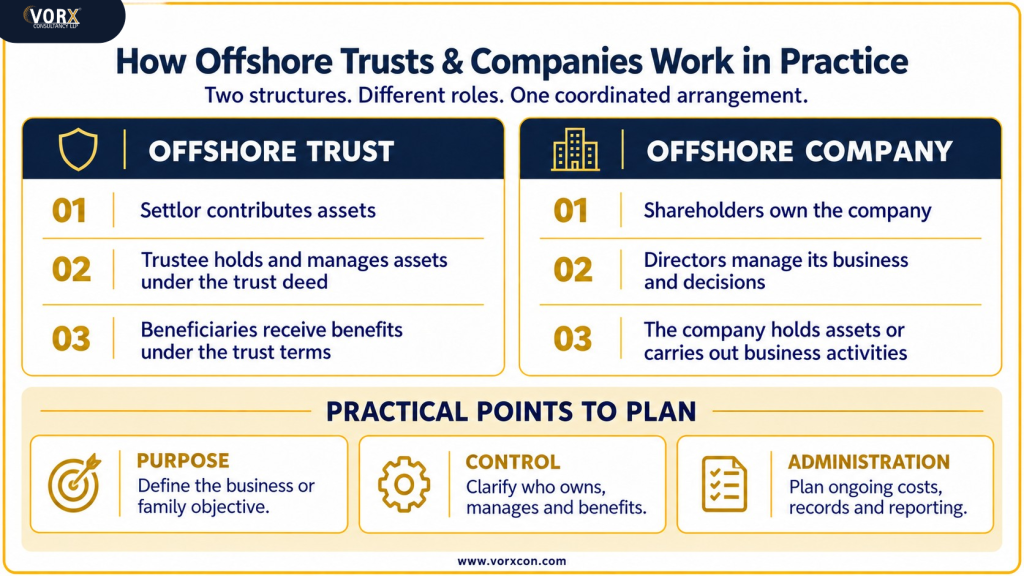
An offshore trust is a legal arrangement where the settlor places his or her property in the trust for the trustee to hold and manage for the beneficiary according to the trust deed and applicable law. A trust is not a separate legal entity but an arrangement for the beneficial ownership and management of property held in the trust.
- Offshore Company – A Separate Legal Entity
An offshore company is a separate legal entity which is formed under the laws of a foreign country, can own property, make contracts and deal with its own corporate name. The company’s corporate structure normally consists of shareholders, directors and an appointed secretary.
Recommended Reading:
“Before choosing an offshore structure, understanding the key aspects covered in our International Tax Planning Guide can help clarify your tax considerations.”
Who Actually Controls and Owns What?
The issue of ownership and control is of particular interest when comparing offshore trust and company because they differ significantly in terms of legal ownership and control of the structure.
- Offshore Trust – Trustee and Beneficiaries
In the case of offshore trust, the trust assets are legally owned by the trustee who manages the trust property according to the trust deed and beneficiary instructions. Depending on the type of trust, there might also be a protector who has a range of protective powers over the trust. In any case, the initial owner of the trust property (settlor) does not retain full ownership of the trust property after the establishment of the trust.
- Offshore Company – Shareholders and Directors
In the case of an offshore company, the corporate property is owned by the company, while the shareholders have ownership rights in the form of shares. Directors run the company affairs in accordance with the applicable law and the company’s own documents. A company has a standard separation between ownership (shareholders) and management of the business (directors).
Looking to explore the right international business structure? Connect with Vorx Consultancy for expert guidance.
Purpose: Wealth Structure or Business Vehicle?
One of the easiest ways to distinguish between offshore trust and company is the purpose of the structure.
- Offshore Trust – Wealth & Succession Planning
An offshore trust is normally applied when there is a need to hold and administer the wealth for the beneficiaries in the long-term. Trusts are often used in family wealth planning to ensure the proper management and distribution of the family assets upon the death of the founder of the trust, settlor. An offshore trust can also be used in estate planning to make sure that the testator’s property will be distributed in accordance with his or her wishes.
- Offshore Company – Business & Investment Activities
An offshore company, on the other hand, is a structure of choice in many cases when such business activities as international trading, consulting, investment and other business activities are involved. A company can invoice and pay its suppliers, make agreements with various business partners, own intellectual property and manage its business activities in accordance with its own needs and the applicable law.
Offshore Trust vs Offshore Company: A Structural Comparison
Feature | Offshore Trust | Offshore Company |
Legal nature | Legal arrangement | Separate legal entity |
Legal ownership | Generally held by trustee | Held by the company itself |
Key parties | Settlor, trustee and beneficiaries | Shareholders and directors |
Management | Trustee according to trust terms | Directors under corporate governance |
Ownership interest | Beneficial interest under trust terms | Shares or membership interests |
Primary purpose | Asset, wealth and succession planning | Business and investment activities |
Governing document | Trust deed | Corporate documents |
Typical role | Holding and administering assets | Operating or holding business assets |
What Happens When an Owner Wants Both?
An offshore trust and an offshore company do not always have to be alternatives. In some international structures, they can perform different roles within the same arrangement.
A simplified structure may look like:
Trust → owns shares in → Offshore Company → Conducts Business / Holds Investments
In this type of structure, the company may handle operational or investment activities, while the trust sits above it as part of a longer-term ownership or succession arrangement. This can separate commercial operations from long-term ownership planning. However, whether such a structure is appropriate depends on the applicable trust law, corporate law, tax rules and the circumstances of the individuals involved.
Looking to explore the right international business structure? Connect with Vorx Consultancy for expert guidance.
The Key Difference Is Not “Offshore” It Is the Role Each Structure Plays
It is easy to focus on the jurisdiction where a trust or company is established. However, the more important question is what role the structure is expected to perform. Before considering an offshore trust or company, it is useful to establish:
- What assets or activities need to be structured?
- Who should legally own them?
- Who should manage or control them?
- Who is expected to benefit?
- Is there an active business involved?
- Is long-term succession planning an important objective?
These questions help determine whether the requirement is primarily for an asset and succession structure, a business vehicle, or potentially a combination of both.
Recommended Reading:
Banking is another important consideration, especially when exploring the Top Banks for Indians to Open a Business Account Abroad.”
What Should Be Considered Before Setting Up Either Structure?
International structuring is about more than the choice of jurisdiction. The broader legal, tax and administrative position should be taken into consideration. Key factors can include the nature and location of the assets, the nature of the proposed business activity, residence of the relevant individuals, banking requirements, beneficial ownership rules and ongoing reporting obligations.
An offshore structure does not automatically make income or assets tax-free. Tax treatment depends on the jurisdictions in question, tax residence, source of income, ownership and applicable reporting or anti-avoidance rules.
Looking to explore the right international business structure? Connect with Vorx Consultancy for expert guidance.
Can One Structure Replace the Other?
An offshore trust and offshore company typically serve different legal purposes. An offshore company provides a separate legal entity for business, investment or asset-holding activities. An offshore trust provides a framework for holding and administering assets for the benefit of beneficiaries.
For this reason, one structure does not necessarily replace the other. Depending on the situation, the two structures may work in tandem, each serving a different purpose within the overall arrangement.
How Vorx Consultancy Supports International Structuring?
Vorx Consultancy helps entrepreneurs and business owners evaluate suitable international structures based on their business objectives, ownership requirements and long-term plans. Our support can include:
- International Company Formation
- Cross-Border Business Structuring
- Banking & Compliance Assistance
- Tax & Regulatory Coordination
- Ongoing Corporate Compliance
From selecting the appropriate setup to managing the required corporate formalities, Vorx Consultancy provides end-to-end support for international business structures.
Explore the right offshore structure for your goals with Vorx Consultancy.
Book a Strategy Call: (Calendly Link)
Visit: www.vorxcon.com
Email: support@vorxcon.com
Final Thoughts
An offshore trust and offshore company are different structures. A trust is focused on the holding and administration of assets and the interests of beneficiaries, while a company provides a separate legal entity for business or investment activities.
In some cases, the two structures can work together. The correct starting point is therefore not a choice of offshore jurisdiction, but an understanding of the purpose, ownership, control and compliance needs of the structure in question.
