
Short answer: yes. You can register a company in France without ever setting foot in the country. No visa, no in-person notary visit, no French residency required.
Thousands of founders in India, the UK, the US, and beyond have already done it, and the process is more standardized now than it was even two years ago.
But “yes, remotely” doesn’t mean “yes, easily.” There are a few genuine friction points banking, document signing, and the French government’s online portal itself that trip people up.
This guide walks through exactly how the process works, what it actually costs, and where non-resident founders tend to get stuck.
Can Non-Residents and Foreigners Legally Register a Company in France?
Yes. France places no requirement that a company’s owner, director, or shareholder be a French citizen, an EU/EEA national, or even a resident of France.
You can own 100% of a French company, appoint yourself as president or director, and manage it entirely from Mumbai, London, or wherever you’re based.
Here’s the distinction that confuses almost everyone: owning a company and living in France to run it are two separate things.
Registering a company is a legal/administrative process. Living in France to work day-to-day requires a visa. If you’re managing the business remotely, you don’t need one.
The process is slightly different depending on where you’re from:
- EU/EEA/Swiss nationals follow the exact same process as French entrepreneurs — no extra permits, no extra paperwork.
- Non-EU nationals (this includes Indian founders, US founders, UK founders post-Brexit) can register and own a company without residing in France. You’ll just need a couple of extra documents, which we’ll cover below.
If you’re an Indian entrepreneur reading this because you’ve heard France is a solid EU entry point you’re not wrong, and you’re not alone.
It’s become one of the more common routes we see.
Why Founders Choose France for EU Expansion
France isn’t the only EU country you could register in, but it’s a strong pick for specific reasons depending on what kind of business you run.
Manufacturing exporters and import-export businesses get access to one of the EU’s largest consumer markets plus France’s port and logistics infrastructure useful if you’re shipping goods into Europe rather than just selling digitally.
SaaS and startup founders register in France mainly for one reason: investors want an EU legal entity before they write a check, especially European VCs.
A French SAS or SASU signals you’re serious about the EU market, not just testing the waters.
E-commerce brands selling on Amazon Europe, Shopify, or running D2C fashion labels use a French entity to build customer trust and simplify VAT handling across the EU, since a local entity often makes tax registration and logistics cleaner than operating purely as a foreign seller.
Agencies, consultants, and freelancers working with European clients register a French entity so they can invoice in euros, look established to EU clients, and avoid the “who is this foreign freelancer” hesitation that sometimes comes with cross-border invoicing.
None of this means France is automatically the right fit for every business but for these five profiles, it consistently shows up as a top contender.
Choosing the Right Legal Structure
Most guides list every French company type and let you figure out which one applies to you. Let’s skip that and go straight to what actually fits your situation.
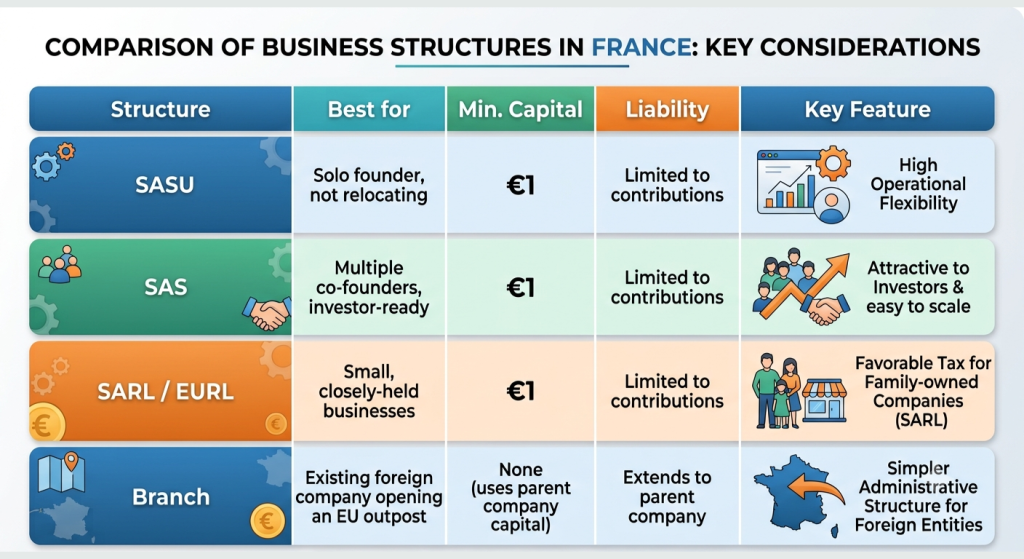
A quick way to think about it:
- Solo founder running a SaaS product or agency, not planning to move to France → SASU. It’s flexible, investor-friendly, and simple to manage alone.
- Two or more co-founders splitting equity → SAS (or SARL if you want a more rigid, traditional governance structure).
- You already run a company abroad and just want an EU presence for invoicing/logistics, not a fully separate legal entity → branch office.
One thing that surprises people: there’s no meaningful minimum capital requirement. You can technically register an SAS or SASU with €1 in share capital.
In practice, most founders put in a few hundred to a few thousand euros for credibility with banks and clients, but legally, €1 works.
Step-by-Step: How to Register a French Company Remotely
Here’s the actual sequence, in order.
- Check and reserve your company name Search the INPI and Infogreffe databases to make sure your chosen name isn’t already taken. This takes minutes and saves you a rejected application later.
- Get a registered French business address You need a physical French address for your company’s official seat. This is non-negotiable, and it’s how non-residents satisfy the “must have a French presence” requirement without living there. Most founders use a domiciliation service, which provides a legitimate registered business address for a monthly fee.
Avoid the temptation to use a virtual mailbox from an unverified provider; stick to licensed domiciliation companies.
- Draft the Articles of Association (statuts) This document must be written in French and signed by every founder/shareholder. As a remote founder, you have two realistic options:
sign electronically through the platform your formation agent or lawyer uses, or grant power of attorney to someone (often your formation agent) to sign on your behalf.
Power of attorney is the more common route for non-residents, since it avoids timezone-dependent e-signature sessions.
- Open a business bank account and deposit share capital This is where things get real.
You’ll deposit your share capital into a blocked account (compte bloqué) and receive a certificate confirming the deposit this certificate is required before you can complete registration.
- Publish a legal notice You’re required to publish a formation notice (avis de constitution) in an authorized legal journal.
You’ll get a certificate of publication, which goes into your registration file.
- File your dossier on the Guichet Unique (INPI) portal Since 2023, every company registration in France goes through one portal: the Guichet Unique, run by the INPI. You upload your documents, pay the registration fee, and submit.
- Wait for validation and receive your Kbis. Once approved, you get your SIREN number, SIRET number, VAT number, and most importantly your Kbis, which is essentially your company’s official ID card.
You’ll need it to open contracts, respond to tenders, and prove your company legally exists.
Realistic timeline: with complete, accurate documentation, most companies get registered within 2–4 weeks.
The most common cause of delay isn’t the process itself, it’s missing or incorrect documents, which sends the INPI a request for correction and resets the review clock.
Read This Guide: How to Register a Company in France from India (2026 Guide)
Documents You'll Need as a Non-Resident
- Valid passport
- Proof of your French registered address (domiciliation contract)
- Criminal record statement specifically required for non-EU/EEA founders, and one of the most commonly forgotten items
- Capital deposit certificate from your bank
- Signed Articles of Association
- Power of attorney, if someone else is signing on your behalf
If you’re applying from India, keep this in mind: foreign documents (like your criminal record extract) may need to be apostilled or officially translated before they’re accepted.
This step alone can take a couple of weeks depending on your local authorities, so start it early, don’t wait until you’re ready to submit everything else.
How Much Does It Actually Cost?
Here’s a realistic breakdown, not just the government registration fee everyone quotes:
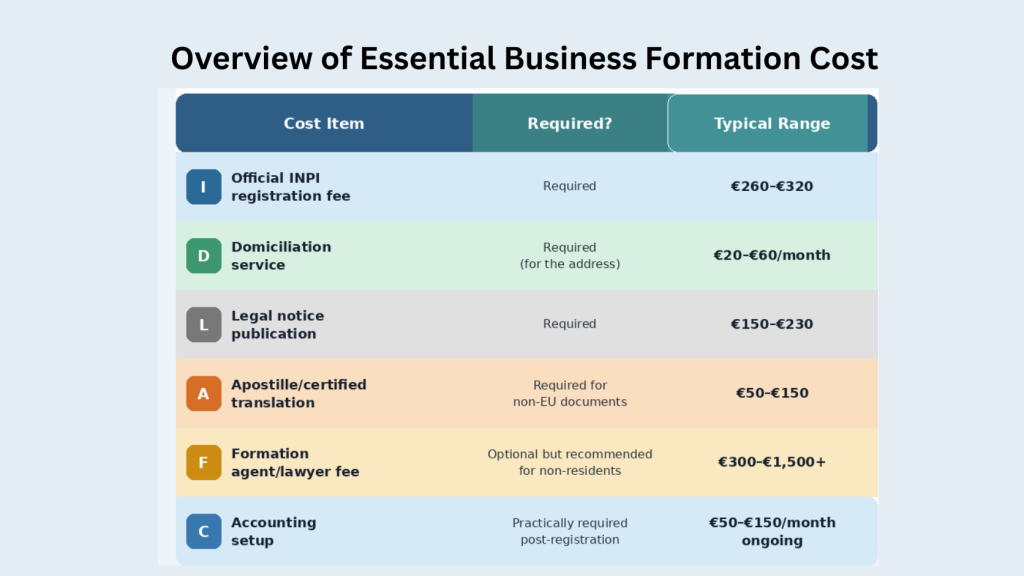
Budget realistically for €800–€1,500 in one-time setup costs if you’re doing this without full legal support, and factor in ongoing monthly costs for domiciliation and accounting once you’re operational company formation is the beginning of the costs, not the whole of them.
Banking and Capital Deposit for Non-Resident Founders
This is the step that quietly derails more remote registrations than anything else.
Traditional French banks are cautious with non-resident applicants. Many require an in-person branch visit, extensive compliance documentation, or simply decline non-resident accounts outright.
If you’ve read a guide that glosses over this step in one sentence, that’s a sign it wasn’t written by someone who’s actually gone through it.
The practical workaround: several European fintechs and neobanks now specifically support remote capital deposits for company formation, with fully online onboarding and compliance checks that don’t require you to be physically present.
They issue the same attestation de dépôt de funds a traditional bank would, and it’s accepted for registration purposes.
Once your Kbis is issued, the blocked funds are released and become available for normal business use.
Do You Need a Visa?
No — not to register or own the company.
If you’re managing it remotely and not relocating, a visa simply isn’t part of the equation.
A visa only becomes relevant if you plan to move to France to run the business in person. In that case, you’d look at the Entrepreneur/Profession Libérale visa or the Talent Passport, depending on your situation.
But for the vast majority of founders reading this Indian SaaS founders raising a seed round, e-commerce brands expanding into the EU, agencies serving French clients the company gets registered and runs remotely, no visa involved.
Tax Obligations for Your French Company
Once registered, your company is subject to French corporate tax (impôt sur les sociétés) on profits earned.
VAT registration kicks in based on your turnover and the nature of your sales. This matters a lot for e-commerce and SaaS sellers, since EU VAT rules apply differently than what you might be used to.
If you’re the company’s president or director, you may also owe French social charges (URSSAF), even while living abroad, depending on how you’re compensated.
For Indian founders specifically: France and India have a double taxation avoidance agreement, which generally prevents you from being taxed twice on the same income.
That said, tax treaty application depends on your specific structure and residency status, so this is genuinely a “talk to a tax advisor” situation rather than something to DIY from a blog post.
A Quick Real-World Example
A Bangalore-based SaaS founder we’ll call Aditya was closing a seed round with a European VC fund.
The fund’s term sheet had one condition attached: an EU legal entity, ideally in France or the Netherlands, before the round closed.
Aditya had never visited France and had no plans to relocate. Here’s roughly how it played out:
- Week 1: chose SASU as the structure (solo founder, simple governance), reserved the company name, and signed up with a domiciliation service in Paris for the registered address.
- Week 2: drafted and signed the Articles of Association via power of attorney, opened a capital deposit account with a fintech company that handled remote non-resident onboarding, and deposited the minimum capital.
- Week 3: published the legal notice and filed the full dossier through the Guichet Unique.
- Week 4: received the Kbis, SIREN, and VAT number.
Total time from start to Kbis: just under four weeks right in line with the typical range, because the documentation was complete on the first submission.
The one hiccup: his criminal record extract needed apostille certification from Indian authorities, which he’d started in parallel during week 1, so it didn’t hold up the rest of the process.
The lesson here isn’t “it’s always this smooth.” It’s that the founders who move fastest are the ones who start the slow parts (apostille, banking setup) in parallel with the fast parts, rather than sequentially.
Common Mistakes Non-Resident Founders Make
Using an unverified formation or domiciliation service. The Guichet Unique portal has been impersonated by fake sites charging “registration fees.”
The only official portal is run through the INPI. If a service is asking for payment before doing anything, verify it independently before sending money.
Forgetting the French-language requirement. Your Articles of Association must be in French, not just translated informally.
Get this drafted by someone who works in French legal documentation, not machine-translated.
Underestimating the banking step. Assuming any bank will work with you remotely is the single most common source of delay.
Research remote-friendly banking options before you’re already mid-registration.
Budgeting only for formation, not for the year after. Registration is a one-time cost. Domiciliation, accounting, and compliance filings are ongoing.
Founders who only budget for the Kbis often get an unpleasant surprise three months in.
Assuming a visa is required. This one costs people time, not money some founders delay registration for months trying to sort out visa logistics they don’t actually need.
What Happens After Registration? Your First-Year Checklist
Getting your This isn’t the finish line it’s the start of ongoing compliance:
- VAT registration and filing: timing depends on your turnover and business activity; e-commerce and SaaS sellers should sort this out early since EU VAT rules are strict about compliance timing.
- Annual accounts filing: French companies must file annual accounts with the commercial court registry.
- URSSAF/social charge deadlines: if you’re drawing a salary as director, these are recurring obligations, not one-off.
- Renewing your domiciliation contract: most agreements are annual and need active renewal; don’t let it lapse, since your registered address is tied to your legal existence.
Treat this as a running checklist, not a box you tick once.
Need Help Registering Your French Company Remotely?
If you’re a Business Owner trying to close a round with an EU-entity requirement, an e-commerce brand ready to sell into the EU market, or a consultant who needs a French entity to invoice European clients properly the process above is entirely manageable, but the details (banking, apostille, French-language statutes) are where things slow down without the right support.
Get in touch and we’ll walk you through exactly what your specific situation needs, start to finish.