

For Indian entrepreneurs looking to expand beyond the domestic market, Hong Kong can be an interesting base for international business. Its established corporate framework, strong commercial ecosystem and access to Asian markets make it relevant for businesses in areas such as technology, consulting, trading, e-commerce and professional services.
But how to register a company in Hong Kong from India is not simply a matter of filling out an incorporation form. An Indian founder also needs to understand the company structure, documentation, Hong Kong corporate requirements, banking, ongoing compliance and the Indian rules that may apply to overseas investment.
This guide explains the process from an Indian entrepreneur’s perspective, including what you should prepare before incorporation and what to consider after the company is registered.
Can Indians Own a Company in Hong Kong?
Yes. Indian entrepreneurs can generally establish and own a Hong Kong company, subject to the applicable incorporation, KYC and regulatory requirements.
For a local private company, Hong Kong does not require the director to be a Hong Kong resident. However, the company must have at least one natural-person director and a company secretary. If the company secretary is an individual, that person must ordinarily reside in Hong Kong; if it is a corporate secretary, its registered or principal office must be in Hong Kong. The company’s registered office must also be located in Hong Kong.
This makes Hong Kong accessible to overseas founders, but the company should be structured according to the actual business objective rather than simply based on the founder’s nationality.
Recommended Reading:
If your goal is not only to establish a Hong Kong company but also to explore relocating and managing your business from Hong Kong, you can learn more about the Hong Kong Entrepreneur Visa and its requirements.
Can You Register a Hong Kong Company Without Visiting Hong Kong?
In many cases, an Indian entrepreneur can manage the incorporation process without travelling to Hong Kong. The required company information, KYC documents and incorporation paperwork can be prepared and submitted through the applicable process.
Hong Kong’s Companies Registry provides electronic incorporation services for local companies. The incorporation application generally involves providing the required incorporation form, articles of association and business registration information.
However, there is an important distinction between company incorporation and banking. Successfully registering a company does not automatically mean that a bank or payment provider will approve an account. Financial institutions may carry out their own KYC and commercial checks.
For an India-based founder, planning both stages together can make the overall India to Hong Kong business setup smoother.
Which Hong Kong Company Type Suits Indian Entrepreneurs?
Choosing the right structure is one of the first decisions to make. The appropriate option depends on whether you are starting a new business, expanding an existing Indian company or simply testing the Hong Kong market.
Private Limited Company:
This is usually the most practical structure for an entrepreneur establishing a new Hong Kong business. It creates a separate legal entity and can be suitable for international consulting, technology, trading, e-commerce and other commercial activities, subject to applicable licensing requirements.
Subsidiary:
An Indian company may establish a Hong Kong subsidiary when it wants a separate local entity for international operations. The subsidiary can be owned by the Indian parent while maintaining its own corporate identity and compliance obligations.
Branch Office:
A branch can be considered when an existing Indian business wants to establish a Hong Kong presence as an extension of its overseas company rather than create a completely separate subsidiary.
Representative Office:
A representative office can be useful for limited activities such as market research, promotion or liaison. It is generally not intended to operate as a full commercial trading entity.
For most Indian entrepreneurs starting a new international business, the private limited company is the structure that deserves the closest evaluation.
Recommended Reading:
If you want to understand the overall incorporation process and requirements in more detail, read our complete guide on how to register a company in Hong Kong.
Documents Required for Hong Kong Company Registration
Preparing the right documentation in advance can prevent unnecessary delays. The exact documents can vary depending on the ownership structure, company type and KYC requirements. For a typical Indian founder, the preparation may include:
- Valid passport or accepted identification document
- Residential address proof
- Director and shareholder details
- Proposed company name
- Description of intended business activities
- Shareholding information
- Contact information
- Corporate documents, if an Indian company will be involved
- Additional KYC or source-of-funds information where required
The key is consistency. Names, addresses, ownership details and business information should match across the documents and incorporation application.
KYC and Document Preparation:
Indian founders should also check whether any document requires certification, or additional verification before submission. Requirements can vary depending on the service provider, company structure and subsequent banking process.
It is also useful to prepare a simple explanation of what the company will do, who its customers will be and where its expected business activity will take place. This information can become particularly relevant during corporate bank or payment-account onboarding.
What Are the Steps to Register a Company in Hong Kong from India?
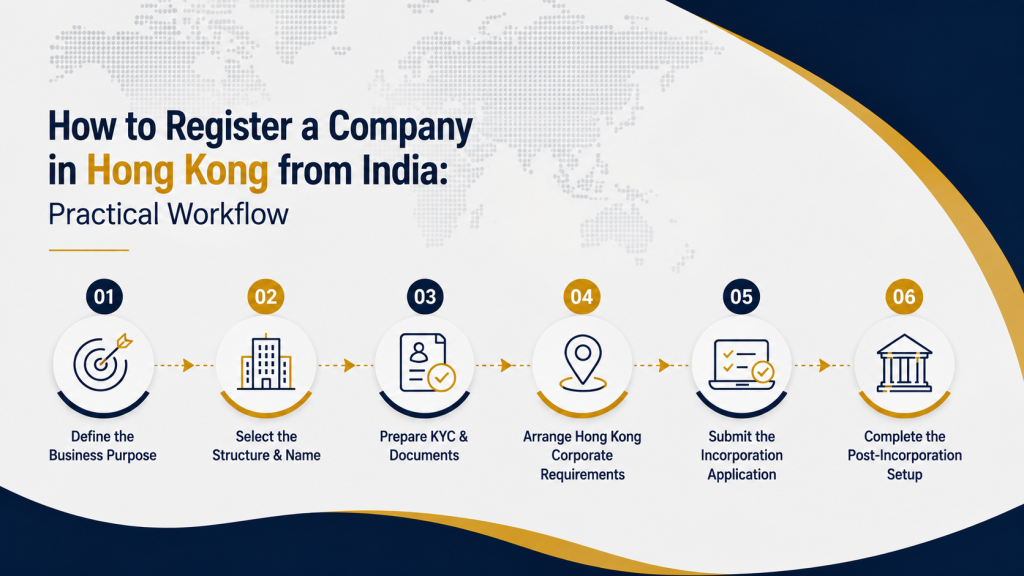
Once the structure and documentation are ready, the process becomes much easier to understand when viewed as a complete workflow.
- Define the business purpose:
Start by deciding what the Hong Kong company will actually do. Your intended activity will influence the appropriate structure and whether any sector-specific licence or approval needs to be considered.
- Select the company structure and name:
Choose the appropriate company type and prepare a suitable company name. At this stage, the proposed shareholders and directors should also be finalised.
- Prepare KYC and incorporation documents:
Collect the identification, address, ownership and business information required for incorporation. Any applicable certification requirements should be confirmed before submission.
- Arrange the Hong Kong corporate requirements:
A local registered office is required, and a private company must have a company secretary. A sole director cannot also act as the company’s secretary.
- Submit the incorporation application:
The relevant incorporation documents are submitted through the applicable Companies Registry process. Once accepted, the company receives its incorporation documentation.
- Complete the post-incorporation setup:
After incorporation, the founder can move on to accounting, tax, banking or payment arrangements and ongoing statutory compliance.
The important point is that incorporation is only the beginning of the setup. A foreign founder should plan for the company’s ongoing administration from the start.
Indian Tax and FEMA Rules for a Hong Kong Company
Under India’s Overseas Investment framework, a person resident in India making an overseas investment in a foreign entity needs to follow the applicable FEMA rules, regulations and reporting requirements. The Reserve Bank of India’s Overseas Investment framework specifically covers overseas direct investment and related financial commitments by Indian residents.
For example, if an Indian resident is investing capital into a newly incorporated Hong Kong company, the route through which the funds are sent from India and the required reporting should be considered before the investment is made. This is different from simply registering the Hong Kong entity; the funding of that entity is a separate India-side compliance matter.
What Indian Founders Should Consider
- Overseas investment in the Hong Kong company: If an Indian resident subscribes to shares or otherwise makes an eligible overseas investment in the Hong Kong entity, the applicable FEMA Overseas Investment framework should be checked before remitting funds.
- Foreign asset disclosure: An Indian tax resident who owns or is a beneficial owner of foreign assets may have disclosure obligations in the Indian income-tax return. The Income Tax Department’s guidance specifically covers foreign assets and foreign-source income through Schedule FA and Schedule FSI, where applicable.
- Income received from Hong Kong: If the Indian founder later receives salary, dividends or other income from the Hong Kong company, the Indian tax treatment needs to be considered based on the founder’s tax status and the nature of the income.
- Hong Kong company profits: Hong Kong generally follows a territorial source principle for profits tax. Profits arising in or derived from Hong Kong from a trade, profession or business can be taxable in Hong Kong, while the source of profits is determined based on the facts of the business.
- Business actually managed from India: Incorporating the company in Hong Kong does not by itself mean that all business activity is considered to take place in Hong Kong. If the founder and management team continue to operate the business primarily from India, the actual facts and activities should be reviewed from an Indian tax perspective.
The key point for Indian founders is that Hong Kong incorporation and Indian tax/FEMA compliance are two connected but separate parts of the setup. Before transferring money from India, deciding the ownership structure or moving profits between India and Hong Kong, it is advisable to obtain professional advice based on the actual business model.
India–Hong Kong Cross-Border Business Considerations
Owning a Hong Kong company while continuing to operate from India creates a cross-border business structure. That means the founder should think beyond incorporation.
For example, if an Indian company provides services to the Hong Kong entity, the relationship should be supported by proper agreements, invoices and accounting records. If the Hong Kong company sells to international customers while its founder and team work primarily from India, the actual management and business activities may also become relevant to tax and regulatory analysis.
In simple terms, where a company is incorporated and where its business is actually managed or conducted are not necessarily the same question.
This is particularly important for entrepreneurs who want to use Hong Kong as an international business base while continuing to live and work in India.
Hong Kong Corporate Bank Account Requirements
Opening a corporate account is often one of the next priorities after incorporation. However, company registration alone does not guarantee banking approval.
Banks and payment providers may assess the company’s business model, ownership, expected transactions, source of funds, customer base and commercial purpose. A founder may therefore be asked for additional information beyond the documents used for incorporation. Before applying, it is sensible to prepare a clear business profile, expected transaction details and supporting commercial documents such as contracts, invoices or website information where available.
Indian founders should also distinguish between a traditional Hong Kong bank account and alternative regulated business payment solutions. The right option depends on the company’s activities, transaction requirements and eligibility.
What Are the Challenges of Operating a Hong Kong Company from India?
The real challenge often begins after incorporation.
An India-based founder may need to coordinate Hong Kong company compliance, accounting, banking, annual filings and corporate records while simultaneously managing customers or employees in India and other countries. Time-zone differences and cross-border payments can also make administration more complicated. A company should therefore have a clear process for maintaining financial records, monitoring deadlines and keeping corporate information updated.
Hong Kong private companies have ongoing filing obligations. For example, a local private company generally needs to file an annual return within 42 days after the anniversary of its incorporation, subject to the applicable rules. Missing statutory deadlines can lead to higher fees and other consequences, so compliance should not be treated as an afterthought.
Common Mistakes Indian Entrepreneurs Should Avoid
Many problems can be avoided with proper planning.
Choosing a structure without considering the business model: A private company, subsidiary, branch or representative office serves different purposes. The cheapest or most familiar option is not necessarily the right one.
Assuming incorporation guarantees a bank account: Banking is a separate approval process and may involve more detailed commercial KYC.
Ignoring Indian FEMA requirements: Overseas investment from India can involve specific regulatory and reporting requirements. These should be checked before funds are transferred.
Treating Hong Kong incorporation as a tax solution: A foreign company does not automatically eliminate Indian tax considerations. Tax residency, management, income and transactions need to be assessed based on the actual circumstances.
Ignoring ongoing compliance: Annual returns, accounting, tax matters and corporate records continue after incorporation.
Which Indian Businesses Are Suitable for a Hong Kong Company?
A Hong Kong company may be worth considering for Indian businesses with a genuine international or Asia-focused objective.
It can be relevant for technology companies, software businesses, international consultants, trading companies, e-commerce businesses, sourcing businesses and professional service providers that want to work with customers or partners outside India.
It may also be considered by an established Indian company looking to create a structured presence in an international market. However, there is no one-size-fits-all answer. The right setup depends on your customers, business activity, ownership, funding, operational location and long-term expansion plans.
Can You Register in Hong Kong and Operate from India?
Registering a Hong Kong company means creating a legal entity under Hong Kong’s corporate framework. It does not automatically mean that the founder has moved their business operations outside India. An entrepreneur can own a Hong Kong company while continuing to live and work in India. However, the Indian side of the arrangement may still involve tax, FEMA and other compliance considerations.
So before deciding how to register a company in Hong Kong from India, look at the complete structure rather than only the incorporation certificate. Ownership, funding, management, contracts, banking and taxation all form part of the bigger picture.
How Vorx Consultancy Can Help?
International company formation becomes much easier when the incorporation process is planned alongside the business’s wider expansion requirements. Vorx Consultancy helps entrepreneurs explore international company formation, documentation, corporate setup and related business expansion requirements. For Indian founders considering Hong Kong, the focus is on understanding the business objective first and then identifying a suitable setup.
If you are planning an India to Hong Kong business setup, Vorx can help you navigate the incorporation process and coordinate the practical requirements involved in establishing an international business presence.
Need Strategic Guidance?
Book a Strategy Call: (Calendly Link)
Visit: www.vorxcon.com
Email: support@vorxcon.com
Final Thoughts:
Registering a Hong Kong company from India can be a promising way for Indian businessmen to invest in the international or Asian markets. Although the incorporation procedure can be completed online, it is essential to understand several details in order to launch the business successfully. Choosing the appropriate company structure, filling the required forms, obtaining a registered office and a company secretary, and arranging financing and other services are some of the critical steps to do.
Besides, businessmen should also evaluate the foreign exchange regulations and tax implications imposed by India on foreign assets and earnings. With the help of professionals, it will be possible to design an efficient structure to complete the registration legally and control the organization effectively from India.
